4D / 3N
17% OFF
4D / 3N
17% OFF
Manali-Kasol Tour Package by Cab for Himachal (4D/3N) - At A Glance
- Hotel
- Meals
- Sightseeing
- Entry Tickets
- Cab Transfer
₹12,688
₹10,500 /pp


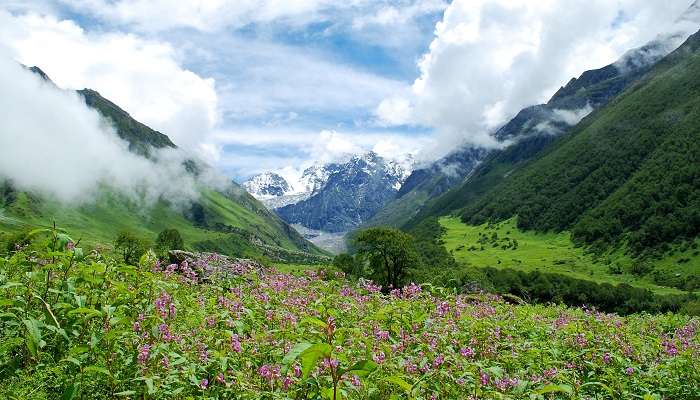
A Tirthan Valley tour package covers a 3 to 4 day trip built around the Tirthan River in Kullu district, Himachal Pradesh, and a typical Delhi departure costs roughly Rs 6,500 to Rs 13,000 per person depending on sharing and season. The valley sits at about 1,500 to 1,600 metres near the Great Himalayan National Park, a UNESCO World Heritage Site, and it is the rare Himachal address that has stayed quiet while Kasol, Tosh and Manali filled up. You come here for trout fishing, the drive over Jalori Pass, the forest walk to Serolsar Lake, and the villages of Jibhi and Gushaini. This guide gives you the full itinerary, the honest cost, the best months, and every way to reach it.
Tirthan Valley trip: the quick answers
Tirthan Valley Tour Package
Best Time
March - June
Select Package Type

3 Days & 2 Nights
₹9,043 /@pp
GET FREE QUOTE

.jpg?tr=w-600,h-300)

If you only read one block before you plan, make it this one.
| Detail | Tirthan Valley |
| Location | Banjar tehsil, Kullu district, Himachal Pradesh |
| Altitude | About 1,500 to 1,600 m at the valley floor; Jalori Pass about 3,120 m |
| Ideal trip length | 3 to 4 days (5 if you add Jibhi and the Great Himalayan National Park) |
| Best season | Mid-March to June and September to November |
| Nearest airport | Bhuntar (Kullu-Manali), about 50 km |
| Nearest railheads | Chandigarh (about 250 km) and Kiratpur Sahib |
| Road gateway | Aut, on the Mandi to Kullu highway; turn off toward Banjar |
| Signature experiences | Trout fishing, Jalori Pass, Serolsar Lake trek, Chhoie Waterfall, GHNP |
| Typical cost from Delhi | Rs 6,500 to Rs 13,000 per person for 3 to 4 days |
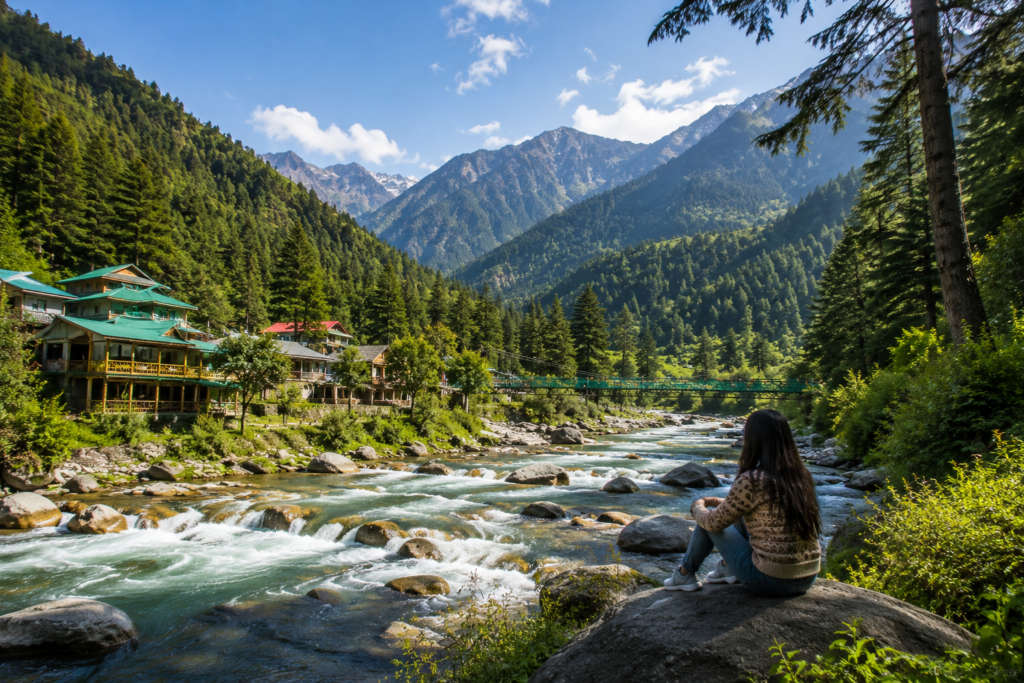
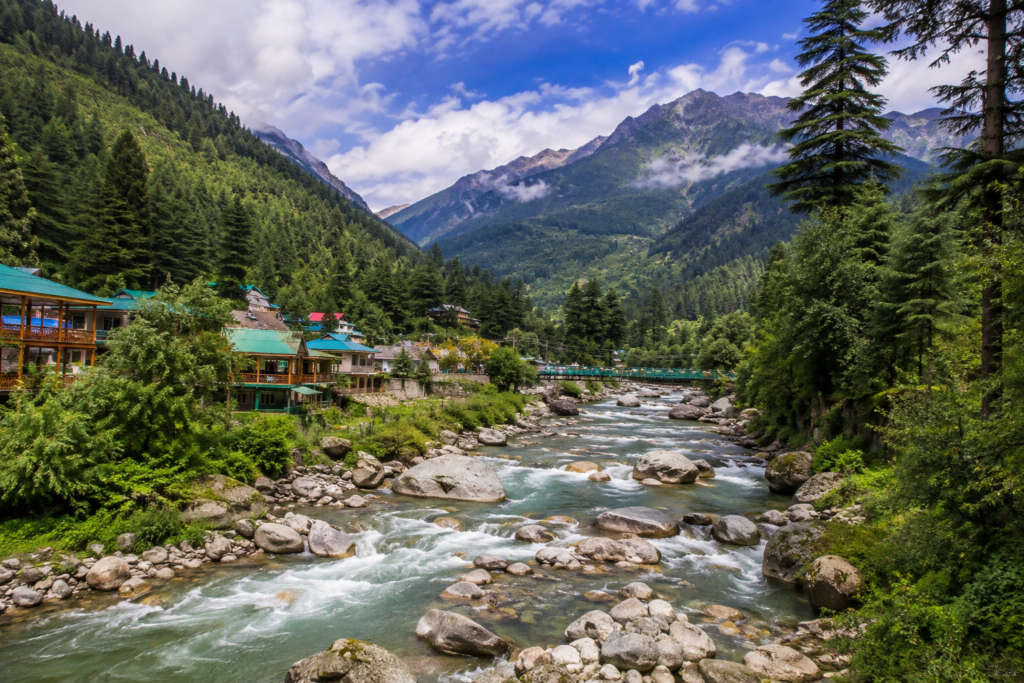
Most Himachal trips end up in the same handful of towns. Tirthan is the antidote. The Tirthan River runs clear and cold straight out of the Great Himalayan National Park, and the valley around it is still mostly homestays, orchards and pine, not concrete and traffic. You can stand on a footbridge at Gushaini in the morning and hear nothing but water.
The pull here is doing, not just looking. This is one of the few places in India where you can fly-fish for brown and rainbow trout in a Himalayan stream. You can walk into a UNESCO-listed national park, trek to an alpine lake with a temple on its shore, and drive one of Himachal’s great mountain passes, all inside four days. Families come for the slow riverside days; trekkers come for the passes above Banjar. Jibhi, ten minutes up the road, adds waterfalls and wood-fired cafes for anyone who wants a softer pace.
For the full regional picture, our Himachal Pradesh travel guide maps how Tirthan fits alongside Manali, Kasol and the wider Kullu circuit.
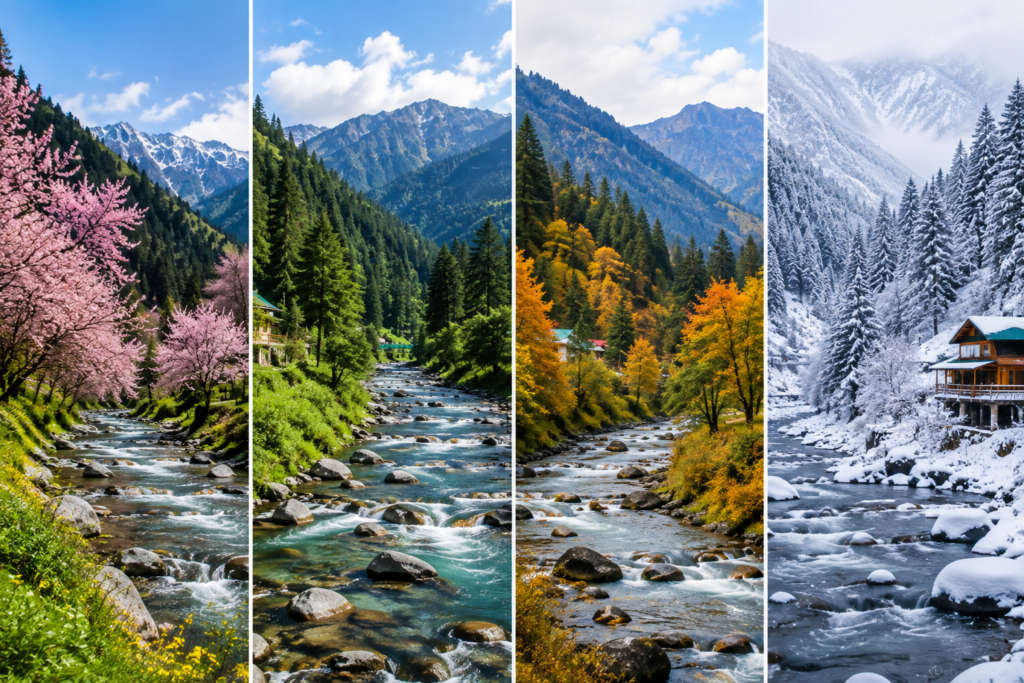
Tirthan is a year-round valley, but what you can actually do changes sharply by season. The short version: come in spring or autumn for the best mix of weather and open roads.
| Season | Temp (deg C) | What to expect |
| Mid-Mar to Jun | 10 to 25 | Green valley, full rivers, all roads open. Best all-round window and peak for trout and camping. |
| Jul to Aug | 15 to 24 | Monsoon. Landslide risk on hill roads, slippery GHNP trails. Cheaper, lush, but plan slack days. |
| Sep to Nov | 5 to 20 | Clear skies, crisp air, golden light. The best window for treks and photography. |
| Dec to Feb | -2 to 10 | Snow. Jalori Pass usually blocked, limited access, but the valley floor is quiet and scenic. |
If Jalori Pass and Serolsar Lake are the reason you are going, avoid deep winter. The pass road is usually snow-blocked from around December to March, and the Serolsar trail disappears under snow. In spring and autumn both are open and gorgeous.
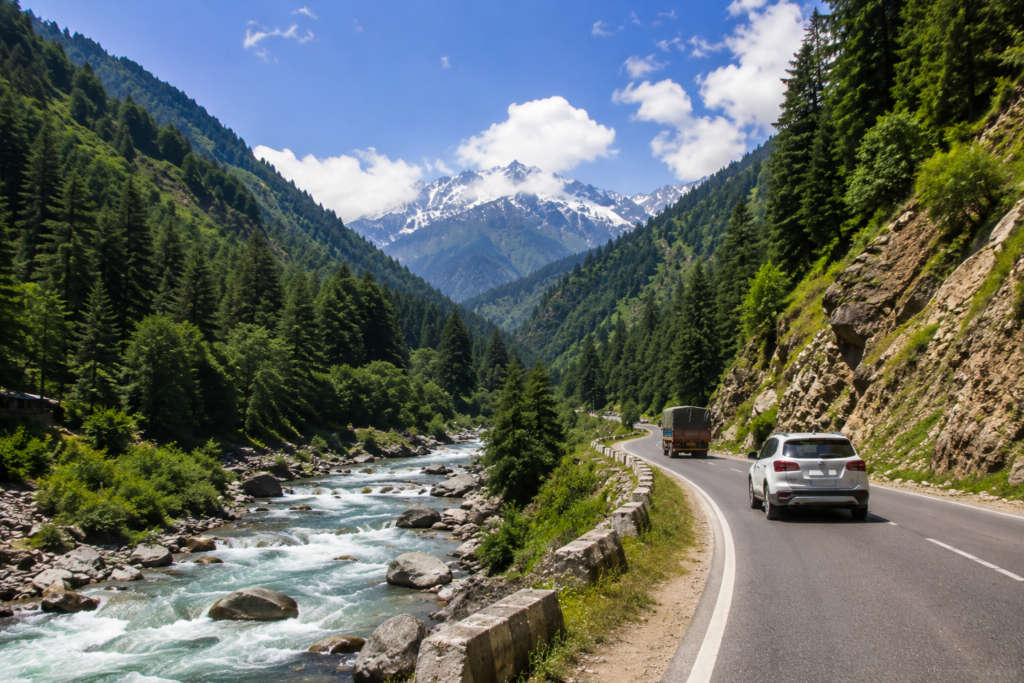
Tirthan has no airport and no railway station of its own, so every route ends with a road leg to Aut and then on to Banjar or Gushaini. Here is how the three options compare.
| Mode | Route and detail |
| By air | Fly to Bhuntar (Kullu-Manali airport), about 50 km / 2 hours away, then taxi via Aut to the valley. Fastest, but flights are limited and weather-dependent. |
| By train | Nearest broad-gauge railheads are Chandigarh (about 250 km) and Kiratpur Sahib. Continue by Volvo or taxi from there. Ambala junction has more train options. |
| By road | About 500 km from Delhi, a 10 to 12 hour overnight drive to Aut, then 30 to 40 km on to Banjar and Gushaini. The most common and cheapest way in. |
Delhi to Tirthan Valley drive time
Plan on 10 to 12 hours from Delhi to Aut for the roughly 500 km haul, plus another 1 to 1.5 hours from Aut to Gushaini. Most travellers take an overnight Volvo that leaves Delhi in the evening and reaches Aut by early morning, which turns the drive into a night’s sleep and saves a day.
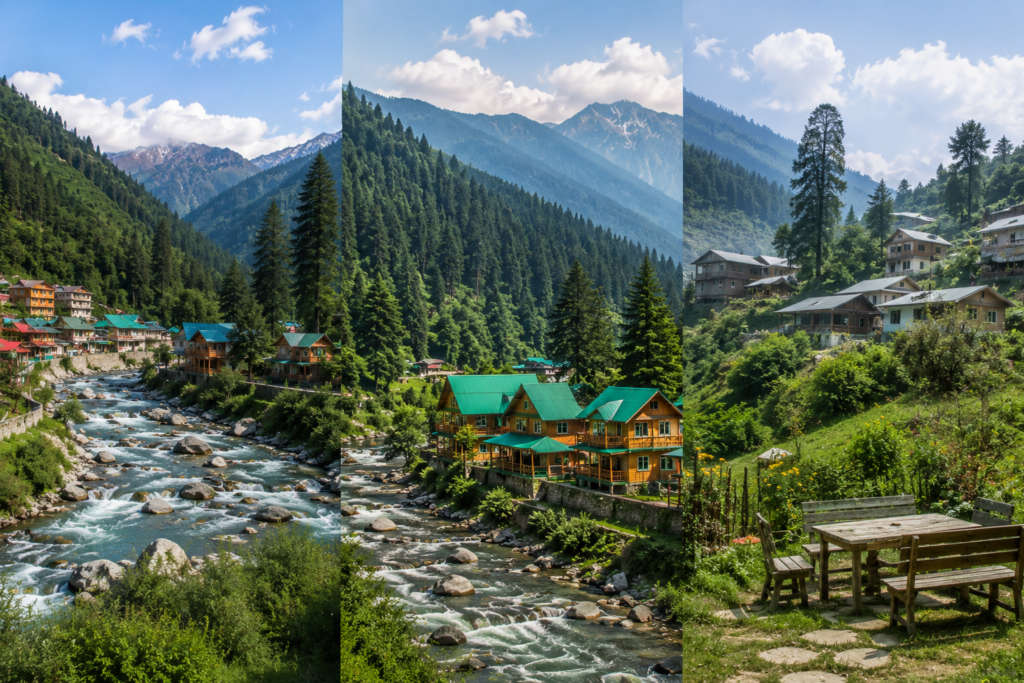
People often ask whether they should stay in Tirthan or Jibhi. They are 20 minutes apart and easy to combine, but they feel different. This is how the main bases compare so you can pick the one that matches your trip.
| Base | Altitude | Vibe | Best for |
| Gushaini / Nagini | ~1,550 m | Riverside quiet, trout fishing, GHNP access | Families, anglers, slow river days |
| Jibhi | ~1,600 m | Waterfalls, wooden cafes, Instagram river spots | Couples, first-timers, short breaks |
| Shoja | ~2,700 m | High pine forest, Jalori Pass on the doorstep | Trekkers, photographers, pass-baggers |
| Banjar | ~1,500 m | Market town, transport hub, Chehni Kothi nearby | Budget travellers, quick overnight stops |
Short answer to the Jibhi versus Tirthan question: if you want the river, the national park and fishing, stay in Tirthan proper at Gushaini. If you want waterfalls, cafes and an easy first trip, base in Jibhi. Two nights split between the two is the sweet spot.
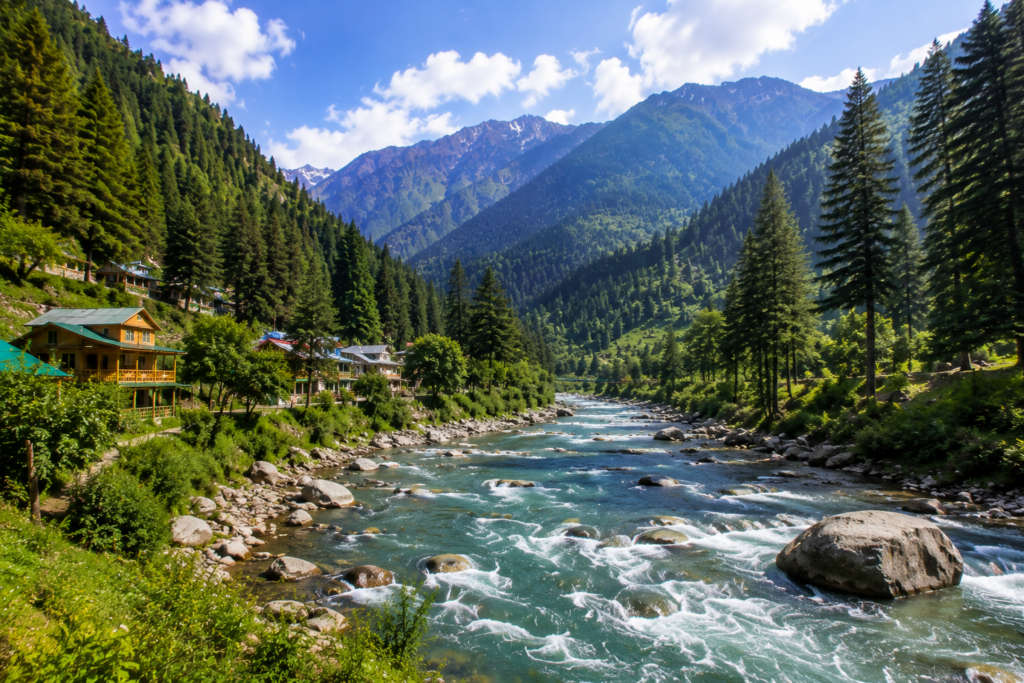
This is the itinerary most Delhi travellers run, and the one our packages are built around. It assumes an overnight Volvo each way, which is why Day 1 is a travel night rather than a wasted daytime drive.
Day 1: Delhi to Tirthan Valley, overnight (about 500 km, 10 to 12 hours)
Board an evening Volvo from Majnu ka Tila or Kashmiri Gate ISBT around 5 to 6 pm. You sleep through the plains, the Chandigarh bypass and the climb along the Beas, and wake near Aut in the morning. Pack light, carry a warm layer for the bus air-conditioning, and keep a government ID handy for boarding.
Day 2: Arrive, settle in at Gushaini, and walk to Chhoie Waterfall
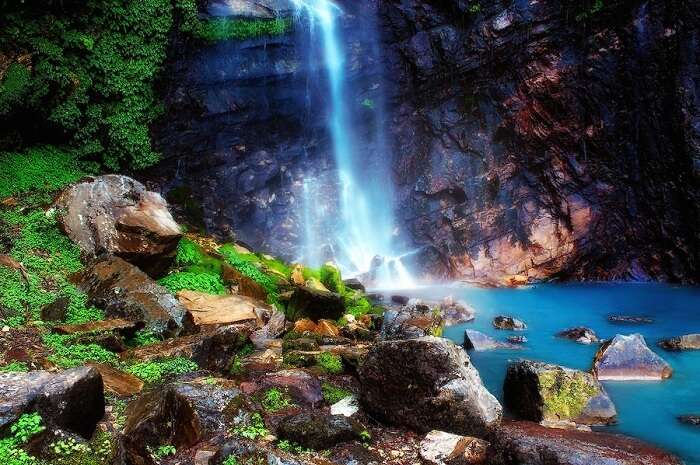
Transfer from Aut to your riverside stay at Gushaini or Nagini, roughly an hour up the valley, and check in. After breakfast and a rest, drive across to Jibhi for the short uphill walk to Chhoie Waterfall, a 1.5 to 2 km trail through deodar forest to a cold, twin-drop fall that locals treat as a small pilgrimage. Back at the river by evening, this is the night for a bonfire and your first plate of Tirthan trout.
Day 3: Jalori Pass and the Serolsar Lake trek
The big day. Drive up to Jalori Pass at about 3,120 metres, where the road tops out and the whole Kullu skyline opens up. From the pass, a gentle 5 km forest trek each way (roughly 1.5 hours in) leads to Serolsar Lake, a still, green pool ringed by oak, with the Budhi Nagin temple on its shore. If your legs are willing, the alternative trail from the pass climbs about 3 km to the meadow ruins of Raghupur Fort. Back down for a late lunch and an easy evening by the fire.
Day 4: Great Himalayan National Park, trout fishing, and the return
After breakfast, head into the eco-zone of the Great Himalayan National Park from the Sai Ropa or Gushaini gate (carry ID for the forest permit). A short guided walk here puts you inside one of the last intact temperate ecosystems in the western Himalaya. Spend the afternoon on the Tirthan River with a rod and an angling permit, then transfer back to Aut for the overnight Volvo to Delhi, reaching the city the next morning.
Have a fifth day? Add Jibhi’s Mini Thailand river pool, the ancient timber tower of Chehni Kothi near the Shringa Rishi temple, and the viewpoint village of Shoja on the Jalori route.
Want this handed to you as a fixed-date, fixed-price trip? Our Tirthan Valley tour package from Delhi runs this exact route with return Volvo, stays and meals sorted.
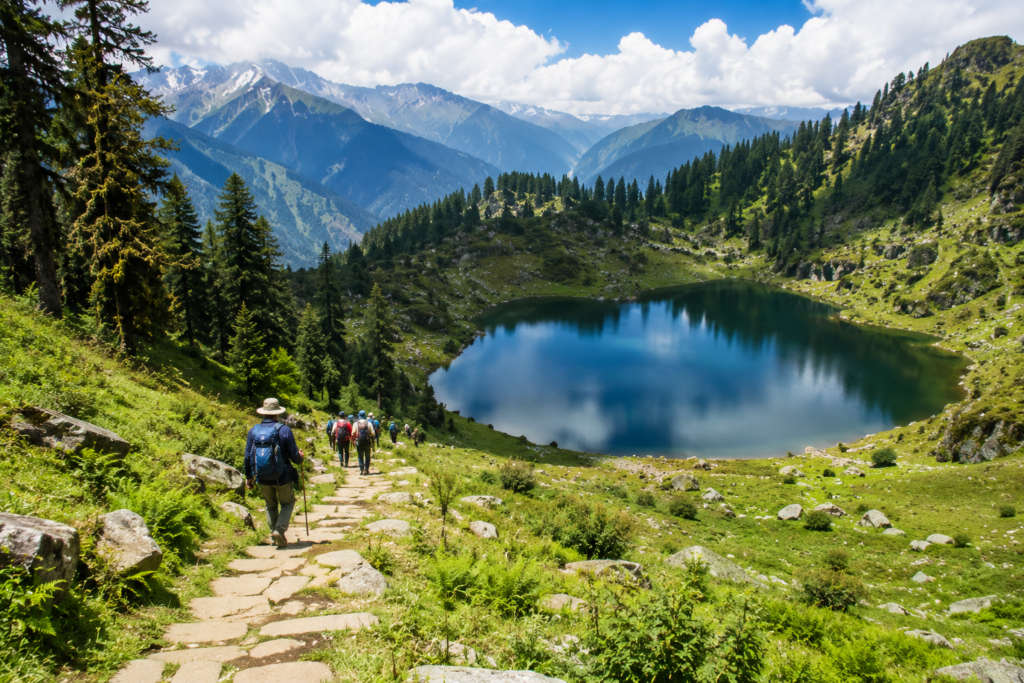
The valley rewards people who come to do things rather than tick sights. These are the experiences worth building your days around.
Trout fishing on the Tirthan River
Tirthan is one of India’s genuine trout streams, stocked with brown and rainbow trout that thrive in the cold, fast water. Gushaini and Nagini are the fishing bases. You will need an angling permit from the state fisheries department, easily arranged through your homestay, and a local ghillie who knows which pools are holding fish. Even if you never cast a line, watching the river work is half the point.
Trek to Serolsar Lake and Raghupur Fort
Both start from Jalori Pass and both are half-day walks. Serolsar is the gentler, forested one to a sacred lake; Raghupur Fort is the more open climb to a ridge-top meadow with wraparound views. Do Serolsar if you want calm and shade, Raghupur if you want the panorama.
Chhoie Waterfall and Jibhi
Jibhi packs a lot into a small village: the Chhoie Waterfall walk, the clear river pools that earned the Mini Thailand nickname, and a cluster of wood-and-glass cafes that make an easy afternoon. It is the softest, most family-friendly corner of the valley.
Great Himalayan National Park
Inscribed as a UNESCO World Heritage Site in 2014, the park protects over 1,000 square kilometres of the upper Tirthan and Sainj catchments. Day walks from the Sai Ropa and Gushaini gates need a forest permit; serious multi-day treks to Hanskund Peak and beyond need a guide and porters arranged in advance.
Camping, riverside stays and the Chehni Kothi tower
Riverside camps along the Tirthan are a highlight in fair weather, with bonfires and cold-water plunges off the bank. History buffs should make the short, steep walk to Chehni Kothi, a centuries-old stone-and-timber tower near the Shringa Rishi temple that survived the 1905 Kangra earthquake.
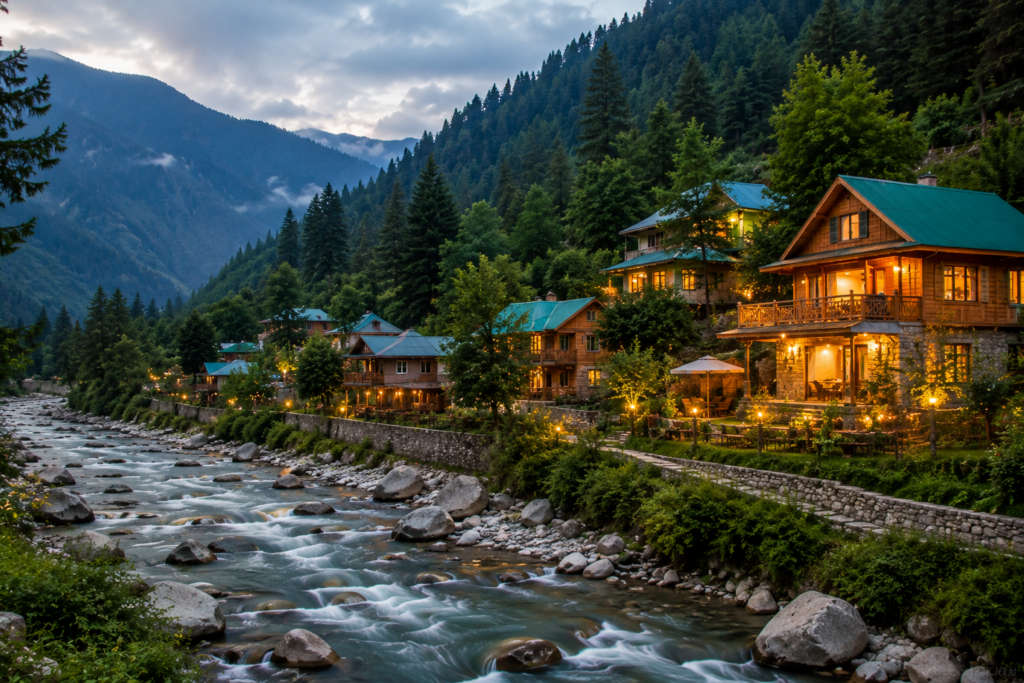
There are no big hotels here, and that is the point. The valley runs on homestays, forest guesthouses and riverside camps, most of them family-run.
Riverside camps run mainly from spring to autumn and close through the coldest, wettest weeks. In peak months (May to June and October) book homestays well ahead, because the good riverside rooms are few and go early.
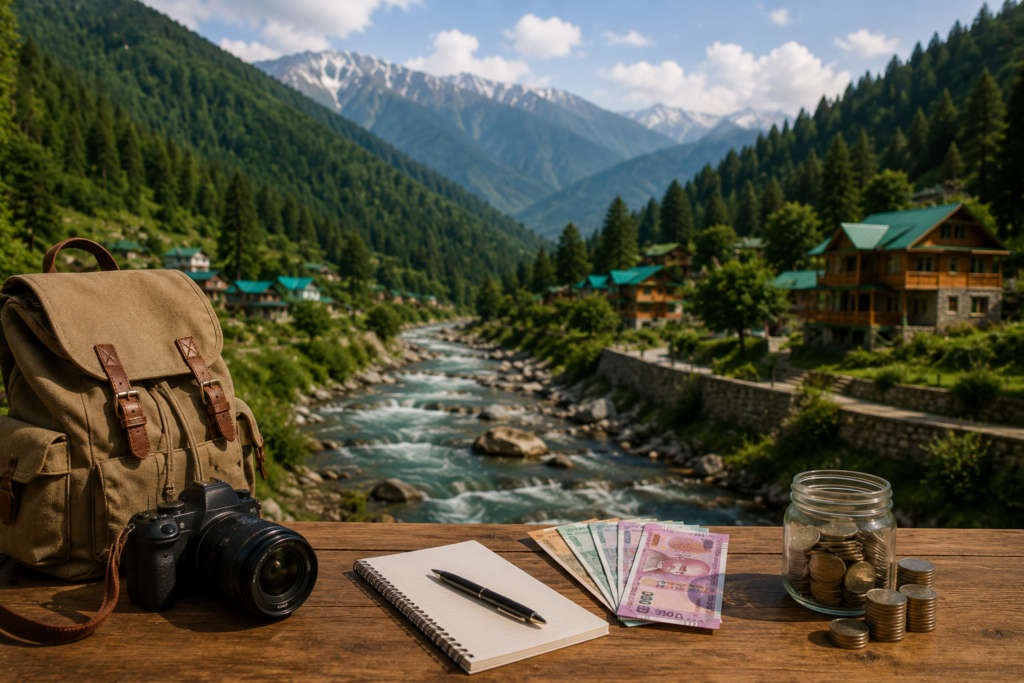
Here is the honest picture, not a bait price. A 3 to 4 day trip from Delhi usually lands between Rs 6,500 and Rs 13,000 per person. Where you fall in that band depends on three things: how many share a room, the category of stay, and whether return transport is bundled.
Budget group departures with quad or triple sharing and an overnight Volvo start near the bottom of that range. A mid-range trip with double-sharing riverside rooms, private transfers and a couple of activities sits in the middle. Private, custom or luxury trips with a dedicated cab and premium stays run higher. Be wary of headline floors like Rs 6,499 that quietly exclude transport, meals or activities; add those back and most trips converge around the middle of the band.
A typical package includes accommodation, breakfast and dinner, AC coach travel from Delhi and back, sightseeing by road as per the itinerary, a bonfire evening, and a guide. It usually excludes flights, lunches, adventure activities like rafting and fishing permits, entry or park fees, tips and anything personal. Always read the inclusions line by line before you compare two quotes.
Compare live prices, dates and inclusions on our Tirthan Valley tour packages page, or start with the shorter 2 nights 3 days Tirthan Valley weekend if you are short on leave.
Tirthan is the version of Himachal most people picture and rarely find: a clear river, real forest, a national park at the head of the valley, and villages that still feel lived-in. Give it four unhurried days, go in spring or autumn, and base yourself by the water.
When you are ready to turn this plan into a booked trip, browse our customisable Tirthan Valley tour packages or explore the wider Himachal tour packages for a longer Kullu circuit.
A 3 to 4 day trip from Delhi typically costs Rs 6,500 to Rs 13,000 per person. Budget group departures with shared rooms and an overnight Volvo sit at the lower end; double-sharing riverside stays with private transfers and activities cost more. Very low floors usually exclude transport or meals, so compare inclusions, not just the headline number.
Four days is the sweet spot: one travel night each way and two full days for Jalori Pass, Serolsar Lake, the national park and the river. Three days works if you skip one trek. Add a fifth day if you want to fold in Jibhi, Mini Thailand and Chehni Kothi at a relaxed pace.
Mid-March to June and September to November are the best windows, with pleasant days, open roads and clear light. Avoid deep winter (December to February) if you want Jalori Pass and Serolsar Lake, because the pass is usually snow-blocked. The monsoon (July to August) is lush but carries landslide and trail risk.
Take an overnight Volvo about 500 km to Aut (10 to 12 hours), then travel 30 to 40 km by taxi or local bus to Banjar and Gushaini. To skip the bus, fly to Bhuntar (Kullu-Manali airport), about 50 km away, and drive in from there. The nearest major railheads are Chandigarh and Kiratpur Sahib.
It is roughly 500 km by road, and the drive takes about 10 to 12 hours to Aut, plus another hour or so up to Gushaini. Most people do it overnight so the journey doubles as a night's sleep and does not eat into a sightseeing day.
Tirthan is in the same Kullu district as Manali but sits in the quieter Banjar valley, about 60 to 70 km short of Manali off the main highway at Aut. It is easy to combine the two, though most people come to Tirthan precisely to avoid the Manali crowds.
Yes. Day visits to the park's eco-zone need a forest entry permit, arranged at the Sai Ropa or Gushaini forest post; carry a government photo ID. Multi-day treks deeper into the park also need a registered guide. Your homestay or operator can set this up before you arrive.
Yes. The Tirthan River is a stocked trout stream and angling is permitted with a licence from the state fisheries department, which your homestay can help arrange. Gushaini and Nagini are the main fishing bases, and a local ghillie will show you the productive pools.
Homestays are the main way to stay here. The valley has almost no large hotels; instead you get family-run homestays, forest guesthouses and riverside camps at Gushaini, Nagini, Jibhi and Shoja. Book ahead in May, June and October, when the best riverside rooms fill quickly.
They are 20 minutes apart and best done together. Choose Tirthan proper (Gushaini) for the river, trout fishing and national park; choose Jibhi for waterfalls, cafes and an easy first trip. Splitting two nights between the two gives you the whole valley without backtracking.
Tirthan is one of the safer, calmer corners of Himachal, and homestay hosts look out for guests. The usual mountain caution applies: watch hill roads in the monsoon, do not swim in the fast-flowing river, trek with a guide inside the national park, and keep warm layers for the passes even in summer.
The valley floor gets occasional light snow between December and February, while the higher points like Jalori Pass and Shoja see heavier, longer-lasting snow. The pass road is usually blocked in that window, so plan a snow trip around the valley floor rather than the treks.
Real reviews from real travelers who booked with us.
View All Reviews