
 5D / 4N
9% OFF


A Food Lover's Guide To Kashmiri And Dogra Cuisine
Kashmir food is built on one big idea: mutton cooked in more ways than you knew existed, balanced by a quiet, deeply savoury vegetarian tradition. The signature dish is Rogan Josh, a red lamb curry coloured not by heat but by Kashmiri chillies and cockscomb flower, and the grand event is the Wazwan, a feast that can run to around 36 courses. Cross the Pir Panjal into Jammu and the food changes character completely, turning tangy and largely vegetarian with dishes like Ambal and Kalari cheese. This guide covers 20-plus dishes across the Kashmir Valley, Jammu’s Dogra kitchen and the Ladakh region, what each one tastes like, and where to eat the real thing.
Key Takeaways
- Start with Rogan Josh, Goshtaba and Rista if you eat meat. These three carry the Wazwan.
- Kashmiri food is aromatic, not fiery. The red colour comes from mild Kashmiri chilli and mawal, not chilli heat.
- Vegetarians are well fed: Dum Aloo, Nadru Yakhni, Haak and Chaman in the Valley, and most of Jammu’s Dogra menu.
- Drink Noon Chai (pink salt tea) with breakfast and Kahwa (saffron green tea) after meals.
- Go in winter for Harissa. Go any time for the Wazwan: restaurant Wazwan plates are walk-in, but order a full Trami for a group a day ahead.
What is Kashmir’s famous food?
Kashmir’s most famous food is Rogan Josh, an aromatic lamb curry, served alongside the Wazwan, a multi-course royal feast of up to 36 dishes such as Goshtaba, Rista and Tabak Maaz. Beyond meat, the Valley is known for Dum Aloo, Nadru Yakhni and greens called Haak, washed down with Noon Chai and Kahwa. In Jammu, the Dogra kitchen turns tangy and vegetarian with Ambal, Khatta Meat and Kalari cheese.
Food in this region is really three cuisines under one name. The Kashmir Valley cooks rich, yogurt-based meat dishes with fennel and dry ginger. Jammu (Dogra country) leans sour and vegetarian, using tamarind, mustard and pomegranate. Ladakh borrows from Tibet, with dumplings, noodle soups and butter tea. Here is the whole spread in one table.
| Dish | Region | Veg / Non-veg | What it is and when to eat it |
| Rogan Josh | Kashmir Valley | Non-veg | Aromatic red lamb curry; the Valley’s signature, eaten year-round |
| Rista | Kashmir Valley | Non-veg | Mutton meatballs in a red Kashmiri-chilli, fennel and mawal gravy; a Wazwan course |
| Goshtaba | Kashmir Valley | Non-veg | Pounded mutton balls in white yogurt gravy; the Wazwan finale |
| Tabak Maaz | Kashmir Valley | Non-veg | Lamb ribs simmered in milk, then fried crisp; a first course |
| Yakhni | Kashmir Valley | Non-veg | Lamb in a mild, pale yogurt gravy; good for low-spice palates |
| Aab Gosh | Kashmir Valley | Non-veg | Lamb slow-cooked in milk and fennel; delicate, festive |
| Matschgand | Kashmir Valley | Non-veg | Elongated mutton koftas in a hot red gravy; a Pandit favourite, richer and spicier |
| Shab Deg | Kashmir Valley | Non-veg | Meat and turnip cooked overnight in a sealed pot; winter dish |
| Harissa | Kashmir Valley | Non-veg | Slow-cooked mutton and rice paste; a winter breakfast |
| Modur Pulao | Kashmir Valley | Veg | Sweet saffron rice with ghee and dry fruits; festive |
| Dum Aloo | Kashmir Valley | Veg | Baby potatoes in a yogurt and fennel gravy; everyday favourite |
| Nadru Yakhni | Kashmir Valley | Veg | Lotus stem in yogurt curry; a Kashmiri Pandit staple |
| Nadru Monji | Kashmir Valley | Veg | Lotus-stem fritters; a monsoon and winter street snack |
| Haak | Kashmir Valley | Veg | Kashmiri collard greens in a thin mustard-oil and asafoetida broth; daily food |
| Chaman (Lyader Tschaman) | Kashmir Valley | Veg | Fried paneer cubes in light turmeric gravy; a Wazwan veg course |
| Kashmiri Baingan | Kashmir Valley | Veg | Eggplant in a spiced yogurt gravy |
| Noon Chai | Kashmir Valley | Veg (drink) | Pink salt tea; drunk at breakfast with bread |
| Kahwa | Kashmir Valley | Veg (drink) | Saffron, almond and cardamom green tea; after meals |
| Sheermal / Lavasa | Kashmir Valley | Veg (bread) | Saffron flatbread / thin soft flatbread from the Kandur |
| Kalari (Kaladi) | Jammu (Dogra) | Veg | Dense Dogra cheese, pan-fried; try it in a Kalari kulcha |
| Ambal | Jammu (Dogra) | Veg | Sweet-sour pumpkin with tamarind and jaggery |
| Khatta Meat | Jammu (Dogra) | Non-veg | Sour mutton curry soured with dried pomegranate |
| Auria | Jammu (Dogra) | Veg | Potatoes in a sharp mustard and yogurt gravy |
| Rajma (Bhaderwah) | Jammu (Dogra) | Veg | Red kidney beans; Jammu’s everyday signature, best from Bhaderwah |
| Momos / Thukpa | Ladakh | Both | Dumplings / noodle soup; Tibetan-influenced comfort food |
| Butter Tea | Ladakh | Veg (drink) | Salted butter tea (gur gur cha); warming at altitude |
Kashmir vs Jammu vs Ladakh: which food suits you
If you have limited meals and want to plan them, this is the quick way to decide what to eat where.
| Region | Flavour profile | Order this first | Best for |
|---|---|---|---|
| Kashmir Valley | Rich, aromatic, fennel and dry ginger, gentle heat | Rogan Josh, Goshtaba, the Wazwan | Meat lovers and the full feast experience |
| Jammu (Dogra) | Tangy and sour, mustard and tamarind, light spice | Ambal, Khatta Meat, Kalari kulcha, Rajma | Vegetarians and anyone who likes sour, bright food |
| Ladakh | Tibetan-influenced, mild and warming | Momos, Thukpa, Butter Tea | High-altitude comfort food on a Leh leg |
India
Kashmir
Valley classics, the Wazwan feast, Dogra dishes from Jammu and where to eat them
Best Time
December - February
Select Package Type
Best Selling Packages


Famous Kashmiri (Valley) non-vegetarian dishes
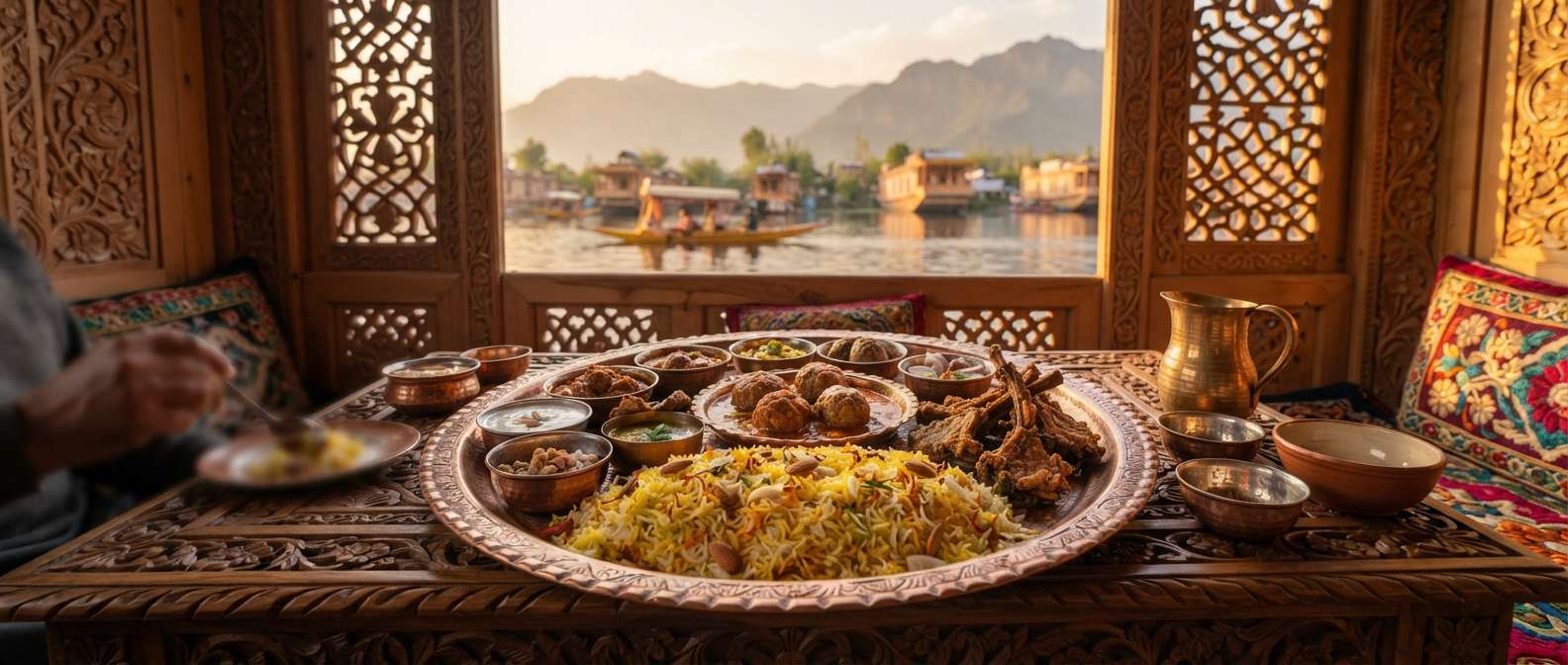
Kashmiris are said to cook mutton around 30 different ways, and the Valley’s reputation rests on the meat courses of the Wazwan. Start here.
Rogan Josh
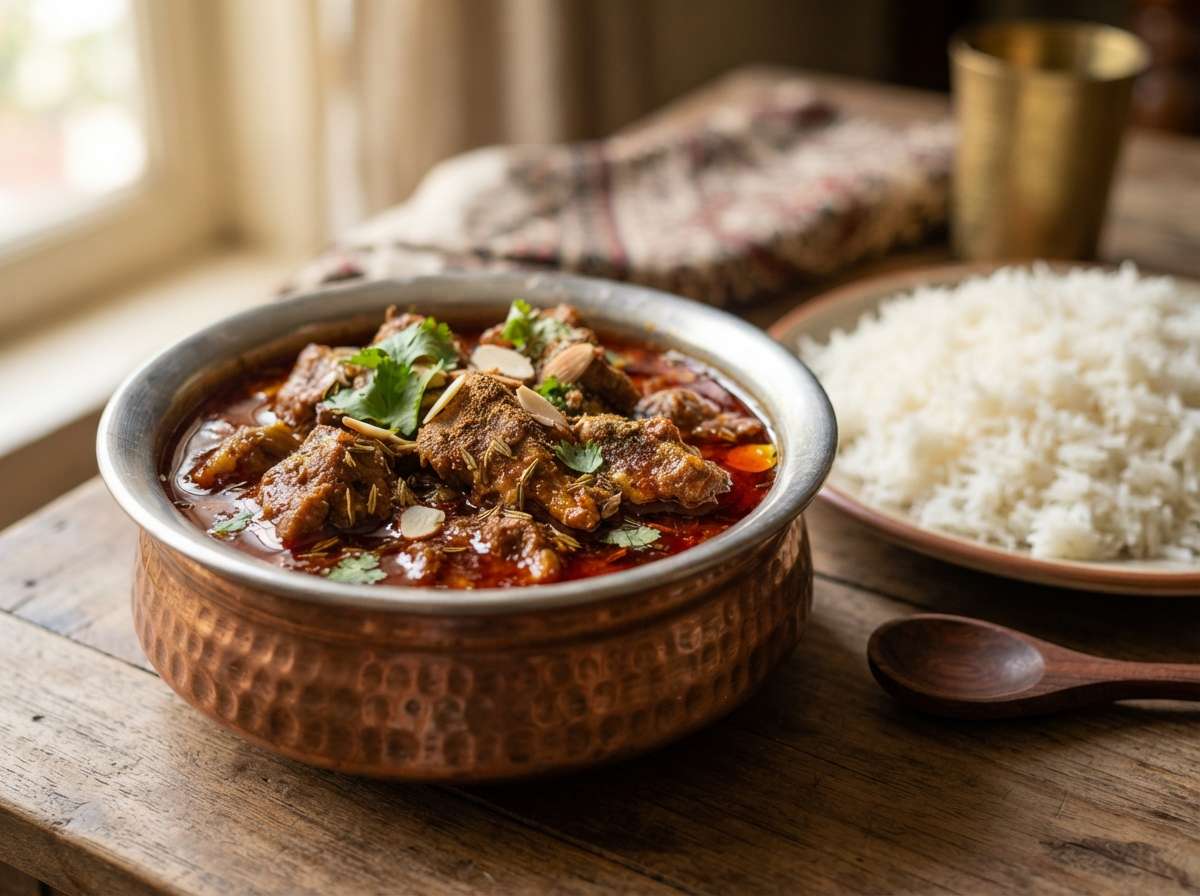
If you eat one dish, eat this. Rogan Josh is lamb braised slowly with fennel, dry ginger and whole spices until the gravy turns deep red. Kashmiri Pandit homes cook it with yogurt and asafoetida and no onion or garlic, while the Muslim Wazwan version uses shallots (praan) and garlic instead. That colour comes from Kashmiri red chilli and mawal (cockscomb flower), not from heat, so it reads as aromatic rather than hot. Eat it with plain rice, which is how locals do it.
Goshtaba
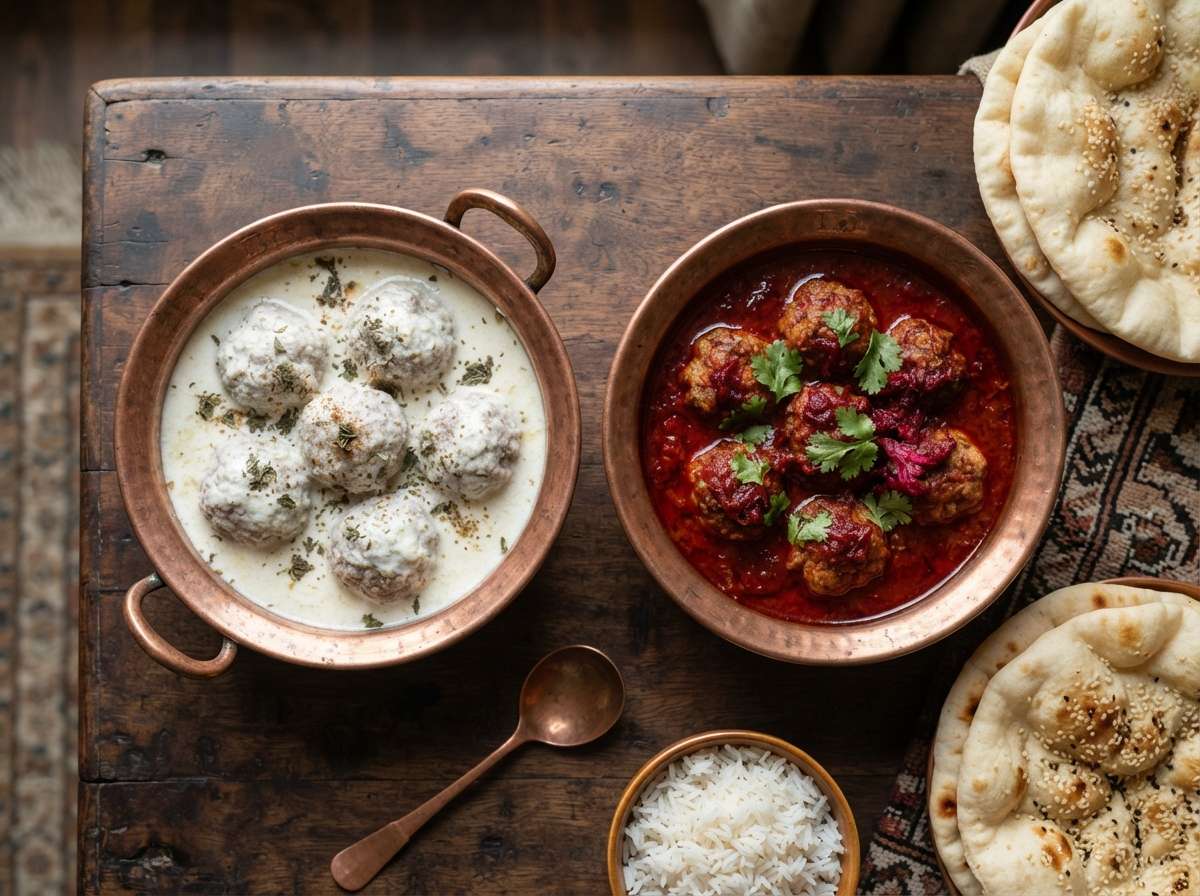
Often called the dish of kings, Goshtaba is minced mutton pounded to a paste, rolled into large soft balls and simmered in a white, spiced yogurt gravy. By tradition it is the last savoury course of a Wazwan, the signal that the feast is winding down. Turning it away is considered mildly rude, so pace yourself.
Rista
Rista is Goshtaba’s red twin: the same pounded-mutton meatballs, but in a red gravy of Kashmiri chilli, fennel and mawal. Soft enough to cut with a spoon, and one of the earliest meat courses to land on the Trami.
Tabak Maaz
A course people fight over. Lamb ribs are first simmered in milk and spices until tender, then shallow-fried so the edges crisp up. You eat it with your fingers, and it usually arrives near the start of the Wazwan.
Yakhni (Lamb Yakhni)
Yakhni is the gentle one. Lamb cooked in a pale yogurt gravy flavoured with fennel, dry ginger, cardamom and dried mint, with almost no chilli. If someone at the table cannot handle spice, this is the safe, satisfying order.
Aab Gosh
Lamb chunks cooked in milk with fennel and cardamom until the gravy is thin, sweetish and delicate. It is a festive, special-occasion dish, usually served with plain rice.
Matschgand
Elongated minced-mutton koftas (mutsch) simmered in a hot red gravy. It is a Kashmiri Pandit favourite, cooked without onion or garlic, and also turns up on many Wazwan menus. Rich and spicy, it rewards a good appetite.
Shab Deg
A winter classic that cooks overnight. Meat, often with turnips, is sealed in a pot and left on a low fire until everything collapses into a single deep flavour. The name itself points to the night-long cooking.
Harissa
Not to be confused with the North African chilli paste. Kashmiri Harissa is mutton and rice slow-cooked overnight into a smooth, savoury paste, finished with a spiced oil and eaten hot with girda bread. It is a winter-only breakfast, sold roughly from November to March and at its best in the deep-winter Chillai Kalan (21 December to 29 January), when queues form outside old-city Harissa shops in Srinagar before dawn.
Vegetarian Kashmiri dishes
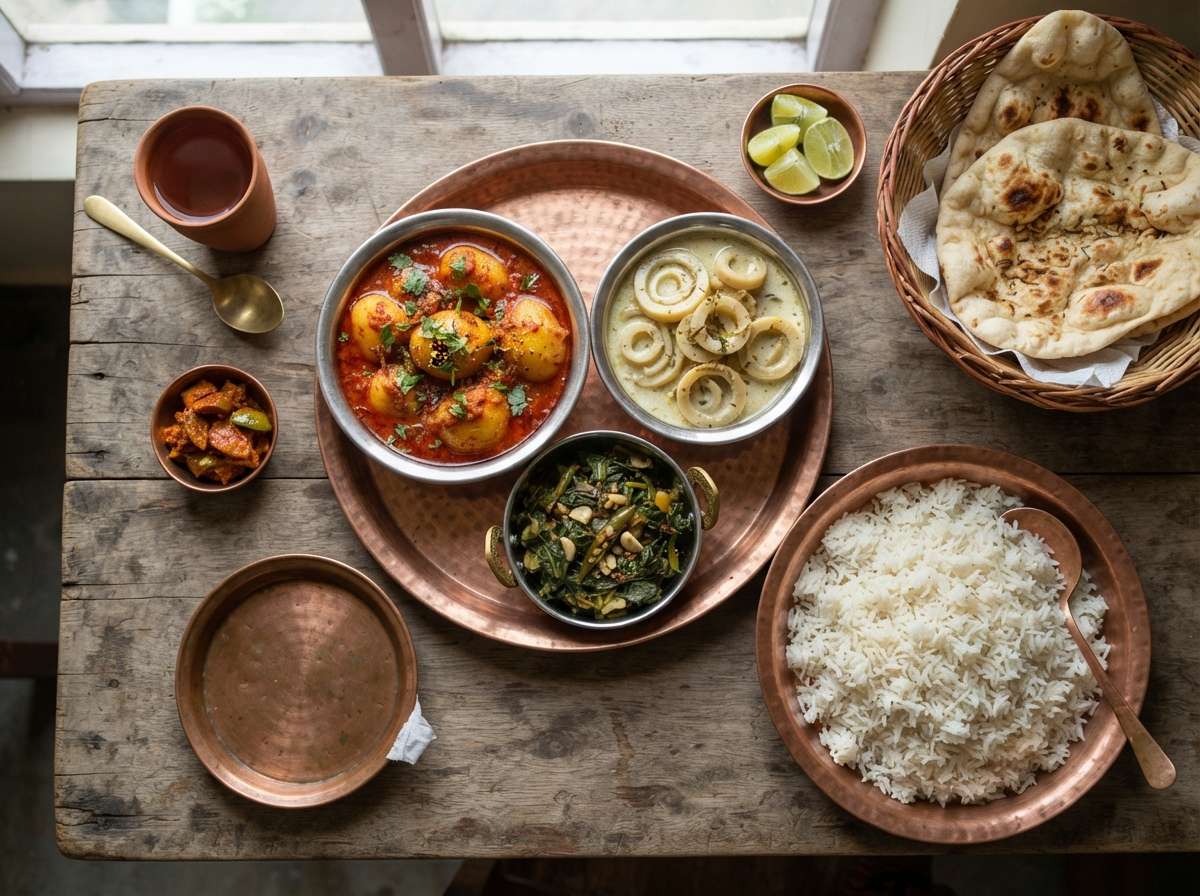
The idea that Kashmiri food is meat-only is wrong. Kashmiri Pandits do eat meat, but their kitchen skips onion and garlic, leaning on yogurt, asafoetida and fennel instead, and it has a deep bench of vegetable dishes.
Dum Aloo
Baby potatoes fried whole, then simmered in a yogurt gravy with fennel and ginger. The Kashmiri version is spicier and tangier than the Punjabi one, and it is on almost every table.
Nadru Yakhni
Lotus stem (nadru) from the Dal and Wular lakes, sliced into rings and simmered in a light yogurt gravy. Yakhni-style cooking, yogurt rather than tomato or onion, is a signature of authentic Kashmiri Pandit food. It appears often at festivals and winter meals.
Nadru Monji
The street-food side of lotus stem: nadru dipped in spiced gram-flour batter and deep-fried into crisp fritters, sold hot with a mint dip. A monsoon and winter favourite.
Haak
Kashmiri collard greens braised in a thin broth of mustard oil, asafoetida and chilli and eaten with rice most days of the week. Simple, and the dish locals actually miss when they travel.
Chaman (Lyader Tschaman)
Firm paneer cubes fried and then simmered in a light turmeric gravy. Many restaurant Wazwan menus now include it as a vegetarian course, though a traditional Wazwan is almost entirely meat.
Kashmiri Baingan and Kashmiri Rajma
Two everyday comforts. Kashmiri Baingan is eggplant cooked down in a spiced yogurt gravy. Kashmiri Rajma is red kidney beans in a thick, chilli-flecked gravy, eaten with rice or paratha and beloved across Jammu and Kashmir.
Kashmiri beverages and breads
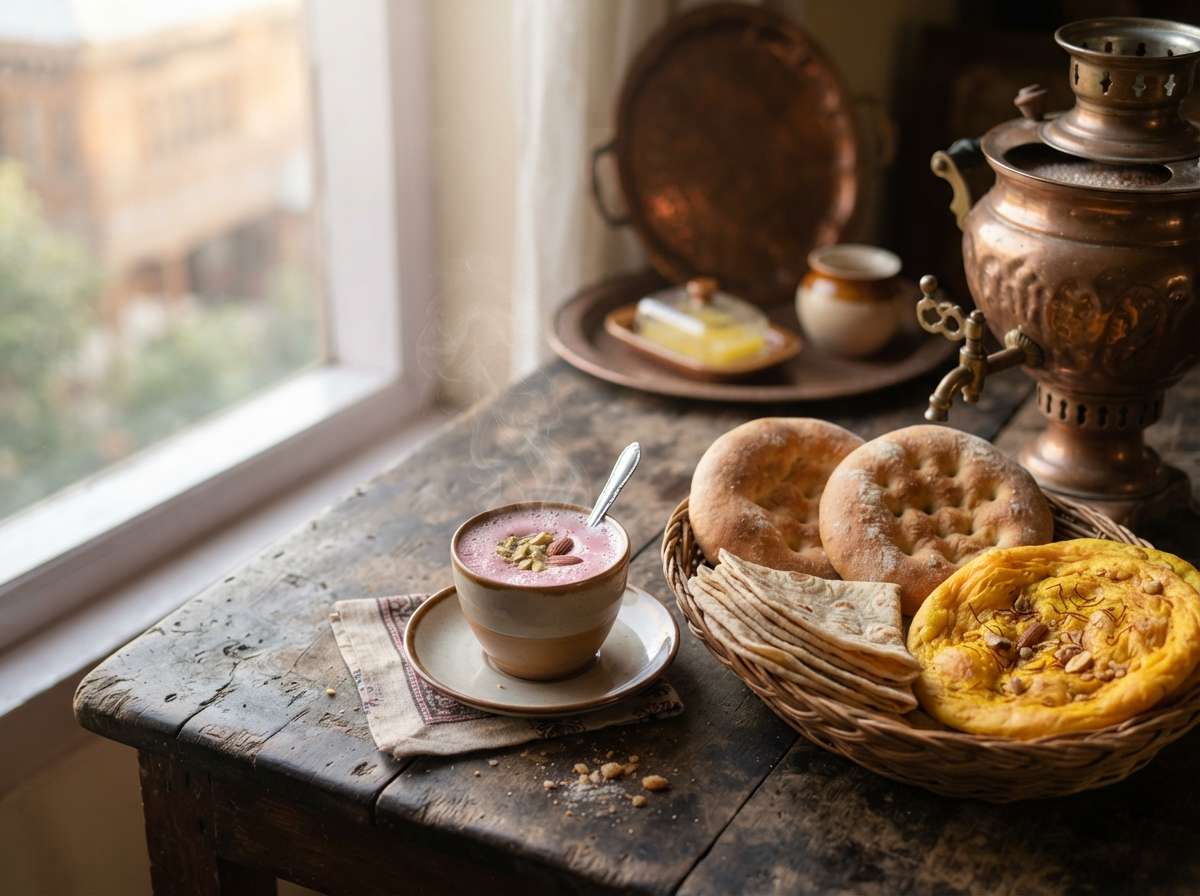
Noon Chai (pink salt tea)
The drink that surprises visitors most. Noon means salt in Kashmiri, and Noon Chai (also called Sheer Chai or gulabi chai) is green tea simmered with milk, salt and a pinch of baking soda. The soda triggers a natural reaction that turns it pink, no food colour involved. It is a savoury, creamy tea, often topped with nuts, and it is the standard breakfast drink with bread.
Kahwa
The one you will want to take home. Kahwa is a green tea brewed with saffron, cardamom, cinnamon and crushed almonds, lightly sweetened, and drunk after meals or through a cold afternoon. It is most commonly spelled Kahwa, though you will see Kehwa or Kahva on some menus.
Sheermal, Lavasa and the Kandur bakery
Bread in Kashmir comes from the Kandur, the neighbourhood bakery. Sheermal is a mildly sweet, saffron-tinged flatbread. Lavasa is a thin, soft flatbread, while Kashmiri kulcha is crisp and crumbly and Bakarkhani flaky and layered, all eaten with Noon Chai, and girda (tsot) is the everyday round loaf that also pairs with Harissa. Buying warm bread at dawn is part of the daily rhythm.
What is the Wazwan, Kashmir's royal feast?
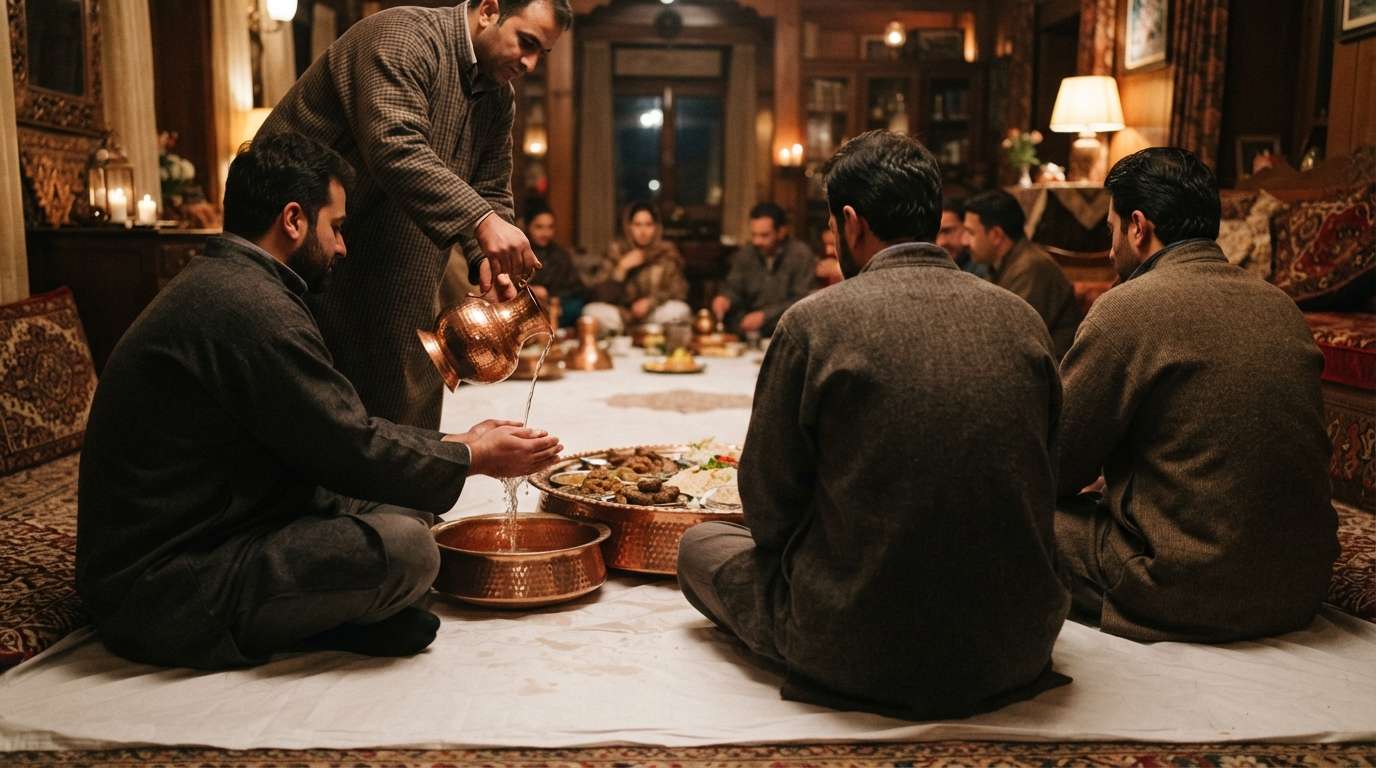
The Wazwan is the centrepiece of Kashmiri food culture: a multi-course banquet that can run to around 36 dishes, most of them meat, cooked overnight by a master chef called a waza and his team. It is served at weddings and big occasions, and it is as much a ritual as a meal.
Guests sit in groups of four around a large copper platter called a Trami. Before eating, a server comes round with the Tash-t-Nari, a copper ewer and basin, so everyone can wash their hands. The platter then arrives under a conical copper lid called a sarposh, heaped with rice and already topped with the opening dishes, usually seekh kebabs, Methi Maaz, Tabak Maaz and often a chicken, and the rest of the courses are ladled onto it one by one. Seven meat dishes are considered essential to a proper Wazwan: Tabak Maaz, Rista, Rogan Josh, Daniwal Korma, Aab Gosh, Marchwangan Korma and Goshtaba, which closes the meal. You eat with your right hand, you share, and you do not rush.
A common myth, repeated even on menus, is that a Wazwan is just ten dishes. Ten is closer to a modest home version. A full ceremonial Wazwan is far larger, which is why a complete Trami for a group is usually ordered a day in advance, even though single Wazwan plates are on everyday restaurant menus.
Traditional food of Jammu: Dogra cuisine
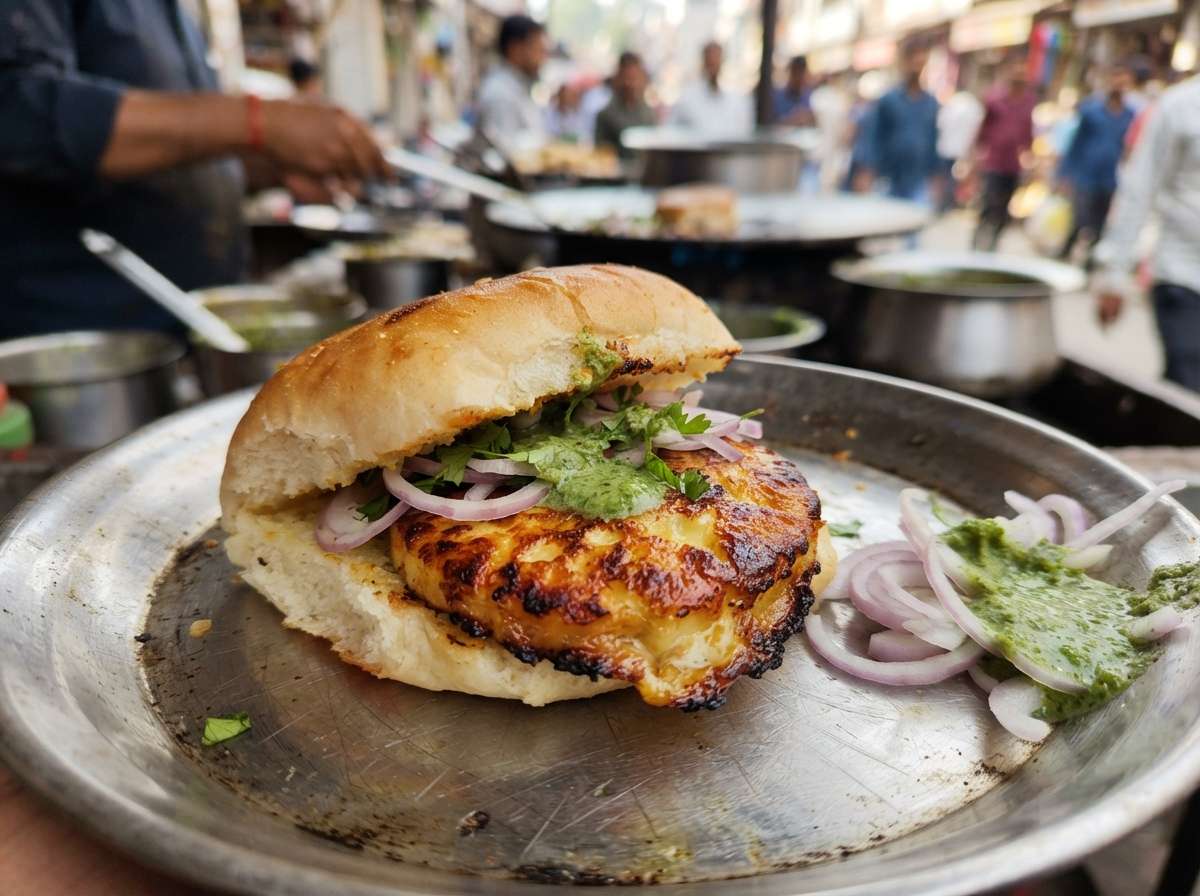
Most food guides stop at the Valley and miss half the region. Jammu’s Dogra cuisine is a separate tradition: largely vegetarian, soured with tamarind, mustard and dried pomegranate, and spiced with a light hand. If you are searching for the famous food of Jammu and Kashmir as a whole, this is the part that usually goes unwritten.
Kalari (Kaladi)
Jammu’s best-known food. Kalari is a dense, chewy ripened cheese from the hills of Udhampur district, traditionally made by local Dogra and Gujjar dairy families. It is pan-fried until it forms a golden crust and served hot, most famously stuffed into a Kalari kulcha, the region’s answer to a cheese burger. Eat it fresh off a roadside griddle.
Ambal
A quintessential Dogra dish: pumpkin cooked with tamarind and jaggery into a sweet-and-sour side that balances a thali. Simple, and unlike anything on the Valley menu.
Khatta Meat
The Dogra meat dish, a mutton curry made deliberately sour with dried pomegranate or amchur. Where Valley curries are rich and yogurt-heavy, Khatta Meat is bright and tangy.
Auria
Potatoes in a sharp mustard-and-yogurt gravy. The mustard gives it a nose-tingling kick that is very Dogra and very moreish with rice.
Rajma, Madra and Maani
Rajma is Jammu’s everyday hero, and the kidney beans from Bhaderwah are prized enough to be sought out by name. Round out a Dogra thali with Madra (chickpeas in a spiced yogurt gravy, a dish shared with neighbouring Himachal) and Dal Bhatt Maani, a Dogra feast spread of lentils and rice with the tangy side dish called Maani. Together these show why the Jammu side deserves its own plate.
Ladakh-region dishes (a quick note)
If your trip continues to Ladakh, the food shifts again toward Tibet. These are not Kashmiri dishes, but travellers on a combined Kashmir and Ladakh route meet them, so it helps to know the shortlist. Momos are steamed or fried dumplings with a fiery red chutney. Thukpa and Thenthuk are warming noodle soups, one with regular noodles and one with hand-torn pieces. Butter Tea (gur gur cha) is a salted butter-and-tea brew that sounds strange and works surprisingly well against the cold and altitude.
Where to eat authentic Kashmiri food
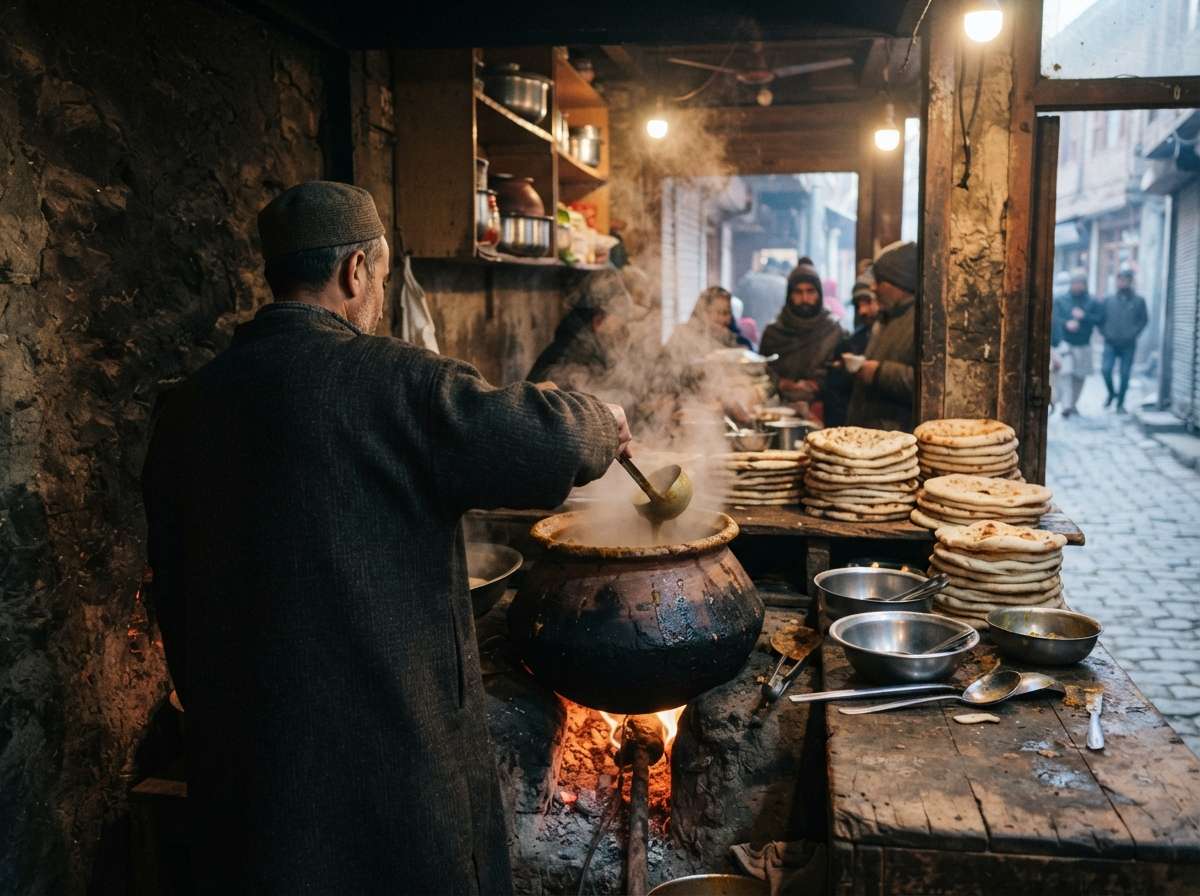
The best Wazwan is the one you are invited to at a Kashmiri home, so if you get the chance, take it. Failing that, Srinagar has the widest choice. Long-running restaurants such as Ahdoos and Mughal Darbar on Residency Road and Shamyana on the Dal Lake Boulevard are the usual recommendations for a sit-down Wazwan or Rogan Josh. For Harissa in winter, head to the old-city lanes around Srinagar early, because the good shops sell out by mid-morning. On the Jammu side, look for a Kalari kulcha from a street griddle rather than a formal restaurant. Booking a Kashmir tour package that includes a houseboat stay is one easy way to line up a home-style Wazwan, since operators can arrange it with a local waza. For seasonal timing on when the Valley is at its best, our guide to the best places to visit in Kashmir pairs well with this menu.
How to eat like a local in Kashmir: a step-by-step
- Start the day at a Kandur bakery. Buy warm girda or Lavasa and pair it with a cup of Noon Chai.
- Plan your Wazwan. Single Wazwan plates and thalis are walk-in at Srinagar restaurants, but a full Trami for four, or a home-style Wazwan cooked by a waza, should be ordered a day ahead.
- Share the Trami. Four people to one platter is the tradition. Eat with your right hand and go slowly.
- Pace the courses. Tabak Maaz and Rista come early, so save room for Goshtaba, which signals the end.
- Finish with Kahwa. The saffron-almond tea settles a heavy meal and is the natural full stop.
- Carry cash or UPI. Many old-city Harissa shops, Kandur bakeries and Kalari stalls do not take cards.
Kashmir ki famous cheezein (quick romanized guide)
Agar aap “kashmir ki famous chijen” ya “jammu kashmir ka famous food” search kar rahe hain, to short list yeh hai. Non-veg mein Rogan Josh, Goshtaba, Rista aur Tabak Maaz sabse famous hain. Veg mein Dum Aloo, Nadru Yakhni, Haak aur Chaman try karein. Peene ke liye Noon Chai (pink namkeen chai) aur Kahwa (saffron wali chai) zaroor lein. Jammu side par Kalari cheese, Ambal aur Rajma sabse mashhoor hain. Aur haan, Wazwan lagbhag 36 courses tak ka royal feast hai, restaurant mein Wazwan plate seedha mil jaati hai, lekin poori Trami ek din pehle order karein.
The bottom of the plate
Kashmiri food rewards a plan: a bakery breakfast with Noon Chai, a proper Wazwan (a full Trami ordered a day ahead), and a Kahwa to close. Add a Dogra thali on the Jammu side and you have eaten across the whole of Jammu and Kashmir, not just the postcard version of it. When you are ready to taste it in person, browse a Kashmir tour package or start with our Kashmir travel guide to build the trip around the meals.
FAQs
FAQs About Kashmir Food
Quick answers on famous dishes, the Wazwan, spice levels, vegetarian options, drinks and prices
Rogan Josh is the single most famous Kashmiri dish, a slow-cooked red lamb curry that is aromatic rather than hot. Close behind are Goshtaba and Rista, the two mutton-meatball dishes at the heart of the Wazwan feast. For vegetarians, Dum Aloo and Nadru Yakhni (lotus stem in yogurt) are the best-known.
A Wazwan is Kashmir's ceremonial multi-course banquet, cooked overnight by a master chef called a waza. A full Wazwan can run to around 36 dishes, most of them meat, though seven are considered essential, including Tabak Maaz, Rista, Rogan Josh and Goshtaba. Guests share it in groups of four from a large copper platter called a Trami.
No. Kashmiri food looks fiery because of its deep red gravies, but that colour comes from mild Kashmiri chilli and mawal (cockscomb flower), not from heat. Most dishes are aromatic and yogurt-based. Yakhni and Aab Gosh in particular are gentle, so there is plenty for people who prefer low spice.
Yes, easily. The Valley offers Dum Aloo, Nadru Yakhni, Haak greens, Chaman (fried paneer) and Kashmiri Rajma, and Kashmiri Pandit cooking, though not vegetarian, has many vegetable dishes made without onion or garlic. Jammu's Dogra cuisine is even more so, with Ambal, Auria, Rajma and Kalari cheese. A vegetarian will never go hungry in either region.
Kashmir Valley food is rich, meat-forward and built on yogurt, fennel and dry ginger, and it centres on the Wazwan. Jammu's Dogra cuisine is largely vegetarian and deliberately sour, using tamarind, mustard and dried pomegranate in dishes like Ambal, Khatta Meat and Auria, plus the famous Kalari cheese. Same union territory, two very different kitchens.
Two teas. Noon Chai is a pink salt tea drunk at breakfast, coloured naturally pink by a reaction between green tea and baking soda. Kahwa is a lightly sweet saffron, cardamom and almond green tea, best after a meal. Both are easy to find, and Kahwa travels home well as a souvenir.
Kalari (also spelled Kaladi) is a dense, chewy cheese from the Jammu region, created by the Dogra community to preserve milk. It is pan-fried until it develops a golden crust and is most loved stuffed into a Kalari kulcha, a hot cheese-filled bun sold at street stalls on the Jammu side.
A Wazwan thali at a Srinagar restaurant is commonly priced from around Rs 500 to Rs 1,800 per head, depending on the number of courses (Mughal Darbar lists a full single-person Wazwan plate at about Rs 1,300). A full wedding-style Trami shared between four costs more (from around Rs 6,200 for four at Mughal Darbar), since it is cooked to order by a waza and includes the complete set of meat courses. Prices vary by season and venue, so confirm when you book.
Harissa is a winter-only dish, sold roughly from November to March and at its best in the 40-day deep winter known as Chillai Kalan (21 December to 29 January), when Srinagar's old-city Harissa shops open before dawn. Shab Deg and other slow-cooked meat dishes also suit the cold months. For the full seasonal picture, see our guide to the best places to visit in Kashmir.