4D / 3N
24% OFF
Best Selling Alleppey-Munnar Kerala Weekend Tour
- Hotel
- Meals
- Sightseeing
- Houseboat
- Cab Transfer
₹17,132
₹13,020 /pp


Here are 40 interesting facts about Kerala, the state on India’s south-west coast that officially became Keralam on 25 August 2026. It has the country’s highest literacy rate (93.91%), the lowest infant mortality of any large state (5 deaths per 1,000 live births), 44 rivers, and the airport that went fully solar before any other in the world. It also has what is widely held to be India’s oldest mosque. Start with the at-a-glance table if you need quick numbers for a quiz or a school project. The Top 10 box comes next. After that, all 40 facts are grouped by theme, each with its source.
Key takeaways
Sourced facts on the new name, people, nature, history, economy and culture of India's south-west coast state
Best Time
October - March
Select Package Type


5 Days & 4 Nights
₹24,604 /@pp
GET FREE QUOTEEvery figure in this table carries its source, so it is safe to copy into a project.
| Fact | Detail | Source |
| Official name | Keralam (called Kerala until 25 August 2026) | MHA gazette, 25 Aug 2026 |
| Nickname | God’s Own Country | Kerala Tourism |
| Capital | Thiruvananthapuram (Trivandrum) | Govt of Kerala |
| Formed | 1 November 1956, celebrated as Kerala Piravi | States Reorganisation Act, 1956 |
| Area | 38,863 km² (1.18% of India) | Govt of Kerala |
| Population | 3,34,06,061 (2.76% of India) | Census 2011 |
| Districts | 14 | Govt of Kerala |
| Official language | Malayalam (classical language since 2013) | Ministry of Culture |
| Literacy rate | 93.91%, highest among Indian states | Census 2011 |
| Sex ratio | 1,084 women per 1,000 men, highest among states | Census 2011 |
| Infant mortality | 5 per 1,000 live births, lowest in India | SRS 2023 |
| Highest peak | Anamudi, 2,695 m | Eravikulam NP, Kerala Forest Dept |
| Rivers | 44 (41 flow west, 3 flow east) | Kerala Water Resources Dept |
| Longest river | Periyar, 244 km | Kerala Water Resources Dept |
| Coastline | About 590 km on the Arabian Sea | Govt of Kerala |
| International airports | 4: Thiruvananthapuram, Kochi, Kozhikode, Kannur | Airports Authority of India, CIAL, KIAL |
| Legislature | 140 Assembly seats, 20 Lok Sabha seats, 9 Rajya Sabha seats | Election Commission of India |
| State animal / bird | Indian elephant / Great hornbill | Govt of Kerala |
| State flower / tree | Kanikonna (golden shower) / Coconut palm | Govt of Kerala |
| State fish / fruit | Karimeen (pearl spot) / Jackfruit | Govt of Kerala |
| Neighbours | Karnataka to the north, Tamil Nadu to the east, Arabian Sea to the west | Survey of India |
Need 10 points about Kerala for a school assignment? These are the ten that show up most often in exams and quizzes.
Looking for 25 facts about Kerala in English? The one-line list below has all 40, and facts 1 to 25 cover the essentials. Facts 26 to 40 add the economy, culture and the fun, unusual side.
Short on time? Here is every fact on this page in a single line. The first 25 make a good set of 25 facts about Kerala in English for a project, and each number jumps to the full entry.
| # | Fact | Theme |
|---|---|---|
| 1 | Kerala’s official name has been Keralam since 25 August 2026. | Name |
| 2 | “Kerala” may come from kera (coconut) + alam (land), or from Cheralam, land of the Cheras. | Name |
| 3 | Kerala was formed on 1 November 1956, celebrated as Kerala Piravi. | Name |
| 4 | “God’s Own Country” began as a Kerala Tourism slogan in 1989. | Name |
| 5 | Its literacy rate of 93.91% is the highest in India (Census 2011). | People |
| 6 | There are 1,084 women for every 1,000 men, the highest sex ratio of any state. | People |
| 7 | Infant mortality is 5 per 1,000 live births, the lowest of any large state (SRS 2023). | People |
| 8 | Only 0.55% of Keralites are multidimensionally poor, the lowest share in India. | People |
| 9 | Kerala has 1.18% of India’s land but 2.76% of its people. | Geography |
| 10 | 44 rivers flow through Kerala, and the Periyar (244 km) is the longest. | Geography |
| 11 | Anamudi (2,695 m) is the highest peak in India south of the Himalayas. | Geography |
| 12 | The south-west monsoon reaches mainland India first in Kerala, around 1 June. | Geography |
| 13 | Vembanad, about 96 km long, is India’s longest lake. | Geography |
| 14 | Kuttanad farmers grow rice up to about 2 m below sea level. | Geography |
| 15 | A people’s campaign saved Silent Valley, a national park since 1984. | Nature |
| 16 | Neelakurinji turns Munnar’s hills blue once every 12 years. | Nature |
| 17 | The ancient port of Muziris shipped black pepper to Rome. | History |
| 18 | By tradition, St Thomas the Apostle reached Kerala in 52 CE. | Faith |
| 19 | Cheraman Juma Masjid (629 CE by tradition) is held to be India’s oldest mosque. | Faith |
| 20 | Kochi’s Paradesi Synagogue (1568) is the oldest active synagogue in the Commonwealth. | Faith |
| 21 | Vasco da Gama landed near Kozhikode in 1498 and died in Kochi in 1524. | History |
| 22 | Sree Padmanabhaswamy Temple is often called the world’s richest temple. | Faith |
| 23 | In 1957 Kerala voted in one of the first elected communist governments. | History |
| 24 | Nair families followed marumakkathayam, passing property through women. | History |
| 25 | Kerala grows most of India’s small cardamom. | Economy |
| 26 | Kerala grows about three-quarters of India’s natural rubber. | Economy |
| 27 | India’s first coir factory opened in Alappuzha in 1859. | Economy |
| 28 | Kerala was declared India’s first digital state in 2016. | Modern |
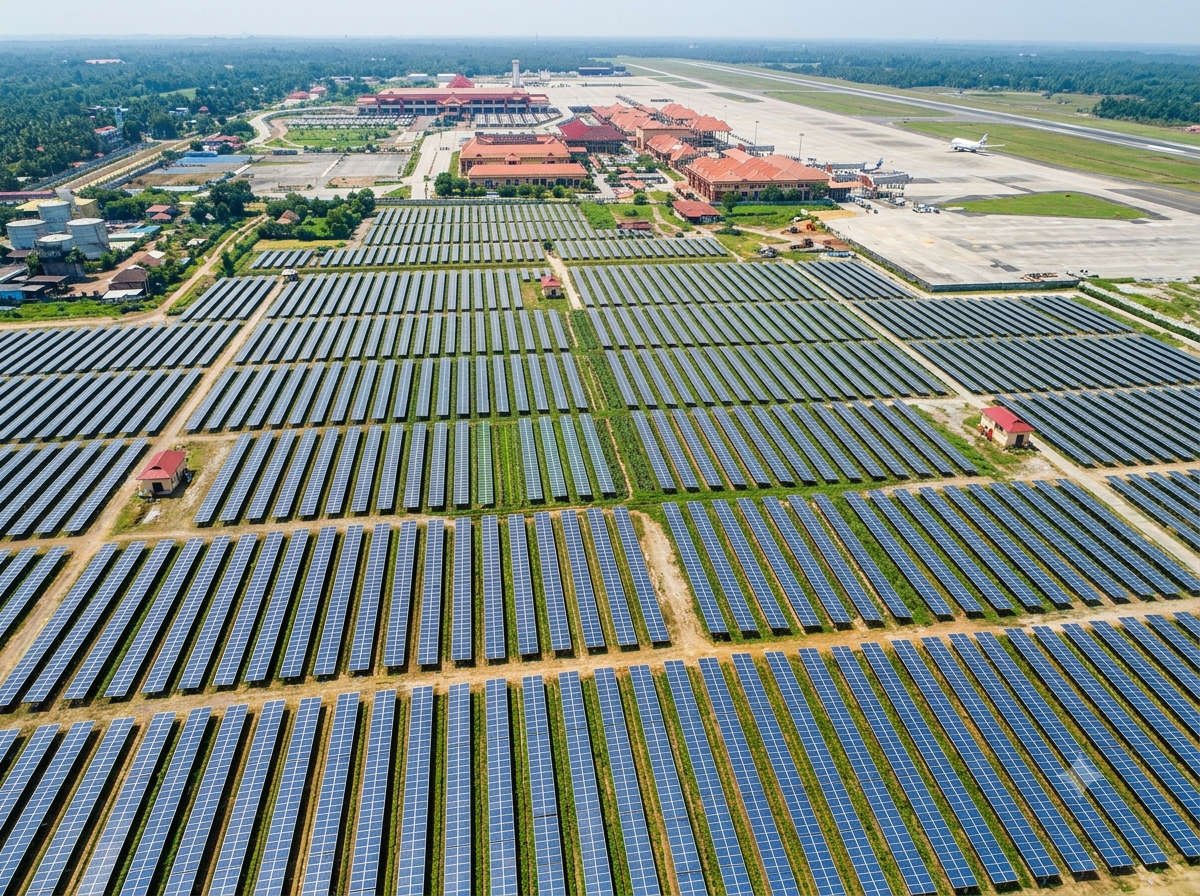
| 29 | Cochin Airport became the world’s first fully solar-powered airport in 2015. | Modern |
| 30 | Kerala has four international airports. | Modern |
| 31 | Vizhinjam, opened in 2025, is India’s first deep-water transshipment port. | Modern |
| 32 | Ayurveda and Kalaripayattu both grew up in Kerala. | Culture |
| 33 | UNESCO recognised Koodiyattam in 2001, among its first 19 masterpieces. | Culture |
| 34 | In Theyyam, the performer is believed to become the god. | Culture |
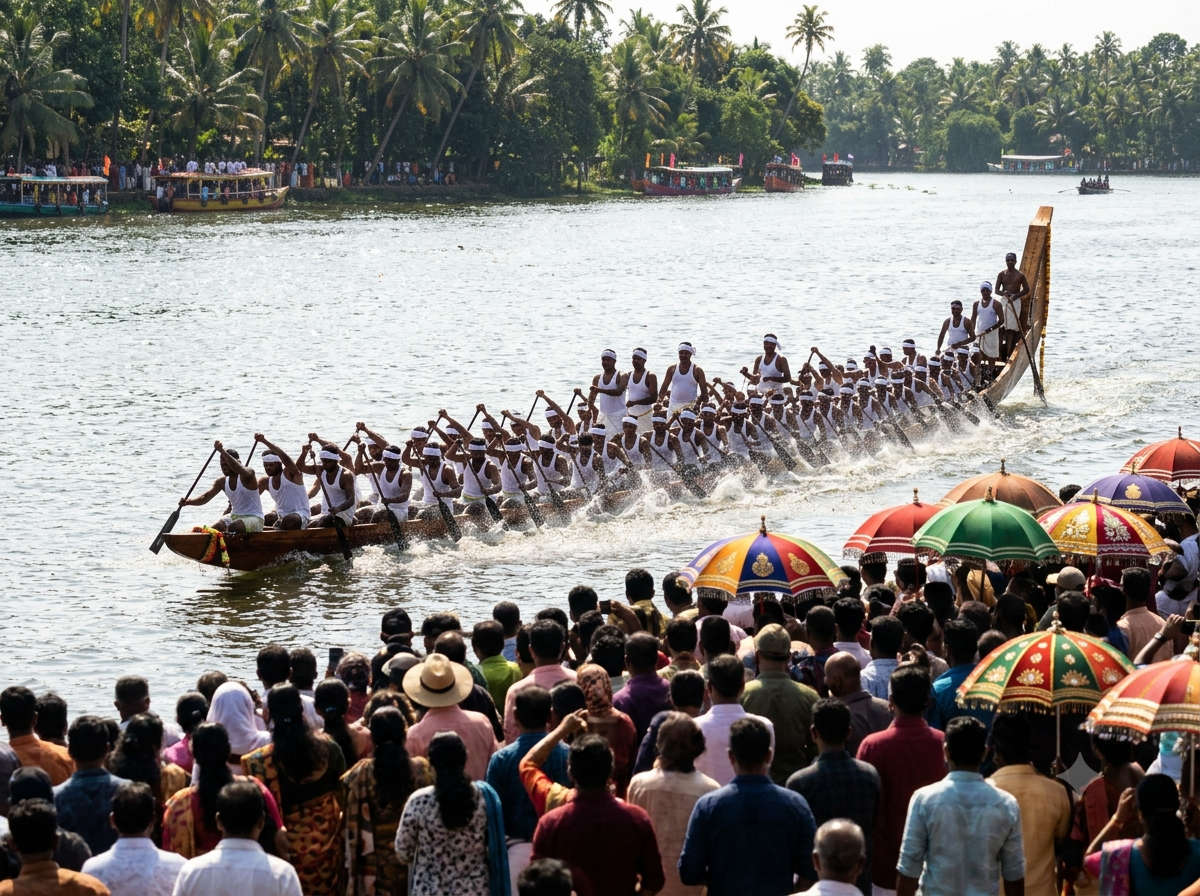
| 35 | Snake boats carry 100+ rowers, and the Onam sadya has about 26 dishes. | Culture |
| 36 | “Malayalam” is a palindrome, and a classical language since 2013. | Culture |
| 37 | Kodinhi village has more than 400 pairs of twins. | Fun |
| 38 | The Jatayu sculpture in Kollam is the world’s largest bird sculpture. | Fun |
| 39 | Muzhappilangad in Kannur is a 4 km drive-in beach. | Fun |
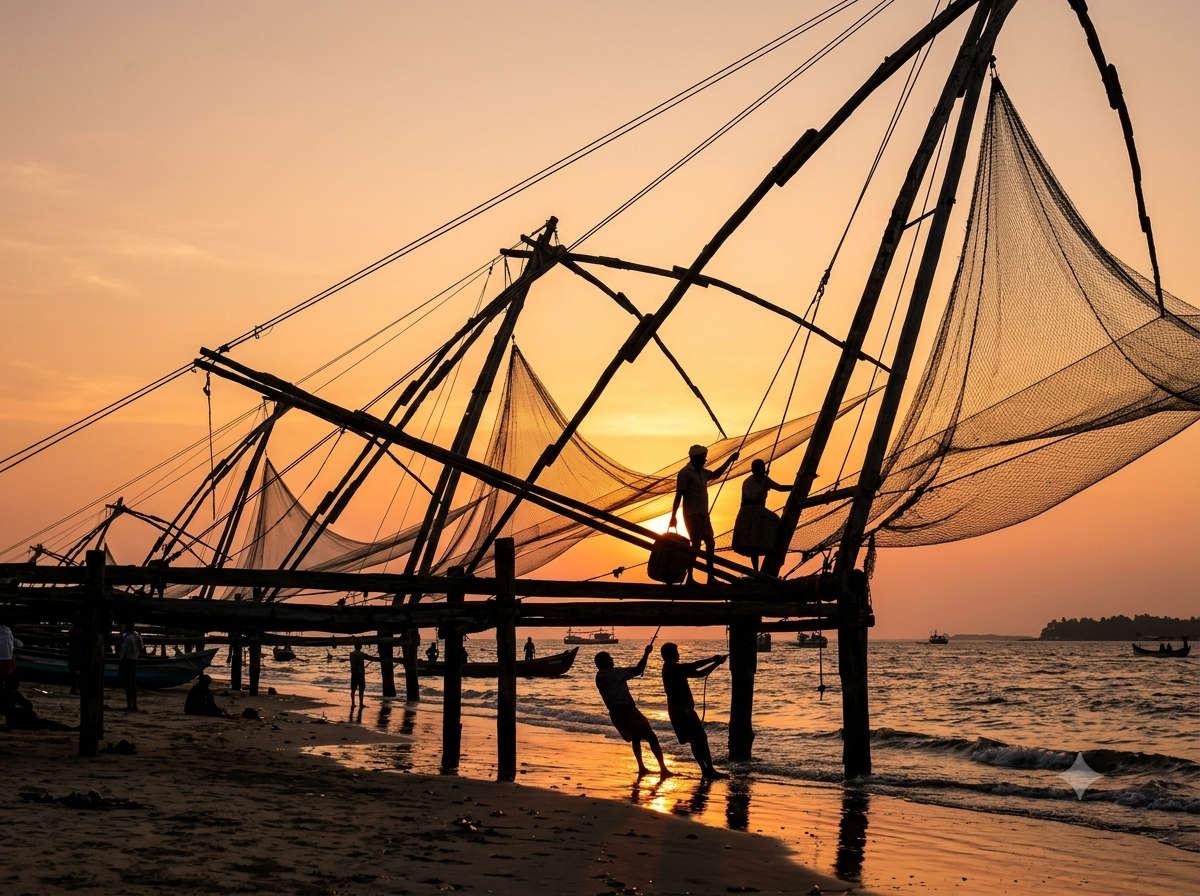
| 40 | Kochi’s Chinese fishing nets date back to the 13th or 14th century. | Fun |
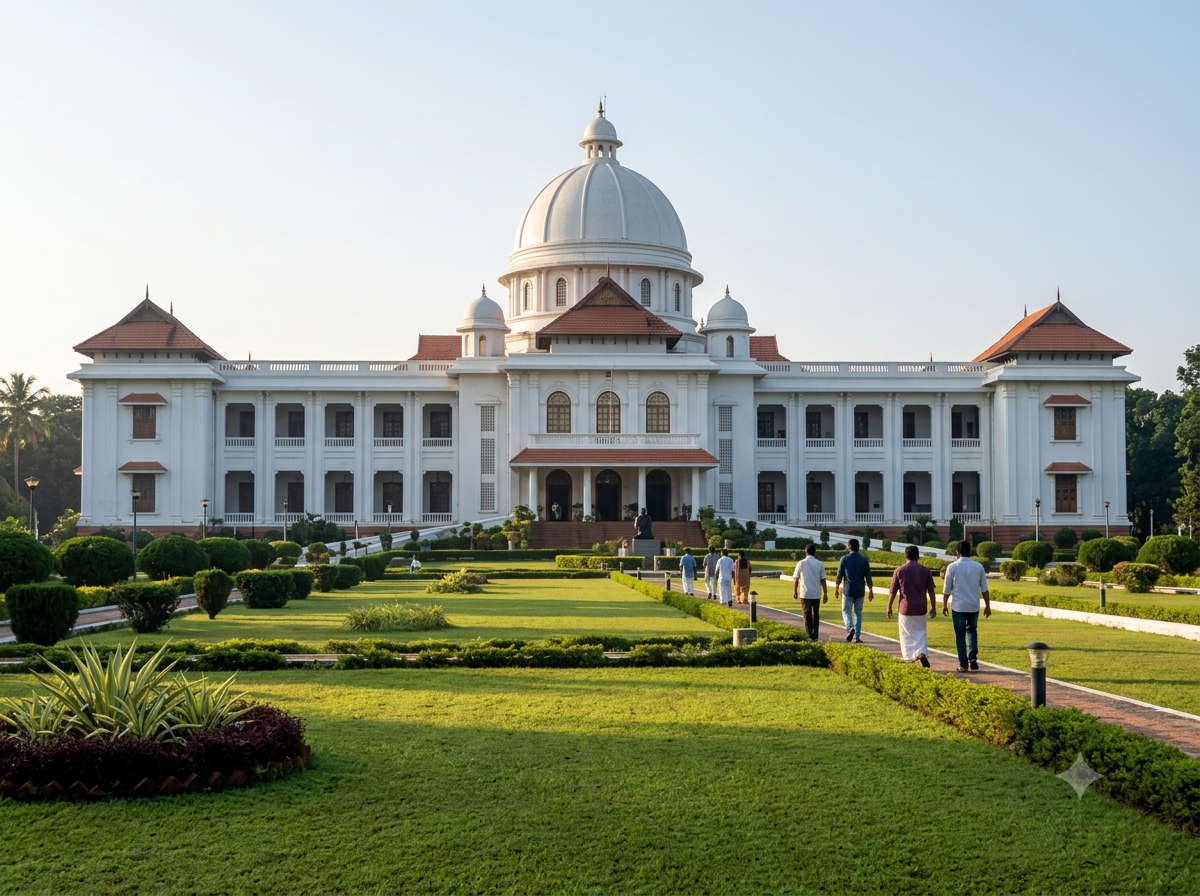
The state’s official name has been Keralam since 25 August 2026. On that day the Ministry of Home Affairs notified the Kerala (Alteration of Name) Act, 2026 (e-Gazette ID CG-DL-E-25082026-275738). Keralam is what Malayalam speakers have always called their state. Until now, English and the other Eighth Schedule languages used “Kerala”. The law makes Keralam the name in every language, so newer maps, textbooks and government forms will show it. People still say Kerala in everyday speech. Britannica has already retitled its entry “Keralam”.
How Kerala became Keralam, step by step
There are two main theories, and the popular “land of coconuts” story is only one of them. The first splits the word into *kera* (coconut palm) and *alam* (land). With around 7.6 lakh hectares under coconut, the state makes the story easy to believe. Historians often favour the second theory. It traces the name to *Cheralam*, the land of the Chera dynasty, which ruled much of this coast in the early centuries CE. An edict of the emperor Ashoka from the 3rd century BCE mentions “Keralaputra”, the oldest written form of the name.
Modern Kerala was created on 1 November 1956 under the States Reorganisation Act. It joined the Malayalam-speaking areas of Travancore-Cochin with the Malabar district of the Madras Presidency and the Kasaragod taluk. The southern taluks around Kanyakumari went to Madras State (now Tamil Nadu). Keralites mark the day as Kerala Piravi (“birth of Kerala”) with school events, cultural programmes and government announcements. The state declared itself free of extreme poverty on Kerala Piravi in 2025.
“God’s Own Country” was written for Kerala Tourism in 1989 by advertising man Walter Mendez. It went on to become one of India’s best-known destination brands. The phrase borrows from a legend in which the sage Parashurama threw his axe into the sea and the water drew back to reveal Kerala. In 1999 *National Geographic Traveler* put Kerala on its list of 50 destinations of a lifetime. That list is still quoted in almost every article about the state. To see what the slogan is selling, our Kerala tourism guide covers the regions one by one.
Kerala’s social numbers get compared with rich countries more often than with other Indian states. Here is the gap, side by side.
| Indicator | Kerala | India | Source |
| Literacy rate | 93.91% | 74.04% | Census 2011 |
| Sex ratio (women per 1,000 men) | 1,084 | 943 | Census 2011 |
| Infant mortality (per 1,000 live births) | 5 | 25 | SRS 2023 |
| Life expectancy at birth | About 75 years | About 70 years | SRS abridged life tables |
| Multidimensionally poor | 0.55% | 14.96% | NITI Aayog MPI 2023 |
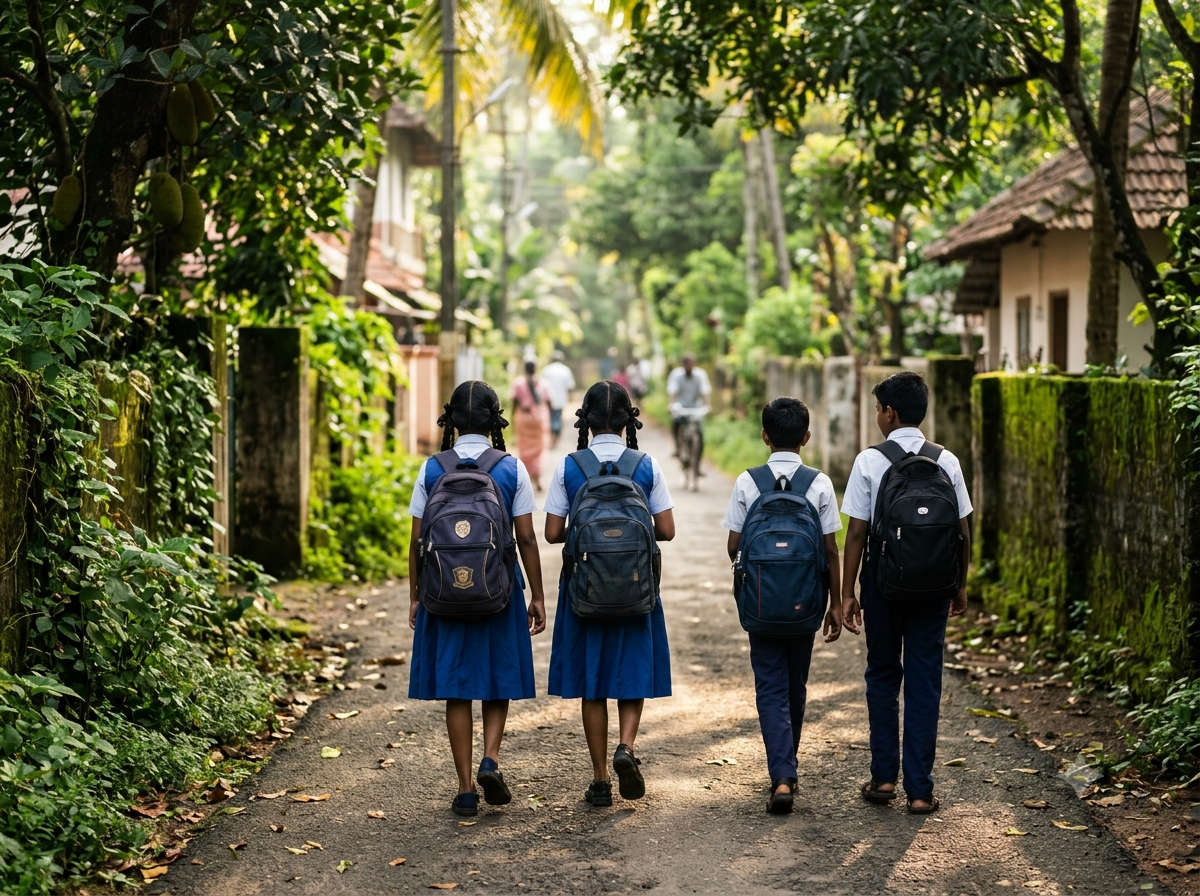
93.91% of Keralites aged seven and above can read and write, the highest of any Indian state (Census 2011). The groundwork goes back a long way. Missionary and princely-state schools in Travancore were teaching girls in the 19th century. In 1989 the town of Kottayam became the first in India to reach 100% literacy. On 18 April 1991 the National Literacy Mission declared Kerala India’s first totally literate state. A newly literate woman, Chelakkodan Ayisha, made the announcement at a rally in Kozhikode.
Kerala has 1,084 women for every 1,000 men, the highest sex ratio of any state (Census 2011). The national figure is 943. Better survival rates for girls and women explain part of the gap. Male migration to the Gulf, which peaked from the 1970s on, explains the rest. Kerala’s women also marry later and have fewer children than the national average. The state’s fertility rate has been below replacement level since the late 1980s.
Life expectancy in Kerala is about 75 years, the highest among India’s major states (SRS abridged life tables). Infant mortality tells the same story more sharply. The Sample Registration System’s 2023 report puts Kerala’s rate at 5 deaths per 1,000 live births, against 25 for India. That figure is in line with many developed countries. A primary health centre in nearly every panchayat and near-universal hospital births explain most of it.
Only 0.55% of Keralites are multidimensionally poor, the lowest share in India (NITI Aayog National MPI, 2023). The national average is 14.96%, and next best is Goa at 0.84%. The state then went further. On 1 November 2025 it became the first Indian state to declare itself free of extreme poverty. Under the Extreme Poverty Eradication Project, local bodies and Kudumbashree identified 64,006 families lacking food, health care, housing or income, and wrote a separate plan for each one (LSGD Kerala).
| Feature | Number | What it means |
| Share of India’s land | 1.18% | Small state, dense population |
| Share of India’s people | 2.76% | About 860 people per km² (Census 2011) |
| Rivers | 44 | 41 flow west into the Arabian Sea |
| Anamudi | 2,695 m | Highest point south of the Himalayas |
| Monsoon onset | Around 1 June | First landfall on the mainland (IMD) |
| Ramsar wetlands | 3 | Vembanad-Kol, Ashtamudi, Sasthamkotta |
| Kuttanad | Up to about 2 m below sea level | Lowest farmland in India |
Kerala covers 1.18% of India’s land but holds 2.76% of its people (Census 2011). That works out to about 860 people per square kilometre, more than double the national average. The state is squeezed into a strip that is never more than about 120 km wide, between the Western Ghats and a coastline of roughly 590 km. Instead of large cities, you get a near-continuous spread of towns and villages. Driving the coast from Thiruvananthapuram to Kochi, you rarely see open country between them.
Kerala has 44 rivers. 41 flow west to the Arabian Sea and 3 (the Kabini, Bhavani and Pambar) flow east into Karnataka and Tamil Nadu. Almost all of them rise in the Western Ghats, a UNESCO World Heritage Site. The longest is the Periyar at 244 km, followed by the Bharathappuzha (209 km) and the Pamba (176 km). Most are short and fast. In the monsoon they swell in hours, which is why the August 2018 floods spread so quickly.
At 2,695 m, Anamudi in Idukki district is the highest point in India south of the Himalayas. It rises inside Eravikulam National Park near Munnar. The park is the main refuge of the Nilgiri tahr, an endangered mountain goat found only in the Western Ghats. The summit trek is closed to the public, but the tahr come close to the road at Rajamala. Our Eravikulam National Park guide covers timings and tickets, and the Munnar guide covers the tea country around it.
The south-west monsoon reaches the Indian mainland first in Kerala, with a normal onset date of 1 June (IMD). Kerala gets two monsoons. The south-west *Edavappathy* runs from June to September, and the north-east *Thulavarsham* runs from October to December. Together they give the state about 3,000 mm of rain a year. The whole country follows the onset forecast, because it signals the start of the kharif sowing season everywhere else. For what the months before the rains feel like, see Kerala in summer.
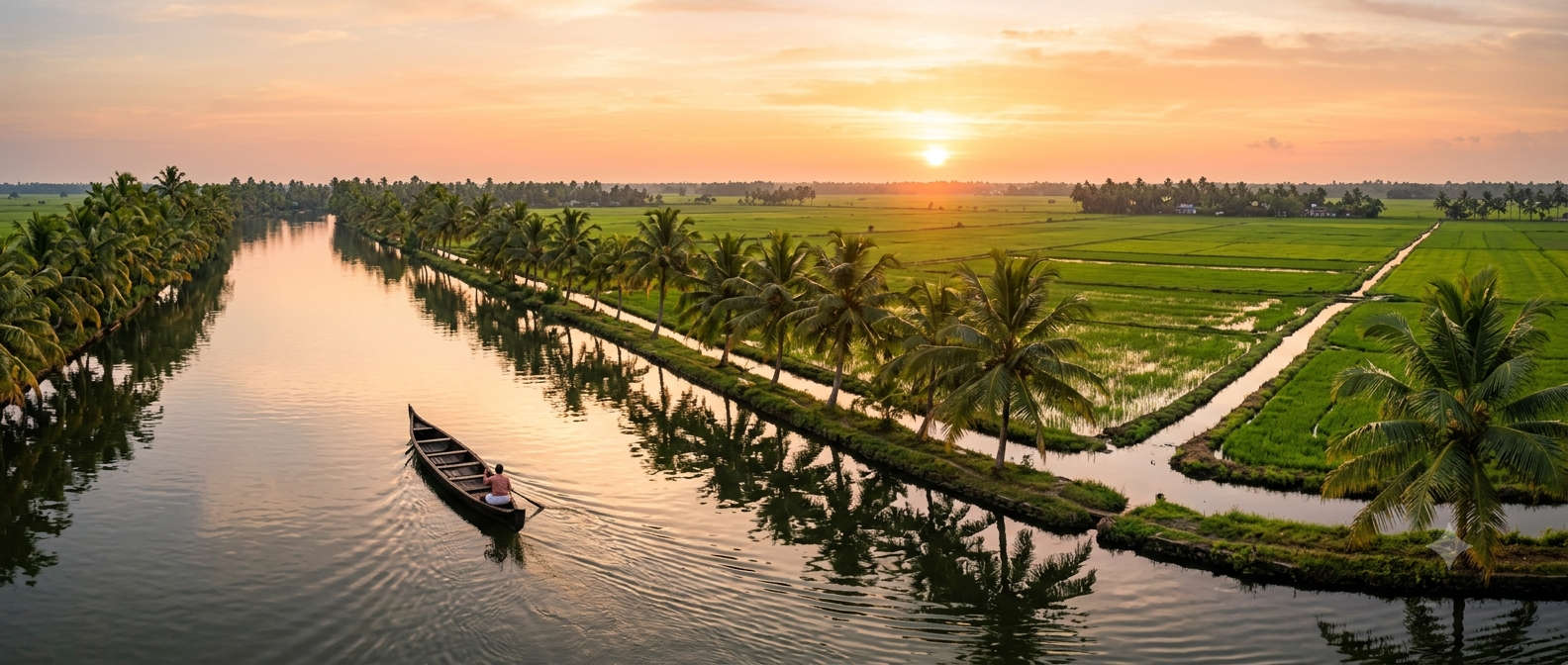
Vembanad, which stretches about 96 km from Alappuzha to Kochi, is the longest lake in India. It anchors the Vembanad-Kol wetland, one of Kerala’s three Ramsar sites. The other two are Ashtamudi and Sasthamkotta, all designated in 2002. Sasthamkotta is the state’s largest freshwater lake and supplies drinking water to Kollam. Vembanad also holds the Thanneermukkom barrier, built in the 1970s to keep seawater out of the rice fields. More on this water world is in our Kerala backwaters guide.
Kuttanad, south of Vembanad, is the lowest-lying region in India. Its farmers grow rice on land up to about 2 m below sea level. Much of the paddy sits on land reclaimed from the lake in the 19th and 20th centuries, held back by mud dykes. FAO lists the system as a Globally Important Agricultural Heritage System. Farmers here have worked below the water line for more than a century, pumping water out of the fields before each crop.
Silent Valley became a national park in 1984 after a public campaign stopped a hydroelectric dam that would have flooded it. Scientists, teachers and the Kerala Sasthra Sahithya Parishad led the campaign, one of India’s earliest environmental movements. The park, in Palakkad district, protects one of the last stretches of undisturbed evergreen rainforest in the Western Ghats. It is also a stronghold of the lion-tailed macaque. Our Silent Valley National Park guide explains how the permit-only visits work.
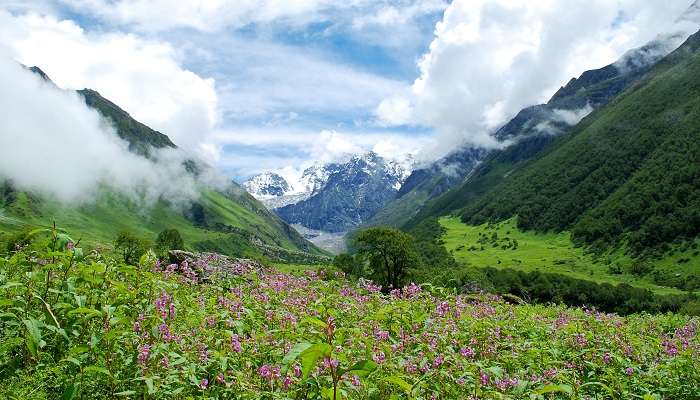
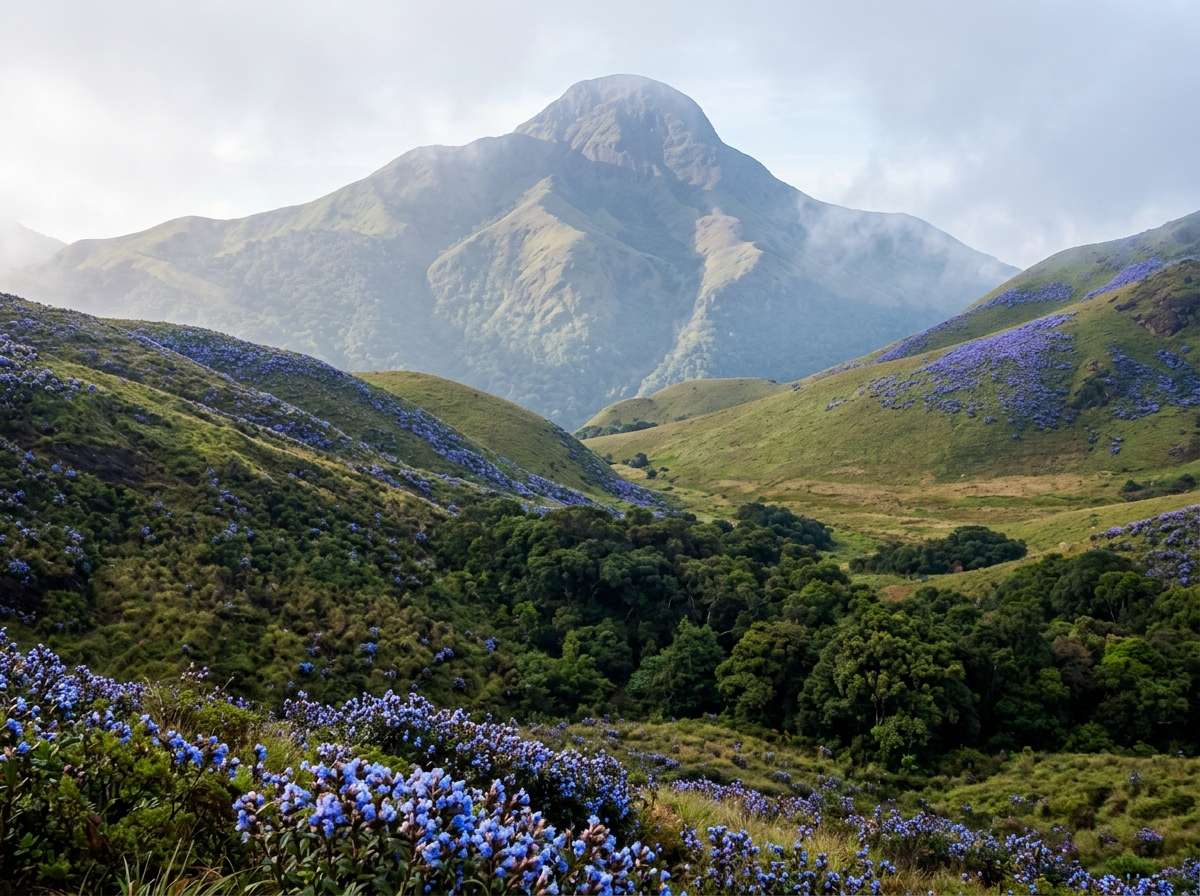
**The Neelakurinji shrub (*Strobilanthes kunthiana*) flowers en masse only once every 12 years, turning the Munnar hills blue-violet.** The last big bloom was in 2018. The next is expected around 2030. The plant grows above about 1,300 m. Eravikulam and the Kurinjimala Sanctuary, set up in 2006 to protect it, are the best places to see it. Our Neelakurinji flowering guide keeps track of bloom reports
| When | What happened | Where |
| 1st century BCE to 2nd century CE | Pepper trade with Rome at its peak | Muziris (near Kodungallur) |
| 52 CE (by tradition) | St Thomas the Apostle arrives | Kodungallur |
| 629 CE (by tradition) | Cheraman Juma Masjid founded | Kodungallur |
| 1498 | Vasco da Gama lands | Kappad, near Kozhikode |
| 1524 | Vasco da Gama dies | Kochi |
| 1568 | Paradesi Synagogue built | Mattancherry, Kochi |
| 1957 | Communist government elected | Statewide |
| 1975 | Matrilineal joint-family system abolished by law | Statewide |
| 2011 | Padmanabhaswamy vault inventory | Thiruvananthapuram |
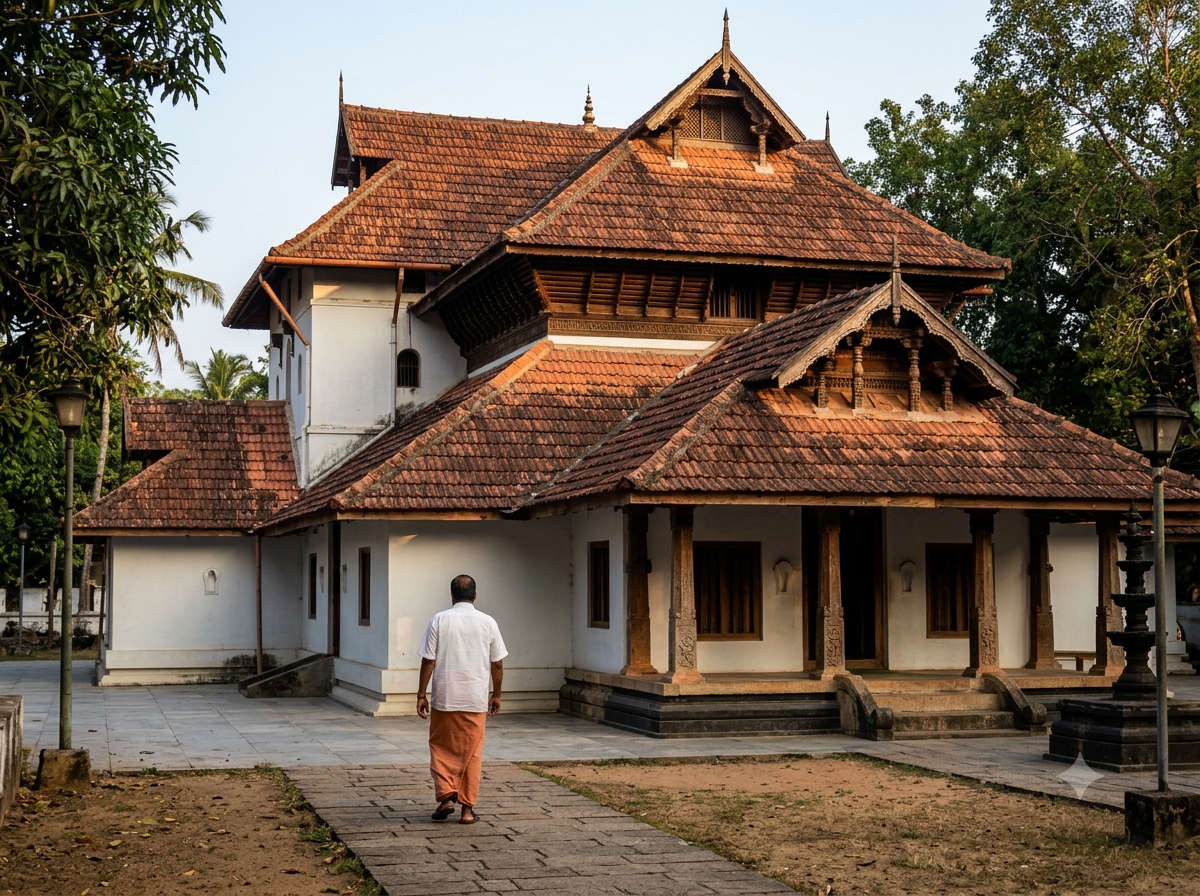
Two thousand years ago, Muziris near present-day Kodungallur was one of the busiest ports on the Indian Ocean, sending black pepper to Rome. A 2nd-century papyrus, the “Muziris papyrus” in Vienna, records a single cargo worth enough to buy a large estate in Egypt. Excavations at Pattanam, begun in 2007, have turned up Roman amphora shards and glass. That is the strongest evidence yet for where the port stood. Pepper was valuable enough to earn the name “black gold”.
By tradition, St Thomas the Apostle landed at Muziris in 52 CE and founded seven churches along the Kerala coast. Kerala’s Syrian Christians, the Saint Thomas Christians, trace their origin to him. About 18% of Keralites are Christian, compared with about 2.3% of Indians (Census 2011). The shrine at Azhikode, near Kodungallur, marks the traditional landing point.
Cheraman Juma Masjid at Kodungallur is widely held to be the oldest mosque in India, founded by tradition in 629 CE. The traditional account credits the Arab merchant Malik Deenar, and says the mosque was built in the lifetime of the Prophet Muhammad. Its old core has a Kerala temple-style roof and a brass oil lamp said to have burned for more than a thousand years. Recent restoration work has taken away later concrete additions to expose the original structure. Our list of mosques in Kerala has visiting details.
The Paradesi Synagogue in Mattancherry, built in 1568, is the oldest active synagogue in the Commonwealth of Nations. You will often see it misdated to 1567. The floor is laid with hand-painted blue-and-white Chinese tiles brought from Canton in the 18th century, and no two are the same. Only a handful of Paradesi Jews still live in Kochi. The street outside is still called Jew Town. See our Paradesi Synagogue guide for opening hours.
Vasco da Gama reached Kappad beach near Kozhikode (Calicut) on 20 May 1498, opening the sea route from Europe to India. He returned in 1524 as Portuguese viceroy and died in Kochi on 24 December that year. He was first buried in St Francis Church, Fort Kochi, the oldest European-built church in India. His remains went back to Portugal in 1539, but the gravestone is still on the church floor.
Sree Padmanabhaswamy Temple in Thiruvananthapuram is widely described as the richest temple in the world. In 2011 a Supreme Court-ordered inventory of its underground vaults found gold, jewels and coins reported to be worth more than ₹1 lakh crore. One vault, Kallara B, has still not been opened. Entry is for Hindus only, with a strict dress code: a mundu for men and a sari or long skirt for women. Details are in our Padmanabhaswamy Temple guide and our list of famous temples in Kerala.
In 1957 Kerala elected a communist government led by E.M.S. Namboodiripad, sworn in on 5 April. It was one of the first communist governments anywhere to come to power through a general election. In its first two years it passed the Kerala Education Bill and began land reforms that gave tenants rights to the land they farmed. The Centre dismissed it in 1959 under President’s Rule. The land reforms carried on under later governments, and historians link them to Kerala’s low poverty today.
Several Kerala communities, most notably the Nairs, followed marumakkathayam, a matrilineal system in which property and family name passed through the female line. A household (*tharavad*) was run by the eldest man on behalf of his sisters’ children, not his own. A series of laws from the 1930s onward, ending with the Kerala Joint Hindu Family System (Abolition) Act of 1975, dismantled it. Its influence still shows in how comfortable Kerala is with women owning property.
| Year | First or record | Where |
| 1859 | India’s first coir factory | Alappuzha |
| 2015 | World’s first fully solar-powered airport | Kochi (CIAL) |
| 2016 | India’s first “digital state” | Statewide |
| 2017 | Internet access declared a basic right | Statewide |
| 2025 | India’s first deep-water container transshipment port | Vizhinjam |
| 2025 | First state declared free of extreme poverty | Statewide |
| 2026 | Renamed Keralam in all languages | Statewide |
The spices that brought Arabs, Romans, Chinese, Portuguese, Dutch and British traders to this coast are still Kerala’s calling card. Kerala grows most of India’s small cardamom, the bulk of it in Idukki’s hills around Kumily and Vandanmedu (Spices Board). Pepper tells a different story. Kerala was India’s pepper bowl for 2,000 years, but Karnataka now grows more. Kochi’s Mattancherry still has working spice warehouses and pepper traders. Plantation walks in Thekkady show you pepper vines on silver-oak trees.
Kerala grows roughly three-quarters of India’s natural rubber. Rubber Board data puts its share at 74.9% in 2019-20. That is well below the “90%” still repeated online, because planting has grown in Tripura and the rest of the North-East. The old claim that rubber covers “5.45 hectares” of the state was a typo. The real area is several lakh hectares, mostly in Kottayam, Pathanamthitta and Ernakulam. Kottayam is also home to the Rubber Board itself.
The first coir factory in India was set up in Alappuzha in 1859 by the Irish-born James Darragh. It turned coconut husk fibre into mats and rope for export. Coir still employs lakhs of people along the backwater belt, most of them women. The Coir Board and the National Coir Research and Management Institute are both based in Kerala. In Alappuzha, the smell of retting husks soaking in the canals still hangs over some villages.
President Pranab Mukherjee declared Kerala India’s first digital state in 2016, citing near-total mobile coverage and high e-literacy. In 2017 Kerala became the first state to call internet access a basic right, and its budget set aside money for free or cheap connections for 20 lakh poor families. That promise became K-FON, the state’s own fibre network. In 2019 the Kerala High Court went further and held that internet access is part of the right to education and privacy.
On 18 August 2015 Cochin International Airport (CIAL) became the first airport in the world to run entirely on solar power. It generates more electricity than it uses from panels spread across its land. Some of those rows have vegetables growing between them. In 2018 CIAL won the UN Environment Programme’s Champions of the Earth award. It was also India’s first airport built under a public-private partnership model, with thousands of small shareholders, many of them non-resident Keralites.
Kerala has four international airports: Thiruvananthapuram, Kochi, Kozhikode and Kannur. That is a lot for a state of its size. The main reason is the Gulf. About 22 lakh Keralites live abroad, most of them in the Gulf (Kerala Migration Survey 2023), and their remittances have long been a pillar of the state economy. Kannur, opened in December 2018, is the newest. Our guide to airports in Kerala lists routes and codes, and how to reach Kerala compares air, rail and road.
Vizhinjam International Seaport near Thiruvananthapuram, opened on 2 May 2025, is India’s first deep-water container transshipment port. It sits about 10 nautical miles from the main east-west shipping lane and has a natural depth of about 20 m close to shore. That is deep enough for the world’s largest container ships. In June 2025 the MSC Irina, one of the largest container ships in the world, called there on its first visit to South Asia. The port should cut India’s reliance on Colombo and Singapore for transshipment.
| Symbol | Kerala’s choice |
| State animal | Indian elephant |
| State bird | Great hornbill |
| State flower | Kanikonna (golden shower, *Cassia fistula*) |
| State tree | Coconut palm |
| State fish | Karimeen (pearl spot) |
| State fruit | Jackfruit (since 2018) |
| State butterfly | Malabar banded peacock |
Kerala runs Ayurveda as a mainstream health system, with its own government department, Ayurveda hospitals in every district and a dispensary network that reaches most panchayats. Its Ashtavaidya physician families kept classical texts alive for centuries. Kerala-style treatments such as *pizhichil* (oil bath) and *njavarakizhi* (rice-bolus massage) are now taught worldwide. Kalaripayattu, the martial art often called one of the oldest still practised, shares Ayurveda’s map of *marma* (vital) points. Its fighters train in sunken earthen halls called kalari. For a stay built around treatment, see our Ayurveda resorts in Kerala.
Koodiyattam, a Sanskrit theatre form performed in temple theatres (koothambalam), was among the first 19 “Masterpieces of the Oral and Intangible Heritage of Humanity” UNESCO proclaimed in 2001. It may be the oldest living theatre tradition in the world, and a single play can run over many nights. Its better-known descendant, Kathakali, uses make-up so elaborate that performers lie still for three to four hours while the green *pacha* face and the white paper-and-rice-paste *chutti* border are built up.
In Theyyam, the ritual form of North Malabar, the performer is believed to become the deity for the length of the performance, and devotees ask him for blessings directly. There are more than 400 theyyams. The season runs from roughly November to May in Kannur and Kasaragod districts. Performers usually come from communities that were once ranked low in the caste order. For those hours, upper-caste devotees bow to them. Our festivals in Kerala guide lists the big kavu (shrine) dates.
A chundan vallam (snake boat) can be over 100 feet long and carry more than 100 rowers and singers. The biggest race is the Nehru Trophy on Punnamada Lake in Alappuzha, held on the second Saturday of August. It began after Jawaharlal Nehru visited in 1952. The races peak around Onam, the harvest festival, whose *sadya* is a vegetarian feast of about 26 dishes served in a fixed order on a banana leaf. See our guides to Kerala boat races, the Onam festival and Kerala cuisine.
Written in English, “MALAYALAM” reads the same backwards and forwards. Try it: M-A-L-A-Y-A-L-A-M. The Government of India declared Malayalam a classical language in 2013. It became the fifth Indian language to get that status. Its script has more than 50 letters, and the 16th-century poet Thunchaththu Ezhuthachan is honoured as the father of modern Malayalam. Our Hindi guide to Kerala mein ghumne ki jagah is for readers who prefer Hindi.
Kodinhi in Malappuram district has more than 400 pairs of twins among about 2,000 families. That is a rate of about 45 twin births per 1,000, against a national average of about 9. Researchers have tested the water and studied the families’ genetics, but no explanation has held up. Residents set up an association of twins and kin in 2008. The sign at the village entrance welcomes visitors to “God’s Own Twin Town”.
The Jatayu sculpture at Jatayu Earth’s Center in Chadayamangalam, Kollam, is the largest bird sculpture in the world. It measures 200 ft long, 150 ft wide and 70 ft high. Film-maker and sculptor Rajiv Anchal spent about a decade building it on a rock where, in the Ramayana, the bird Jatayu fell after fighting Ravana. A cable car takes visitors up the hill, and you can walk inside the sculpture.
Muzhappilangad in Kannur is Kerala’s only drive-in beach and is often called the longest in Asia. About 4 km of firm, packed sand is open to cars and bikes. Offshore rocks keep the big waves away, so the sand stays firm. Driving is allowed along a marked stretch in daylight. Dharmadam Island, a short way offshore, can be reached on foot at low tide. More coastal picks are in our list of beaches in Kerala.
**Kochi’s Chinese fishing nets (*cheena vala*) are shore-operated lift nets, each worked by a team of about six. Traders from the court of Kublai Khan or the fleets of Zheng He are believed to have brought them in the 13th or 14th century.** A net can be 20 m across, balanced by rocks tied to ropes, and it is lowered and raised by hand every few minutes at high tide. The fishermen will usually let visitors help haul for a small tip.
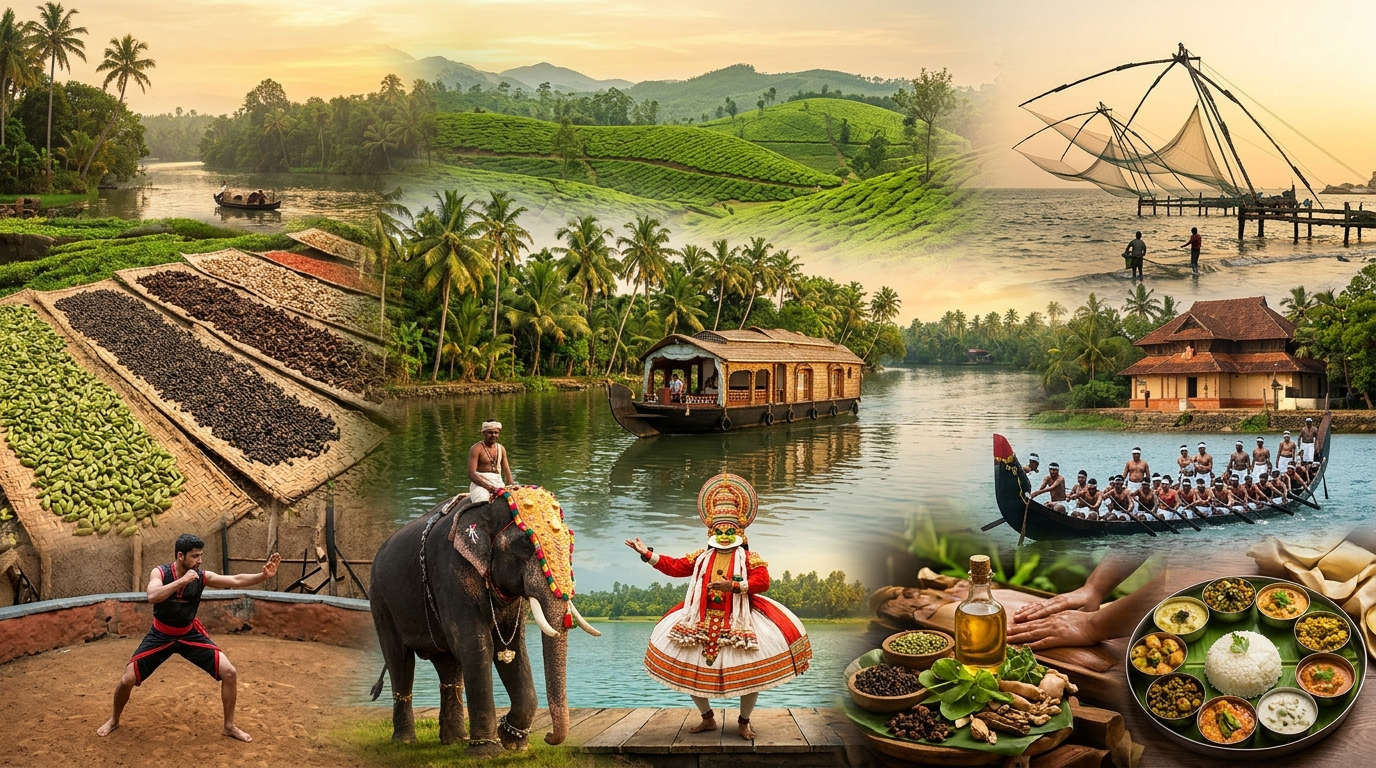
Kerala is famous for its backwaters and houseboats, Ayurveda, spices, Munnar’s tea estates, Kathakali and Theyyam, Onam and its snake-boat races, beaches such as Varkala and Kovalam, and a coconut-based cuisine of appam and stew, sadya and karimeen pollichathu. What visitors notice after a few days is how the numbers above show up in daily life. Newspapers get read at every tea shop. Women run shops and panchayats. There is a church, a mosque and a temple on the same stretch of road.
If you want a trip rather than a fact file, our pages on places to visit in Kerala and the best time to visit Kerala cover planning in depth.
Some “facts” about Kerala get copied from site to site without anyone checking them. Here is where the popular claims stand.
| Popular claim | What the record shows |
| “Kerala literally means land of coconuts.” | That is one of two theories. Many historians prefer *Cheralam*, land of the Cheras. |
| “Kerala is India’s cleanest state.” | There is no official state-level “cleanest” ranking. Swachh Survekshan ranks cities, and the claim usually cited has no traceable NSSO report behind it. Kerala does lead on sanitation-related health outcomes. |
| “Kerala produces 90% of India’s rubber.” | Its share has fallen to about three-quarters (74.9% in 2019-20, Rubber Board) as the North-East planted more. |
| “Kerala is still the official name.” | The official name has been Keralam since 25 August 2026. |
| “The Paradesi Synagogue was built in 1567.” | The synagogue itself gives the date as 1568. |
| “Kerala is India’s least corrupt state.” | This comes from a 2017 perception survey, not an official index. Treat it as an opinion poll. |
Every statistic above comes from these records. Figures were checked on 28 September 2026.
Kerala’s reputation rests on numbers most states can’t match: 93.91% literacy, an infant mortality rate of 5 and poverty below 1%. The name on the map changed too, to Keralam, in August 2026. If these facts have you wondering what the place is like in person, our Kerala tour packages pair the backwaters, Munnar and Fort Kochi in trips you can shape around your own dates.
Quick answers on the Keralam name change, literacy, districts, language, formation and more
Yes. Kerala's official name has been Keralam since 25 August 2026, when the Ministry of Home Affairs notified the Kerala (Alteration of Name) Act, 2026. Parliament passed the bill on 11 and 12 August, and President Droupadi Murmu gave her assent on 14 August. The new name applies in every language, including English and Hindi. "Kerala" is still widely used in everyday speech.
"God's Own Country" is the tagline Kerala Tourism adopted in 1989, written by adman Walter Mendez. It grew into one of India's best-known travel brands. It draws on the legend of Parashurama, who threw his axe into the sea and made the water draw back to create the land. The state's mix of backwaters, hills, beaches and green farmland made the line easy to believe.
Kerala is famous for its backwaters and houseboats, Ayurveda, spices such as pepper and cardamom, Munnar's tea gardens and Kathakali. Other big draws are Theyyam, Onam, snake-boat races and beaches like Varkala and Kovalam. It is also known for India's highest literacy rate (93.91%), the highest sex ratio (1,084) and the lowest infant mortality among large states (5 per 1,000).
Kerala's literacy rate is 93.91% according to the Census of India 2011, the highest of any state. The national figure was 74.04%. Male literacy was 96.11% and female literacy 92.07%. Kottayam became India's first fully literate town in 1989, and Kerala was declared India's first totally literate state on 18 April 1991.
Kerala has 14 districts. From south to north they are Thiruvananthapuram, Kollam, Pathanamthitta, Alappuzha, Kottayam, Idukki, Ernakulam, Thrissur, Palakkad, Malappuram, Kozhikode, Wayanad, Kannur and Kasaragod. Palakkad is the largest by area, Malappuram the most populous (Census 2011) and Alappuzha the smallest
Thiruvananthapuram, formerly Trivandrum, is the capital of Kerala. It was also the capital of the old princely state of Travancore. The city is home to the Legislative Assembly, the Secretariat, Sree Padmanabhaswamy Temple and one of the state's four international airports. Kochi is the main commercial city, and the High Court sits in Ernakulam.
Before 1956 the region was split into Travancore, Cochin and Malabar. Travancore and Cochin had merged into Travancore-Cochin in 1949. Ancient texts call the coast Keralaputra (in Ashoka's edicts) or Chera land, and Arab and European traders knew it as Malabar. In Malayalam the state has always been Keralam, which became the official name in all languages on 25 August 2026.
Malayalam is the official language and is spoken by about 97% of the population. The Government of India gave it classical language status in 2013. English is widely understood, especially in cities and tourist areas. Tamil is spoken near the Tamil Nadu border and in Idukki, and Tulu and Kannada are spoken in Kasaragod.
Kerala was formed on 1 November 1956 under the States Reorganisation Act. It combined Travancore-Cochin with the Malabar district of Madras State and the Kasaragod taluk. The day is celebrated every year as Kerala Piravi. In 2025 the state used Kerala Piravi to declare itself free of extreme poverty.
1) Kerala's official name is Keralam since August 2026. 2) Its state animal is the elephant and its state bird is the great hornbill. 3) It has 44 rivers and India's longest lake, Vembanad. 4) The monsoon rains reach Kerala first, around 1 June. 5) "Malayalam", its language, reads the same backwards and forwards in English.
The Periyar is Kerala's longest river at 244 km. It rises in the Western Ghats in Idukki district and reaches the Arabian Sea near Kochi. It feeds the Idukki and Mullaperiyar dams, supplies drinking water to Kochi, and is often called the "lifeline of Kerala". The Bharathappuzha (209 km) and the Pamba (176 km) are the next longest.
Real reviews from real travelers who booked with us.
View All Reviews