4D / 3N
17% OFF
4D / 3N
17% OFF
Manali-Kasol Tour Package by Cab for Himachal (4D/3N) - At A Glance
- Hotel
- Meals
- Sightseeing
- Entry Tickets
- Cab Transfer
₹12,688
₹10,500 /pp


Spiti in winter is one of the coldest places you can legally drive to in India. Between December and February, daytime highs in Kaza sit between -1C and -15C and the nights fall to -25C, touching -30C at the turn of January. Only one road stays open, the long Shimla-Kinnaur route, because the shorter Manali approach shuts the moment Kunzum La fills with snow. What you get in return is a white desert almost to yourself: frozen waterfalls, monasteries with no queue, clear black skies full of stars, and the best odds anywhere of seeing a wild snow leopard. This guide gives you the month-by-month temperatures, the honest best time to go, the road status, and exactly what there is to do.
Key takeaways
Spiti in Winter
Best Time
March - June
Select Package Type

3 Days & 2 Nights
₹9,043 /@pp
GET FREE QUOTE

.jpg?tr=w-600,h-300)

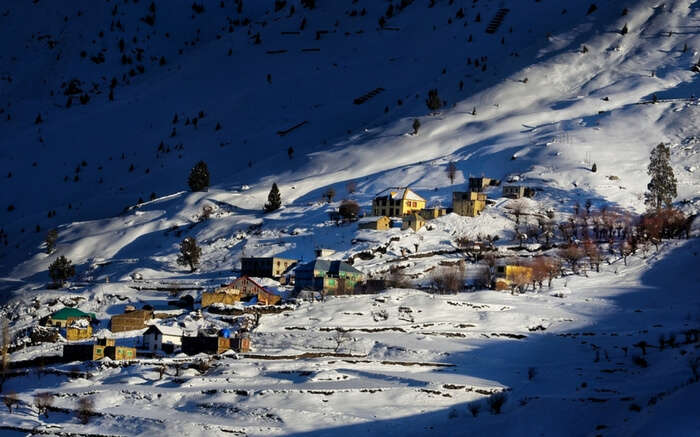
Spiti is a high, cold desert even in summer. In winter it becomes something starker. The Spiti river freezes in long silver sheets, the fields above Langza and Komic disappear under a metre of snow, and the whole valley empties of the crowds that fill it from June to September. Ki Monastery and Dhankar, which look handsome enough in summer, sit over a white valley in winter with woodsmoke rising and almost nobody around.
It is not a soft trip. Above 3,600 metres the air is thin, the cold is constant, and services thin out to a handful of homestays running on solar power and bukhari wood stoves. The people who come in winter come for exactly that: silence, snow, and a version of Spiti that most travellers never see. If your idea of a good trip includes a heated hotel and reliable Wi-Fi, this is not your season. If it includes stepping onto a frozen river at dawn with no one else in sight, it very much is.
Here is what the mercury actually does across the winter, measured around Kaza (about 3,650 metres), the valley headquarters. Villages higher up, like Kibber, Komic and Hikkim, run a few degrees colder still. Figures are day highs and night lows; treat them as the normal range, because a clear day can feel almost warm in direct sun while the next night drops far below these numbers.
| Month | Day high | Night low | Snowfall | Road access to Kaza |
| October | 10C to 14C | 0C to -5C | First light snow late in the month | Both routes usually open early Oct |
| November | 0C to 5C | -12C to -18C | First heavy snow | Manali route shuts; Shimla route open |
| December | -1C to -8C | -20C to -30C | Heavy | Shimla-Kinnaur route only |
| January | -10C to -17C | -25C to -30C (coldest) | Heavy | Shimla-Kinnaur route only |
| February | -8C to -15C | -20C to -25C | Heavy, easing late | Shimla-Kinnaur route only |
| Early March | -2C to 6C | -14C to -20C | Easing | Shimla-Kinnaur route only |
Two things stand out. First, the day-night swing is huge, often 20 degrees or more, so you dress for two climates in one day. Second, the old idea that Spiti winters average 8C by day is only true at the October shoulder; through the true winter, even the daytime high stays below freezing. The lowest readings, around -30C, come at the end of December and through January. Figures compiled from Kaza weather records and winter operators (Thrillophilia and Holidify weather guides, cross-checked against weather-and-climate.com).
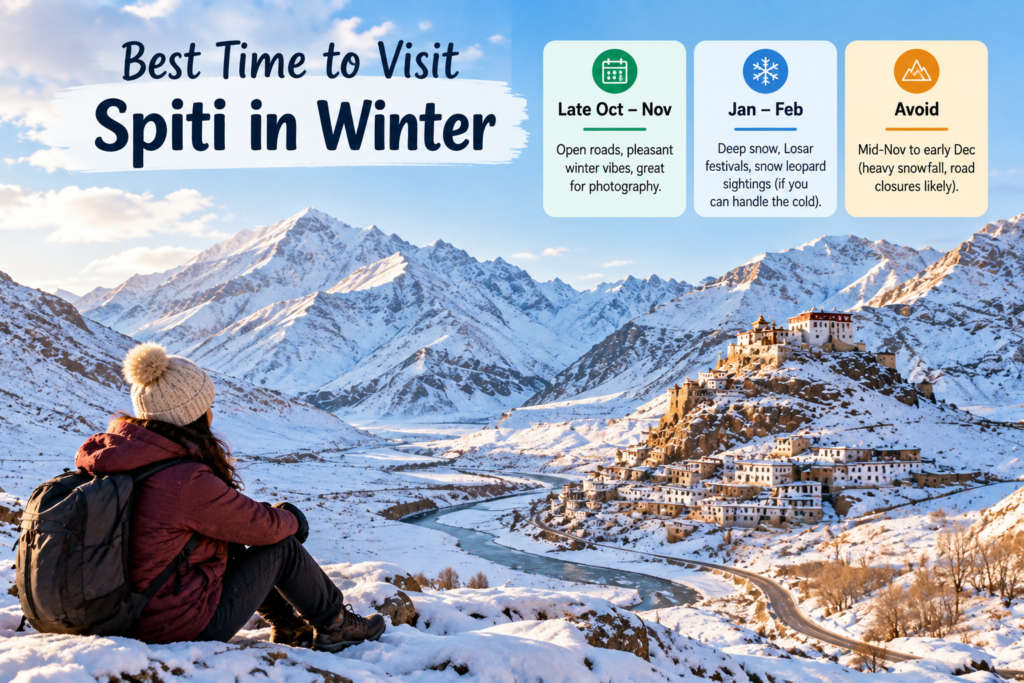
There is no single best time. There are two different winters, and they suit different travellers.
Late October to November: the soft entry
This is the easiest way to taste a Spiti winter. Nights are cold but not brutal, the first snow dusts the peaks without burying the road, and both approach routes may still be open early in October before Kunzum La shuts. You get the low light, the empty valley and the frozen edges of the river without committing to -30C. If it is your first winter visit, come now.
January to February: the deep freeze
This is Spiti at its hardest and, for some, its finest. The valley is fully snowbound, the river freezes solid enough to walk in places, Losar brings the monasteries to life, and February is peak season for snow-leopard expeditions above Kibber because the cats drop to lower slopes to hunt. You pay for it in cold, in longer road days, and in genuinely basic living conditions. Only come now if you are fit, properly kitted, and travelling with people who know the winter valley.
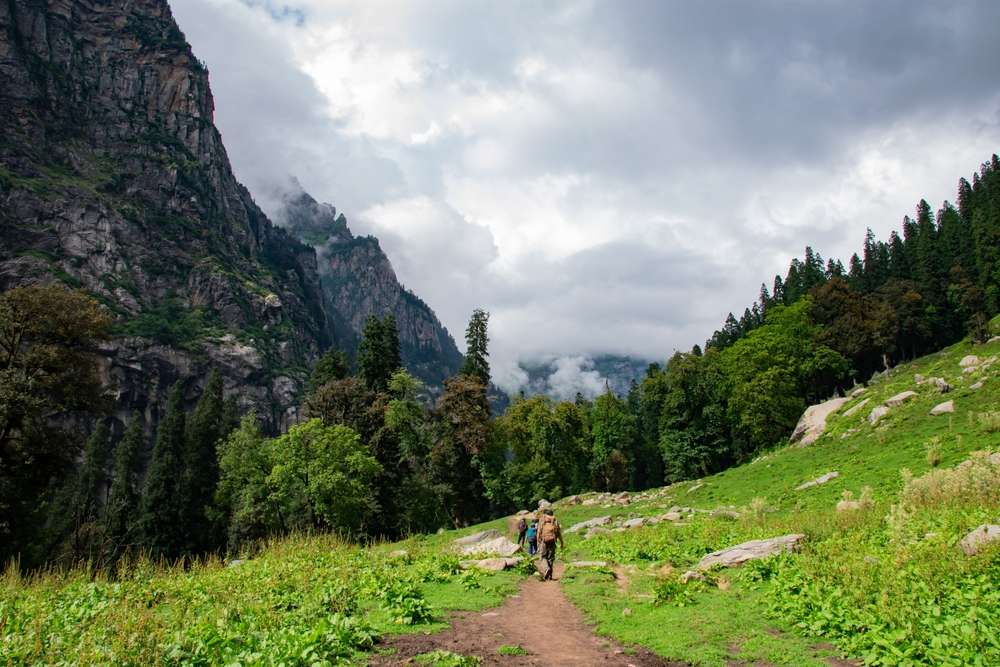
Yes, but only one of the two roads. This is the single most misunderstood thing about winter Spiti, so it is worth being exact.
The Shimla-Kinnaur road (NH-5) stays open all year. It follows the Sutlej and Spiti rivers through Kinnaur and has no high pass that seals shut, so with care it reaches Kaza right through winter. Expect ice, single-lane stretches and slow going, and expect the odd temporary closure after fresh snow near Pooh or Nako that clears in a day or two.
The Manali road closes for the winter. The Atal Tunnel (open since October 2020) lets you skip Rohtang Pass year-round, but the road beyond Gramphu still climbs to Kunzum La at 4,551 metres, and Kunzum shuts under snow. It closes by early November and reopens only in late May or June, per Himachal road-status reporting (The Tribune). Through the winter, Spiti is cut off from Manali and everyone uses the Shimla side.
So a winter trip means driving in from Shimla and, usually, out the same way. Here is how the two routes compare in winter.
| Route | Winter status | Approx distance to Kaza | Typical winter drive | Notes |
| Shimla to Kinnaur to Kaza (NH-5) | Open all year | About 412 km from Shimla | 2 days with a Kalpa or Nako night halt | The only reliable winter road; icy but no sealed pass |
| Manali to Atal Tunnel to Kunzum to Kaza | Closed early Nov to late May/June | About 200 km from Manali | Not passable in winter | Kunzum La snowbound; do not attempt |
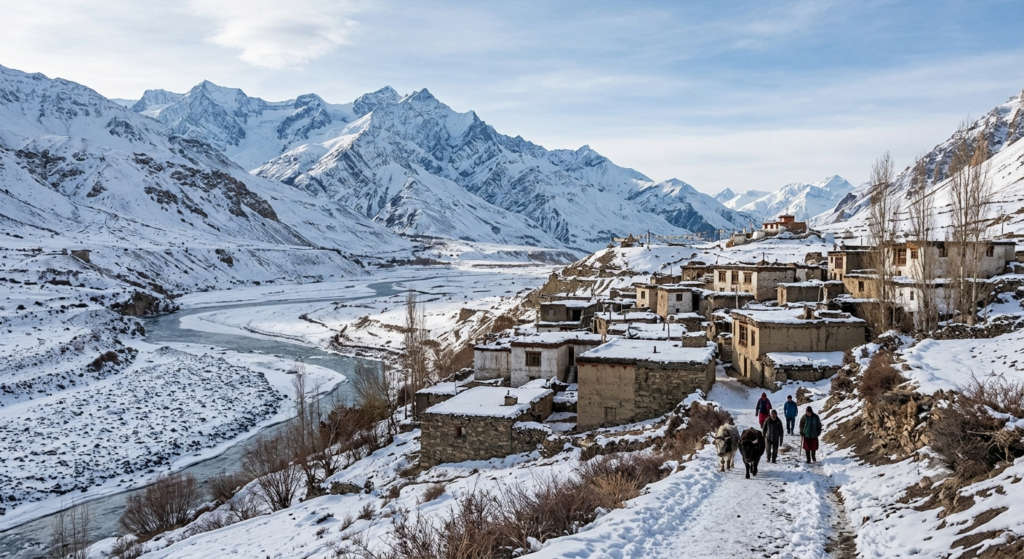
A winter route usually runs Shimla to Kalpa to Nako to Tabo to Kaza, then day trips out to the high villages when the weather allows. These are the places worth the cold.
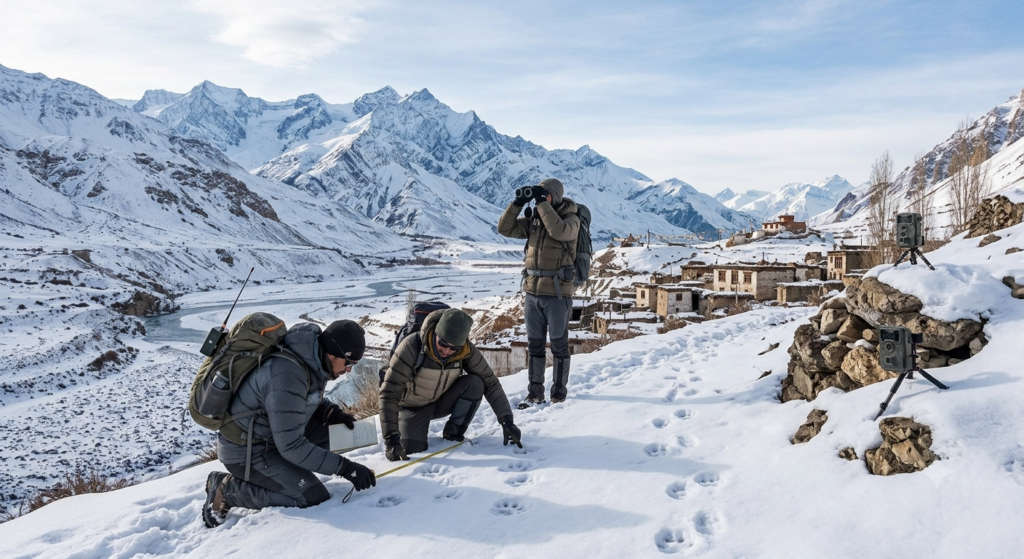
Winter cuts the activity list down, but what remains is rarer than anything the summer offers.
Track a snow leopard
Spiti, and the slopes above Kibber in particular, is one of the most reliable places on Earth to see a wild snow leopard. Through January and February the cats move to lower ground to hunt blue sheep and ibex, and dedicated expeditions with local spotters and scopes run right through the season. It takes patience and several cold mornings, but the sighting rate here is genuinely high. Book a guided expedition rather than trying it alone.
Watch Losar come to the monasteries
Losar, the Tibetan New Year, is marked across Spiti in the depth of winter with prayers, masked gatherings and family feasts at Ki, Dhankar and Tabo. It is the one time the frozen valley fills with colour and sound, and it is a rare thing to witness with almost no other outsiders present.
Stand on a frozen waterfall and under a full sky
The valley waterfalls freeze into blue-white columns that draw ice-climbers, and because Spiti has almost no light pollution or cloud in winter, the night sky is as clear as it gets in India. On a moonless night the Milky Way is plainly visible with the naked eye above Langza.
Live a Spiti homestay winter
With the crowds gone, winter is when a homestay becomes the real thing: shared meals around a bukhari stove, thukpa and butter tea, and long evenings of conversation because there is no signal and little power. Several travellers rate this the highlight of the whole trip.
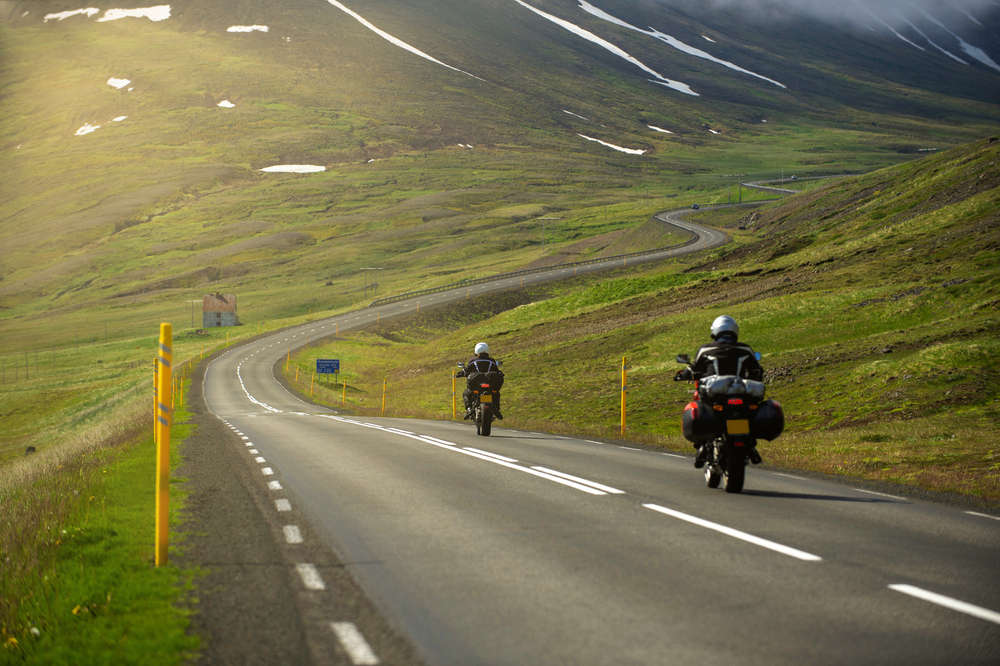
Every winter arrival is via the Shimla side. Here is the sequence that works.
You can self-drive only with a capable vehicle, snow chains, and real high-altitude winter experience. For everyone else, a hired driver who knows the winter road or a booked winter package is the safer call. See our detailed guide on how to reach Spiti for the full route breakdown.
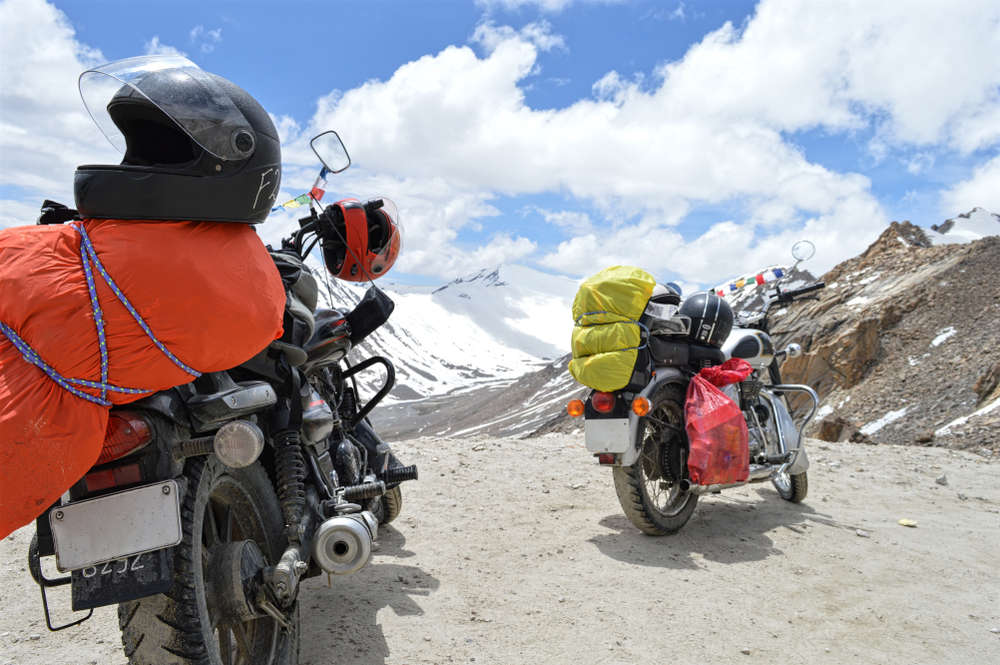
At -30C, packing is a safety matter, not a comfort one. Build your kit in layers and do not cut corners on the extremities.
Pack
Precautions
Winter Spiti rewards planning more than any other Himalayan trip. Because so much hinges on the road, the weather and acclimatisation, most travellers go with a fixed winter itinerary rather than improvising. You can browse and customise Spiti winter tour packages that already build in the Shimla-Kinnaur route, altitude-friendly halts and warm homestays. For the wider region, our Himachal tour packages and the Himachal travel guide cover the surrounding hill circuits, and if you would rather see Spiti when the passes are open, read our guides to Spiti Valley in June and the classic 8-day Spiti Valley trip.
Spiti in winter asks a lot: a long icy road in, sub-zero days, thin air and few comforts. What it gives back is a valley almost nobody else sees, a real chance at a snow leopard, and skies and silence you will not find in the summer season. Come in November for the gentle version or in January for the hard one, plan the road and the altitude with care, and it will be one of the great trips of your life.
Yes. Spiti is reachable all winter via the Shimla-Kinnaur road (NH-5), which has no high pass that seals shut. The Manali route is closed because Kunzum La is snowbound from early November to late May or June. So you drive in from the Shimla side, expect ice and slow going, and plan for basic services once you are there.
Yes, December is open via the Shimla-Kinnaur road, and it is a fine time for snow and empty monasteries. Days run about -1C to -8C and nights fall to -20C or lower. Homestays operate on limited power and water, roads can close for a day after fresh snow, and you should carry cash and warm kit. Go prepared and it is a rewarding month.
Yes, but January is the hardest month. The Shimla-Kinnaur road stays open, yet nights drop to -25C or -30C and days often stay below -10C. Only fit, well-equipped travellers with local support should attempt it. The payoff is deep snow, a frozen river, Losar celebrations and the best snow-leopard odds of the year around Kibber.
Across December to February, daytime highs in Kaza range from about -1C down to -15C, and nights fall to -25C, touching -30C at the coldest. October is milder, with days around 10C to 14C, and early March starts to thaw. Higher villages like Kibber and Komic run a few degrees colder than Kaza throughout.
The mercury drops to around -30C at its lowest, typically at the end of December and through January. These readings come at night and in the higher villages; daytime in the sun feels warmer, but the true daytime high still stays below freezing in the deep winter months.
January is the coldest month in Spiti. Daytime highs often stay between -10C and -17C and nights sink to -25C or -30C, with heavy snow and the most difficult road conditions. February is only slightly warmer, while December sits just above January in severity.
For a first winter visit, late October to November is best: cold but manageable, with open roads and early snow. For deep snow, Losar and snow-leopard expeditions, come in January or February, but only if you are fit and properly equipped. There is no single best time, just two very different winters.
Only via the Shimla-Kinnaur road. Reach Shimla or Chandigarh by air or train, then drive over two days through Kinnaur with halts at Kalpa or Reckong Peo and at Nako or Tabo, arriving in Kaza on the third day. The Manali-Atal Tunnel route is closed in winter because Kunzum La is shut.
Yes, and winter is the season for it. Through January and February, snow leopards move to lower slopes above Kibber to hunt, and Spiti has one of the highest sighting rates anywhere. Dedicated expeditions with local spotters and scopes run all season. It takes patience over several cold mornings, so book a guided expedition rather than looking alone.
They are broadly similar, both dropping to around -25C to -30C at night in deep winter. Leh in Ladakh often sits slightly colder on the coldest nights, but Spiti feels just as harsh because its winter services are more basic and its one open road is longer. In practice, both demand the same level of preparation.
Real reviews from real travelers who booked with us.
View All Reviews