
- 1800-123-5555
- Travel Agent? Join Us
- Blog
- Offers










Angkor Wat, Siem Reap: Ticket Price, Timings, Sunrise and Visitor Guide
Visit the Temple Of the Behemoths and be mesmerized with its beauty
Rated 4.60/5 ( based on 264 reviews )
About Angkor Wat in Siem Reap
Angkor Wat is a 12th-century temple built by the Khmer king Suryavarman II for the Hindu god Vishnu, and today the largest religious monument in the world. It stands in Angkor Archaeological Park, 6 km north of Siem Reap and 15 to 20 minutes away by tuk-tuk. It opens at 5:00 am for sunrise and closes at 5:30 pm. Entry is on the Angkor Pass (USD 37 for one day, about Rs 3,500), and you need 3 to 4 hours to see it properly.
Earlier Khmer kings had built their state temples for Shiva, so giving this one to Vishnu was a break with tradition. It is the high point of classical Khmer architecture and the building on the Cambodian flag, and no other Khmer king's state temple comes close to its size. From the late 12th century it slowly became Buddhist. Theravada monks and local families still worship here today, among walls carved with Hindu myths and Buddha images added over the centuries since.
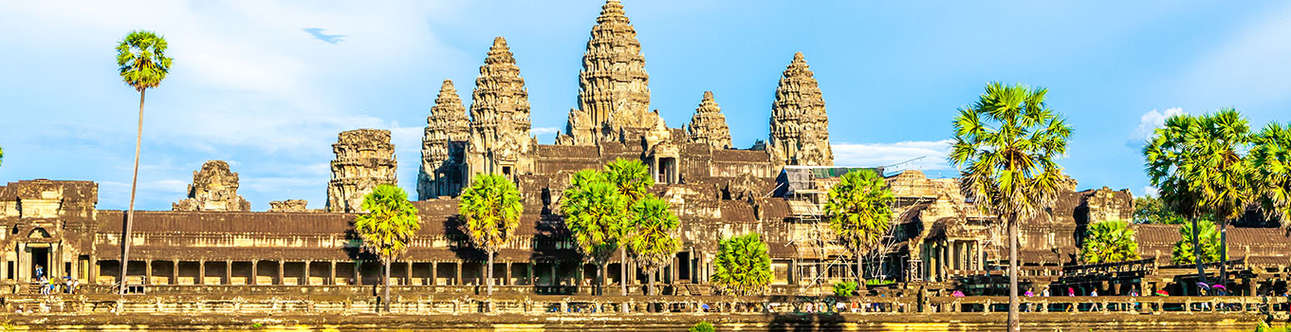
The temple is a model of Mount Meru, the home of the gods in Hindu mythology, with a quincunx of five towers at its centre. Like other Khmer state temples it is ringed by a moat, here 190 m wide and more than 5 km around. It is the symbol of Cambodia, and the millions who visit each year keep Siem Reap's economy running. Most come for its sunrise, when the five towers turn black against a pink sky and their reflection sits in the pool in front.
Angkor Wat at a glance
| Detail | Information |
|---|---|
| Where | Angkor Archaeological Park, 6 km north of Siem Reap town |
| Getting there | 15 to 20 minutes by tuk-tuk or car from town |
| Opening hours | 5:00 am to 5:30 pm, every day (park gates close 6:30 pm) |
| Ticket | Angkor Pass: USD 37 for 1 day (about Rs 3,500), USD 62 for 3 days, USD 72 for 7 days. No separate Angkor Wat ticket |
| Time needed | 3 to 4 hours. Add an hour if you come for sunrise |
| Best time of day | 5:00 am for sunrise, or after 2:30 pm when the west face is lit |
| Best months | November to February (dry and cooler) |
| Built | 1122 to 1150 CE, by King Suryavarman II |
| Dedicated to | Vishnu. Buddhist since the late 12th century, Theravada today |
| Size | 162.6 hectares (402 acres). Central tower 65 m high |
| Faces | West, unlike most Khmer temples |
| UNESCO | Part of the Angkor World Heritage Site, inscribed 1992 |
| Dress | Shoulders and knees covered. Stricter on the top level (Bakan) |
| Nearest airport | Siem Reap Angkor International Airport (SAI), about an hour by road |
Hours checked by our Cambodia desk against the official Angkor Enterprise page for Angkor Wat, and pass prices against the Angkor Enterprise ticket listing, on 2 November 2026. All rupee figures on this page use US$1 = Rs 95 (late October 2026).
Angkor Wat ticket price 2026 (USD and Rupees)
There is no Angkor Wat ticket as such. You enter on the Angkor Pass, which also covers Angkor Thom, the Bayon, Ta Prohm and more than 50 other temples in the park. Since 2024 there are no ticket checks on the roads into the park. The pass is scanned at the temple entrances, so keep it on you at every stop.
| Angkor Pass | Price (USD) | Approx. in Rupees | How long it is valid |
|---|---|---|---|
| 1-day | 37 | Rs 3,500 | The day of use |
| 3-day | 62 | Rs 5,900 | Any 3 days within 7 days |
| 7-day | 72 | Rs 6,850 | Any 7 days within 30 days |
| Children under 12 | Free | Free | Show the child's passport |
Buy the pass only from Angkor Enterprise, the official seller. You can buy at the Angkor Ticket Office on Road 60, about 4 km from the centre of Siem Reap, or on the official website, angkorenterprise.gov.kh (or its Angkor Pass app). Since 2025 there are also official self-service kiosks at the ticket office, the Angkor Parvis complex near Angkor Wat and the Heritage Walk mall in town. The official site says plainly that tickets bought anywhere else are not valid, so a pass offered by a hotel, a tour company or a man at a traffic light can be refused at the gate. If you come by tuk-tuk, the driver stops at the ticket office first.
The 3-day and 7-day passes carry your photo, taken at the counter, so the pass cannot be shared. You can pay in US dollars or by card. The 1-day pass needs no photo. One official rule is worth knowing. Buy a 1-day pass for tomorrow after 4:45 pm and you can enter the park that same evening for sunset, then use the pass for the whole of the next day. Since 2017, USD 2 of every pass has gone to the Kantha Bopha children's hospitals, which treat Cambodian children free of charge.
For most Indian travellers on a 3N/4D Siem Reap trip, the 3-day pass is the better buy. It costs USD 25 (about Rs 2,400) more than a single day and lets you split Angkor Wat into a sunrise visit and a second, unhurried visit for the carvings.
Angkor Wat timings and how long you need
Angkor Wat opens at 5:00 am and closes at 5:30 pm every day, according to the official Angkor Enterprise page for the temple. It opens earlier than most temples in the park so visitors can be in place for sunrise. Some older guides give 7:30 am or 6 pm. Go by the official times.
| What | Hours |
|---|---|
| Angkor Wat | 5:00 am to 5:30 pm, daily |
| Bakan (top level) stairs | About 7:40 am to 5 pm. Closed on Buddhist holy days |
| Angkor Archaeological Park gates | 5:00 am to 6:30 pm |
| Angkor Ticket Office, Road 60 | Opens before dawn, so sunrise visitors can buy on the way. Buy after 4:45 pm to use tomorrow's pass for tonight's sunset |
| Phnom Bakheng (sunset hill) | Climb by 4:00 pm in peak season, visitor numbers on top are capped |
How long you need. Give Angkor Wat 3 to 4 hours. Two hours covers the causeway, the west gate, the main reliefs and a quick look from the second level. Four hours lets you walk all 8 stops below, including the full gallery of carvings and the climb to the Bakan. If you only have one day for all of Angkor, spend the morning here and move on to Angkor Thom by 9:30 am. To tour every building in the wider park takes several days, which is why the 3-day pass exists.
What to see inside Angkor Wat: an 8-stop route
Angkor Wat is huge, and most first-timers see the pool, take the sunrise photo and leave. The route below starts at the main west entrance and ends at the quieter east gate. It follows the order in which the temple was meant to be approached, from the outer world to the god at the centre. Allow about 3.5 hours at an easy pace.
| Stop | What you see | Time to spend |
|---|---|---|
| 1. Western causeway and moat | 190 m moat, the grand stone causeway | 15 min |
| 2. West gopura and Ta Reach | Entrance tower, the eight-armed Vishnu statue | 15 min |
| 3. Inner causeway, libraries and pools | 350 m naga causeway, the sunrise pool | 20 min (60 at sunrise) |
| 4. Bas-relief galleries | Mahabharata, Ramayana, Samudra Manthan | 60 to 75 min |
| 5. Preah Poan cruciform cloister | Hall of a Thousand Buddhas, four dry pools | 15 min |
| 6. Second level | Apsaras and devatas on every wall | 15 min |
| 7. The Bakan | Steep stairs, central tower, views | 30 min |
| 8. East gate exit | Earthen causeway, quiet forest path | 15 min |
1. The western causeway and the moat
Everything at Angkor Wat is on a scale that takes a minute to register. The moat is 190 m wide and more than 5 km around, lined with sandstone blocks. A broad stone causeway, its railings carved as serpents, carries you across it from the west. The outer wall beyond measures 1,024 m by 802 m. Walk slowly and look left and right along the water. Families from Siem Reap picnic on its banks on Sundays.
2. The west gopura and Ta Reach
The west gopura (entrance tower) is the grandest gateway at Angkor, and most people rush through it in the dark. Come back in daylight. In its southern wing stands a tall eight-armed statue of Vishnu, known locally as Ta Reach. It may once have stood in the central shrine, and it is still worshipped today, wrapped in saffron cloth with incense burning at its feet. Indian visitors often find this the most moving spot in the temple. Here is a Vishnu image that people still pray to, 900 years after the temple was built for him. Look also for the "elephant gates" at both ends of the gopura, built wide enough for elephants and carts.
3. The inner causeway, the libraries and the sunrise pools
From the gopura, a 350 m causeway with naga balustrades leads to the temple itself. Two small buildings called libraries stand on either side, and in front of each is a pool. The pool on the left (north) is where everyone stands at sunrise to photograph the five towers and their reflection. The pool on the right (south) is often low outside the rainy months. Near the west entrance is the Angkor Parvis complex, with food stalls, coffee, clean toilets and wheelchair and pram hire, and more drink stalls stand north of the north library.
4. The bas-relief galleries
The inner walls of the outer gallery are carved with a series of huge scenes, which the archaeologist Charles Higham called "the greatest known linear arrangement of stone carving". Enter by the western steps and turn right (south), so you walk the gallery anti-clockwise with the carvings on your left. First comes the Battle of Kurukshetra from the Mahabharata. Then the procession of Suryavarman II, the only historical scene, and the 37 heavens and 32 hells. The Samudra Manthan fills the east gallery, with Vishnu's victory over the asuras after it. The north side has Krishna's victory over Bana and a battle of gods and demons, and you finish with the Battle of Lanka from the Ramayana. The next section explains each one for Indian readers. Some of the eastern and northern panels were carved in the 16th century, which is why their style looks rougher.
5. Preah Poan, the cruciform cloister
Behind the western entrance of the gallery is a cloister shaped like a cross, with four sunken pools that once held water. It is known as Preah Poan, the Hall of a Thousand Buddhas, because after Angkor Wat became Buddhist, pilgrims left Buddha images here for centuries. Most have been lost or moved, but a few remain, and the pillars still carry inscriptions left by pilgrims, including a Japanese visitor who celebrated Khmer New Year here in 1632.
6. The second level: apsaras and devatas
From the second level up, the walls are crowded with women. Some 1,796 devatas (celestial women) have been documented at Angkor Wat, most about a metre tall, plus smaller dancing apsaras on the pillars. No two are dressed alike. Look closely at the hairstyles, jewellery and the flowers they hold.
7. The Bakan, the top level
The Bakan is the inner sanctum, a 60 m square platform carrying the five towers, with the central tower rising 65 m above the ground. Wooden stairs with a handrail are fitted over the original stone steps, which are near vertical. The stairs open at about 7:40 am, well after sunrise, close at about 5 pm and stay shut on Buddhist holy days, and guards check dress strictly here. Shoulders and knees must be covered, with no exceptions. Children under 12 are not allowed up, according to the official Angkor Enterprise FAQ. At the top, the stone doorways of the central shrine are carved with standing Buddhas, sealed in when the temple became Buddhist, and the views over the forest to the west causeway are the best in the temple. Allow 30 minutes including the queue, which is shortest before 9 am.
8. The east gate
Leave by the east side. A simple earthen causeway crosses the moat through trees, there are no stalls and no crowds, and on a hot afternoon this is the shadiest walk in the temple. Ask your tuk-tuk driver to wait at the east gate. It saves a 20-minute walk back through the crowds to the west.
Angkor Wat and India: Vishnu, the epics and the ASI
No foreign monument tells Indian stories on a larger scale. Angkor Wat was built as a home for Vishnu, its carvings are drawn from the Mahabharata, the Ramayana and the Puranas, and between 1986 and 1992 the Archaeological Survey of India restored it, at a time when France did not recognise Cambodia's government.
The epics on the walls. These are the panels to find, all in the outer gallery:
| Panel | Where | What to look for |
|---|---|---|
| Battle of Kurukshetra (Mahabharata) | West gallery, south wing | The Kaurava and Pandava armies meeting, Bhishma on his bed of arrows |
| Procession of Suryavarman II | South gallery, west wing | The king who built the temple, holding court and then marching with his army |
| Heavens and hells | South gallery, east wing | Yama on a buffalo judging souls, 37 heavens above, 32 hells below |
| Samudra Manthan (Churning of the Ocean of Milk) | East gallery, south wing | 92 asuras and 88 devas pulling Vasuki, with Vishnu at the centre above his turtle avatar, Kurma |
| Vishnu defeats the asuras | East gallery, north wing | Vishnu on Garuda. A 16th-century addition |
| Krishna and Bana | North gallery, east wing | Krishna on Garuda before a burning city. Also 16th century |
| Battle of Lanka (Ramayana) | West gallery, north wing | Rama and Lakshmana against ten-headed Ravana, Hanuman's monkey army |
The Samudra Manthan panel is the one to give time to. It runs for nearly 50 m, and the scholar Eleanor Mannikka has argued that the number of figures on each side matches the days between the solstices and equinoxes, tying the myth to the solar year. Apsaras, born from the churning in the story, fly above the scene.
India and the restoration. Between 1986 and 1992 the ASI carried out restoration and cleaning across the temple. The work drew criticism later for the chemicals used to clean the stone, and conservation methods have changed since. India's link continues at Ta Prohm, where the ASI has led the restoration for more than two decades and rebuilt the Hall of Dancers, opened in November 2022. See our guide to Ta Prohm, the Tomb Raider temple for that story.
Was Angkor Wat built by a Tamil king? No. It was built by the Khmer king Suryavarman II, whose family ruled from Angkor. The confusion comes from real links. Khmer kings exchanged envoys with the Chola court in South India, Khmer inscriptions use Sanskrit and a script descended from South Indian Pallava writing, and the Hindu traditions on Angkor's walls came from India over the previous thousand years. But there is no evidence that a Tamil ruler or Tamil builders made the temple. It is Khmer work through and through.
For the full story of Angkor Wat as the world's largest Vishnu temple, from its probable original name, Vrah Vishnulok, to the rituals once held here, read our Angkor Wat Vishnu temple guide.
Sunrise and sunset at Angkor Wat
Sunrise is why most people come, and it is worth the 4:30 am alarm. Gates open at 5:00 am. Be at the left (north) pool 20 to 30 minutes before the sunrise time below, because the best spots at the water's edge fill first. The sky colours up to half an hour before the sun shows.
| Month | Sunrise (approx.) | Reach the north pool by |
|---|---|---|
| November | 6:00 am | 5:30 am |
| December | 6:20 am | 5:50 am |
| January | 6:30 am | 6:00 am |
| February | 6:25 am | 5:55 am |
| March | 6:15 am | 5:45 am |
| April | 5:50 am | 5:20 am |
| May to July | 5:40 am | 5:10 am |
| August to October | 5:50 am | 5:20 am |
Times calculated for Angkor Wat's coordinates for the middle of each month, Cambodia time.
The equinox sunrise. Around the spring and autumn equinoxes (about 21 March and 22 September), the sun rises directly over the central tower when seen from the west entrance. It draws a large crowd, so arrive at 5:00 am.
A quieter sunrise. If you do not need the classic photo, stand on the right (south) side of the causeway, or skip the pools, walk the reliefs first and be at the Bakan stairs when they open at about 7:40 am. Others watch sunrise from Srah Srang, a royal pool 5 km east, and save Angkor Wat for the afternoon.
Sunset. Angkor Wat closes at 5:30 pm, before the sun goes down for most of the year, so you cannot watch sunset from inside. Because the temple faces west, its front glows gold from about 3:30 pm, which is the best time to photograph the facade. For sunset itself, go to Phnom Bakheng, the hill temple 1.5 km north, where visitor numbers on the summit are capped, or to Pre Rup on the eastern side of the park, which is quieter.
Best time to visit Angkor Wat
The best time to visit Angkor Wat is November to February. Cambodia has no real winter, but these four months are dry, with cooler winds and the easiest walking weather of the year. That makes them the peak season, so expect a crowd at sunrise.
| Season | Months | Weather | What it means at Angkor Wat |
|---|---|---|---|
| Cool and dry | November to February | Highs around 30 to 32°C, little rain | Best walking weather. Busiest, especially late December and Chinese New Year |
| Hot | March to May | Highs of 34 to 36°C, April hottest | Go at 5 am, rest from 11 am to 3 pm. Khmer New Year (mid-April) brings local crowds |
| Green season | June to October | Afternoon showers, wettest in September and October | Moat and pools full for reflections, fewer people, lower hotel rates. Carry a poncho |
The time of day matters as much as the month. From 7:00 am to 9:30 am, after sunrise, the crowds leave for breakfast, so this is the best window for the carvings. Tour groups return from 10:00 am. From 2:30 pm the light moves to the west face and the galleries empty again. For month-by-month weather across the region, see our guide to the best time to visit Siem Reap.
How to reach Angkor Wat from India and Siem Reap
Angkor Wat is 6 km north of Siem Reap town, a 15 to 20 minute ride on a sealed road through the park. There is no Angkor Wat airport or station of its own. Siem Reap is the base, and every visit starts there.
From Siem Reap town.
| Way to get there | Cost (approx.) | Good for |
|---|---|---|
| Tuk-tuk hired for the day | USD 15 to 20 (Rs 1,400 to Rs 1,900) | Most visitors. The driver waits at each temple |
| Tuk-tuk for sunrise plus the Small Circuit | USD 20 to 25 (Rs 1,900 to Rs 2,400) | An early 4:30 am start |
| Grab or PassApp tuk-tuk, one way | USD 3 to 5 (Rs 285 to Rs 475) | A quick return visit in the afternoon |
| Private car with driver, full day | USD 30 to 40 (Rs 2,850 to Rs 3,800) | Families, seniors, hot months |
| E-bike or bicycle hire | USD 2 to 10 a day | Fit travellers in the cool season |
Tuk-tuks are booked for the day, and the drivers will take you around all the temple entrances, including the ticket office on the way. Settle the route and price the evening before, and ask for a drop at the west entrance and a pick-up at the east gate.
From India. IndiGo runs the only nonstop between India and Siem Reap, from Kolkata (6E 1655/1656), which takes about three hours. It launched in November 2025, paused over the 2026 monsoon and restarted on 1 October 2026. It flies on Mondays, Thursdays and Saturdays: Kolkata 3:35 am to Siem Reap 8:00 am, and back at 9:00 am to land in Kolkata at 10:45 am (local times). See our Kolkata to Cambodia flight guide. From Delhi, Air Cambodia flies nonstop to Phnom Penh (K6761, overnight), and Siem Reap is a short domestic flight from there. From other cities you fly one-stop via Bangkok, Kuala Lumpur, Singapore or Ho Chi Minh City. Our route guides cover flights from Delhi to Siem Reap, Mumbai to Siem Reap and Bangalore to Siem Reap.
All flights land at Siem Reap Angkor International Airport (SAI), which opened in 2023 well east of town. Allow about an hour by road to your hotel. If you land on the morning Kolkata flight, rest, then buy a 1-day pass for the next day after 4:45 pm. It gets you into the park that evening for sunset at Phnom Bakheng, and you still have the whole next day, starting with sunrise at Angkor Wat.
Visa and arrival card. Indian passport holders need a Cambodian tourist visa, available as an e-visa online before you fly or as a visa on arrival at Siem Reap. Separately, fill in the free Cambodia e-Arrival card at arrival.gov.kh within seven days before you land. It is compulsory for air arrivals. Our Cambodia visa guide for Indians has the steps.
Dress code and temple rules
Angkor Wat is an active place of worship, and the rules are enforced, most strictly at the Bakan. The official Angkor visitor code bars bare shoulders, and shorts or skirts that end above the knee, in temples.
- Cover shoulders and knees. A T-shirt with sleeves and full trousers or a long skirt is safest. A scarf over a sleeveless top is often refused at the Bakan.
- Do not touch, lean on or sit on carvings, and do not climb on fallen stones. Keep away from roped-off and restricted areas.
- Ask monks before you take their picture, and put the camera away if they say no. Women should not touch a monk or hand things to him directly.
- Speak quietly near shrines, and remove your hat and shoes where worshippers do, such as at the Ta Reach statue.
- Smoking is not allowed inside the temple. Flying a drone needs prior permission from APSARA, the Angkor authority.
- You can carry water and snacks into the grounds, but eat outside the galleries and take your litter back out.
Angkor Wat in a 1-, 2- or 3-day Angkor plan
Angkor Wat is the first stop of the Small Circuit, the 17 km loop through the central temples. Where it sits in your plan decides how much of it you see.
| Plan | Day 1 | Day 2 | Day 3 |
|---|---|---|---|
| 1 day (1-day pass) | Angkor Wat sunrise and the reliefs, Angkor Thom and the Bayon, Ta Prohm, sunset at Phnom Bakheng | ||
| 2 days (3-day pass) | Angkor Wat sunrise, Angkor Thom and the Bayon, Ta Prohm | Grand Circuit: Preah Khan, Neak Pean, Ta Som, East Mebon, sunset at Pre Rup. Back to Angkor Wat at 3 pm for the reliefs | |
| 3 days (3-day pass) | As above | As above | Banteay Srei (the "citadel of women", about 35 km north-east of town) and Beng Mealea, about 70 km away |
On a one-day pass, leave Angkor Wat by 9:30 am for Angkor Thom and the Bayon, then reach Ta Prohm around midday when its morning crowds have left. On day two, Preah Khan is the bigger, emptier sister of Ta Prohm, and on day three Beng Mealea is the almost unrestored temple many travellers rate as their favourite.
Our 3N/4D Angkor Wat trip follows this two-day order with a driver, a guide and airport transfers, and the full range of Siem Reap tour packages lets you add a day for Banteay Srei or the Tonle Sap lake.
Angkor Wat tips for Indian travellers: budget, timing, tickets and heat
These are the things to know before visiting Angkor Wat, in one place. Most of them come back to three facts. The gates open at 5:00 am, the heat is fierce by 11, and your pass is scanned at every temple. A day at Angkor Wat costs about Rs 6,500 to Rs 7,900 per person when two people share a tuk-tuk and a guide. The pass is half of it.
| Item | USD | Approx. in Rupees |
|---|---|---|
| Angkor Pass, 1 day | 37 | Rs 3,500 |
| Tuk-tuk for the day (shared by 2) | 15 to 20 | Rs 700 to Rs 950 per person |
| Licensed English-speaking guide, full day (shared by 2) | 35 to 50 | Rs 1,650 to Rs 2,375 per person |
| Breakfast at the Parvis stalls | 4 to 6 | Rs 380 to Rs 570 |
| Water, coconut and snacks | 3 to 5 | Rs 285 to Rs 475 |
| Total, one day, per person | about 70 to 83 | about Rs 6,500 to Rs 7,900 |
Timing and crowds
- Bring a torch for sunrise. The western causeway and the path to the north pool are unlit when the gates open, and the old sandstone slabs are uneven. A phone torch is enough. Be at the pool 20 to 30 minutes before the sunrise time in the table above.
- See the carvings while everyone eats breakfast. Once the sun is up, most people head back to the stalls or their hotel. Walk straight into the bas-relief galleries instead. From 7:00 to 9:30 am they are at their quietest, and the tour groups return from 10:00 am.
- Or reverse the route. Arriving mid-morning? Ask your driver to drop you at the east gate. Almost every group enters from the west, so you meet them in the middle rather than queuing behind them on the causeway.
- Sit out the midday heat. Leave by about 10:30 am, rest at your hotel or over a long lunch in town, and come back after 2:30 pm. By then the light has moved onto the west face and the galleries have emptied again. A 1-day pass is valid all day, so the second visit costs nothing.
- Climb the Bakan early. Its stairs open at about 7:40 am and the queue is shortest before 9. They close on Buddhist holy days, so ask your guide the evening before.
Tickets and the Angkor Pass
- Buy only through Angkor Enterprise. Its official channels are the ticket office on Road 60, the self-service kiosks, the website angkorenterprise.gov.kh, the Angkor Pass app and your licensed guide. A pass resold by a tout or a stranger at a traffic light can be refused at the gate. The ticket price table has every pass in rupees.
- Use a 3-day pass within 7 days. Older guides and several tour sites still say 10 days. The official rule is any 3 days within 7, and any 7 days within 30 for the 7-day pass.
- Buy after 4:45 pm for a free sunset. A 1-day pass for tomorrow bought after 4:45 pm lets you into the park that same evening, then covers the whole next day. If you land on the morning flight from Kolkata, this is the plan.
- Keep the pass on you at every stop. There are no checks on the roads, but it is scanned at each temple entrance. The 1-day pass has no photo. The 3-day and 7-day passes carry your photo, taken at the counter or uploaded when you buy online, so they cannot be shared. The counter takes US dollars and cards.
Dress and etiquette
- Cover shoulders and knees. The guards at the Bakan stairs turn people back for bare shoulders or shorts, and a scarf over a sleeveless top is often refused. A light cotton kurta with full-length trousers copes with the heat. The full rules are under dress code and temple rules.
- Keep your voice low and your hands off the stone. Monks still live in the grounds, and incense burns at the Ta Reach statue in the west gate. Ask before you photograph a monk. Children at the gates selling postcards or bracelets are best politely declined, as buying keeps them out of school.
- Leave the drone at the hotel. APSARA, the authority that runs the park, banned camera drones at Angkor in 2016, and any filming for business needs its written permission. Tripods are fine at the sunrise pools.
Money, food and heat
- Carry US dollars, in small notes. Cambodia runs on the dollar, with riel given as change. Indian rupees are hard to exchange in Siem Reap, so buy dollars in India. Stalls and drivers rarely have change for a USD 50 or 100 note. ATMs in town give US dollars and take Visa and Mastercard, but each withdrawal carries a local bank fee, so take out larger sums less often.
- Agree the tuk-tuk fare first. Settle the route, the price and the waiting time the evening before. A full day costs about USD 15 to 20. In the cool months, fit travellers can hire a bicycle or e-bike for USD 2 to 10 a day. The 6 km ride from town is flat.
- Hire a guide for the reliefs. An Angkor Wat tour guide costs about USD 35 to 50 for a day for English, and licensed guides wait near the ticket office and the west entrance. Without a guide, the Kurukshetra and Samudra Manthan panels are just crowds of figures. With one, they become stories you already know. Ask your hotel or our Cambodia desk if you want a guide who speaks Hindi, as they are few and need booking ahead.
- Ask for no fish sauce. It goes into most Khmer dishes, so vegetarians should ask for no meat, no egg and no fish sauce. The Parvis stalls sell fried rice, noodles, fruit and coconut water. Jain travellers should pack dry snacks for the day and eat in town, where several Indian restaurants around Pub Street cook vegetarian food to order.
- Pace the day for seniors and children. The ground level, the causeways and the relief galleries are flat and easy, with a few steps at thresholds. If anyone in your group uses a wheelchair, arrange one through your hotel or tour operator in town before the day. The Bakan stairs are steep even with the handrail, and older travellers can enjoy the view from the second level instead. Children under 12 enter the park free with their passport, but they are not allowed up the Bakan stairs.
- Wear shoes made for walking. A full day on the Small Circuit adds up to several kilometres on foot, much of it over worn stone and steep thresholds. Closed shoes with grip beat sandals, and flip-flops are a bad idea on the Bakan stairs.
- Beat the heat. Carry at least a litre of water per person and a sachet or two of electrolytes, plus a cap or an umbrella, sunscreen and mosquito repellent for sunrise. A cold coconut at the Parvis stalls costs a dollar or two. Angkor Wat has little shade outside the galleries, so plan the open causeways for early morning or late afternoon.
- Don't let the border news put you off. Siem Reap and the Angkor park are open and running normally. They lie more than 100 km by road from the Thai border, and the Australian and Canadian advisories only ask travellers to avoid the 50 km strip along it. The land crossings from Thailand are closed, so fly in, nonstop from Kolkata or one-stop via Bangkok or Singapore. In a tuk-tuk, keep your bag on the side away from the road. Check India's MEA advisory before you fly.
For Cambodia-wide do's and don'ts, from temple etiquette to photographing monks, read things not to do in Cambodia.
A short history of Angkor Wat
Angkor Wat was commissioned by King Suryavarman II, who ruled from about 1113 to 1150, in his capital Yasodharapura. Work began in about 1122 and stopped around the time of his death in about 1150, leaving some reliefs unfinished. Unlike most Khmer temples it faces west, the direction associated with Vishnu and with death, which has led scholars to suggest it was also his mausoleum. Five to ten million sandstone blocks were cut at Phnom Kulen, about 40 km away, and moved here by canal.
The Chams sacked Angkor in the late 1170s. The new king, Jayavarman VII, rebuilt the empire as a Buddhist state and built Angkor Thom next door, and Angkor Wat slowly became a Buddhist temple. It was never fully abandoned. Japanese pilgrims came in the 1600s, and monks have lived here ever since.
The French explorer Henri Mouhot made it famous in Europe after his visit in 1860, and the French began clearing and restoring it in 1908. Work stopped during the civil war and the Khmer Rouge years, which left bullet marks but little other damage. The ASI's restoration of 1986 to 1992 followed. Angkor was inscribed as a UNESCO World Heritage Site in 1992, and since 1995 the APSARA authority has managed the park.
Plan your Siem Reap trip
Angkor Wat rewards the traveller who splits it in two. See sunrise from the north pool, walk the reliefs anti-clockwise while the crowds eat breakfast, and come back after 2:30 pm for the gold light on the west face and the climb to the Bakan. For Indian travellers there is more to find here than anywhere else in Angkor, from Ta Reach to the Samudra Manthan. When you are ready to plan the trip around it, browse our Siem Reap tour packages, or combine Angkor with Hanoi and Ha Long Bay on a Vietnam and Cambodia tour. For the rest of the town's sights, start with the Siem Reap travel guide.
Edited by TravelTriangle
Popular Packages
Unlimited Choices. Trusted Agents. Best Prices. Happy Memories.
Cities:
- Siem Reap
Starting from:
₹16,999/-
₹18,888/-10% OffCities:
- Siem Reap
- Phnom Penh
Starting from:
₹23,500/-
₹26,404/-11% OffCities:
- Hanoi
- Halong Bay
- Ho Chi Minh City
- Siem Reap
Starting from:
₹23,949/-
₹26,610/-10% OffCities:
- Phnom Penh
- Siem Reap
Starting from:
₹25,299/-
₹28,913/-12% OffCities:
- Siem Reap
Starting from:
₹25,900/-
₹28,461/-9% OffCities:
- Siem Reap
Starting from:
₹25,900/-
₹28,461/-9% OffCities:
- Phnom Penh
- Siem Reap
Starting from:
₹28,900/-
₹31,758/-9% OffCities:
- Siem Reap
Starting from:
₹28,900/-
₹31,758/-9% OffCities:
- Hanoi
- Ho Chi Minh City
Starting from:
₹29,000/-
₹31,868/-9% OffCities:
- Siem Reap
- Phnom Penh
Starting from:
₹29,999/-
₹32,608/-8% OffCities:
- Siem Reap
- Phnom Penh
Starting from:
₹29,999/-
₹32,608/-8% OffCities:
- Siem Reap
- Phnom Penh
Starting from:
₹30,999/-
₹33,695/-8% OffCities:
- Hanoi
- Halong Bay
- Siem Reap
Starting from:
₹31,899/-
₹35,054/-9% OffCities:
- Phnom Penh
- Siem Reap
Starting from:
₹31,899/-
₹35,054/-9% OffCities:
- Siem Reap
- Phnom Penh
Starting from:
₹31,899/-
₹35,054/-9% OffCities:
- Phnom Penh
- Siem Reap
Starting from:
₹41,648/-
₹46,796/-11% OffCities:
- Hanoi
- Siem Reap
Starting from:
₹42,000/-
₹45,652/-8% OffCities:
- Hanoi
- Halong Bay
- Ho Chi Minh City
Starting from:
₹42,000/-
₹45,652/-8% OffCities:
- Hanoi
- Siem Reap
Starting from:
₹42,999/-
₹46,307/-7% OffCities:
- Hanoi
- Ho Chi Minh City
- Siem Reap
Starting from:
₹44,000/-
₹47,826/-8% OffPlaces To Visit In Siem Reap
Let the experts guide you to the best of this mesmerizing destination
View AllPreah Khan Temple In Siem Reap
Preah Khan is a Buddhist temple at Angkor built by King Jayavarman VII and dedicated in 1191 to his father, Dharanindravarman II. Its central sanctuary portrayed the father as the bodhisattva Lokesvara (Avalokiteshvara). Its original name was Jayasri, and "Preah Khan" means "sacred sword". It stands 1.2 km past the north ga...
- Temple
- Sightseeing
- Nature
Beng Mealea In Siem Reap
Beng Mealea is a 12th-century Hindu temple about 40 km east of the main Angkor group and about 77 km by road from Siem Reap, built on the same plan as Angkor Wat and left almost unrestored in the forest. The Angkor Pass covers it. Without a pass, a separate Beng Mealea ticket costs US$10 (about Rs 950) at the temple's own o...
- Temple
- Sightseeing
- Nature
Angkor Thom In Siem Reap
Angkor Thom, literally the "Great City", is the walled royal capital that King Jayavarman VII built in the late 12th century, 7.2 km north of Siem Reap and 1.7 km north of Angkor Wat. Inside its 9 sq km of walls stand the stone faces of the Bayon, the Baphuon, the old Royal Palace and the two great Terraces. Give it 3 to 4 ...
- Angkor Thom
- Sightseeing
- Nature
Ta Prohm In Siem Reap
Ta Prohm is the "Tomb Raider temple" of Angkor, a Buddhist monastery founded in 1186 by King Jayavarman VII, where the roots of giant silk-cotton and strangler-fig trees grip the stone. It stands inside Angkor Archaeological Park, about 3 km north-east of Angkor Wat and 20 to 25 minutes by tuk-tuk from Siem Reap town. It is...
- Sightseeing
- Nature
- Temple
Angkor Wat In Siem Reap
Angkor Wat is a 12th-century temple built by the Khmer king Suryavarman II for the Hindu god Vishnu, and today the largest religious monument in the world. It stands in Angkor Archaeological Park, 6 km north of Siem Reap and 15 to 20 minutes away by tuk-tuk. It opens at 5:00 am for sunrise and closes at 5:30 pm. Entry is on...
- Angkor Wat
- Sightseeing
- Nature
Things To Do In Siem Reap
Your list of the best things to do, compiled on the basis of actual traveler experiences
View AllPrek Toal Bird Sanctuary
There is a reason why the Prek Toal bird sanctuary within the Tonle Sap Lake Biosphere is called the most important breeding ground in South-East Asia for large water birds. Tonle Sap has three distinct ecological spheres within its vast expanse. Among them, Prek toal with its 31,280 hectares area of lowlands and swamps is ...
- Bird Watching
- Sightseeing
- Nature
River Cruise In Siem Reap
Siem Reap river cruise is one of the best alternatives of going around Cambodia. Usually, most people take the roadway to travel from one part to another and have their whole Siem Reap experience. But the water cruises undeniably add an edge to the entire thing. There are many different Siem Reap river tours as offered by t...
- River Cruise
- Adventure
- Sightseeing
Hot Air Balloon In Siem Reap
Siem Reap has two kinds of hot air balloon ride. The tethered Angkor Balloon rises about 120 m on a cable for 10 to 15 minutes, costs US$20 (about Rs 1,900) and runs all year with no Angkor Pass needed. Free-flight hot air balloons drift over Bakong and the rice fields of Roluos at sunrise or sunset from December to March, ...
- Adventure
- Hot Air Balloon Ride
- Unlimited Fun
Our experts would love to create a package just for you!
Fill in your requirements here >
Fastest Growing Holiday Marketplace
650+
Verified Agents
22 Lac+
Happy Travellers
65+
Destinations
Easy, Secure & Reliable
Traveltriangle
Verified
Stringent
Quality Control
24/7
Support
What Travelers Say About Our Siem Reap Packages
Read real reviews,packages, stories, and experiences from happy customers who booked with TravelTriangle.
Nrithika
Bangalore
Nrithika's 7 days trip to Siem Reap
Swapnil Wankhede
Navi mumbai
Swapnil's 9 days trip to Siem Reap
Ajesh Desai
Ahmedabad
Ajesh's 10 days trip to Siem Reap
Debasish Patnaik
Bengaluru
Debasish's 7 days trip to Siem Reap
Arvind Jayaprakash
Bangalore
Arvind's 6 days trip to Siem Reap
Chetan K
Bangalore
Chetan's 9 days trip to Siem Reap
Kotravel Murugan
Banglore
Kotravel's 8 days trip to Siem Reap
KRISHNAN VAIRAKANNU RAJA
Singapore
Gomthii's 7 days trip to Siem Reap
Ameya Natu
Mumbai
Ameya's 9 days trip to Siem Reap
Sujeeth Kumar
Sujeeth's 7 days trip to Siem Reap
Want best packages handpicked just for you?
Fill the form and get a callback from our holiday experts
FAQ's of Siem Reap
Read on to find out why our customers love us!
What is the Angkor Wat ticket price for Indians?
Indians pay the same as every foreign visitor. The Angkor Pass costs USD 37 for one day (about Rs 3,500), USD 62 for three days (about Rs 5,900, valid within 7 days) and USD 72 for seven days (about Rs 6,850, valid within 30 days), at US$1 = Rs 95. There is no separate Angkor Wat ticket. Buy it only through Angkor Enterprise: the ticket office on Road 60, its kiosks, angkorenterprise.gov.kh, the Angkor Pass app or a licensed guide. Buy a 1-day pass for the next day after 4:45 pm and you can also enter that evening for sunset. Children under 12 enter free with their passport.
What are Angkor Wat's timings?
Angkor Wat is open from 5:00 am to 5:30 pm every day, according to the official Angkor Enterprise page for the temple. The stairs to the Bakan, the top level, run on shorter hours, from about 7:40 am to 5 pm, and close on Buddhist holy days. Children under 12 are not allowed up the Bakan. The wider Angkor park closes at 6:30 pm, so you can still reach Phnom Bakheng or Pre Rup for sunset after leaving Angkor Wat. Older websites list 7:30 am or 6 pm, which are out of date.
What time is sunrise at Angkor Wat?
Sunrise at Angkor Wat is between about 5:40 am (May to July) and 6:30 am (January). In the peak months of November to February it is roughly 6:00 to 6:30 am. Gates open at 5:00 am, and you should be at the left (north) reflecting pool 20 to 30 minutes before sunrise, since the sky colours well before the sun appears. Around 21 March and 22 September the sun rises directly over the central tower.
How much time do you need at Angkor Wat?
Plan 3 to 4 hours for Angkor Wat itself. Two hours covers the causeway, the west gate, the main bas-reliefs and the view from the second level. Four hours lets you walk all eight stops, including the full relief gallery and the Bakan climb, and add an hour if you arrive for sunrise. Touring all the buildings of the wider Angkor park takes two to three days, so most visitors buy the 3-day pass.
What should I know before visiting Angkor Wat?
Angkor Wat opens at 5:00 am and closes at 5:30 pm, and you enter on the Angkor Pass (USD 37 for one day, about Rs 3,500), bought only through Angkor Enterprise. Cover your shoulders and knees, or the guards at the Bakan stairs will turn you back, and note that children under 12 cannot climb it. Bring a torch for the dark causeway at sunrise, shoes with grip and a litre of water. See the reliefs between 7:00 and 9:30 am, rest through the midday heat and come back after 2:30 pm. The tips section on this page has the full list.
Is there a direct flight from India to Siem Reap?
Yes, from Kolkata only. IndiGo's Kolkata to Siem Reap nonstop (6E 1655/1656) takes about three hours. It was paused from July to September 2026 and restarted on 1 October 2026. It flies on Mondays, Thursdays and Saturdays, leaving Kolkata at 3:35 am and landing at 8:00 am local time. From Delhi, Air Cambodia flies nonstop to Phnom Penh, with a short onward flight. From other cities, fly one-stop via Bangkok, Kuala Lumpur, Singapore or Ho Chi Minh City.
How It Works
Personalise This Package
Make changes as per your travel plan & submit the request.
Get Multiple Quotes
Connect with top 3 agents, compare quotes & customize further.
Book The Best Deal
Pay in easy installments & get ready to enjoy your holiday.
Corporate Office:
Holiday Triangle Travel Private Limited
Address: Plot No - 52 , 3rd Floor,
Batra House , Sector 32,
Gurugram -122001,Haryana
Landline: 1800 123 5555
Connect with us on :

Made with
in India
All rights reserved © 2026