
 7D / 6N
8% OFF


Are There Temples in Legian?
Yes. The temples in Legian are working village temples run by the desa adat (the customary village), not ticketed sights: the beachfront Pura Segara, the Pura Desa and Pura Puseh, the Pura Dalem Kahyangan and Pura Bagus Teruna in Legian Kaja. Kuta, 10 minutes south, adds its own sea temple, a Chinese temple dating to 1876 and the Bali Bombing Memorial. None of them charges entry. Tanah Lot and Uluwatu, the famous ones, are 45 to 80 minutes away by car.
Most lists skip this. Search for temples near Legian and you will be sent to Tanah Lot, Taman Ayun or Uluwatu, which are 20 to 25 km away. Legian itself is a small place. The Indonesian Wikipedia entry gives it 3.05 km², three banjar (Legian Kaja, Pekandelan in the middle and Legian Kelod) and an old name, Karang Kemanisan, from manis, “sweet”, which in Javanese and Old Javanese is legi. Every banjar keeps its temples in daily use. You will walk past split gates, kulkul drum towers and fresh offerings on the pavement a dozen times a day without realising they belong to a temple.
This guide lists the 10 temples and sacred sites you can actually reach on foot or by a short ride from a Legian hotel, says plainly which ones you can enter, and puts the famous temples where they belong, in a day-trip table. For the whole island, see our guide to Bali temples.
Key takeaways
- Carry your own sarong and sash. Village temples in Legian have no rental desk, unlike Petitenget, where a sarong comes with the ticket.
- Expect to see most Legian temples from the outer courtyard or the street. The inner courtyard (jeroan) is for worshippers. Bali’s rules for foreign visitors bar tourists from it unless they are there to pray in proper temple dress.
- Go to Pura Segara Legian at about 5.30 pm, when families bring sunset offerings to the beach.
- Visit Vihara Dharmayana in Kuta any day between 9 am and 8 pm. It is free and the easiest temple on this list to walk into.
- Book Tanah Lot or Uluwatu as a half-day trip. Each is IDR 60,000 to 75,000 (₹315 to ₹395) and 45 to 80 minutes each way.
10 temples in Legian and Kuta at a glance
| Temple or site | Area | From Jl. Padma, Legian | Entry | Can visitors go in? | Best time |
| Pura Segara Legian | Legian Beach | 5 min walk | Free | Outer area and beach | Sunset, Purnama |
| Pura Desa and Pura Puseh Legian | Central Legian | 10 min walk | Free | Outer courtyard only | Morning |
| Pura Dalem Kahyangan Legian | Jl. Patih Jelantik, Legian | 15 to 20 min walk | Free | Gate and outer courtyard | Morning |
| Pura Dalem Penataran Legian | Jl. Patih Jelantik, Legian | 15 to 20 min walk | Free | Gate and outer courtyard | Morning |
| Pura Bagus Teruna | Legian Kaja (Rum Jungle Road) | 10 to 15 min walk | Free | Street view; outer area | Odalan days |
| Vihara Dharmayana | Jl. Blambangan, Kuta | 10 to 15 min ride | Free, donation box | Yes, daily 9 am to 8 pm | Late afternoon |
| Bali Bombing Memorial | Jl. Legian, Kuta | 5 to 10 min ride | Free | Yes, open-air | Evening, 12 October |
| Pura Segara Kuta | Kuta Beach | 10 min ride | Free | Outer area and beach | Sunset, Melasti |
| Pura Dalem Pakendungan, Kuta | Jl. Kartika Plaza, south Kuta | 15 min ride | Free | Gate and outer courtyard | Morning |
| Pura Petitenget | Kerobokan, north of Seminyak | 15 to 20 min ride (4 to 6 km) | IDR 50,000 (₹265) with sarong | Yes, outer courtyards | Sunset |
Walking and riding times are typical mid-afternoon times from the beach end of Jl. Padma. Rupee figures use IDR 190 to ₹1.
Indonesia
Bali
Temples in Legian & Kuta, Bali: 10 Temples and Sacred Sites Near Legian
Best Time
April - October
Select Package Type
Best Selling Packages


10 Temples In And Near Legian, Village By Village
The list starts with the five village temples of Legian, then moves south into Kuta for its Chinese temple, the bombing memorial, its sea temple and its temple of the dead, and ends north at Pura Petitenget. After them come day trips to the famous temples, temple etiquette, when to catch a ceremony, a half-day temple walk and the FAQ
Explore Popular Destination In Bali
01
Pura Segara Legian
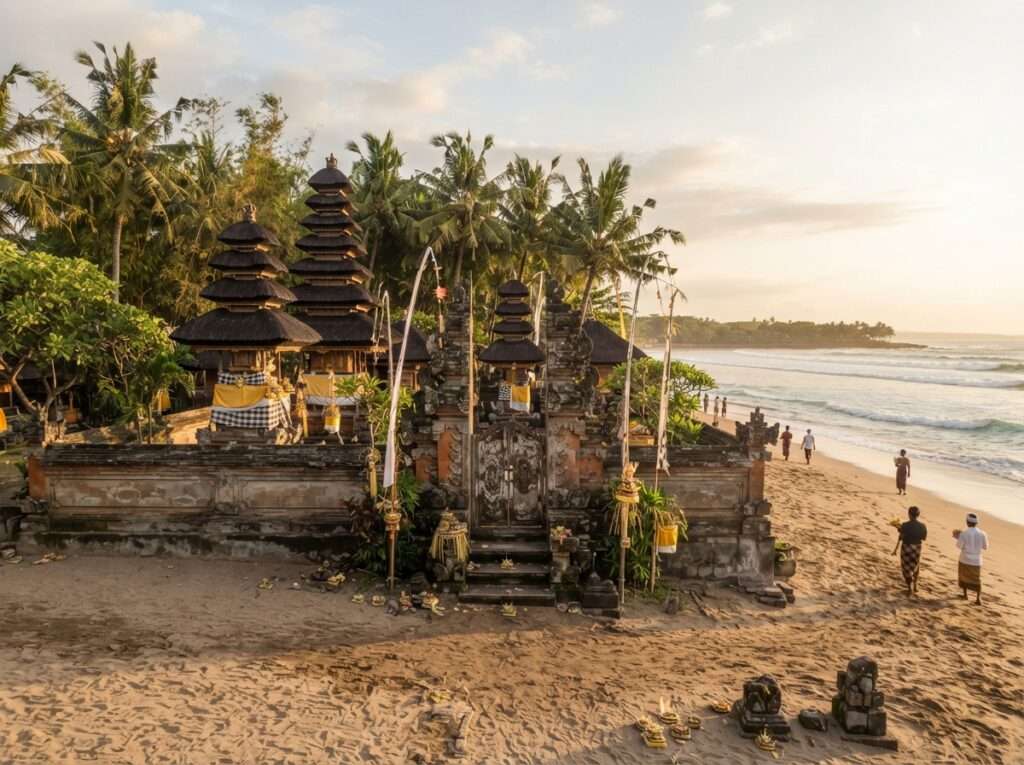
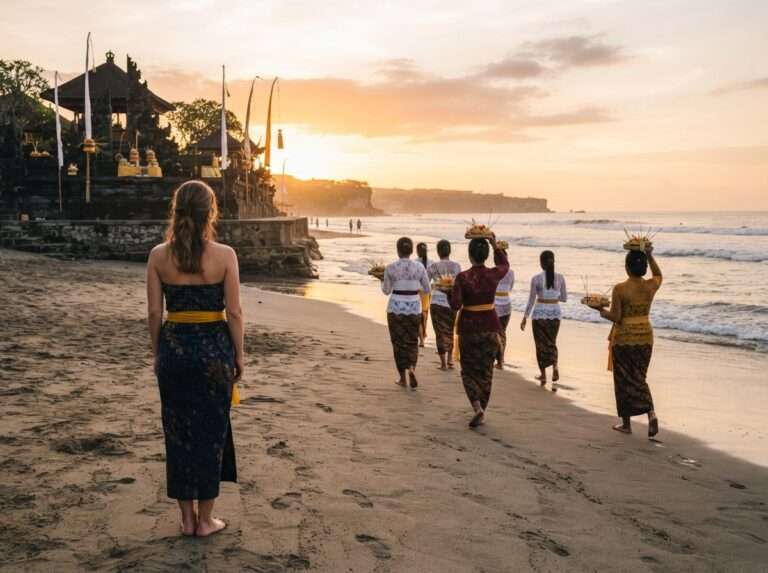
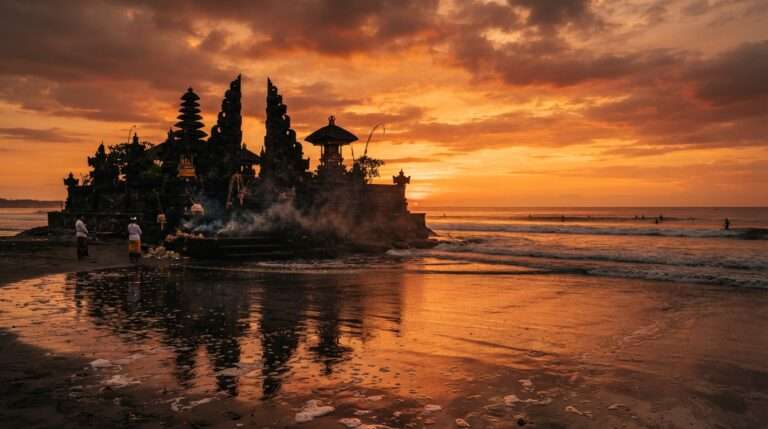
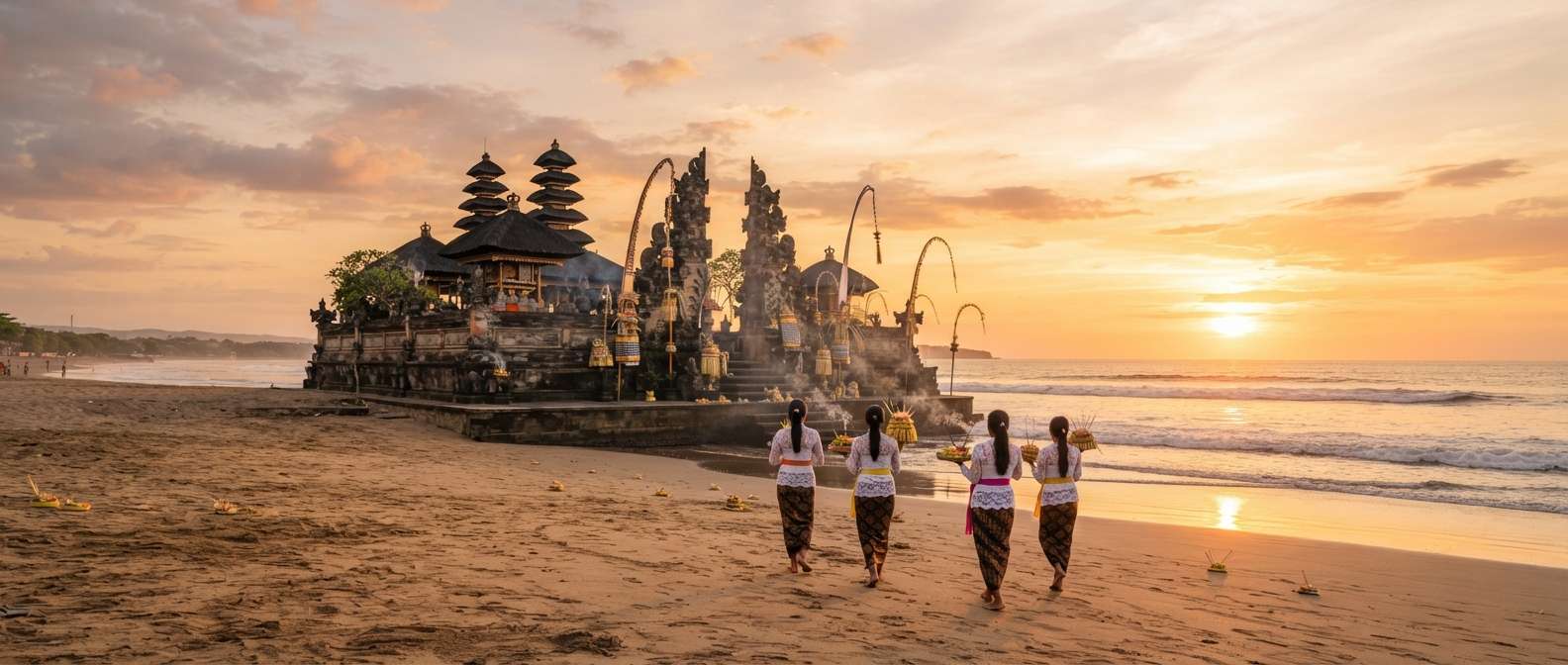
Pura Segara Legian is the temple most visitors to Legian have already seen without knowing its name. It sits right on the sand, and it is the village’s sea temple, the place where Legian faces the ocean that its fishermen and, later, its surf economy depended on. The Indonesian Wikipedia entry on Legian lists a Pura Segara Bena among the village’s pemaksan temples, the ones looked after by a group of families rather than the whole village.
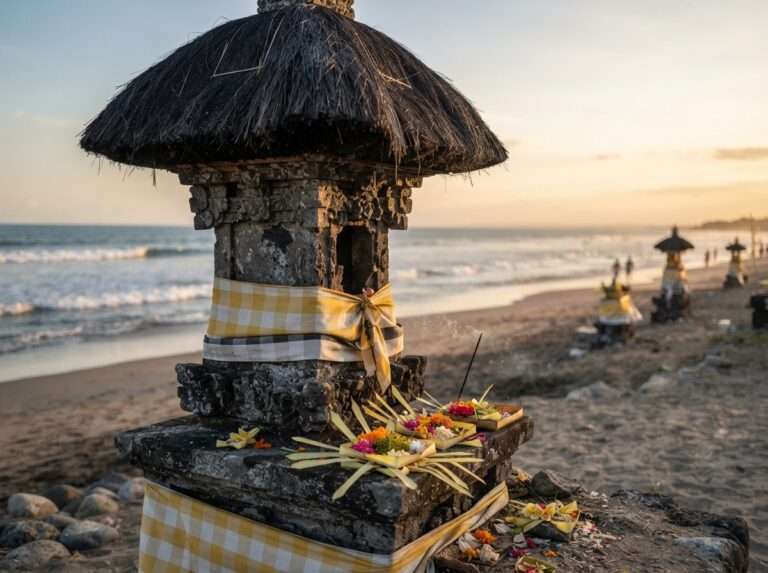
On many evenings, women from the banjar bring small woven trays of flowers and rice down to the shrine and the water’s edge. You can watch from a respectful distance on the beach. Keep to the sand side and do not step onto the shrine platform. The big day here is Melasti, when the village carries its temple effigies down to the sea to be cleansed a few days before Nyepi. In 2027 that falls in the first days of March, and Legian Beach fills with white-clad families and gamelan.
Pair it with a walk along Legian Beach at sunset.
| Area | Legian Beach, Legian |
| Type | Pura segara (sea temple) of the Legian community |
| Entry | Free. Bring your own sarong |
| Open | Beach side always visible. Inner area for worshippers |
| Best time | Sunset, full moon (Purnama), and Melasti before Nyepi |
Related Tour Packages


❮
❯
02
Pura Desa And Pura Puseh Legian
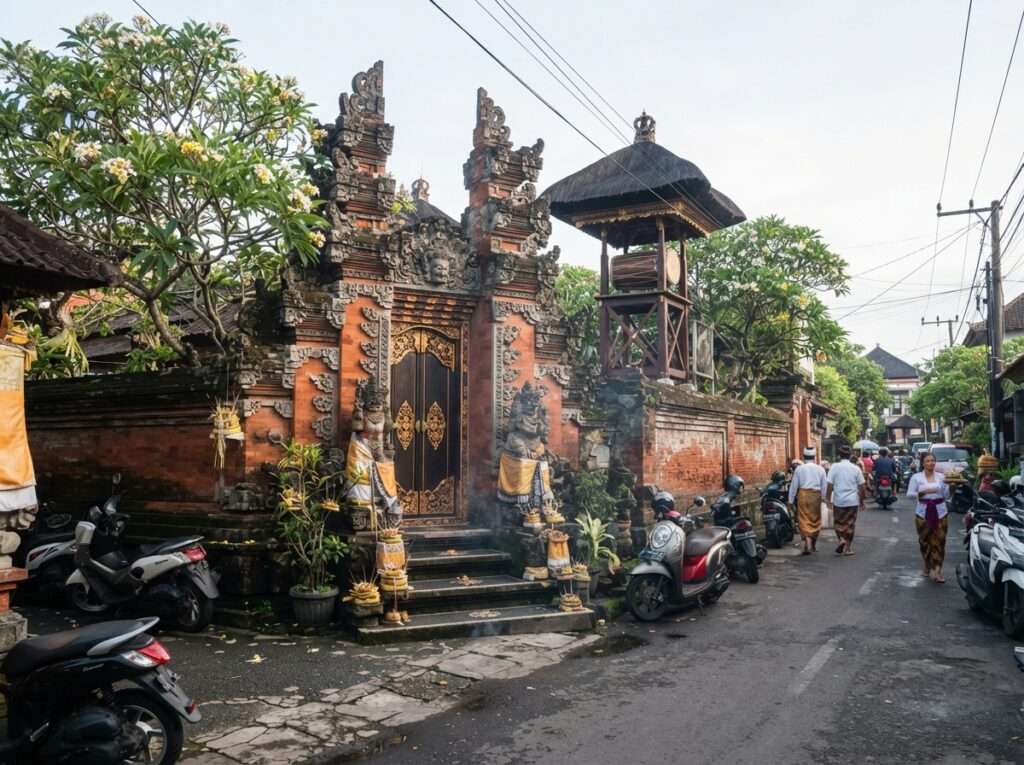
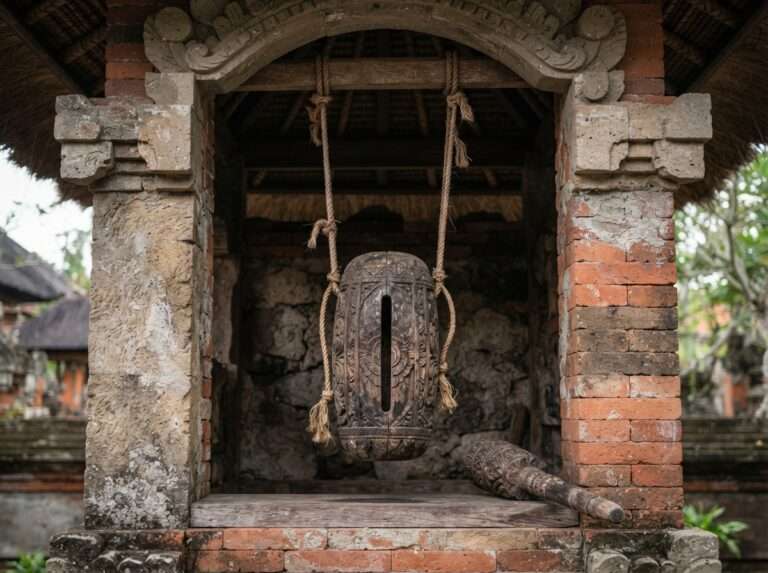
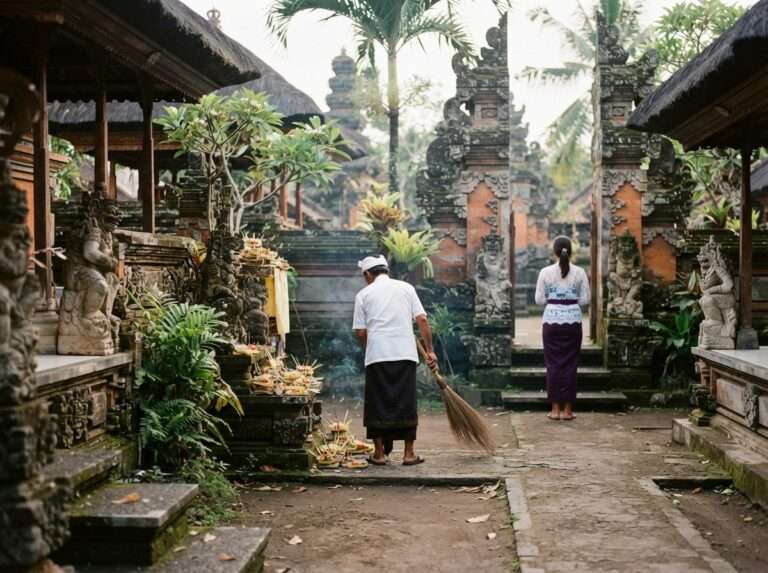
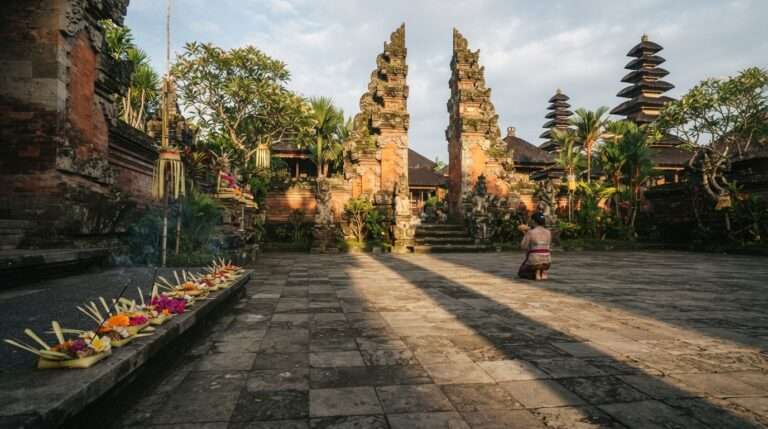
Every Balinese village has three core temples, the kahyangan tiga. The Pura Puseh honours the village founders and is linked with Vishnu. The Pura Desa is where the village meets the gods on daily business and is linked with Brahma. In Legian the two sit in the old village core, and together they are the heart of the place. Legian’s fifth parahyangan temple, Pura Agung Desa Adat Legian, is in the same core, so look for it on the same walk.
According to the Indonesian Wikipedia entry on Legian, Nengah Kasim, a Legian surfer known well beyond Bali, now leads ceremonies at Pura Puseh as a temple priest. The same compound houses the Pesraman Santi Wana, the village’s Hindu religious school. Come in the morning, keep to the outer courtyard (the jaba), and if someone in a white headcloth is sweeping or arranging offerings, ask before you take a photo. A smile and “boleh?” (may I?) goes a long way.
| Area | Central Legian, in the village core |
| Type | Kahyangan tiga: village temple (Desa) and origin temple (Puseh) |
| Entry | Free. Sarong and sash required |
| Open | Outer courtyard most mornings. Inner courtyard for prayer |
| Good to know | The Pesraman Santi Wana religious school is in the Puseh compound |
Related Tour Packages


❮
❯
03
Pura Dalem Kahyangan Legian
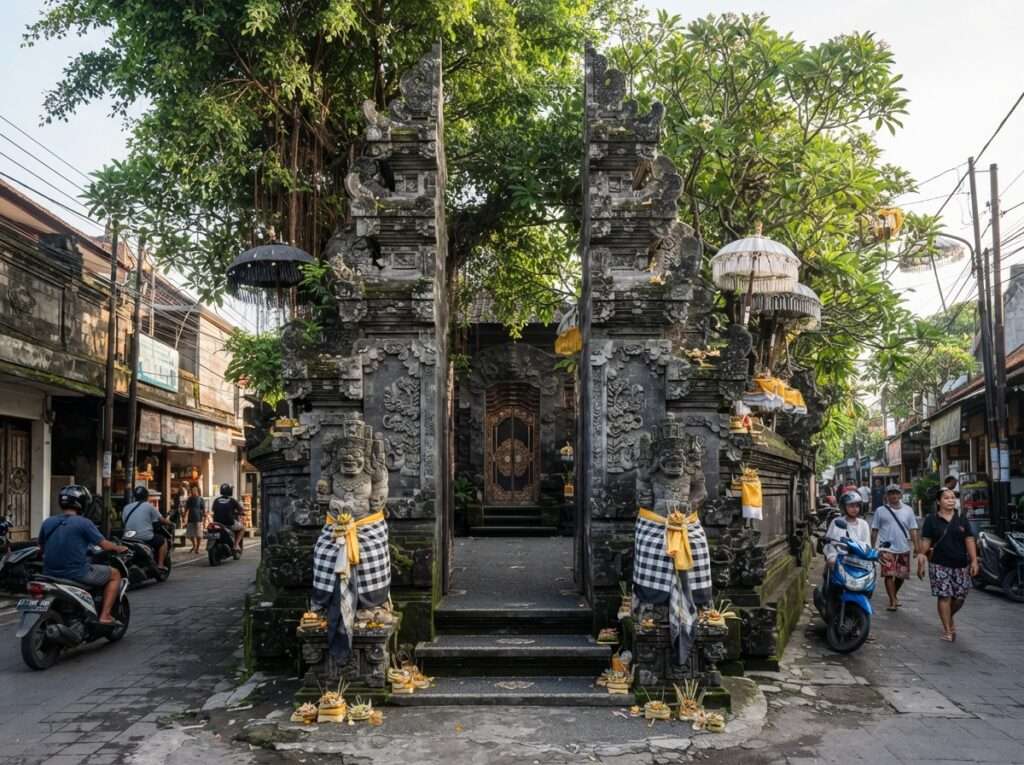
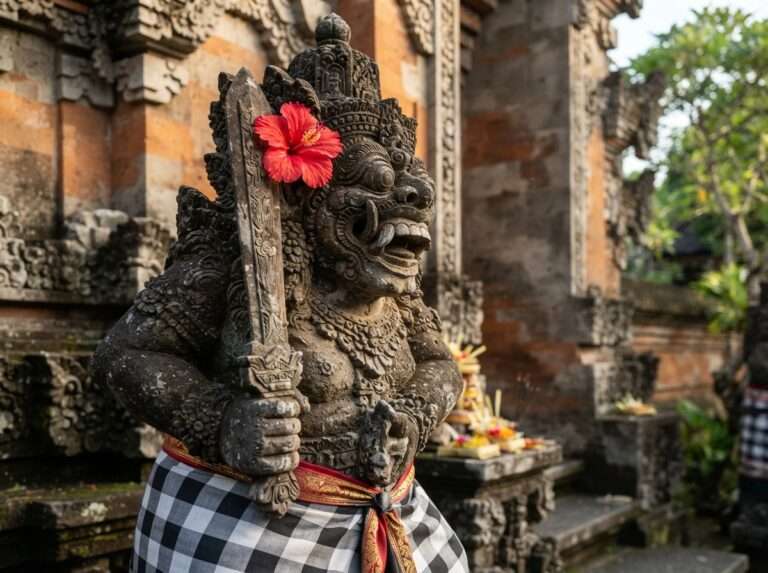
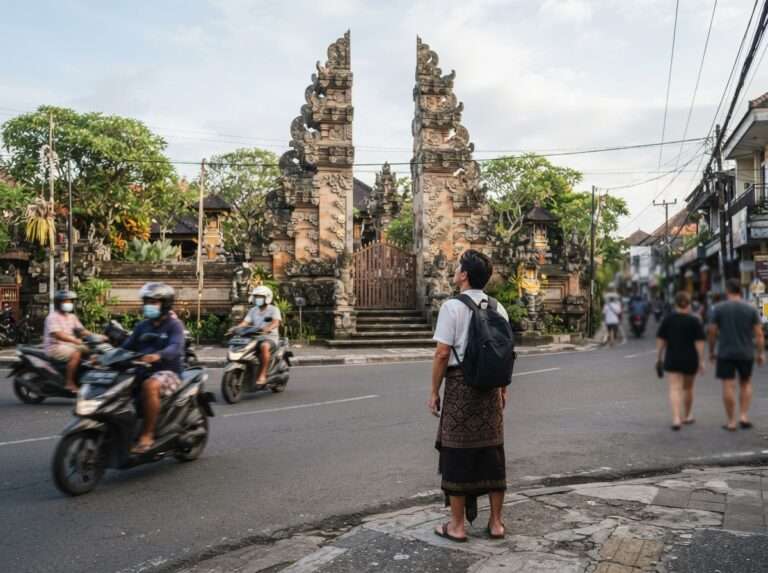
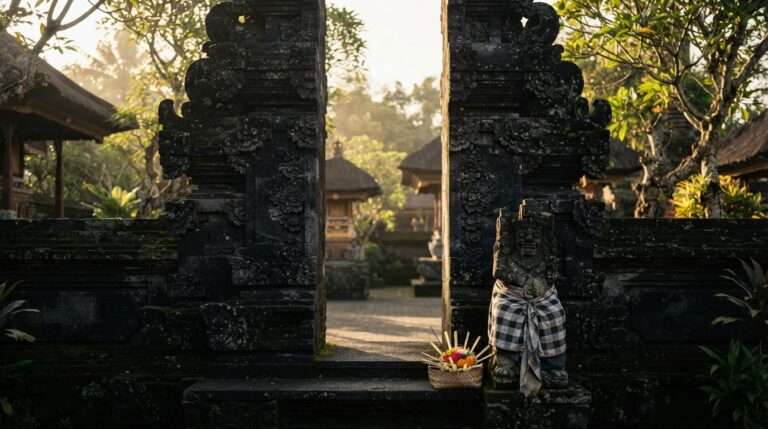
The Pura Dalem is the third of Legian’s kahyangan tiga. It stands on Jl. Patih Jelantik, east of Jl. Legian, about 100 m from the Pura Dalem Penataran, and two sword-bearing guardian statues flank its gate. Dalem temples face the world of the dead and the goddess Durga, so across Bali their gates carry heavier, darker carving and fiercer guardian figures than a village temple. Dalem temples usually stand near the village cremation ground (setra), which is normal in Bali and nothing to be uneasy about.
You will get the best look at the carving from the street in morning light. Do not climb the steps of the split gate (candi bentar) for a better angle. If there is a cremation or a ceremony under way, stay well back, keep your camera down and do not walk through the procession.
| Area | Jl. Patih Jelantik, Legian, east of Jl. Legian |
| Type | Kahyangan tiga: temple of the dead (Dalem), linked with Shiva and Durga |
| Entry | Free. Sarong and sash required |
| Open | Gate and outer courtyard. Inner courtyard for worshippers only |
| Look for | The carved split gate (candi bentar) and its guardian figures |
Related Tour Packages


❮
❯
04
Pura Dalem Penataran Legian
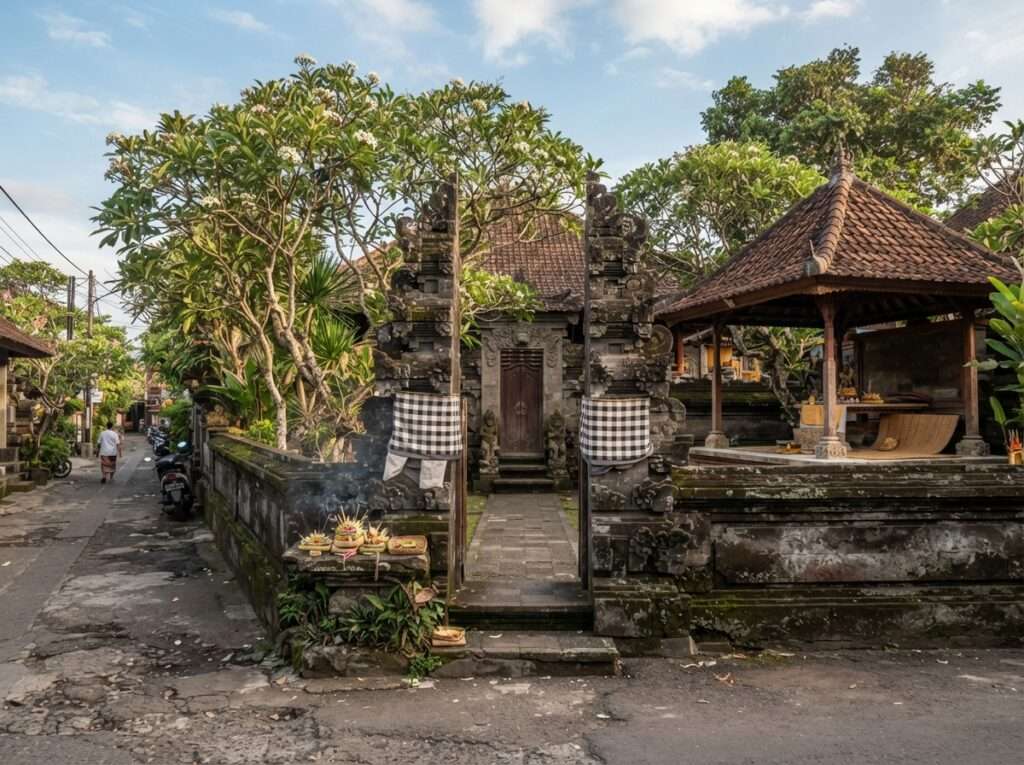
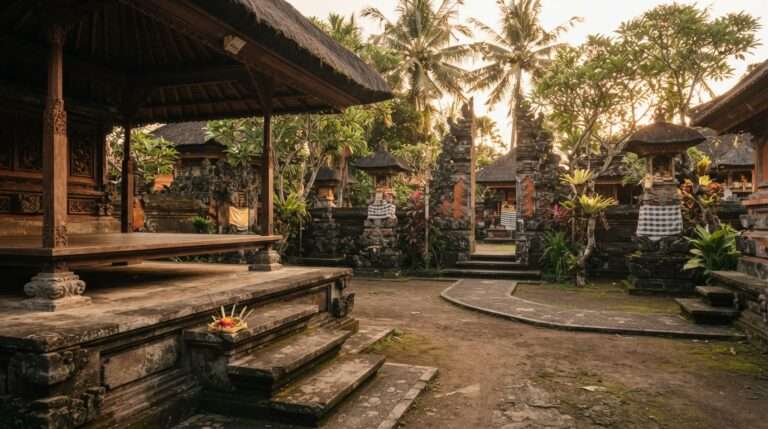
Pura Penataran is one of the five parahyangan temples that Legian’s customary village maintains, alongside Pura Agung, Pura Puseh, Pura Desa and Pura Dalem Kahyangan. Google Maps and TripAdvisor list it as “Dalem Penataran Desa Adat Temple”, which is the easiest name to search for on your phone. In Bali the word penataran is used for a sanctuary’s main temple, as in Pura Penataran Agung at Besakih.
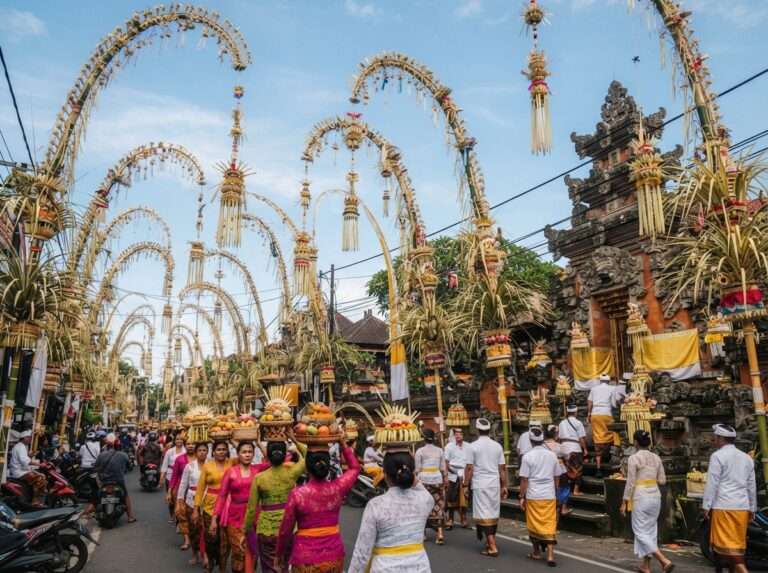
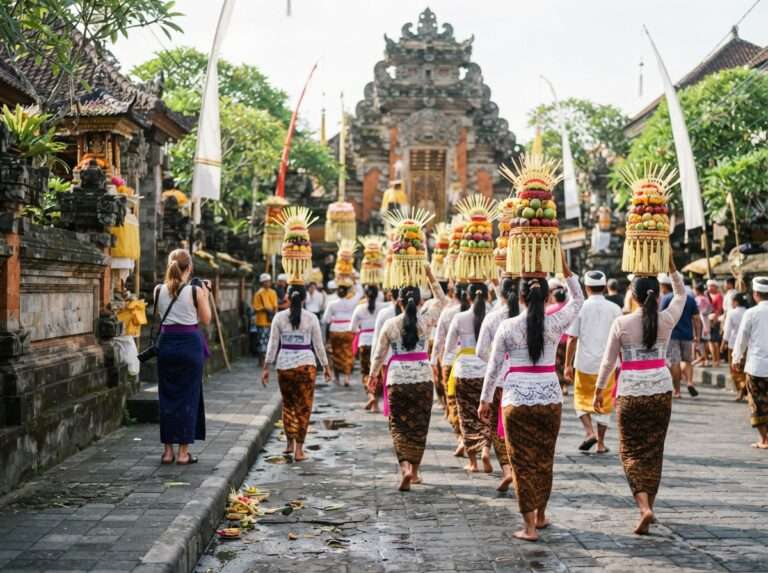
For a visitor, this is a quiet stop. Most days you will see an outer courtyard, a bale (open pavilion) and a few offerings. On its odalan, the temple birthday that comes round every 210 days, the street fills with penjor (tall curved bamboo poles), gamelan and women carrying fruit towers on their heads. If you are staying nearby, ask your hotel staff whether an odalan is coming up. They will know.
| Area | Jl. Patih Jelantik, Legian, east of Jl. Legian |
| Type | Village temple, listed on maps as Dalem Penataran Desa Adat Temple |
| Entry | Free. Sarong and sash required |
| Open | Gate and outer courtyard |
| Best time | Morning, or during an odalan festival |
05
Pura Bagus Teruna
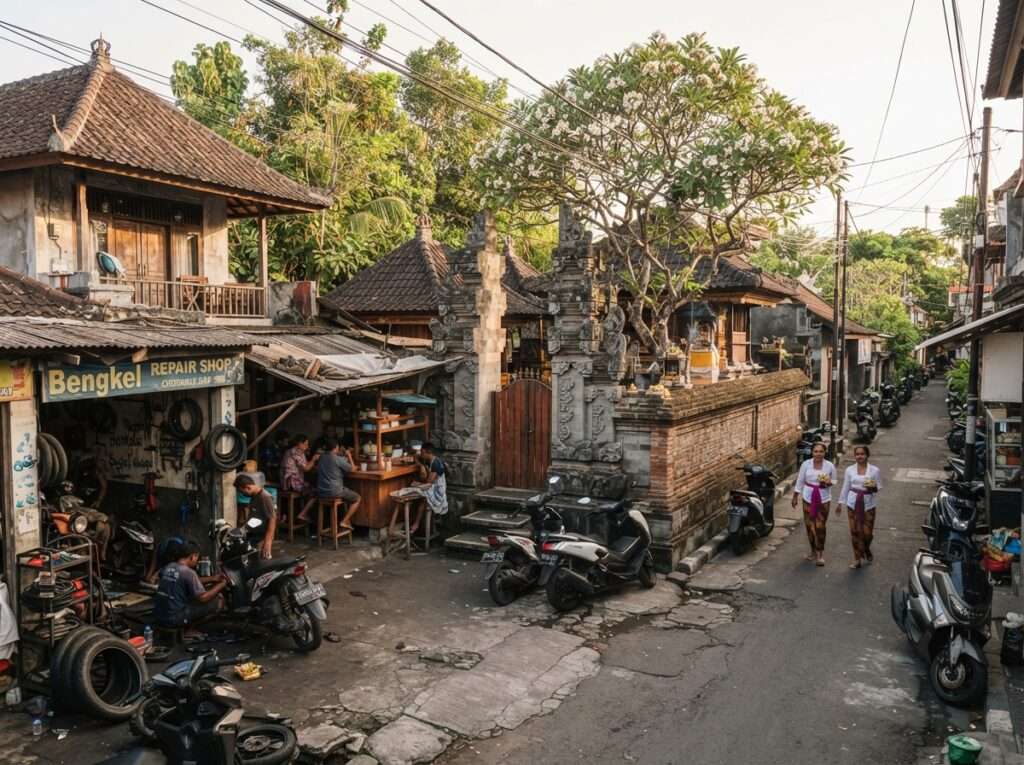
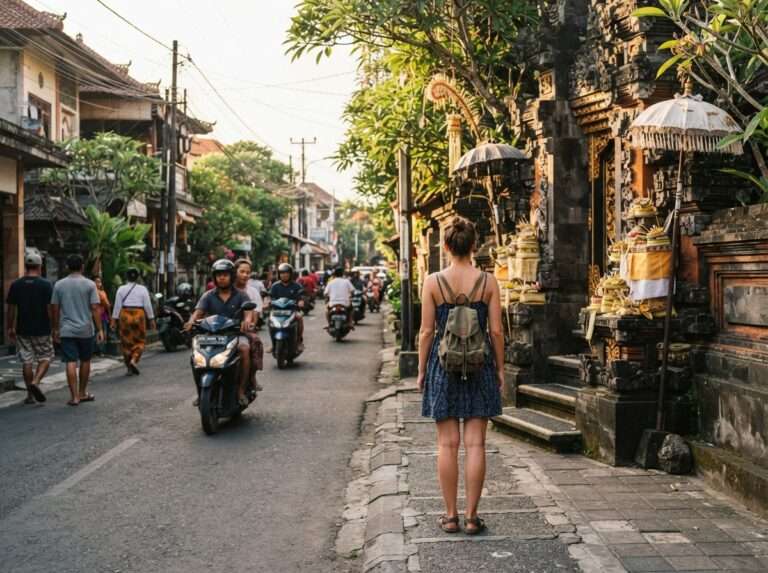
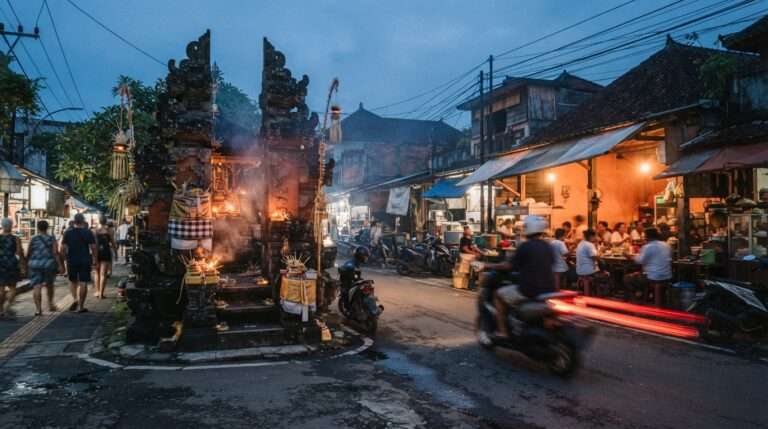
Pura Bagus Teruna is the easiest of Legian’s small temples to find, because the street it stands on, Jl. Pura Bagus Teruna (often signed Bagus Taruna, and known to most visitors as Rum Jungle Road) in Legian Kaja, carries its name. It is one of the pemaksan temples on the Indonesian Wikipedia list, a smaller compound looked after by the families of one part of the village rather than the whole community.
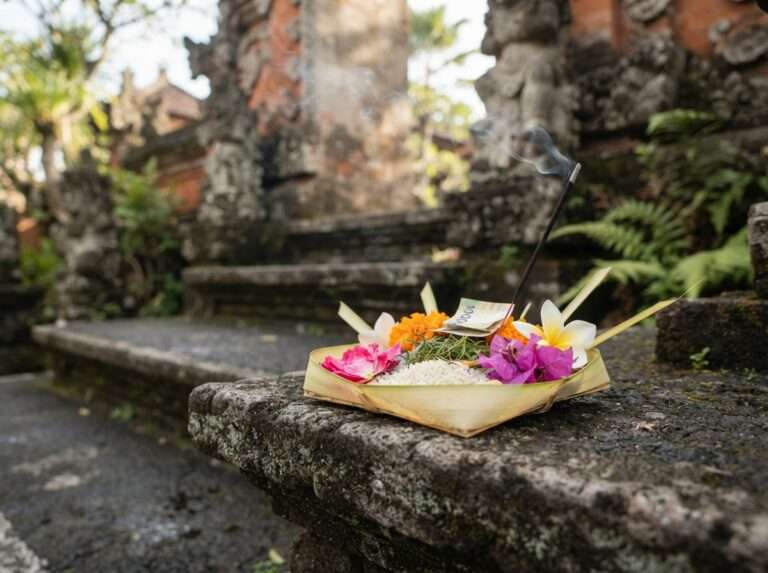
Treat it as a five-minute stop on a walk through north Legian rather than a destination. The appeal is the setting: a functioning temple a few metres from guesthouses, warungs and scooter repair shops, with the day’s canang sari (palm-leaf offerings) on its steps. If you are heading north towards Double Six and Seminyak anyway, it sits naturally on that route.
| Area | Legian Kaja, the northern banjar of Legian |
| Type | Pemaksan temple, maintained by a group of local families |
| Entry | Free |
| Open | Street view and outer area |
| How to find | Jl. Pura Bagus Teruna (Rum Jungle Road) is named after it |
06
Vihara Dharmayana
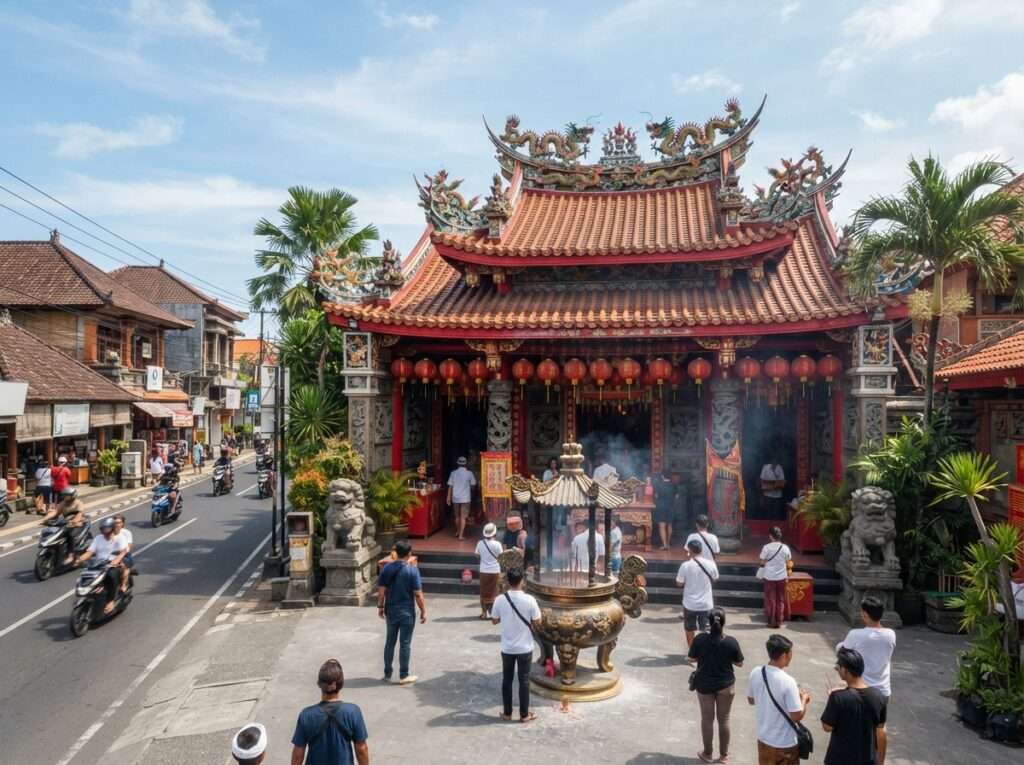
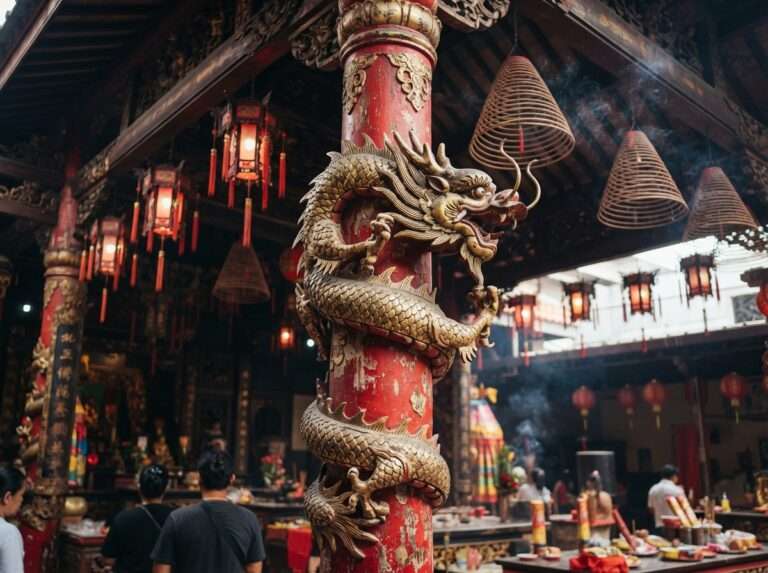
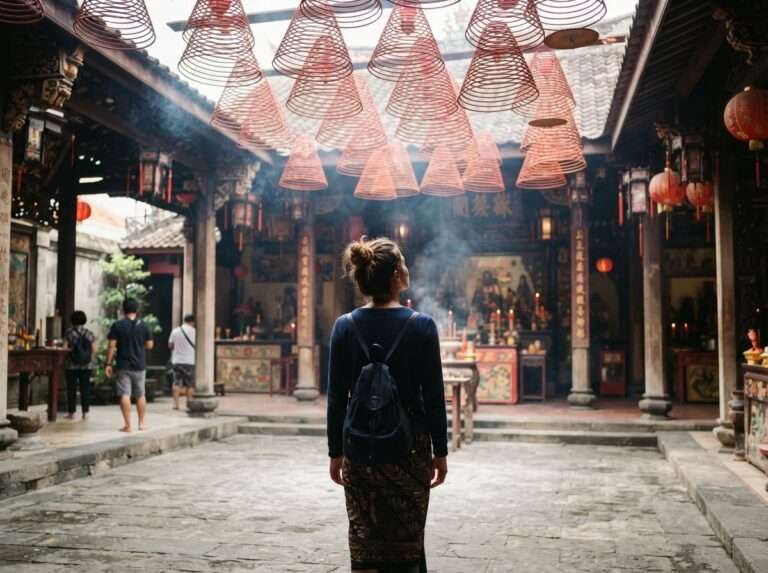
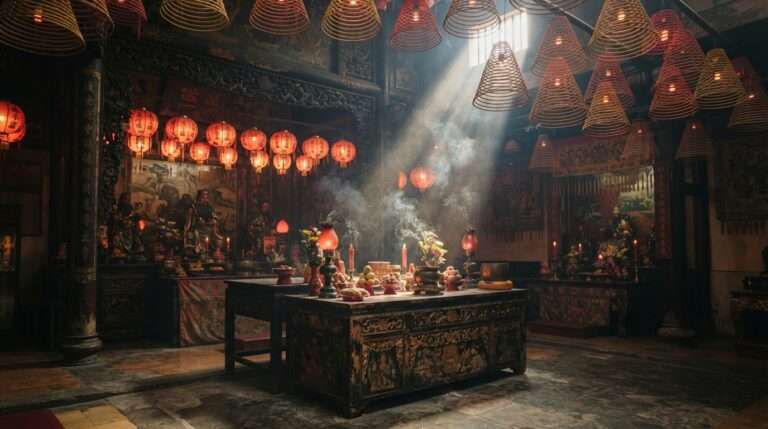
Vihara Dharmayana is the most visitor-friendly temple on this list and the easiest one to walk straight into on any day. It began life as Leeng Gwan Bio, a temple for Kuta’s Chinese traders. It is usually dated to 1876, and on 23 February 1980 it took its present name, Vihara Dharmayana. The main deity is Tan Hu Cin Jin, a figure honoured in Chinese temples across Bali.
Inside are red lanterns, incense coils hanging from the roof beams and carved dragon pillars, and the smell of incense reaches you from the street. You do not need a sarong here, but cover your shoulders and knees, and do not point your feet at the altars if you sit down. Lunar New Year (Imlek) is the busiest time of the year.
Read more in our full guide to the Dharmayana Temple.
| Area | Jl. Blambangan, Kuta (postcode Legian 80361) |
| Type | Chinese Buddhist and Taoist temple, also called Kongco Kuta |
| Entry | Free. Donation box inside |
| Open | Daily, 9 am to 8 pm |
| Best time | Late afternoon, and Lunar New Year (6 February 2027) |
07
Bali Bombing Memorial
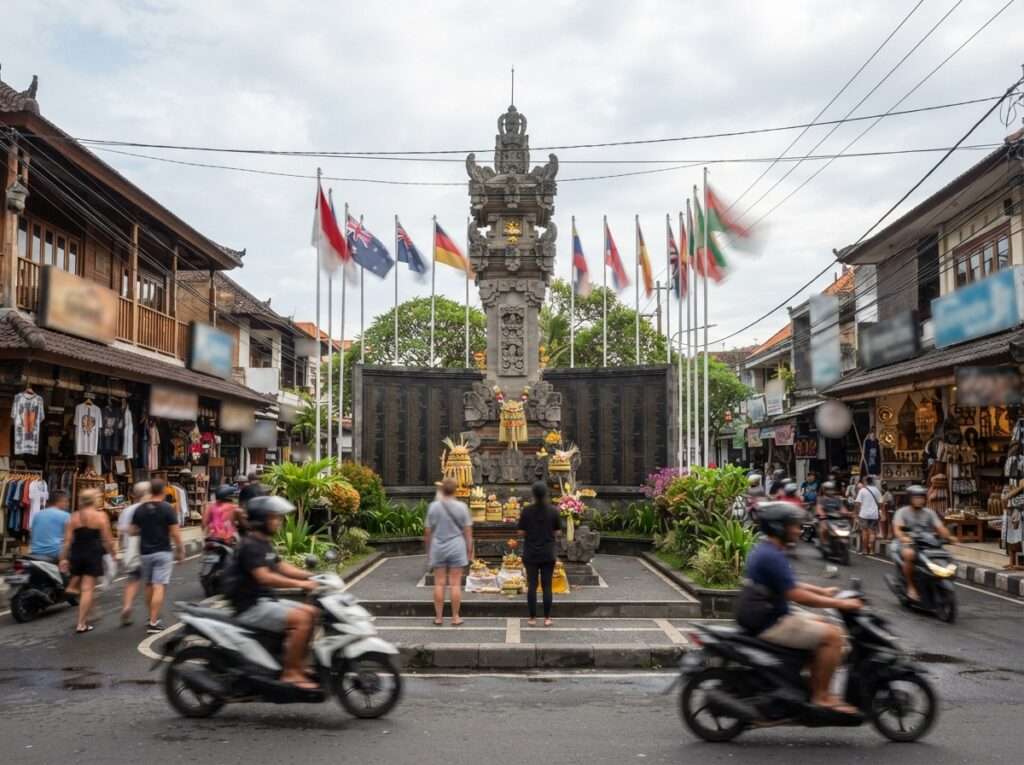
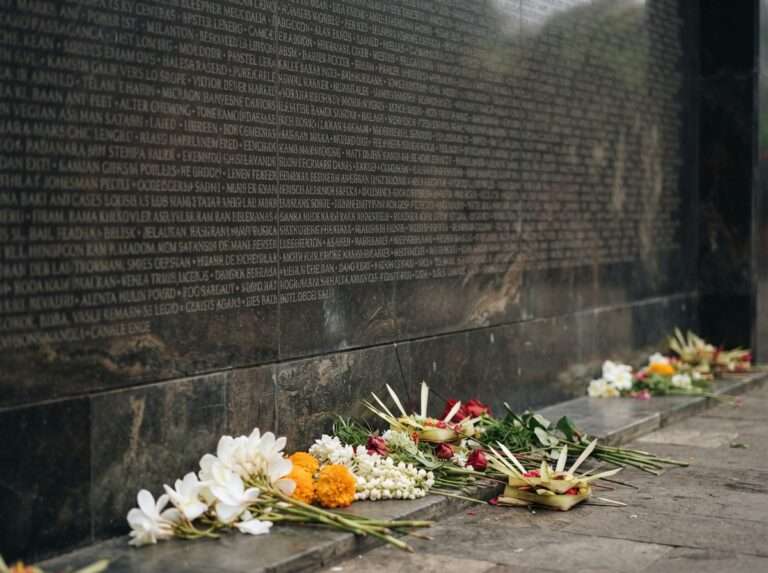
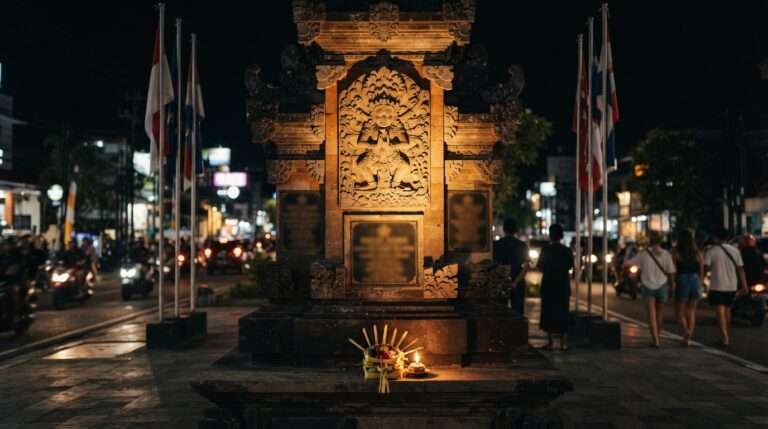
This is not a temple, and we list it separately for that reason. It is, though, the most visited place of remembrance in Kuta, and some travellers searching for temples near Legian are looking for somewhere to pause rather than for a particular shrine. On 12 October 2002, bombs at Paddy’s Pub and the Sari Club on Jl. Legian killed 202 people, 88 of them Australians and 38 Indonesians. The memorial stands on Jl. Legian at the bomb site, facing the empty lot where the Sari Club stood, and was dedicated on the second anniversary in 2004.
The central marble wall carries the names and nationalities of the victims, flanked by the flags of their countries. Visitors still leave flowers here, and the 12 October service draws survivors and relatives from Australia every year. Keep your voice low, do not pose for selfies at the plaque, and look for the small offerings that local people still leave. It is a short walk from the bars and a very different stop.
For the history in full, see our guide to the Bali Bomb Memorial.
| Area | Jl. Legian, Kuta |
| Type | Memorial (Monumen Tragedi Kemanusiaan). A sacred site, not a temple |
| Entry | Free |
| Open | Open-air, any time. Lit at night |
| Good to know | Annual commemoration on 12 October |
08
Pura Segara Kuta
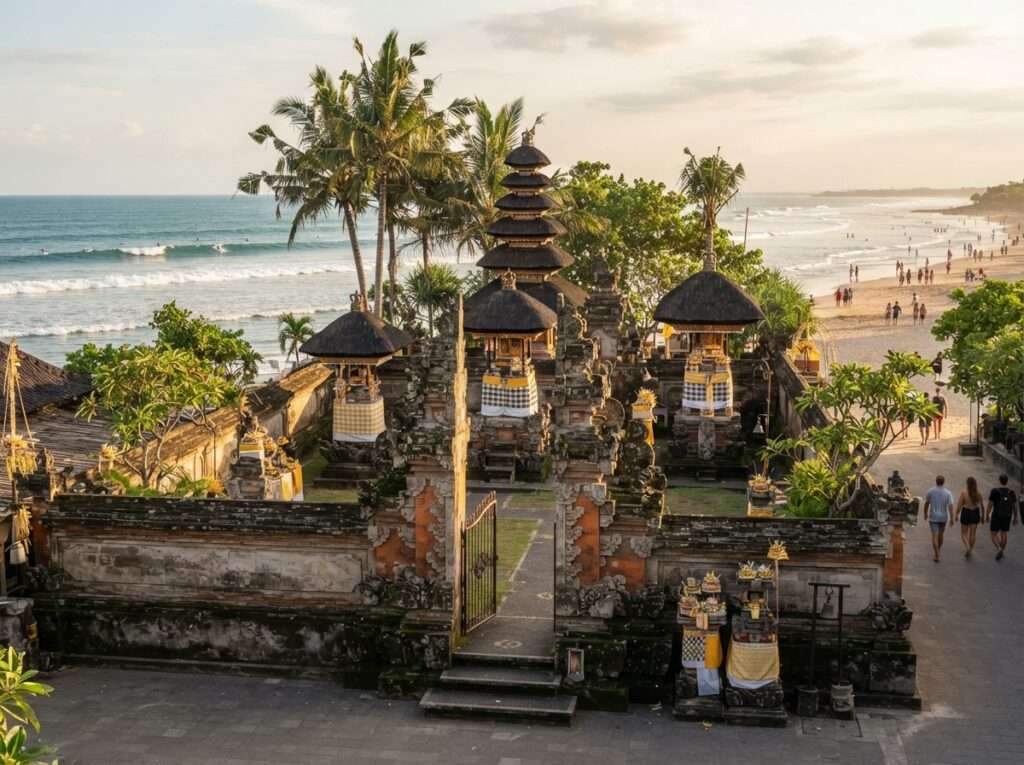
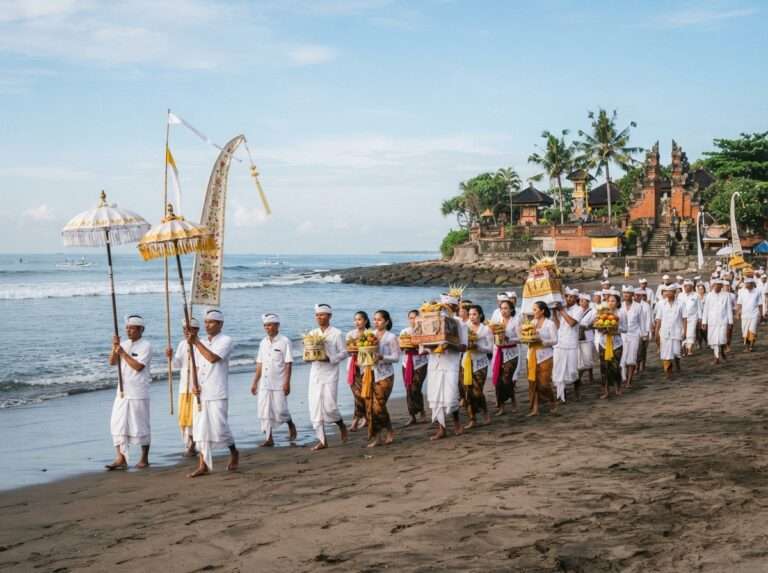
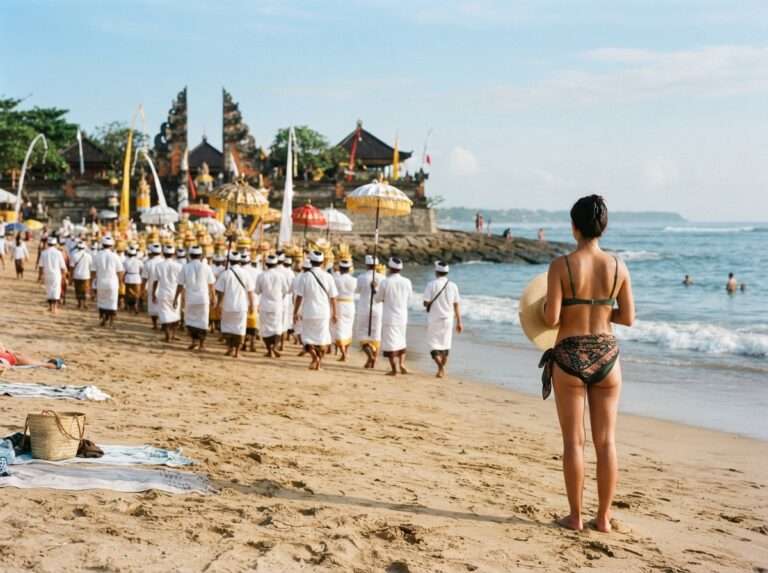
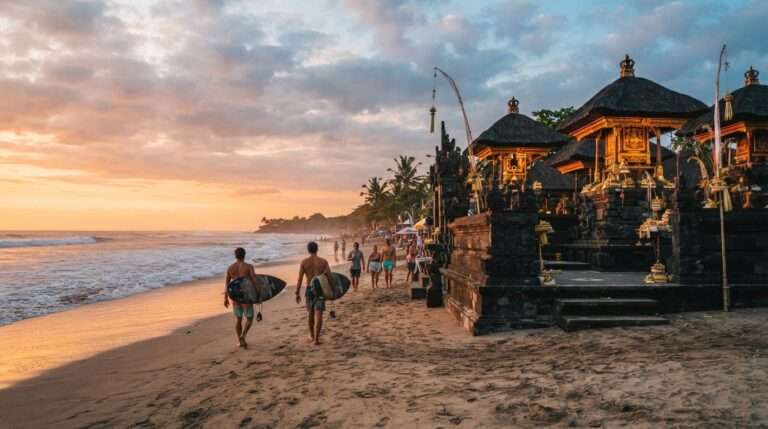
Kuta has its own sea temple on the beachfront, the counterpart of Legian’s Pura Segara. Like every sea temple on the west coast, it is where the village sends offerings to the ocean and where Melasti processions end before Nyepi. On Melasti day, three or four days before Nyepi, long processions in white and gold walk down to the water with umbrellas, banners and the temple’s sacred objects, and sunbathers make room for them.
The rest of the year, it is a calm corner of one of Bali’s busiest beaches. Search “Pura Segara Kuta” on Google Maps to find the gate, and come just before sunset when the surf schools pack up.
For the beach itself, swimming flags and tides, our page on Kuta Beach has the details.
| Area | Kuta Beach |
| Type | Pura segara (sea temple) of Desa Adat Kuta |
| Entry | Free. Bring your own sarong |
| Open | Beach side always visible. Inner area for worshippers |
| Best time | Sunset, and Melasti before Nyepi |
09
Pura Dalem Pakendungan, Kuta
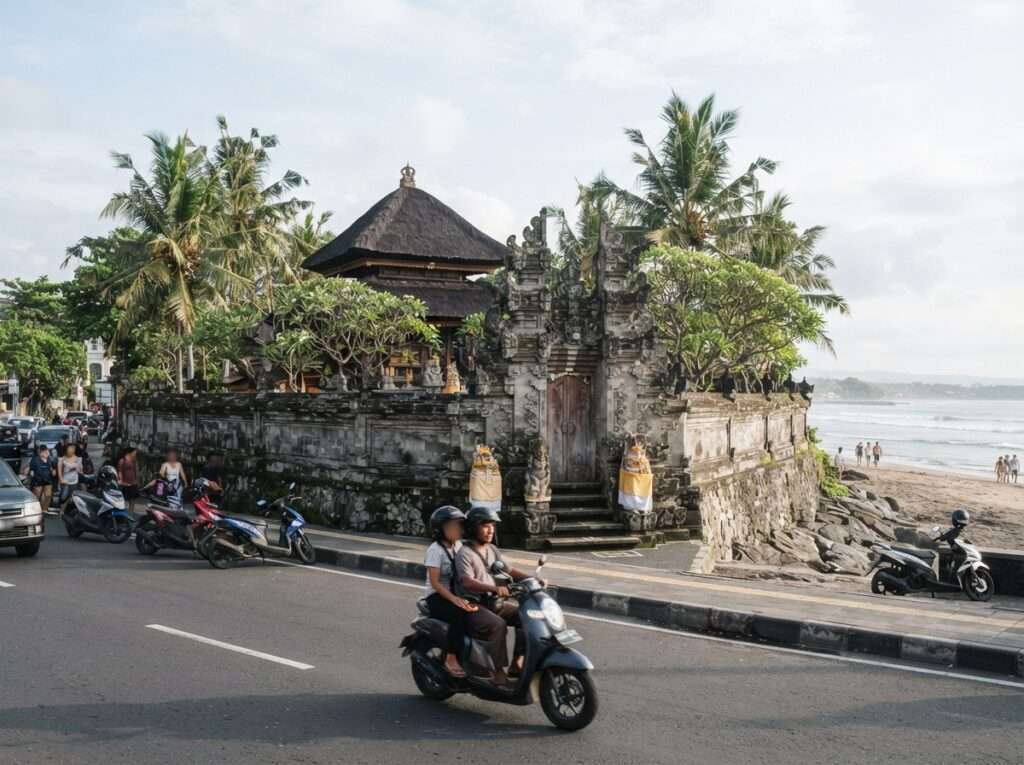
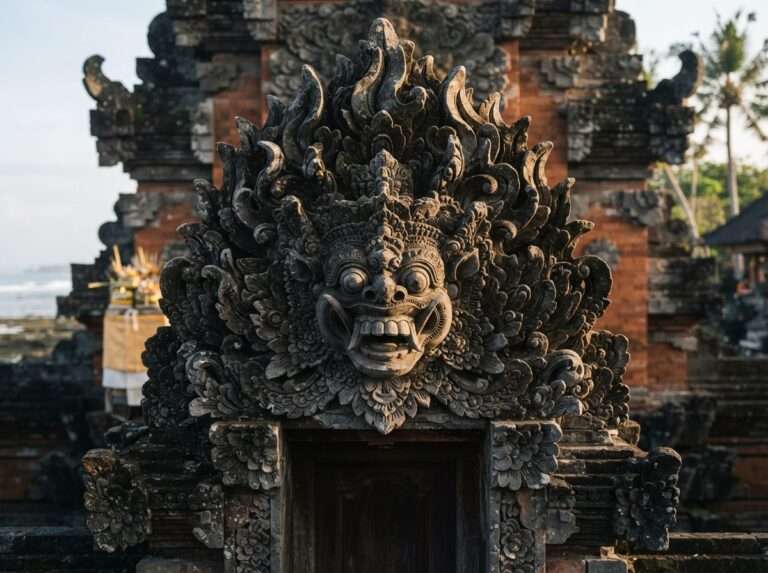
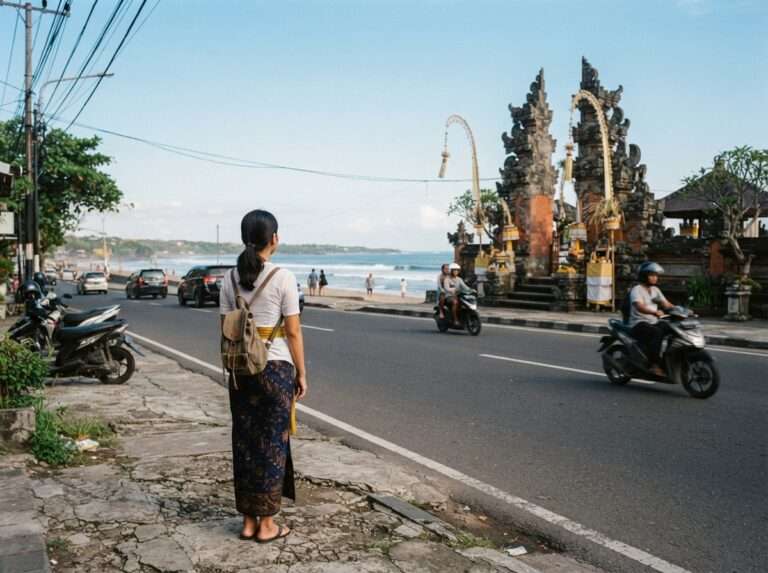
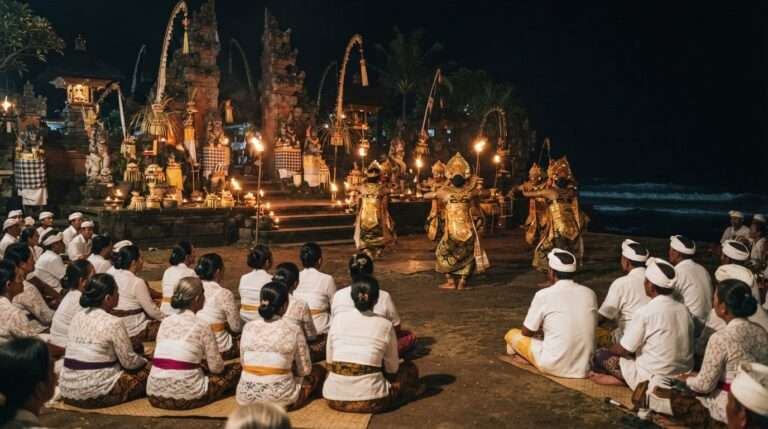
Pura Dalem Pakendungan stands on the shore at the south end of Kuta Beach, off Jl. Kartika Plaza, about 400 m north of the Discovery shopping mall. It is a coastal temple rather than Desa Adat Kuta’s main village Dalem, which stands inland. Like other Dalem temples, it is linked with Shiva in his role as dissolver and with Durga.
It is easy to miss behind the traffic, which is the point of including it. Stop on the pavement opposite for the best view of the gate, and come in the morning when the light is on the carving. On the nights of temple ceremonies, travellers sometimes see dance performed in the courtyard for the gods rather than for an audience. If that happens, you may be allowed to watch from the back in a sarong. Never use flash.
| Area | Jl. Kartika Plaza, south Kuta |
| Type | Coastal Dalem temple on Kuta Beach |
| Entry | Free. Sarong and sash required |
| Open | Gate and outer courtyard |
| Good to know | Busiest on ceremony nights and cremation days |
10
Pura Petitenget
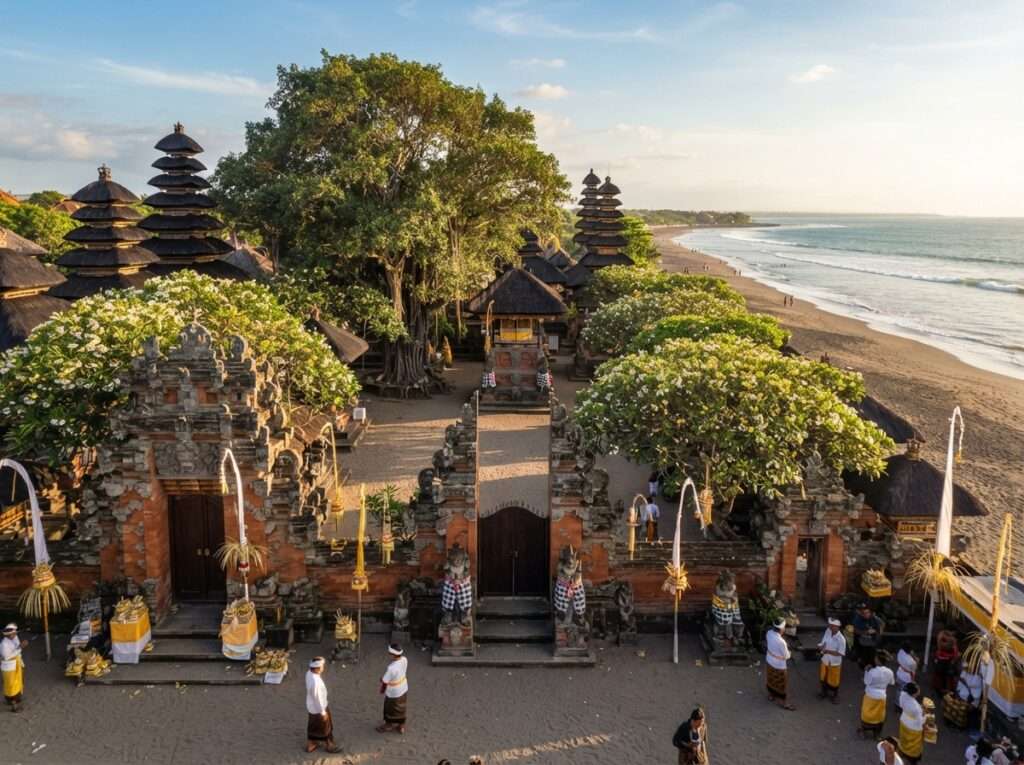
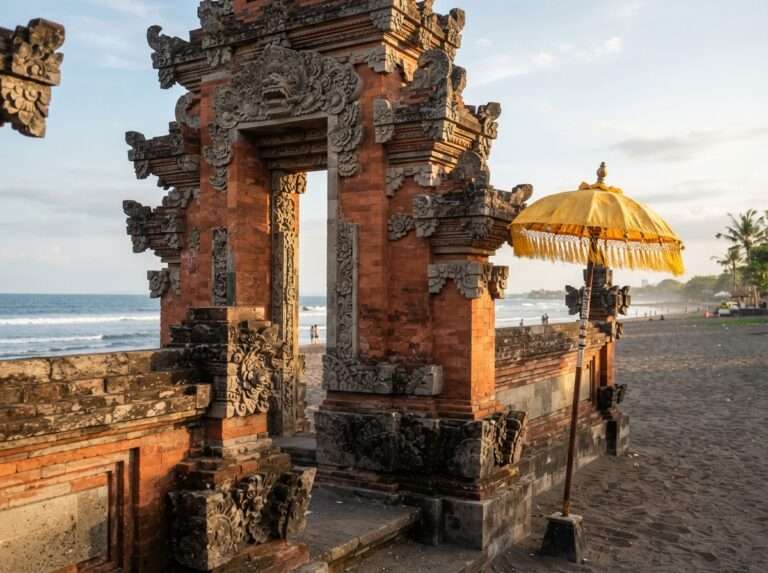
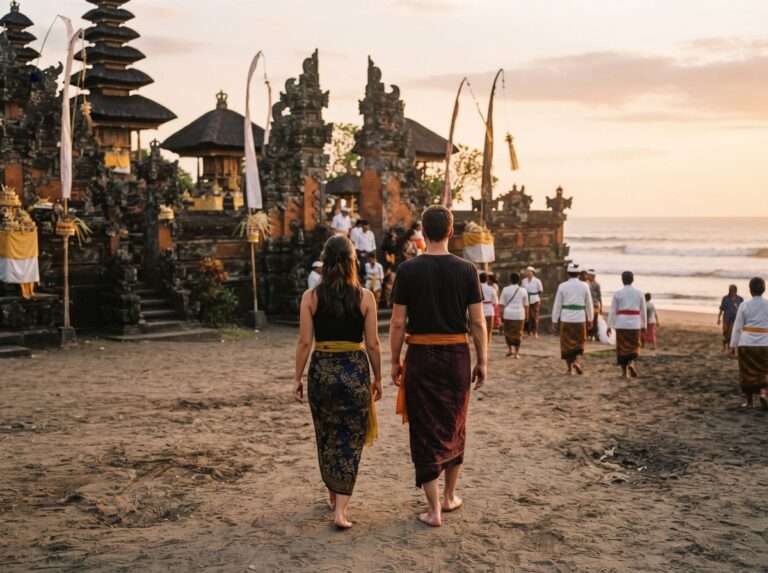
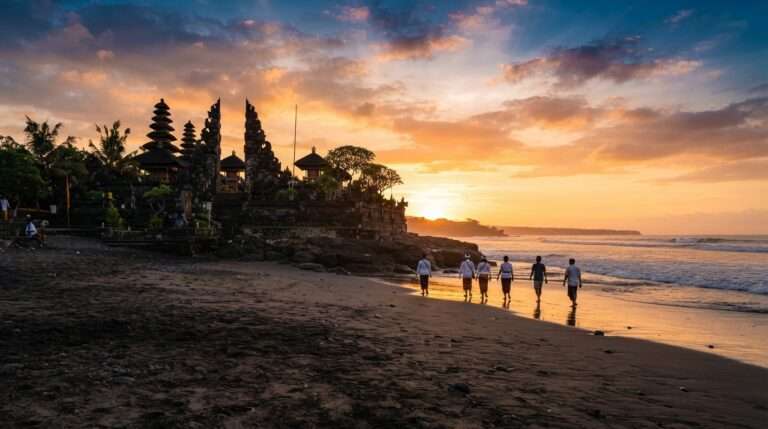
Pura Petitenget is the closest famous temple to Legian, and the one to choose if you want a “proper” temple visit without leaving the coast. It is a sea temple on the beach north of Seminyak, linked by tradition to the 16th-century priest Dang Hyang Nirartha, who is also credited with founding Tanah Lot and with shaping Uluwatu. Unlike the Legian village temples, it is set up for visitors, with a ticket desk and sarongs to borrow.
Go for sunset. The temple faces the same stretch of sand as Seminyak’s beach clubs, so book dinner nearby and walk over at 5.30 pm. The ceremony dates, fees and nearby temples are covered in depth in our guide to temples near Seminyak, which is the page to read if Petitenget is your main target.
| Area | Jl. Petitenget, Kerobokan Kelod, north of Seminyak |
| Type | Sea temple linked to the priest Dang Hyang Nirartha |
| Entry | IDR 50,000 (₹265), sarong included |
| Open | Outer courtyards daily. Inner courtyard for worship |
| From Legian | About 4 to 6 km, 15 to 20 minutes by car |
Day Trips From Legian To Bali's Famous Temples
If you want the temples on the postcards, you will need a car for half a day. All four below are easy from Legian, and each pairs well with a sunset.
| Temple | Where it actually is | Distance from Legian | Drive time | Entry (IDR ≈ ₹) | Best time |
|---|---|---|---|---|---|
| Tanah Lot | Beraban, Tabanan | About 20 km | 45 to 75 min | 75,000 (₹395) | Low tide, sunset |
| Pura Batu Bolong | Canggu beach | About 10 to 15 km | 30 to 45 min | Small donation | Sunset |
| Pura Taman Ayun | Mengwi, Badung | About 24 km | 40 to 60 min | 50,000 (₹265) | Morning |
| Uluwatu Temple | Pecatu, Bukit peninsula | About 22 to 25 km | 50 to 80 min | 60,000 (₹315); Kecak 150,000 (₹790) | 4 pm, Kecak at 6 pm |
Tanah Lot is a rock temple off the coast of Beraban in Tabanan, an hour or so up the west coast. At low tide you can walk to the foot of the rock and receive holy water from the spring beneath it. Leave Legian by 3 pm to beat sunset traffic. Our page on how to reach Tanah Lot covers the route and parking.
Pura Batu Bolong sits on a rocky outcrop at Batu Bolong Beach in Canggu, roughly halfway between Legian and Tanah Lot. It is small and free apart from a donation, and it is the easy add-on if you are already in Canggu for the afternoon. Do not mix it up with the arched rock shrine of the same name inside the Tanah Lot complex.
Pura Taman Ayun in Mengwi is the 17th-century royal temple of the Mengwi kingdom, ringed by a moat and with tiered meru towers rising behind its walls. Go in the morning, before the tour buses. Details are on our Taman Ayun Temple page.
Uluwatu Temple stands on a 70-metre cliff at the tip of the Bukit. Arrive by 4 pm, hold on to your sunglasses (the monkeys steal them) and stay for the 6 pm Kecak fire dance. Our guide to Uluwatu Temple has tickets and timings.
Further afield, Besakih, Tirta Empul and Ulun Danu Bratan each need a full day from Legian and are covered in our island-wide guide to places to visit in Bali.
How To Visit A Temple In Legian Respectfully
Legian’s temples are places of daily worship, so a little preparation matters more here than at a ticketed site with a rental desk. Follow these steps and you will be welcome almost anywhere.
- Bring a sarong and a sash. A sarong (kamen) that covers your legs below the knee and a sash (selendang) tied at the waist are required in every Hindu temple. Legian’s market stalls sell both for about IDR 50,000 to 100,000 (₹265 to ₹525), and you will use them all trip.
- Cover your shoulders. A T-shirt is fine. A singlet or bikini top is not, even at a beach temple.
- Stop at the outer courtyard and look for someone. If a temple caretaker or priest (pemangku) is there, ask with a gesture whether you may look around the outer courtyard. Do not go through the inner gate unless you have come to pray, in full temple dress.
- Watch where you step. Canang sari offerings on the ground are for the spirits. Walk around them, never over them, and never sit on a shrine, wall or gate.
- Bring small notes for the donation box. IDR 10,000 to 20,000 (₹55 to ₹105) is a normal donation at a village temple that has a box. Do not hand cash to anyone who is not attached to the temple.
- Keep your head lower than the priest’s and your camera down during prayer. No flash, no drones, and ask before photographing people.
- Respect the custom on bleeding. Balinese custom asks anyone with an open wound, and women who are menstruating, not to enter a temple. Nobody will check, but local people take it seriously.
When To See A Temple Ceremony In Legian And Kuta
You will see more of Legian’s temple life on a ceremony day in 10 minutes than in a week of ordinary visits. These are the dates worth planning around.
| Occasion | When (2027) | What you will see near Legian |
|---|---|---|
| Galungan | 13 January 2027 and 11 August 2027 | Penjor poles lining Jl. Legian, every family at its temples |
| Kuningan | 23 January 2027 and 21 August 2027 | Close of the Galungan period, offerings at the beach temples |
| Melasti | First days of March 2027 | Processions in white to Legian Beach and Kuta Beach |
| Ogoh-ogoh night | Sunday 7 March 2027 | Giant demon effigies paraded through Legian and Kuta |
| Nyepi (Day of Silence) | Monday 8 March 2027 | Everything closes for 24 hours, including the airport |
| Odalan | Every 210 days, per temple | A single temple’s birthday, with gamelan and dance |
| Purnama and Tilem | Every full and new moon | Extra offerings at the sea temples at dusk |
The ogoh-ogoh parade on the evening before Nyepi is the night most visitors remember. Each banjar builds its own monster figure for weeks, then carries it through the streets with drums and torches. On Nyepi itself you must stay inside your hotel from 6 am to 6 am the next day, with lights low and no noise. If you are travelling at the end of the year instead, our guide to Bali in December covers what is on.
A Half-Day Temple Walk From Kuta To Legian
This route links seven of the stops above in about 4 km (5 km with the Bagus Teruna detour), ending at the beach for sunset. Start at about 2 pm, carry your sarong in your bag, and take a Grab for the first leg if it is hot.
- Vihara Dharmayana, Jl. Blambangan (2 pm). Start indoors in the shade. Allow 20 minutes.
- Bali Bombing Memorial, Jl. Legian (2.45 pm). A short taxi or about 15 minutes on foot (1 km). Allow 15 minutes.
- North up Jl. Legian into the village core (3.30 pm). Turn east to Jl. Patih Jelantik for the Pura Dalem Kahyangan and Pura Dalem Penataran, which stand about 100 m apart, then ask locally for the Pura Desa, Pura Puseh and Pura Agung in the village core. Allow an hour for all of them, at an easy pace.
- Pura Bagus Teruna, Rum Jungle Road, Legian Kaja (4.45 pm). A detour north if you have the legs for it. Otherwise skip to the beach.
- Pura Segara Legian (5.30 pm). Walk down Jl. Padma to the sand (or straight down Rum Jungle Road to the beach if you took the Bagus Teruna detour) and watch the sunset offerings.
Shops and markets along the way are in our guide to markets in Legian, and the rest of the area is in things to do in Legian and places to visit in Kuta.
How We Checked This Guide
Our writers built this list from the temples named for Legian’s customary village on the Indonesian Wikipedia entry for Legian, cross-checked against OpenStreetMap temple pins, Google Maps, road and walking distances from the OSRM route planner and the histories published for Vihara Dharmayana and the Bali Bombing Memorial. Fees for the day-trip temples are the latest gate prices reported in 2026 under Badung and Tabanan rules. Ceremony dates follow the 210-day Balinese Pawukon calendar and Indonesia’s official 2027 holiday list. We removed Puseh Batuan (in Gianyar, 25 km away) and corrected Tanah Lot’s location. This update is desk research and map checks. Our Bali team will walk the route and add dated notes to each entry. If something has changed when you visit, tell us and we will update the page.
Planning Your Trip Around Legian
Legian’s temples will not fill a day, and that is fine. Give the village temples a morning, Dharmayana and the memorial an hour, Pura Segara a sunset, and save one afternoon for Tanah Lot or Uluwatu, and you will have seen both the Bali that people live in and the Bali on the postcards. If you would rather have the hotel, transfers and temple day trips arranged in one plan, browse our Bali tour packages and ask for a Legian stay with a Tanah Lot sunset added.
FAQs
Temples In Legian And Kuta: Frequently Asked Questions
Everything you need to know about temple in legain
Yes. Legian has about a dozen temples. Its customary village maintains five main parahyangan temples (Pura Agung, Pura Puseh, Pura Desa, Pura Dalem Kahyangan and Pura Penataran) and several family-run pemaksan temples, including Pura Segara Bena on the beach and Pura Bagus Teruna in Legian Kaja. They are working village temples rather than ticketed attractions, so expect to see them from the outer courtyard or the street, free of charge.
Usually only as far as the outer courtyard. Bali's rules for foreign visitors keep the inner courtyard for people who have come to pray, in proper temple dress. Village temples in Legian are for local worship, and the inner courtyard is often locked outside ceremonies. Wear a sarong and sash, cover your shoulders, and do not step through the inner gate to sightsee. Vihara Dharmayana in Kuta is the exception: it is open to everyone daily from 9 am to 8 pm.
Wear a sarong that covers your legs below the knee, a sash tied at the waist and a top that covers your shoulders. Legian's village temples do not rent sarongs, so bring your own. They cost about IDR 50,000 to 100,000 (₹265 to ₹525) at Legian's market stalls. Pura Petitenget includes a sarong in its IDR 50,000 ticket. At the Chinese Vihara Dharmayana, modest clothing is enough.
No. The temples in Legian and Kuta are free to visit, and some have a donation box where IDR 10,000 to 20,000 (₹55 to ₹105) is normal. The nearby temples that do charge are Pura Petitenget (IDR 50,000), Taman Ayun (IDR 50,000), Uluwatu (IDR 60,000) and Tanah Lot (IDR 75,000). Carry small notes, since none of the village temples take cards.
Pura Petitenget is the closest well-known temple, about 4 to 6 km north on Jl. Petitenget in Kerobokan, a 15 to 20 minute drive. It is a sea temple linked to the 16th-century priest Dang Hyang Nirartha, with a ticket desk and sarongs provided. Go at sunset. Pura Batu Bolong in Canggu, about 10 to 15 km away, is the next closest.
Tanah Lot is about 20 km from Legian, in Beraban village in Tabanan regency, and takes 45 to 75 minutes by car depending on traffic. Leave by 3 pm if you want sunset. A Grab or taxi costs about IDR 150,000 to 250,000 (₹790 to ₹1,315) one way, and entry is IDR 75,000 (₹395). Many visitors pair it with Pura Batu Bolong in Canggu on the way back.
Uluwatu is about 22 to 25 km south of Legian, on the cliffs at Pecatu, and takes 50 to 80 minutes by car. From Kuta it is about 10 minutes less. Entry is IDR 60,000 (₹315) and the 6 pm Kecak fire dance costs IDR 150,000 (₹790). Arrive by 4 pm to walk the cliff path before the show, and keep your sunglasses away from the monkeys.
No. The Bali Bombing Memorial on Jl. Legian, Kuta, is a memorial to the 202 people killed in the bombings of 12 October 2002, including 88 Australians and 38 Indonesians. It stands at the bomb site, opposite the former Sari Club, and lists the victims' names and nationalities. It is free, open at all hours and lit at night. Treat it as a sacred place: keep quiet and skip the selfies.
Melasti processions reach Legian Beach and Kuta Beach three or four days before Nyepi, the Balinese new year in March or April. In 2027 Nyepi is Monday 8 March, so Melasti falls in the first days of March. Villagers in white walk to the sea with their temples' sacred objects to purify them. Watch from the side of the beach, give the procession plenty of room, and do not step into its path for photos.
Balinese custom asks women who are menstruating, and anyone with a bleeding wound, not to enter a temple. Nobody checks, but local people consider it important, so most visitors respect it. You can still see the temples in Legian from the street or the beach. The Bali Bombing Memorial is a public monument, so the custom does not apply there. Some Chinese temples, Vihara Dharmayana included, keep a similar custom for their prayer halls, so ask at the door.
Vihara Dharmayana is a Chinese Buddhist and Taoist temple on Jl. Blambangan in Kuta, near the Legian border. It began as Leeng Gwan Bio (Kongco Kuta) and is dated to 1876. It took its present name in 1980 and honours Tan Hu Cin Jin as its main deity. Entry is free, it opens daily from 9 am to 8 pm, and it is busiest at Lunar New Year.
For a sunset you can walk to, choose Pura Segara Legian on Legian Beach, where families bring offerings at dusk. For a famous temple, go to Pura Petitenget (15 to 20 minutes), Tanah Lot (45 to 75 minutes) or Uluwatu with its 6 pm Kecak dance. Tanah Lot is best at low tide, so check the tide table before you leave Legian.