4D / 3N
17% OFF
4D / 3N
17% OFF
Manali-Kasol Tour Package by Cab for Himachal (4D/3N) - At A Glance
- Hotel
- Meals
- Sightseeing
- Entry Tickets
- Cab Transfer
₹12,688
₹10,500 /pp
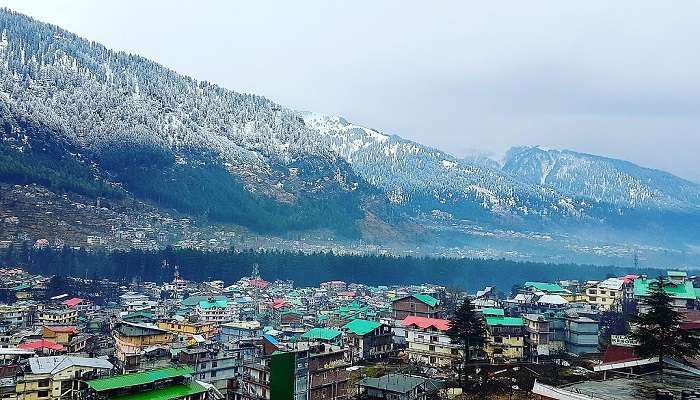


The Manali to Kaza distance is about 185 km via the Atal Tunnel, and on a good day the drive takes 9 to 12 hours in one push. That single stretch climbs from an alpine valley to a cold high-altitude desert, crosses Kunzum La at roughly 4,550 m, and runs on broken road for a solid 45 km in the middle. It is one of the finest road trips in India and one of the most demanding. This guide gives you the exact route, the 2026 road status, the real drive time, bus and taxi fares, permit rules, and a 2 to 3 day plan that keeps the trip safe and worth it.
Key takeaways
Manali to Kaza
Best Time
March - June
Select Package Type

3 Days & 2 Nights
₹9,043 /@pp
GET FREE QUOTE

.jpg?tr=w-600,h-300)

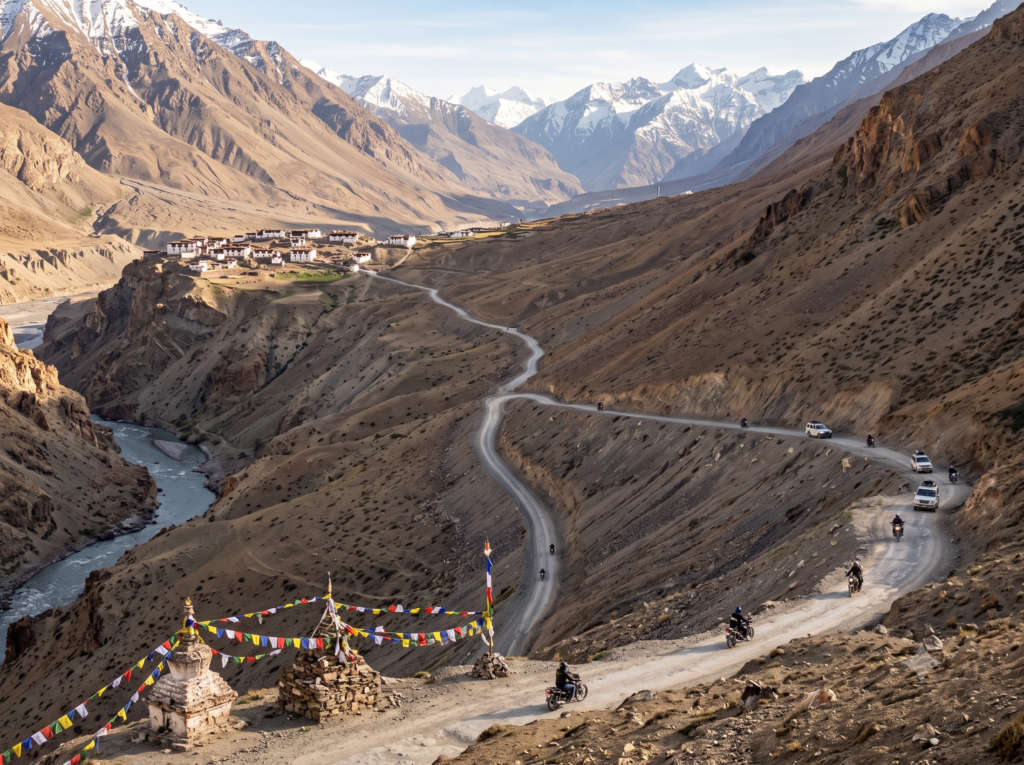
Here is the part that confuses most people first. Search the distance and you will see two different numbers, and both are right in their own way. The road you almost certainly want, through the Atal Tunnel, is about 185 km. The figure closer to 200-203 km that some map tools still show is the older alignment over Rohtang Pass, which the tunnel now bypasses. Since the Atal Tunnel opened in 2020, the tunnel route is shorter, quicker and open earlier in the season, so that is the one drivers use.
The route runs Manali to the Atal Tunnel (a 9.02 km tunnel under the Rohtang ridge), on to Gramphu, then the long unpaved run through Chhatru, Chhota Dhara and Batal, up over Kunzum La, down to Losar and finally along the Spiti river to Kaza on NH505. The table below breaks it into legs with per-leg and running distance, so you can plan fuel, breaks and daylight.
Distance by segment (via the Atal Tunnel):
| Segment | This leg (km) | Cumulative (km) | Surface |
| Manali to Atal Tunnel (south portal) | ~25 | 25 | Paved highway (NH3) |
| Atal Tunnel to Sissu | ~15 | 40 | Paved |
| Sissu to Gramphu | ~16 | 56 | Paved, then junction for Spiti |
| Gramphu to Chhatru | ~16 | 72 | Rough, gravel, water crossings |
| Chhatru to Chhota Dhara | ~16 | 88 | Rough, gravel, water crossings |
| Chhota Dhara to Batal | ~15 | 103 | Rough, boulders, stream fords |
| Batal to Kunzum La | ~12 | 115 | Gravel switchbacks |
| Kunzum La to Losar | ~19 | 134 | Mixed, improving |
| Losar to Kaza | ~51 | 185 | Mostly paved (NH505) |
The middle stretch from Gramphu to Batal, roughly 45 km, is the one that sets the pace. It is unpaved, crossed by snow-melt streams and prone to landslides, so an honest average is closer to 20 kmph there even in a capable vehicle. A short detour from Batal takes you to Chandratal Lake, about 14 km off the main road, which is why many drivers break the journey here rather than push straight through.
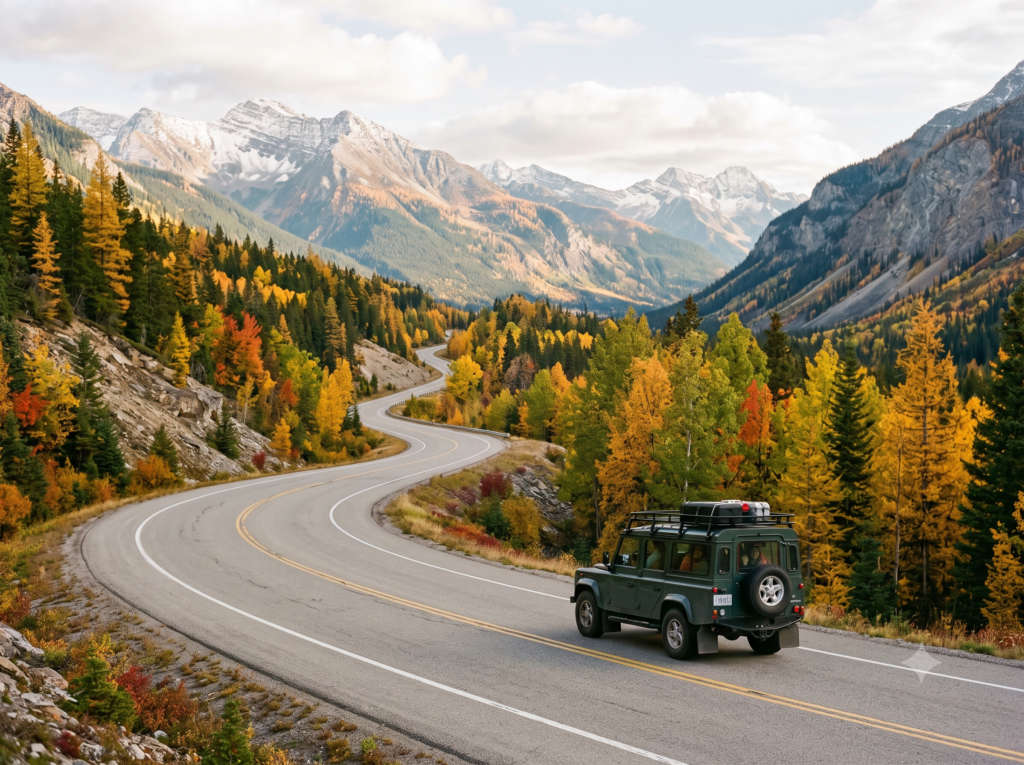
This road is seasonal, and the season is short. The Border Roads Organisation clears snow off Kunzum La from both sides through spring, and in 2026 the pass opened to traffic in the second half of May, in line with the 24 May opening the year before. Regular cars are better off waiting until mid-June, when the early-season snow walls and stream crossings settle. The road stays open until the first heavy snowfall shuts Kunzum La again, usually around late October or early November.
Month-by-month, this is what to expect on the ground:
| Period | Road status | What to expect |
| Late May to early June | Just opened, 4×4 only | Snow walls at Kunzum, cold, high streams. For experienced drivers. |
| Mid-June to early July | Open, settling | The sweet spot early in the season. Fewer vehicles, greener Lahaul. |
| Mid-July to August | Open, monsoon caution | Water crossings on Gramphu-Batal run high by afternoon. Landslide risk. Spiti itself stays dry. |
| September | Open, best month | Clear skies, firm ground, the sharpest mountain views of the year. |
| Early to mid-October | Open, cold and dry | Golden Spiti, thin crowds. Watch the forecast for the first snow. |
| Late October to April | Closed at Kunzum La | The direct route shuts. Kaza is reachable only from the Shimla-Kinnaur side. |
During the monsoon the water crossings between Gramphu and Batal are lowest before about 10 AM and deepen through the afternoon as the snow melts, so start early and cross the tricky nalas in the morning. If you are travelling in the shoulder weeks, check a current-day status update before you leave Manali. For the wider seasonal picture across the valley, see the best time to visit Spiti guide.
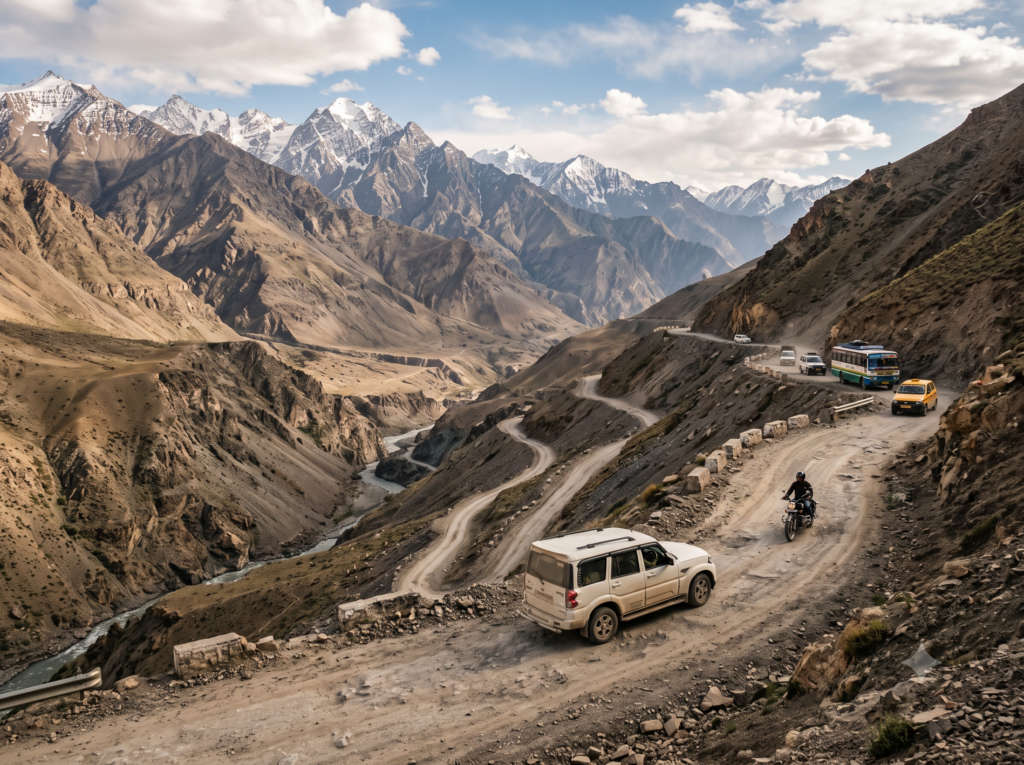
There is no single right way to do this drive. It depends on your budget, your comfort with rough mountain roads and how many days you have. Here is how the four common options compare before the detail.
| Option | Rough cost | Time | Best for |
| HRTC ordinary bus | Rs 400-600 per person | 9-12 hrs | Solo and budget travellers, no driving stress |
| Shared taxi / cab | Rs 1,000-1,500 per seat | 9-11 hrs | Splitting cost, no self-drive |
| Private taxi (full) | Rs 9,000-14,000 per vehicle | Flexible, 2 days | Families, stopping where you like |
| Self-drive SUV / 4×4 | Fuel + rental | 2 days ideal | Control, Chandratal detour, photography |
| Motorbike (350cc+) | Fuel + rental | 2 days ideal | Riders after the classic experience |
By bus
The Himachal Road Transport Corporation runs an ordinary bus between Manali and Kaza during the summer window, roughly mid-June to early October. It leaves Manali early, usually between 5:00 and 6:00 AM, and reaches Kaza the same afternoon after 9 to 12 hours through Gramphu, Batal and Losar. The fare sits around Rs 400 to 600. There is no online booking, so buy the ticket at the Manali bus stand a day ahead and reach early for a seat, and always confirm the service is running for your date because road conditions can pause it.
By taxi
Shared cabs run the route in season and cost roughly Rs 1,000 to 1,500 per seat, filling up at the taxi stand in the morning. A full private taxi for the day, or over two days with a Chandratal night, runs about Rs 9,000 to 14,000 depending on the vehicle and your bargaining. Insist on a driver who knows the Gramphu to Batal section and a high-clearance vehicle.
By self-drive or bike
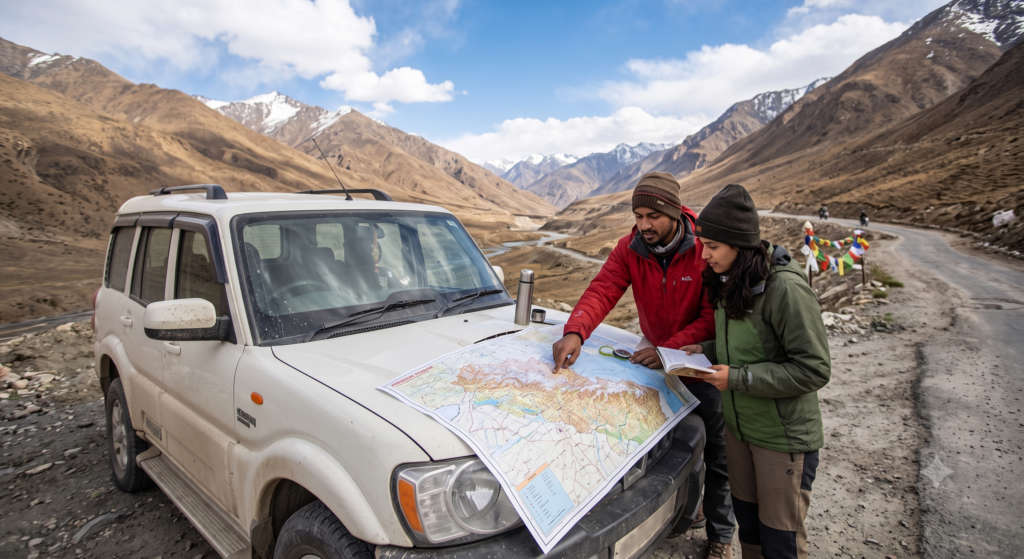
This is the route most road-trippers dream of, and it rewards the right vehicle. A high-clearance SUV or a proper 4×4 handles the broken middle stretch and the stream crossings far better than a hatchback, which can bottom out or stall in the fords. On two wheels, a 350cc or larger motorcycle with good tyres is plenty. The advice you may have read about needing a 750cc bike is overkill, and Royal Enfield 350s make this trip every season. Whatever you drive, do not attempt Gramphu to Batal after heavy afternoon rain.
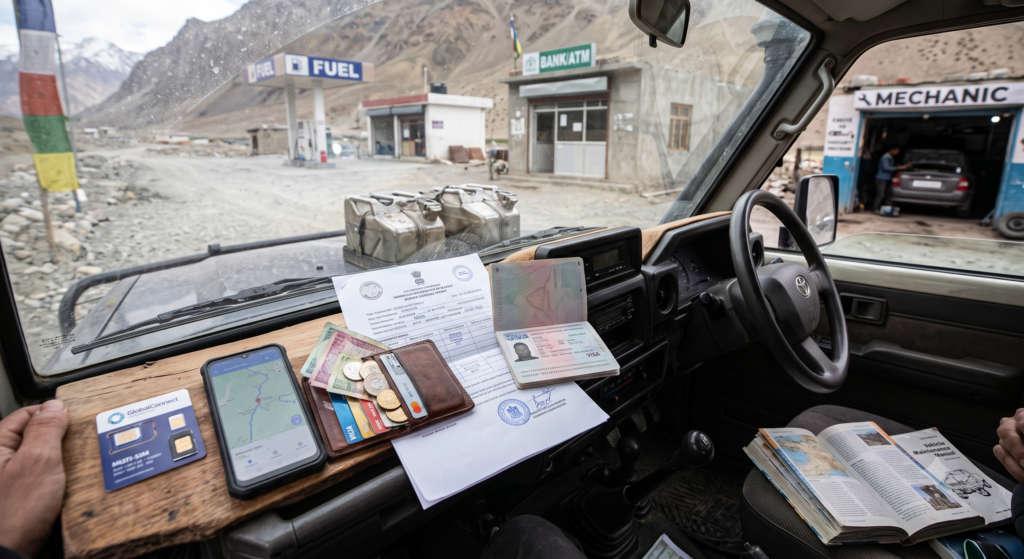
The reason this drive needs planning is that the middle of it has almost no services. Sort these five things in Manali and you remove most of what goes wrong.
Money and time. Indian citizens need no permit for Kaza or the core Spiti route, only a valid photo ID for the checkposts. Foreign nationals need a Protected Area Permit for the restricted stretches near the border, a small government fee of about Rs 200 to 250. Full detail sits in the Spiti travel guide.
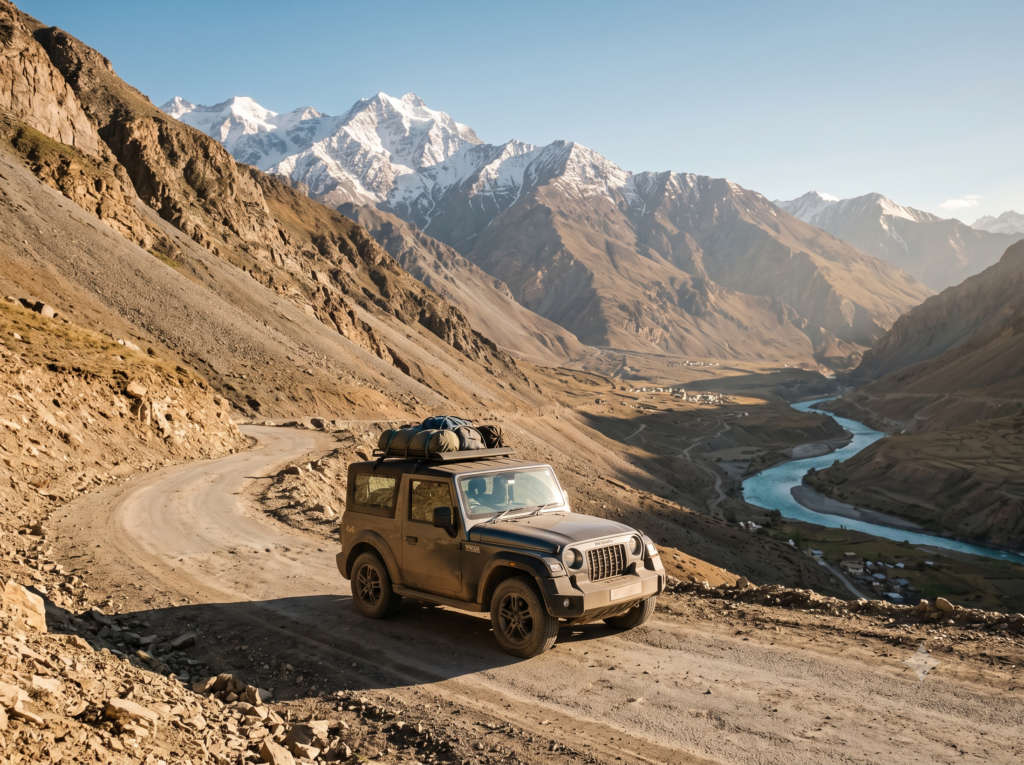
You can do Manali to Kaza in a single long day, but at this altitude that is hard on your body and leaves no room for the road to misbehave. Splitting it over two or three days lets you acclimatise, see Chandratal, and reach Kaza with something left in the tank. Here is the plan I use.
Day 1: Manali to Chandratal or Batal
Leave Manali by 7:00 AM. Take the Gurudwara road onto NH3 and through the Atal Tunnel, which drops you into the Lahaul valley in minutes rather than the old two-hour Rohtang crawl. Stop for breakfast around Chhatru, where the dhabas do hot thukpa and momos. Push on through Chhota Dhara to Batal, then take the 14 km detour to Chandratal for the night at one of the seasonal camps (roughly Rs 1,500 to 2,500 per person with meals). Sleeping near 4,270 m helps you acclimatise before Kaza.
Day 2: Chandratal to Kaza via Kunzum La
Rejoin the main road at Batal and climb the gravel switchbacks to Kunzum La at about 4,550 m. Take the customary slow circle at the Kunzum Mata temple, then descend to Losar, the first Spiti village, where you can grab a warm lunch. From Losar the road smooths out onto NH505 for the run to Kaza past Hansa and Kyato. Reach Kaza by mid-afternoon, settle into a homestay, and let your body adjust before doing more.
Day 3: Around Kaza
Give Kaza a full day. Ride up to the Key Monastery, the thousand-year-old cluster of whitewashed rooms stacked on a hill that is the picture everyone knows of Spiti. Carry on to Langza with its giant Buddha statue and fossil fields, Komic (among the highest villages reachable by road), and Hikkim, home to the world’s highest post office, where you can actually post a card. Come back through the Kaza market. For more ideas, see our guide to Kaza in Himachal Pradesh.
If you do these six things in order, the trip mostly plans itself.
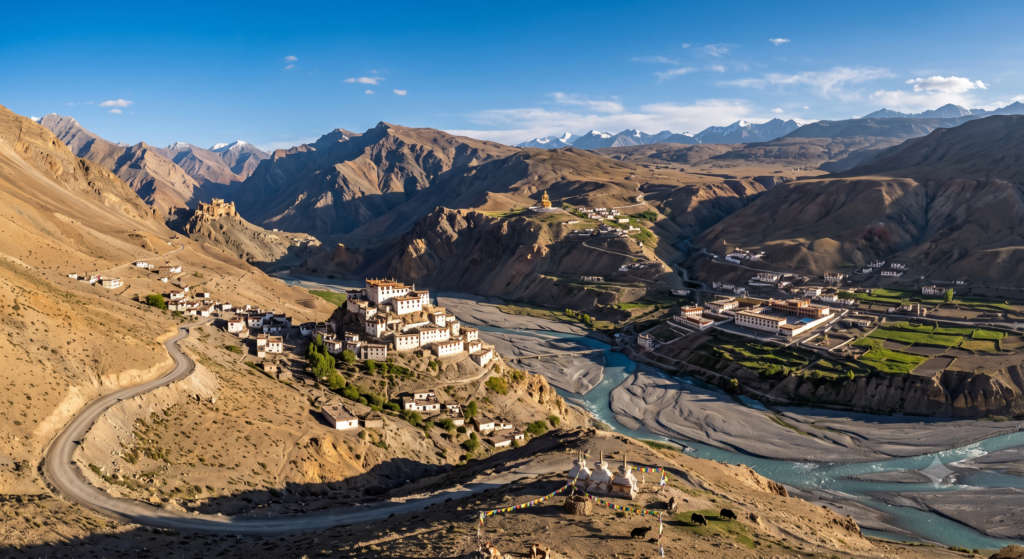
The road itself is the attraction, but a few stops are worth building in. Kunzum La marks your crossing into Spiti and is where the landscape turns to cold desert. Chandratal, the crescent-shaped lake off Batal, is the standout overnight. Around Kaza, the Key Monastery, Langza, Komic and Hikkim make an easy day loop. To go deeper, browse our full list of places to visit in Spiti Valley rather than cramming them all into one drive.
Manali to Kaza is a short distance on paper and a big drive in practice: about 185 km, a full day at the wheel, and one high pass that only opens for a few months. Time it for the open window, take the right vehicle, and split the drive so the altitude works with you rather than against you. If you would rather leave the logistics, permits and vehicle to someone who runs this route every season, browse our Spiti Valley tour packages and wider Himachal tour packages to build a trip around it.
The Manali to Kaza distance is about 185 km via the Atal Tunnel, which is the route almost everyone drives now. Some maps show close to 200-203 km because they still use the older Rohtang Pass alignment that the tunnel bypasses. For planning fuel and daylight, work with roughly 185 km and 9 to 12 hours of driving.
Plan for 9 to 12 hours to drive it in one day, and expect the longer end early in the season or after rain. The 45 km of unpaved road between Gramphu and Batal slows you to around 20 kmph, so it eats far more time than the distance suggests. Most travellers split the trip over two days with a night near Chandratal.
The road is seasonal. The Border Roads Organisation clears Kunzum La through spring, and in 2026 it opened to traffic in the second half of May. It is settled enough for regular cars from mid-June and stays open until the first heavy snow, usually late October or early November. Check a current-day status update before you leave Manali.
Indian citizens need no permit for Kaza or the core Spiti route, only a valid photo ID for the checkposts. Foreign nationals need a Protected Area Permit for the restricted stretches near the border, which costs a small government fee of about Rs 200 to 250 and is quick to arrange.
Yes. HRTC runs an ordinary bus in the summer window, roughly mid-June to early October. It leaves Manali early, usually between 5:00 and 6:00 AM, and reaches Kaza the same afternoon in 9 to 12 hours. The fare is around Rs 400 to 600, there is no online booking, and you should always confirm it is running for your date.
There are none on the direct route. Fill your tank in Manali, carry 5 to 10 litres spare, and the next reliable pump is in Kaza. For money, carry enough cash from Manali, because ATMs only exist in Kaza and are frequently out of service or offline.
It is safe with the right vehicle and sensible timing, but it is a demanding high-altitude road, not a casual drive. A high-clearance SUV or a 4x4 handles the Gramphu-Batal section and the stream crossings comfortably, while a low hatchback can struggle. On a bike, a 350cc or larger machine is ideal. Cross the water crossings in the morning and avoid the rough stretch after heavy rain.
Mid-June to mid-October is the open window. September is the best single month for clear skies, firm ground and the sharpest views. Mid-July to August brings the monsoon, which raises the water crossings and the landslide risk, though Spiti itself stays dry in the rain shadow.
Real reviews from real travelers who booked with us.
View All Reviews