4D / 3N
17% OFF
Manali-Kasol Tour Package by Cab for Himachal (4D/3N) - At A Glance
- Hotel
- Meals
- Sightseeing
- Entry Tickets
- Cab Transfer
₹12,688
₹10,500 /pp
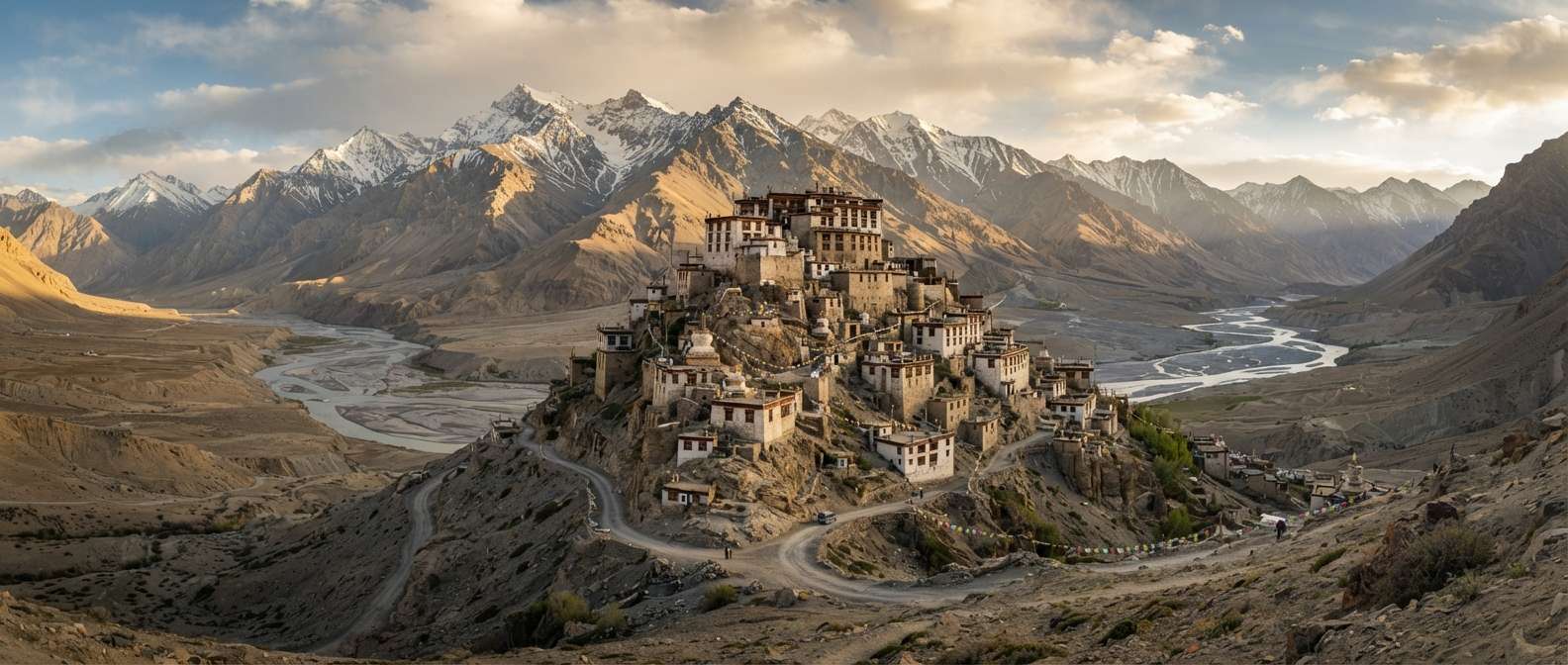


This guide covers both approaches to the Spiti circuit: the gradual Shimla to Kinnaur to Kaza route that lets you acclimatise, and the harder Manali crossing over Kunzum La once the Border Roads Organisation reopens it. Every altitude, distance and season below is checked against current sources.
The best things to do in Spiti Valley run from white-knuckle to deeply quiet, often in the same afternoon. You can walk across Chicham Bridge, Asia’s highest suspension bridge at 13,596 feet, then sit through evening prayers at a 1,000-year-old monastery two hours later. Spiti is a cold desert wedged between Kinnaur and Ladakh, roughly 3,800 metres up, and it packs river rafting, high-pass drives, fossil hunting, star-heavy night skies and the world’s highest post office into one week-long loop. This guide curates 18 experiences that are actually worth your limited time at altitude, grouped by theme, with the best season and difficulty for each. For a place-by-place breakdown of where to base yourself, pair it with our guide to places to visit in Spiti Valley.
Things to do in Spiti Valley
Best Time
May - October
Select Package Type

3 Days & 2 Nights
₹9,043 /@pp
GET FREE QUOTE

9 Days & 8 Nights
₹36,484 /@pp
GET FREE QUOTE

A quick reference to plan around the weather and your fitness. Altitudes are rounded; confirm current road status before you set out, because high-altitude access shifts year to year.
| Thing to do | Best season | Difficulty | Where | Approx altitude |
|---|---|---|---|---|
| Cross Chicham Bridge (Asia’s highest) | May-Oct | Easy | Kibber to Chicham | 13,596 ft |
| Camp near Chandratal (Moon Lake) | Jun-Sep | Easy to moderate | off Kunzum La | 14,100 ft / 4,300 m |
| Drive Kunzum La pass | Jun-Oct | Easy (by vehicle) | Lahaul-Spiti border | 14,931 ft / 4,551 m |
| Visit Key Monastery | May-Oct | Easy | 12 km from Kaza | 13,668 ft / 4,166 m |
| See Tabo Monastery (1,000+ years) | Year-round road | Easy | Tabo | 10,010 ft / 3,050 m |
| Trek to Dhankar Lake | Jun-Sep | Moderate | above Dhankar | 13,580 ft / 4,140 m |
| World’s highest post office | May-Oct | Easy | Hikkim | 14,567 ft / 4,440 m |
| Komik village + Tangyud Monastery | May-Oct | Easy | Komik | 15,049 ft / 4,587 m |
| Fossil hunting + giant Buddha | May-Oct | Easy | Langza | 14,500 ft / 4,420 m |
| See the Giu mummy | May-Oct | Easy | Giu, near Sumdo | 10,500 ft / 3,200 m |
| River rafting on the Spiti | Jun-Sep | Moderate | Rangrik to Sichling stretch near Kaza | 10,000 ft / 3,050 m |
| Stargazing and night skies | May-Oct (clear) | Easy | Langza / Kaza / Komik | 12,500 ft+ |
| Cycle or bike to Pin Valley | Jun-Sep | Hard | Pin Valley (Mudh) | 12,000 ft / 3,650 m |
| Wildlife in Pin Valley N.P. | Jun-Sep; winter for leopard | Moderate | Pin Valley | 11,500 ft+ |
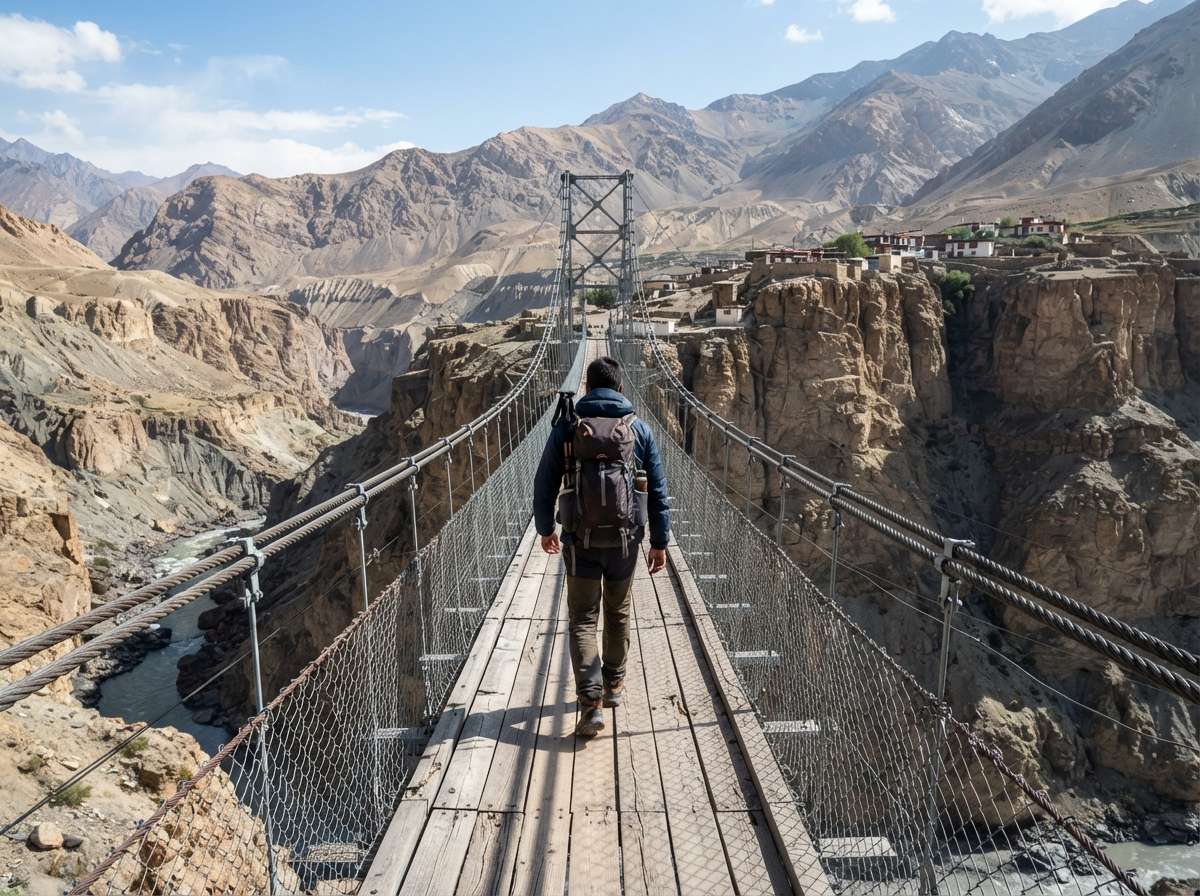
If you searched for spiti adventure, this is your section. Spiti is not a soft destination. The air is thin, the roads are raw, and the payoff is a kind of thrill you do not get on a resort holiday. Start with the marquee one.
The Chicham Bridge connects the villages of Kibber and Chicham across a gorge that drops close to 1,000 feet to the Samba Lamba stream below. At 13,596 feet it is rated Asia’s highest suspension bridge, and it opened in 2017 after years of construction that ended the old, terrifying ropeway trolley locals once used to cross. Walk to the middle, look down, and you understand Spiti in one glance. It is about 20 km from Kaza and pairs naturally with a morning at Kibber.
On the upper Spiti River near Kaza, roughly around the Rangrik to Sichling stretch, the river opens up for rafting when snowmelt swells it from June to September. It is cold, glacier-fed and moderate in grade, less about big rapids and more about running a turquoise river through a bare brown canyon with nobody else around. Operators run short stretches out of Kaza in the summer months.
The ride into Pin Valley, ending at the last village of Mudh, is one of the best rides in the Indian Himalaya. Cyclists take it on as a hard, high-altitude test; motorcyclists treat the whole Spiti loop as a bucket-list circuit. Either way the green Pin Valley floor against grey peaks is a jarring, welcome change from the rest of the cold desert.
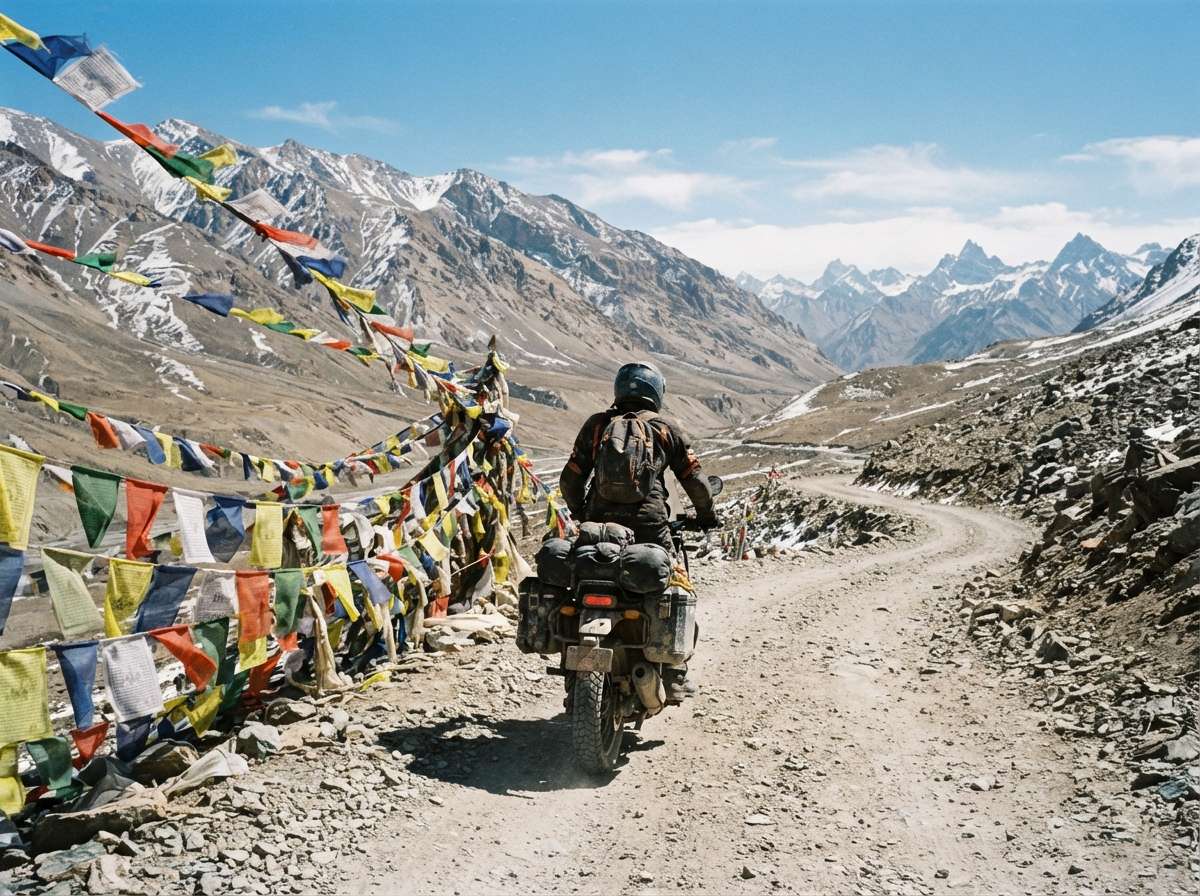
The drives are an activity in themselves. at 14,931 feet links Lahaul with Spiti and is the gateway from the Manali side. The road to Chandratal branches off the Gramphu to Batal to Kaza road near Batal, just below , not from Baralacha La, which sits far to the north in Lahaul on the Manali to Leh highway. Both are only open in summer, roughly June to October, and both are pure white-knuckle mountain driving.
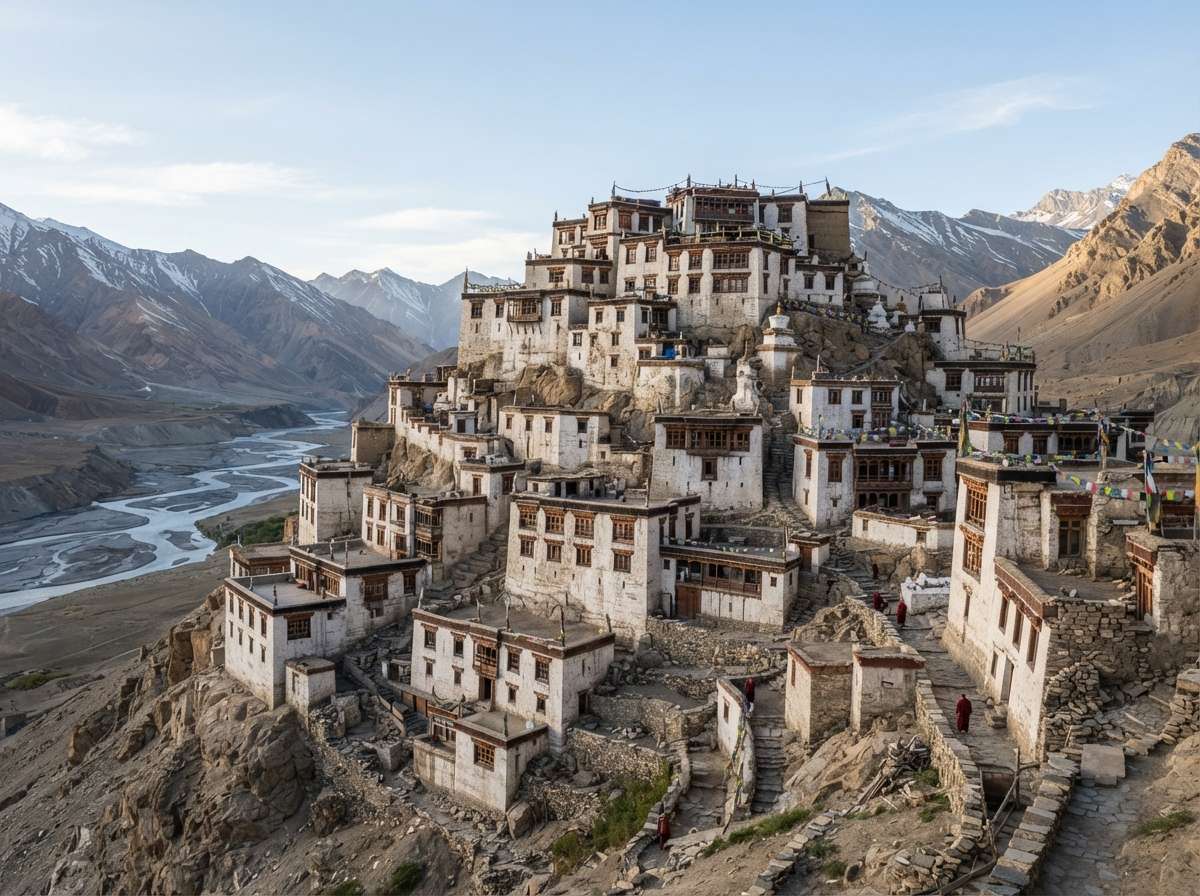
Spiti is one of the last strongholds of Tibetan Buddhism inside India, and its monasteries are living institutions, not museums. Time your visit for morning or evening prayers if you can.
Kye Gompa, usually written Key, is the largest monastery in Spiti, stacked like a fort on a hill at about 13,668 feet, 12 km from Kaza. It houses monks in training, ancient murals and thangkas, and the single most photographed skyline in the valley. Stay for a cup of butter tea in the kitchen if you are invited.
Founded in 996 CE, Tabo is over a thousand years old and often called the Ajanta of the Himalayas for its cave shrines and wall paintings. The Dalai Lama has said he would like to retire here. Its road stays open much of the year, which makes it one of the few Spiti sights you can reach even in the shoulder season.
Dhankar clings to a crag between the Spiti and Pin rivers and was once the valley’s capital. Kungri, in Pin Valley, is the Nyingma-order monastery known for its Devil Dance. Tangyud Monastery at Komik sits beside one of the world’s highest villages reachable by road. And Lhalung, the Golden Temple in the Lingti valley, is a quieter stop most itineraries skip. Between them you get the full sweep of Spiti’s Buddhist heritage.
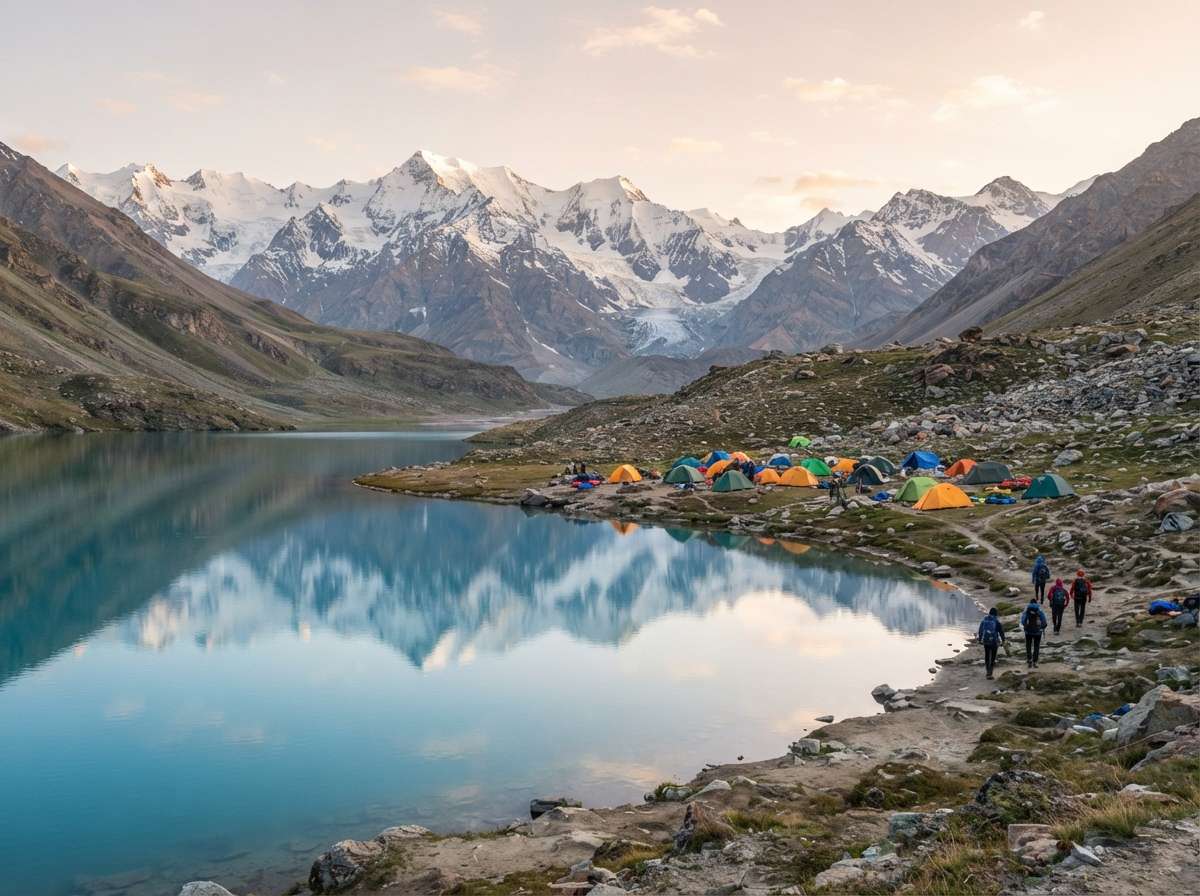 Camp near Chandratal, the Moon Lake
Chandratal, the crescent-shaped Moon Lake, sits at roughly 14,100 feet off the Kunzum route. Camps now pitch a few kilometres back from the shore under conservation rules, so plan a short walk in to the water. The lake changes colour through the day and the night sky above it is astonishing. It is reachable only from about June to September, once Kunzum La is open.
A steady one to one-and-a-half hour climb above Dhankar Monastery brings you to Dhankar Lake at about 13,580 feet, a still green tarn ringed by peaks. It is a moderate trek that repays the effort with silence and one of the best-value views in Spiti. Go slow, the altitude is real.
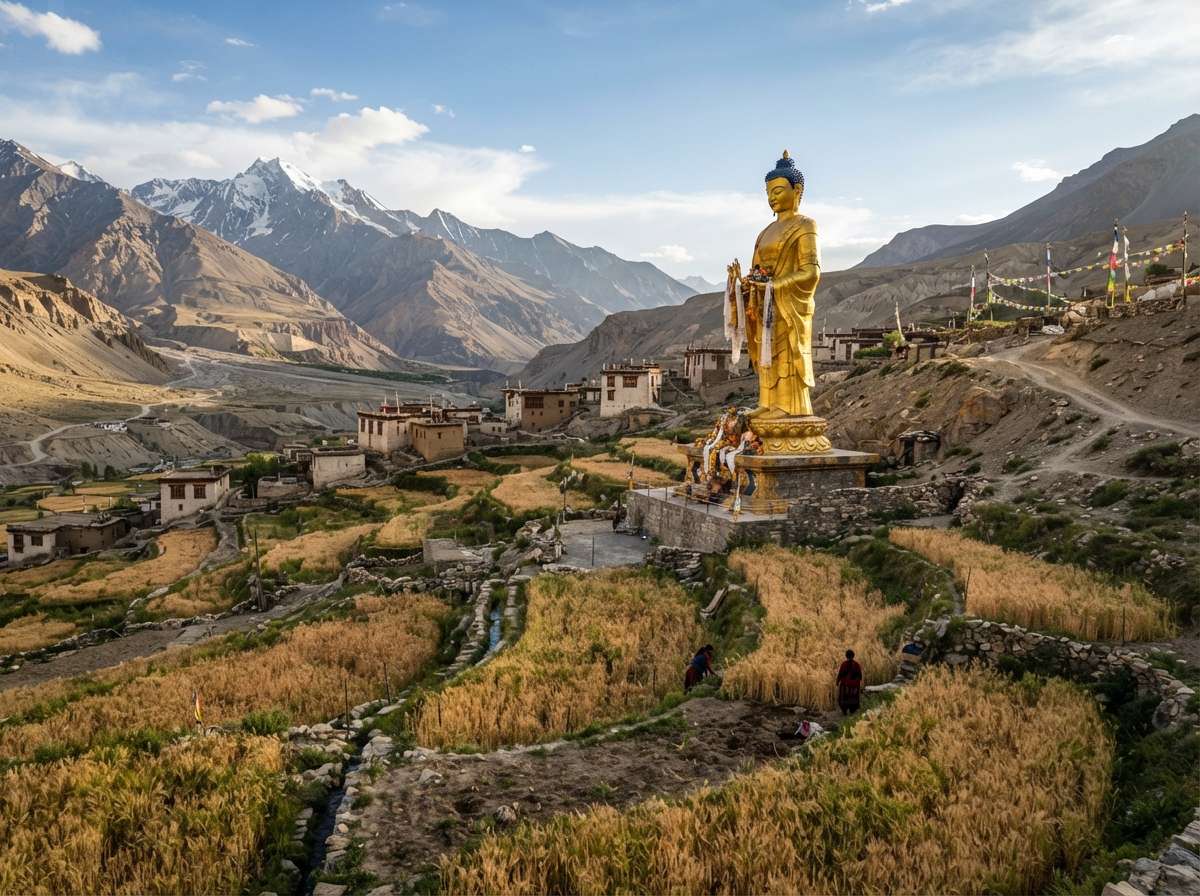
Langza, at about 4,420 metres, is famous for two things: a giant golden Buddha statue watching over the village, and marine fossils. This whole plateau was once the floor of the ancient Tethys Sea, so ammonite fossils turn up in the soil. Collecting, buying or removing these fossils is illegal under the Antiquities and Art Treasures Act, so do not buy them from local children or take any from the ground. Look, photograph and leave the fragile sites exactly as you found them.
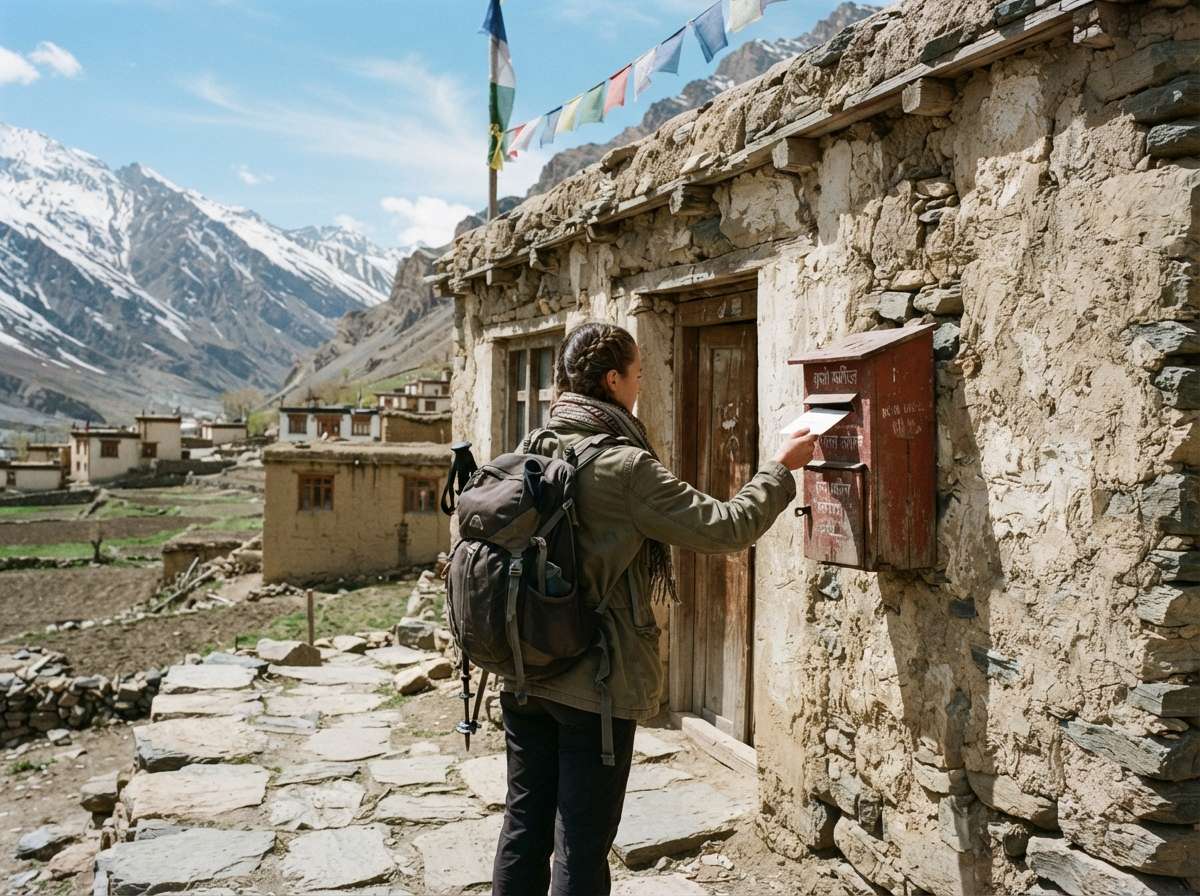
Hikkim runs the highest post office in the world at 14,567 feet, PIN code 172114. Write a postcard, hand it over, and it works its way down the mountain into the regular postal system. It is a small, genuinely moving thing to do, and the view on the way up is worth the drive on its own.
Komik, at about 15,049 feet, is billed as among the highest villages in the world connected by a motorable road. Kibber is a high village and a base for snow leopard sightings in winter. And in Giu, near the Sumdo checkpost, a naturally preserved monk’s mummy, said to be around 500 years old, still sits in a small shrine, teeth and hair intact. Note that these three lie in different directions from Kaza, so they do not make a single easy day out. Komik pairs naturally with Langza and Hikkim on the high plateau, Kibber with Key Monastery and Chicham Bridge to the north, while Giu sits well to the southeast near Sumdo and is best visited while travelling the Tabo to Kaza stretch.
Kaza’s little market is the place to restock, sip coffee, buy Spiti wool and swap road notes with other travellers. Sleep at a village homestay in Langza, Kibber or Mudh to actually understand the rhythm of life here. And on the way in from Kinnaur, Nako village and its lake make a natural first-night halt to break the climb.
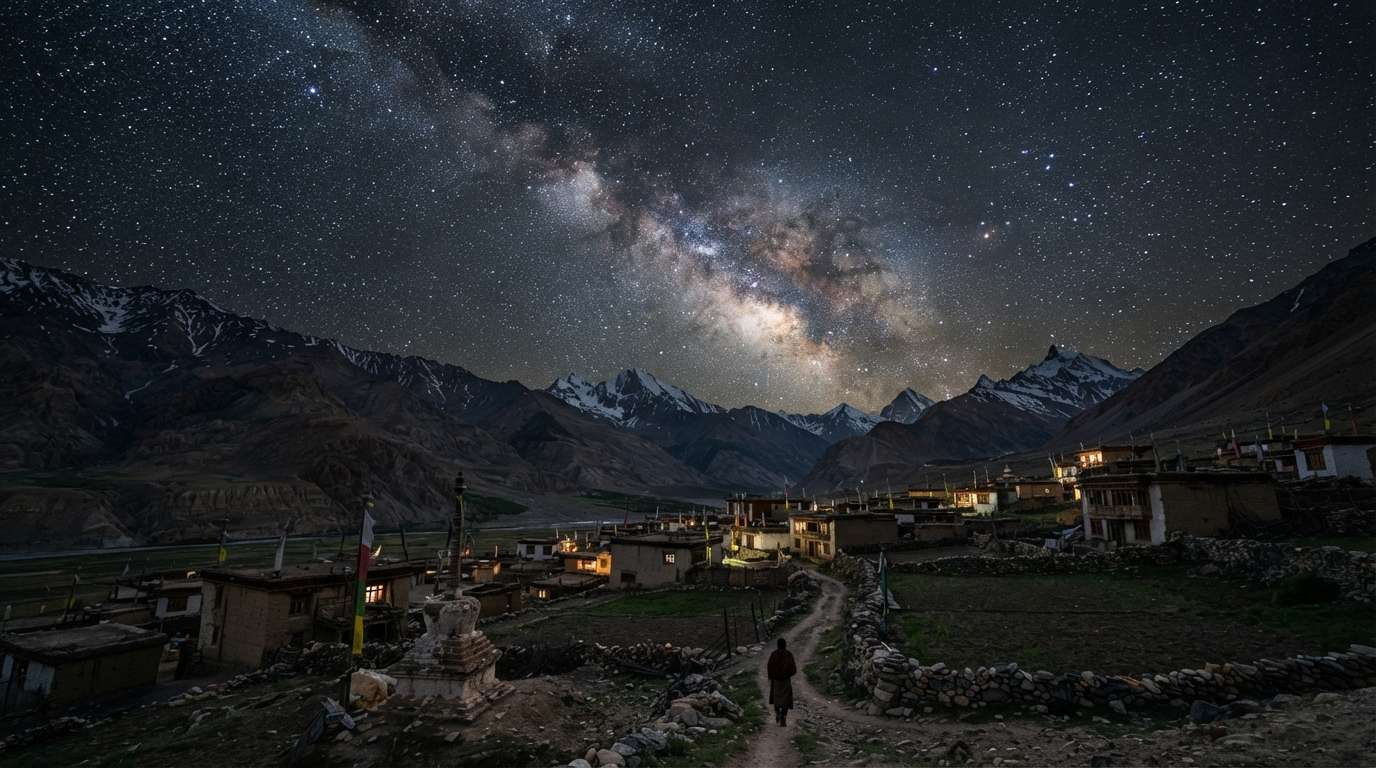
If you searched night spiti valley, Spiti is one of the darkest, clearest night skies you can drive to in India. From Langza, Kaza or Komik on a clear night the Milky Way is plainly visible, no telescope needed. Astro-photographers plan whole trips around the new moon here.
By day, add the offbeat touches the fly-through itineraries miss. Take a short yak safari around Langza or Kibber. Walk out for a full-moon evening by the Spiti River. Sit with the meditating nuns near villages like Fukchung if your route allows. These are the moments regular travellers remember longest, and they cost almost nothing but time.
The single biggest planning decision is which side you enter from. It changes your safety, your season and your whole trip. Here is the honest comparison.
| Factor | Via Shimla (Kinnaur side) | Via Manali (Kunzum side) |
|---|---|---|
| Altitude gain | Gradual, over 2 days (kinder on AMS) | Steep, in one day over Kunzum La |
| Open season | Almost year-round to Kaza | June to October only |
| Road character | Longer, more distance, better acclimatisation | Shorter, rougher, includes Kunzum + Chandratal |
| Best for | First-timers, families, AMS-cautious | Experienced road-trippers chasing Chandratal |
| Typical drive to Kaza | About 2 days from Shimla | 8 to 10 hours from Manali (when open) |
The travellers who enjoy Spiti most do the full loop: in via Shimla to acclimatise, out via Manali once Kunzum La opens. It gives you the safe climb and the dramatic descent, and you never repeat a road.
Spiti is hard-seasonal. What you can do depends entirely on the month, because the Manali side and the high passes are shut for much of the year. This is why the same searcher asks about spiti in June, in July and in winter, and gets a different answer each time.
| When | Conditions | What to do |
|---|---|---|
| Mar-Apr | Shimla side thawing; Kunzum shut; very cold | Tabo and Dhankar monasteries, snow-leopard photography tours |
| May | Shimla-Kaza open; Kunzum + Chandratal still shut | Villages, Chicham, Hikkim, Komik, Key Monastery |
| June | Full circuit opens; passes accessible | Chandratal camping, high passes, rafting, things to do in Spiti in June |
| July | Peak circuit; occasional rain-triggered blocks | Chandratal, Pin Valley trek, cycling, things to do in Spiti in July |
| August | Green Pin Valley; watch the monsoon | Pin Valley, local festivals, rafting |
| Sep-Oct | Clear skies, golden light, thinning crowds | Best photography and stargazing; circuit closes by late Oct |
| Nov-Feb | Deep winter; Manali side shut; villages snowbound | Winter Spiti via Shimla, frozen waterfalls, snow-leopard expeditions |
A simple sequence that keeps you safe at altitude and lets you fit the most in.
Spiti rewards travellers who treat it as a slow, high-altitude circuit rather than a checklist. Pick the loop, respect the season, give the mountains a couple of extra days, and these 18 experiences fall into place naturally. When you are ready to turn the plan into dates, our Spiti Valley tour packages bundle the route, homestays and a local driver so you can focus on the valley, and the Spiti tourism guide and our how to reach Spiti page cover the logistics in depth.
Plan 7 to 9 days for the full circuit. Spiti has two approaches, one from Shimla and Kinnaur, the other from Manali over Kunzum La, and covering the whole loop with time to acclimatise takes roughly a week. A shorter 5 to 6 day trip works if you enter and exit from the same side, usually Shimla, but you will miss Chandratal and the Manali crossing.
Spiti is famous for being a high-altitude cold desert of ancient Tibetan-Buddhist monasteries, record-setting villages and raw mountain roads. Its headline sights include Key and Tabo monasteries, Chandratal lake, the world's highest post office at Hikkim, Asia's highest bridge at Chicham, and some of the clearest night skies in India.
The Shimla-to-Kaza road is open almost year-round, so the Kinnaur side and its monasteries are reachable from roughly April onwards. The full circuit, including Kunzum La and Chandratal from the Manali side, opens only around June and stays open to about October. June to September is the best time for the complete loop; May and October are quieter and suit the Shimla-side villages.
Yes. You can drive in from Shimla via Kinnaur, which takes about two days to Kaza and gains height gradually, or from Manali over Kunzum La in roughly 8 to 10 hours when the pass is open. A high-clearance vehicle is strongly advised; the roads include water crossings, loose gravel and steep sections. Many travellers hire a local driver who knows the conditions.
From Manali the road now runs through the Atal Tunnel to Gramphu before climbing to Kunzum La, which bypasses the old Rohtang Pass crossing. [VERIFY: whether online vehicle registration on the Himachal e-Aagman portal is currently required to enter Lahaul and Spiti - confirm the live rule before publishing]
Indian citizens do not need any Inner Line Permit for Spiti or Kinnaur. Just carry a valid photo ID, such as an Aadhaar card, voter ID or passport, for registration at the Jangi and Sumdo checkposts. Foreign nationals must obtain a Protected Area Permit to enter Spiti, as the region shares a sensitive border. Confirm the current rule with the Lahaul and Spiti district administration before you travel. [VERIFY: foreign-national PAP rule for Spiti - some sources say a foreigner cannot get a PAP solo and must apply as a group of 2+ through a registered Indian travel agency; confirm the current MHA/HP requirement with the Lahaul & Spiti district administration] [VERIFY: current checkpost names/locations - the Kinnaur-side checkpost may have moved from Jangi to Dubling; confirm the active registration checkposts before publishing]
Yes, Spiti is considered one of the safer Himalayan regions for solo and women travellers, with tight-knit villages and a strong homestay culture. The real risks are natural, not human: altitude sickness, thin mobile network, few ATMs and long gaps between fuel stops. Travel with acclimatisation time, keep some cash, share your route with someone, and you can comfortably do Spiti alone.
Pack for cold nights even in summer: thermal layers, a warm jacket, gloves, a windproof shell, sturdy shoes and a good sleeping bag if you plan to camp. Add strong sunscreen and sunglasses for the high-altitude glare, a refillable water bottle, a power bank, offline maps, plenty of cash, and any AMS medication your doctor recommends. Lip balm and moisturiser matter more than you think in the dry desert air.
For adventure, cross Chicham Bridge, raft the Spiti River, cycle or bike to Pin Valley, and drive the high passes. For offbeat, spend a night at a Langza or Komik homestay, hunt fossils, post a letter from Hikkim, stargaze from the darkest villages, and take a short yak safari. The valley rewards travellers who slow down and go a little beyond the standard Key-Chandratal loop.
Ascend gradually, which is the main reason to enter via Shimla rather than jumping straight over Kunzum La from Manali. Spend your first night lower, around Kalpa or Nako, before sleeping at Kaza's 3,800 metres. Hydrate constantly, avoid alcohol on arrival, climb high but sleep low, and build in a rest day. If headaches or breathlessness worsen, descend. Ask a doctor about preventive medication before you go.
Real reviews from real travelers who booked with us.
View All Reviews