
 8D / 7N
6% OFF


What Mihintale Is and Why It Matters
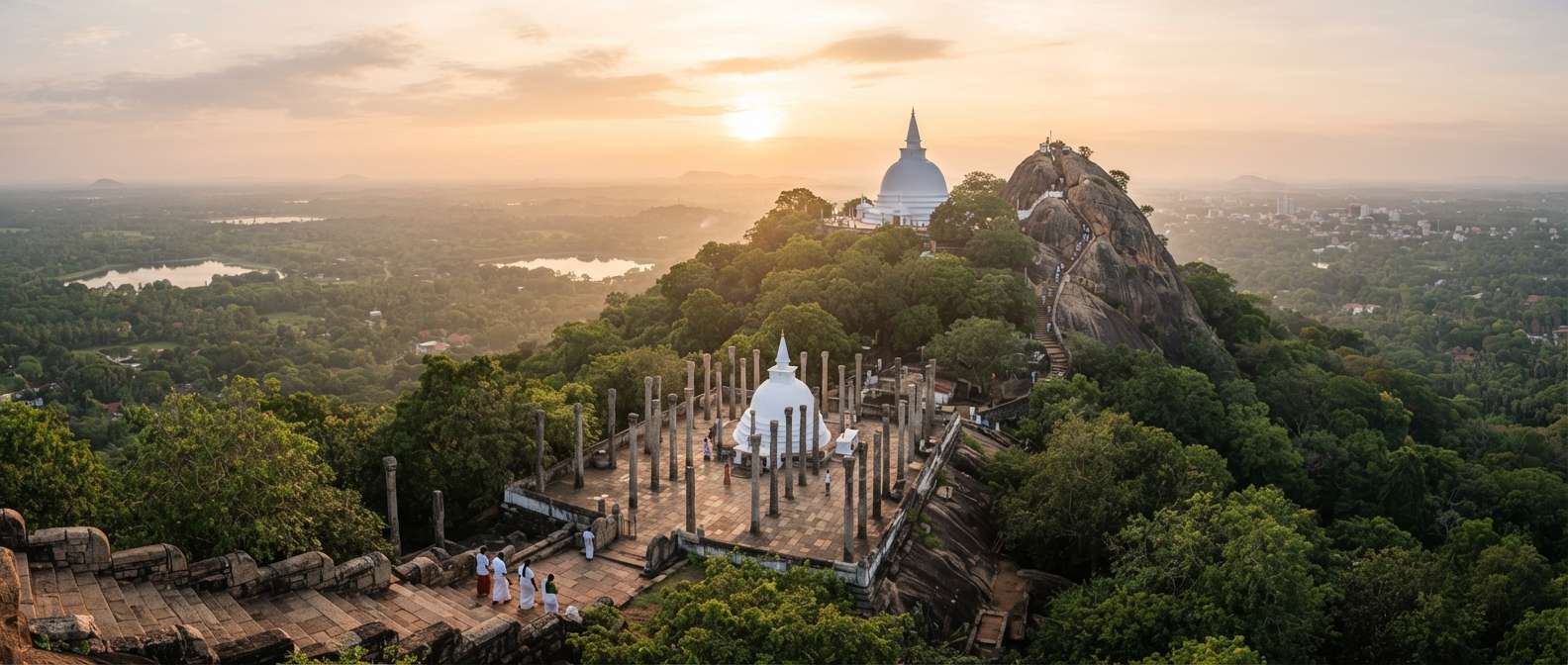
Mihintale is a sacred hill 12.5 km east of Anuradhapura where, according to the Mahavamsa chronicle, the monk Mahinda, son of India’s Emperor Ashoka, met King Devanampiya Tissa on a June full moon in about 247 BCE and brought Buddhism to Sri Lanka. That is why Sri Lankans call it the cradle of Buddhism on the island. You reach the summit by a granite stairway of 1,840 steps, passing a 9th-century monastery hospital, monks’ caves, carved ponds and three stupas on the way. Foreign adults pay a cash ticket at the middle terrace (LKR 2,000 on AmazingLanka’s 2026 fee list). Give it two to three hours, and start before 8 am, because the bare rock at the top gets hot enough to burn your feet by late morning.
Key Takeaways
- Park at the upper car park if you want to skip roughly 1,000 of the 1,840 steps. About 800 remain from there to the summit.
- Carry about LKR 2,000 per foreign adult in cash. Children under 12 and Sri Lankan citizens enter free, and there is no card machine.
- Climb before 8 am or after 4 pm, and pack thick socks. Shoes come off on the sacred upper terrace and the rock heats up fast.
- Pair Mihintale with Anuradhapura’s Sacred City on the same day. The two sites are a 25-minute tuk-tuk ride apart.
- Avoid Poson Poya (18 June 2027) unless you want the festival itself. Crowds then run into the hundreds of thousands.
Mihintale at a Glance
The table below covers the practical facts most visitors ask about first. Fees and hours change, so check the Sources list at the end for where each figure comes from.
| What you need to know | Details |
|---|---|
| Location | Anuradhapura District, North Central Province, beside the Anuradhapura to Trincomalee road (A12) |
| Distance from Anuradhapura | 12.5 km east, 20 to 25 minutes by tuk-tuk or car |
| Height | Main peak (Missaka Pabbata) about 300 m |
| Steps | 1,840 from the lower car park, about 800 from the upper car park |
| Entry fee | LKR 2,000 per foreign adult (12+), cash only. Free for under-12s and Sri Lankans |
| Opening hours | Ticketed area about 6 am to 6 pm daily. The temple stays open longer for worship |
| Time needed | 2 to 3 hours for the main hill, 3 to 4 hours with Kaludiya Pokuna and Indikatu Seya |
| Dress code | Shoulders and knees covered. Shoes and hats off on the upper terrace |
| Best months | January to April, June to September (dry). October to December brings the heaviest rain |
| Best time of day | 6 am to 8:30 am, or after 4 pm for sunset from Aradhana Gala |
| Guides | Guides wait near the ticket office. Not included in the ticket, so agree the fee first |
| Parking | Free at both car parks |
Sri Lanka
Sri Lanka
Where Buddhism reached Sri Lanka: entry fee, the 1,840-step climb, the sites and how to get there
Best Time
January - April
Select Package Type
Best Selling Packages


The Story of Mihintale: Mahinda, Ashoka and the King's Deer Hunt
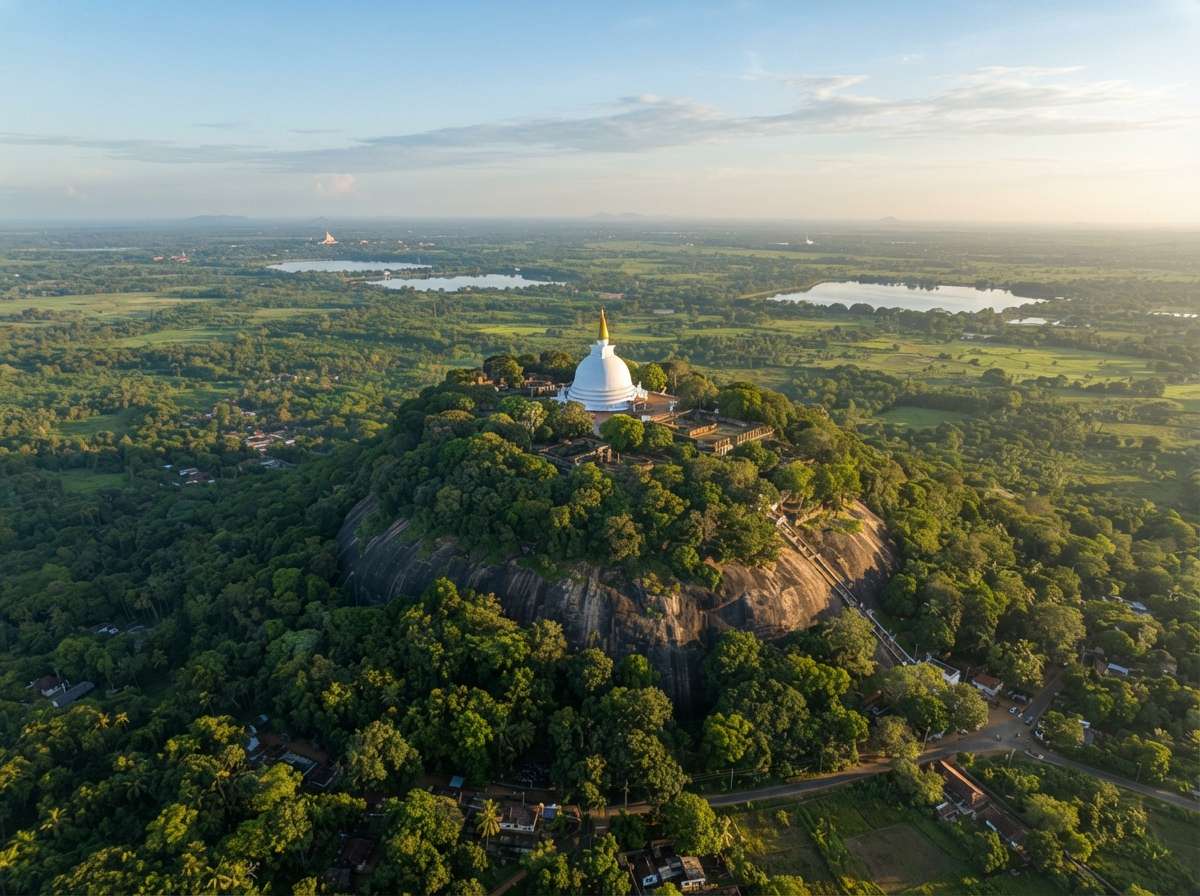
Mihintale matters because this is where Sri Lanka’s Buddhist history begins, and the story starts in India. Before Mahinda arrived, the hill was called Missaka Pabbata. The name Mihintale (Mihintalawa in Sinhala) simply means “Mahinda’s hill”.
Emperor Ashoka’s mission from India
After the Third Buddhist Council at Pataliputra (modern Patna), Emperor Ashoka sent missionary monks to nine regions, and he chose his own son, the monk Mahinda, to lead the mission to Lanka. Mahinda’s mother, Devi, came from Vidisha in present-day Madhya Pradesh. The Mahavamsa (chapter 13) says Mahinda stayed with her at the Vedisagiri monastery, near today’s Sanchi stupas, before he left for the island. For Indian travellers, that thread is the reason this hill feels familiar. It is the far end of a journey that began on the Ganges plain.
The Poson full moon meeting and the mango tree riddle
Tradition places the meeting on the full moon of the month of Poson, which falls in June. King Devanampiya Tissa was out hunting deer on the hill when a voice called him by name. He turned to find Mahinda and his companions standing on a rock. Before teaching him, Mahinda tested the king with a riddle about mango trees. He asked whether there were other mango trees besides the one in front of them, then other trees besides those, and so on, until the king worked out that the answer was “the tree itself”. Satisfied that the king could follow a reasoned argument, Mahinda preached to him, and the king and his court of about 40,000 followers accepted Buddhism, by the chronicle’s count. The spot is now the Ambasthala, the “mango tree plateau”, and Sri Lanka still marks the day as Poson Poya.
Sanghamitta and the Bodhi tree
Mahinda’s sister, the nun Sanghamitta, followed him from India with a sapling of the Bodhi tree from Bodh Gaya. It was planted in Anuradhapura and still grows there as the Jaya Sri Maha Bodhi, which Sri Lankans revere as the oldest documented tree planted by human hand. Most visitors see Mihintale and the Bodhi tree on the same day, which joins up both halves of the story.
Mihintale after the Anuradhapura kingdom
King Devanampiya Tissa built a monastery here and had 68 caves cut for monks, and later kings kept adding to it for more than a thousand years. The hospital, refectory and stone tablets you see today date from the 9th and 10th centuries, when Mihintale ran as a large, organised monastery. After Anuradhapura fell and the capital moved to Polonnaruwa, the jungle took over much of the site. It was cleared and excavated from the late 19th century onwards, and the Mihintale Raja Maha Viharaya still runs it as a working temple today.
After his conversion, the king is also said to have declared the area around Mihintale a protected zone where no animal could be killed, which is why Sri Lankans often call it the world’s first recorded wildlife sanctuary.
Is Mihintale Worth Visiting?
Yes, if you are already in Anuradhapura, Sigiriya or Dambulla. Mihintale gives you the founding story of Sri Lankan Buddhism, a 360-degree view over the dry-zone plains and their tanks, and a much quieter morning than Anuradhapura’s Sacred City or Sigiriya. The ticket costs a fraction of Sigiriya’s, and you can see the main hill in about two and a half hours.
The trade-offs are real, though. The climb is long and hot, the last stretch to Aradhana Gala is a steep scramble on worn rock with a handrail, and you walk barefoot on stone that can scorch by 11 am. Toque macaques patrol the car parks. And there is no lift, ramp or wheelchair route, so anyone with knee problems should plan on the upper car park only and stop at the Ambasthala terrace.
Mihintale Entry Fee and Opening Hours
The foreigner ticket is LKR 2,000 per adult aged 12 and over, according to AmazingLanka’s 2026 fee list. Earlier first-hand reports from The Restless Beans (published April 2025) and RooWanders paid LKR 1,000, so the price appears to have doubled recently. Carry LKR 2,000 per adult in cash to be safe. At about LKR 3.5 to one Indian rupee, that is roughly ₹570.
| Visitor | Ticket | Notes |
|---|---|---|
| Foreign adult (12 and over) | LKR 2,000 | Cash only, in Sri Lankan rupees |
| Foreign child (under 12) | Free | Bring a passport copy in case staff ask for age proof |
| Sri Lankan citizens | Free | Pilgrims climb at no charge |
| Indian and other SAARC passport holders | LKR 2,000 | None of the 2025 or 2026 sources we checked lists a separate SAARC rate |
| Parking | Free | Upper and lower car parks |
| Temple guide | Extra (agree the fee) | Not included. Agree the guide’s fee before you start |
The ticket covers the stairway to the sacred upper sites. Most of the ruins at the foot of the hill, including the hospital, can be seen without one. Published opening hours vary. TravelMapSriLanka gives 6 am to 6 pm, The Restless Beans reported 7 am to 8 pm, and AmazingLanka says “daylight hours, seven days a week”. The safest plan is to arrive between 6 and 7 am. The temple itself stays open for worship after the counter closes, and on every full moon (poya) day the hill is busy with white-clad pilgrims into the evening.
Where to buy the ticket
The ticket office sits on the middle terrace (Meda Maluwa), beside the old assembly hall and refectory, a short walk from the upper car park. If you start at the lower car park, you climb the first long flight before you reach it. You get a paper ticket. The Restless Beans noted that nobody checked theirs, but keep it until you leave. Turn down unofficial guides who approach you in the car park. Guides also wait near the counter. A guide is not included in the ticket, so agree the fee before you set off.
Climbing the 1,840 Steps
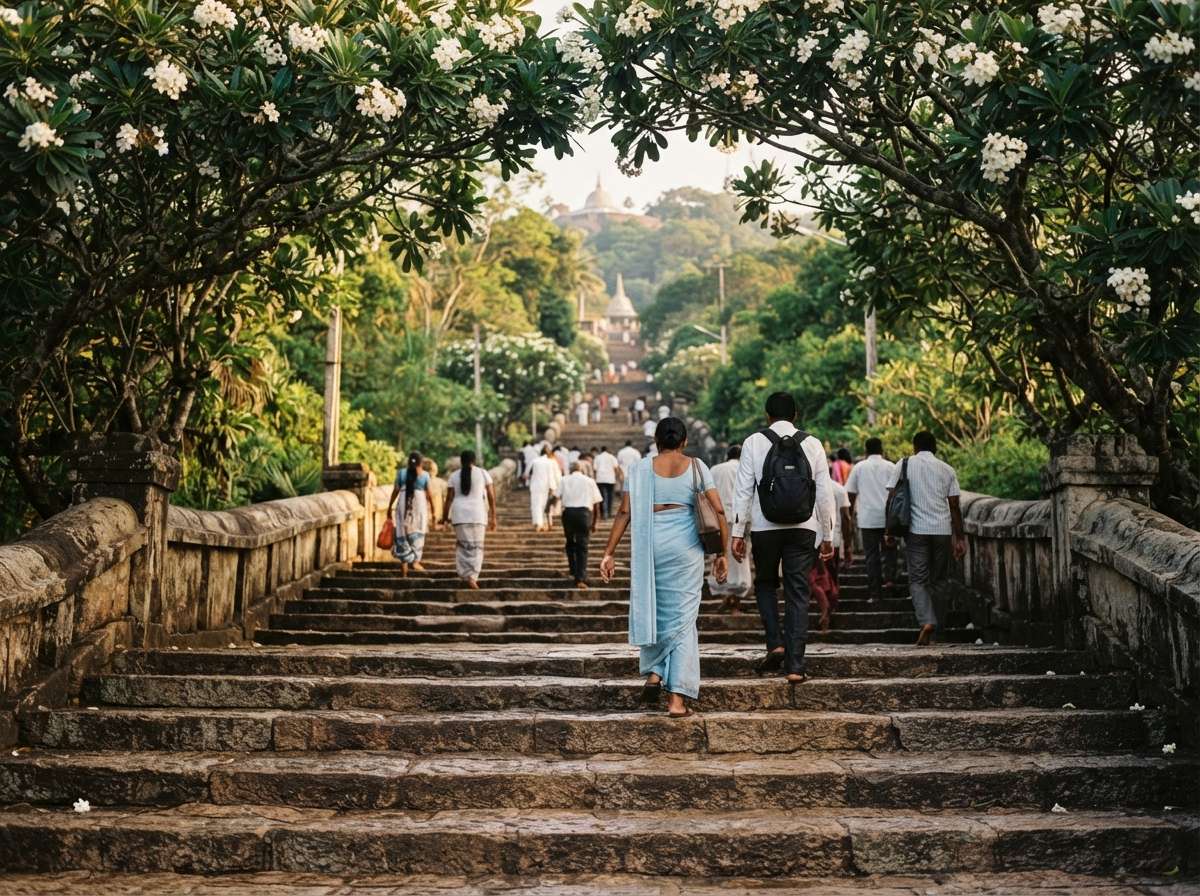
The full stairway from the bottom of the hill to the summit has 1,840 granite steps, according to Wikipedia’s Mihintale article and most guides on the site. The steps are wide and shallow on the lower flights and lined with frangipani trees, which flower white from about March. They get steeper, narrower and more worn higher up. How many of them you climb depends on where you park.
Upper car park or lower car park
This is the one decision that changes your visit the most.
| Lower car park | Upper car park | |
|---|---|---|
| Steps to the summit | About 1,840 (the full stairway) | About 800 |
| Climb time to the main terrace | About 30 minutes | About 15 to 20 minutes up to the Ambasthala terrace |
| What you see on the way | Hospital ruins, the great stairway, Kantaka Cetiya | You reach the refectory and ticket office almost at once |
| Monkeys | Common | Fewer, but watch bags near the stalls |
| Best for | Fit travellers, photographers, anyone who wants the full pilgrim route | Families, older travellers, hot middays, short stops |
The Restless Beans gave GPS points of 8.352911, 80.51156 for the lower car park and 8.351613, 80.513974 for the upper one, and both are free. Our suggestion is to have your driver drop you at the bottom, climb the full stairway early in the morning, and have the driver meet you at the upper car park. You get the whole route without walking back down the hot lower flights.
How long the climb takes and how hard it is
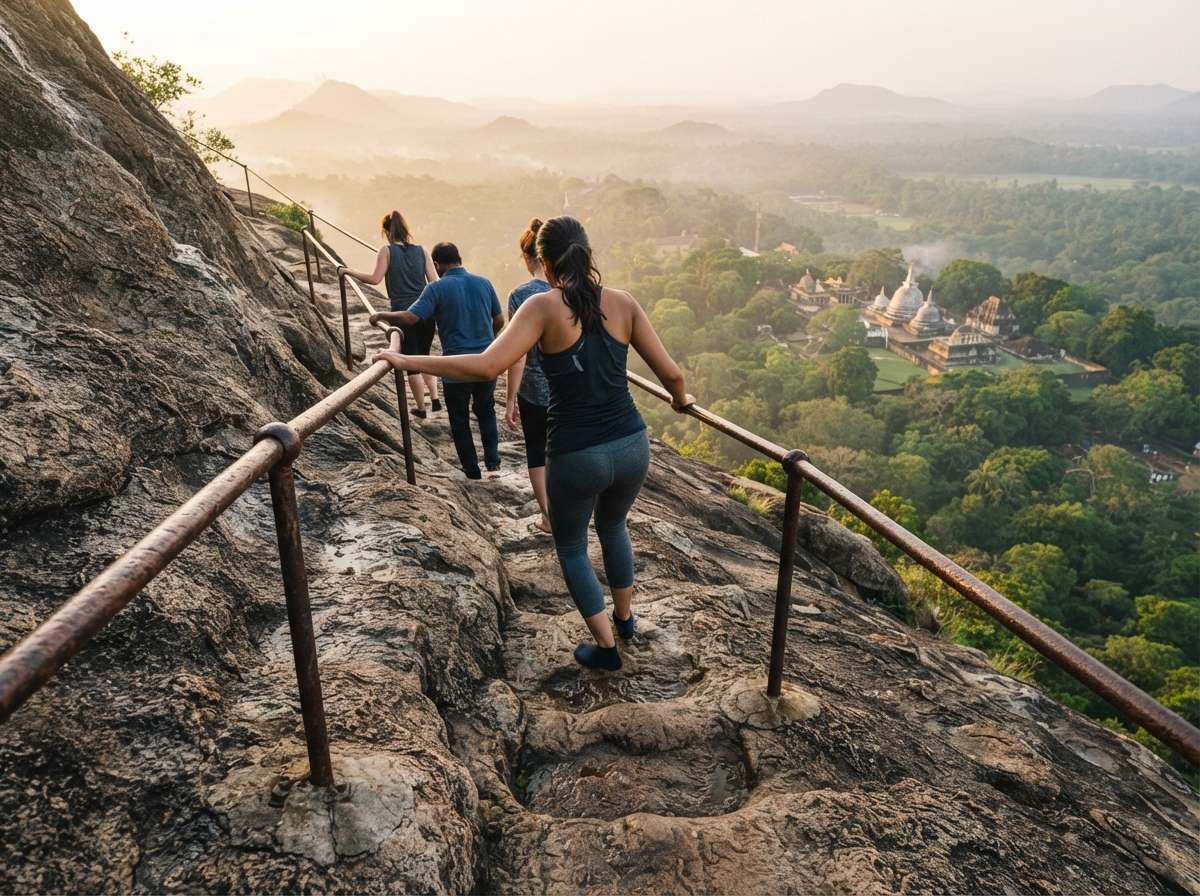
From the lower car park, allow 45 to 60 minutes up to Aradhana Gala at a steady pace with stops, and 35 to 45 minutes back down. The first flights are easy. The final 10 minutes to the Aradhana Gala summit are not. You climb a bare rock face on carved footholds, holding an iron handrail, in bare feet or socks. It is fine for most reasonably fit people, but skip that last section if you have vertigo, small children or a bad knee. You lose nothing important, because Maha Seya and the Ambasthala terrace are reached by easier steps.
What to See at Mihintale: The Sites in Climbing Order
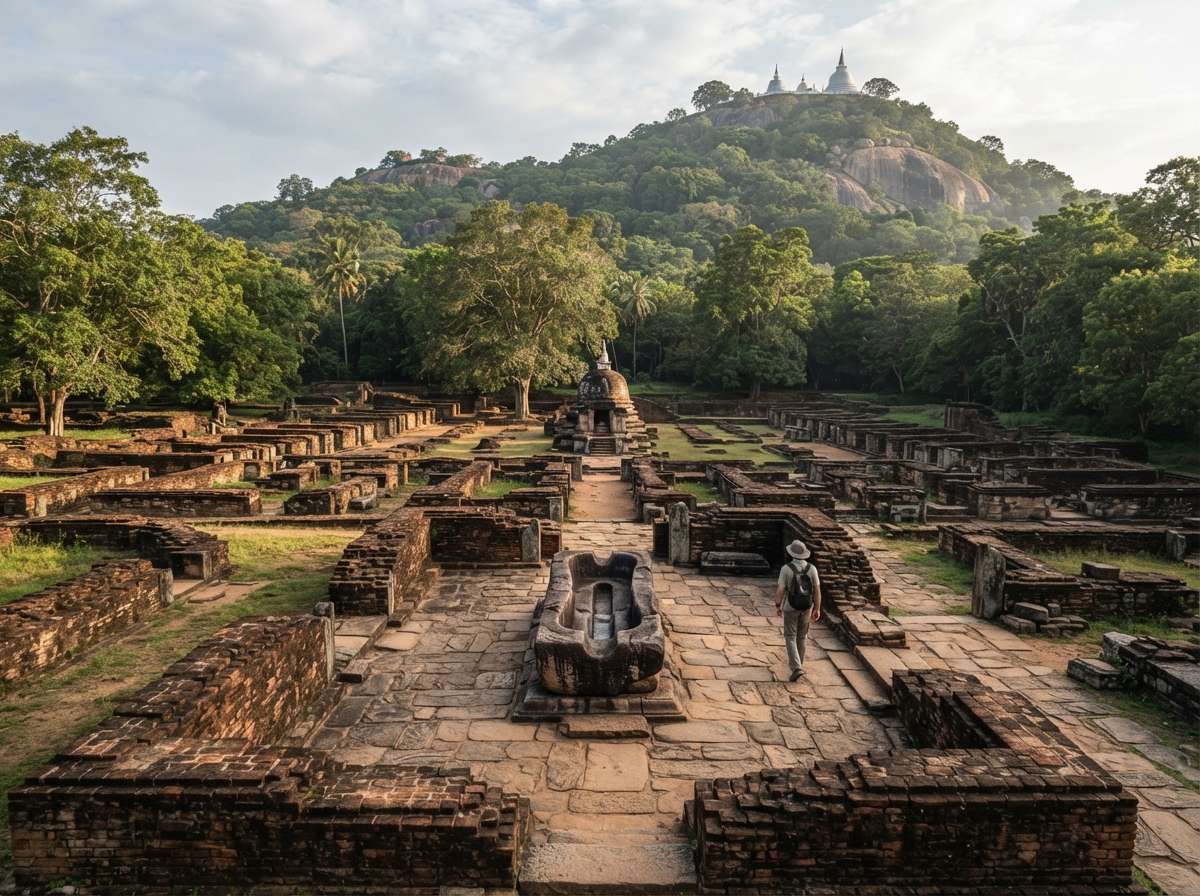
Mihintale is a spread-out monastery, not one temple. The sites below follow the order most visitors walk them, from the bottom of the hill to the top, followed by the outlying sites a short drive away.
The ancient hospital and Mihintale museum
Start at the foot of the hill, between the old Jaffna road and the Archaeological Museum. Here are the ruins of a monastery hospital attributed to King Sena II (853 to 887 CE), with patients’ rooms around a central shrine and a stone medicine trough shaped for a person to lie in herbal oil. Wikipedia cites researchers who describe it as possibly one of the oldest hospitals in the world. The small museum next door is worth 15 minutes for the finds from the site.
The great stairway
The stairway climbs the western face of the hill in long flights. The lower stretch is broad and shaded by frangipani, and pilgrims often stop at the landings. Count the first 1,000 or so steps, and you will see why the upper car park is popular.
Kantaka Cetiya
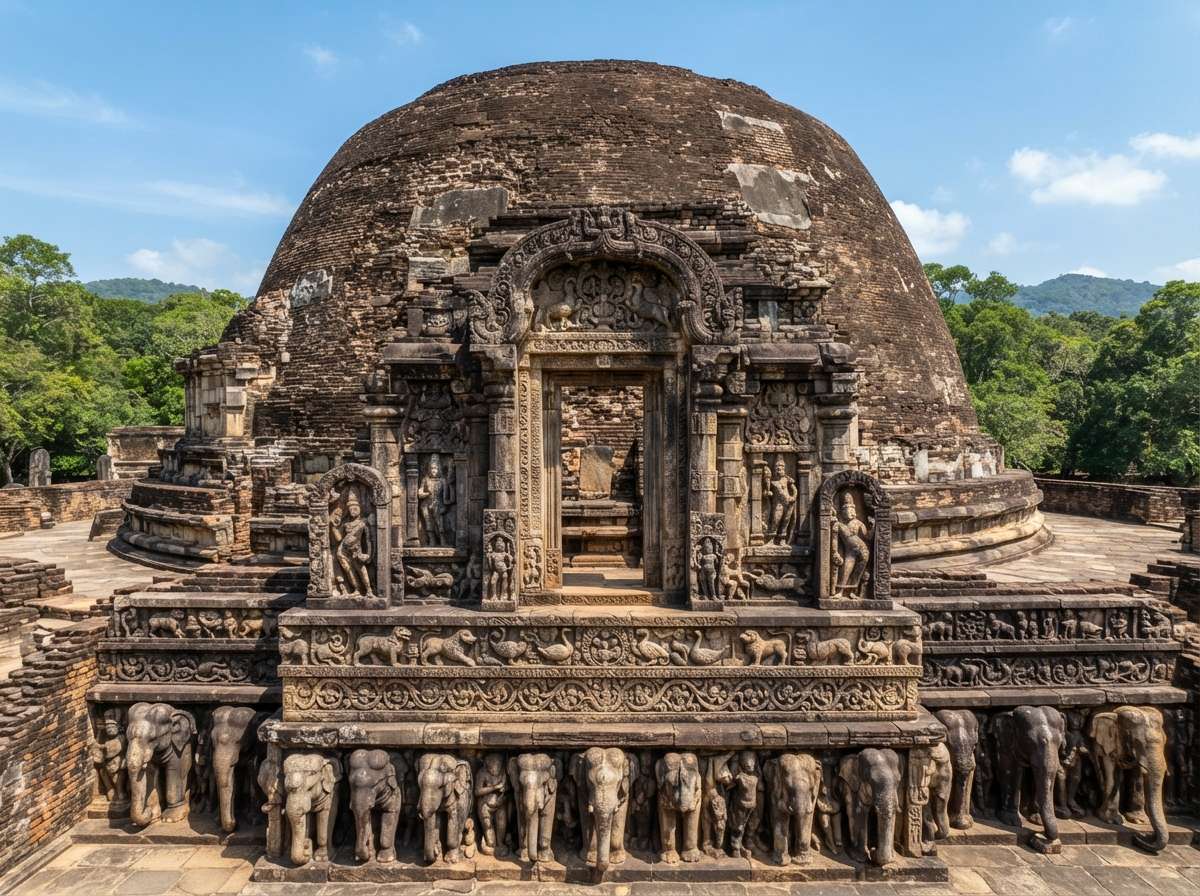
Take the path to the right off the first main landing for one of the oldest stupas on the island. Kantaka Cetiya dates to the 1st century BCE. Its base runs about 130 m (425 ft) around, and the ruin still stands about 12 m high. What makes it special is its four vahalkada frontispieces, carved with dwarfs, elephants, lions, geese and floral scrolls. These are among the earliest examples of the style in Sri Lanka, and few visitors take the side path, so you often have it to yourself.
The refectory and the stone rice trough
At the top of the first stairway is the monks’ refectory (dana salawa), a hall about 19 m long and 7.6 m wide. Look for the long stone trough in which rice was served to the community. Its size gives you an idea of how many monks lived here.
The assembly hall and the Mihintale tablets
Next door is the monks’ meeting hall, 19 m square and once roofed on 48 stone pillars, with a raised platform in the middle for the senior monk. At the entrance to the nearby relic house stand the two great Mihintale tablets, slabs carved in the 10th century under King Mahinda IV. They set out the monastery’s rules in detail, from the duties and wages of its staff to the conduct expected of monks. For historians, they are one of the best records of how an ancient Sri Lankan monastery was actually run.
Sinha Pokuna (the Lion Pond)
Below the refectory terrace is a small bathing pond with a lion carved in relief on the rock. Water from Naga Pokuna, higher up, was fed to it through a channel and poured out of the lion’s mouth. Look closely at the frieze of animals carved around it.
The sixty-eight caves
Close to Sinha Pokuna, rock overhangs mark the “Ata Seta Len”, part of the 68 caves the Mahavamsa says King Devanampiya Tissa had prepared for Mahinda and his monks. Several carry early Brahmi inscriptions recording who donated each cave. Wikipedia counts 106 Brahmi inscriptions in the Mihintale area, dating from the 3rd century BCE to the 1st century CE.
Ambasthala Dagoba and the meeting terrace
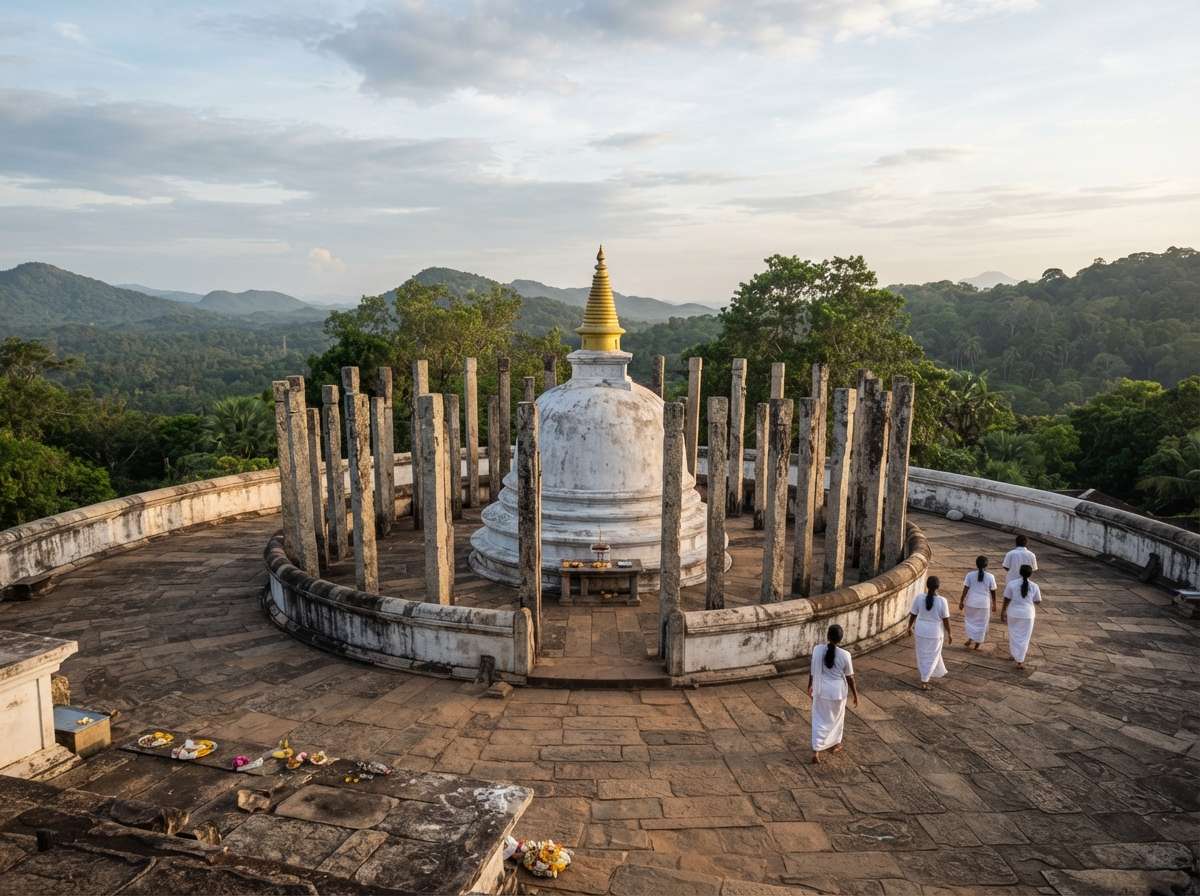
Climb the next flight and take off your shoes and hat. You are now on the most sacred ground at Mihintale, the Ambasthala terrace, one level above the Meda Maluwa (middle terrace) where you bought your ticket. The small white stupa, ringed by stone pillars that once held a roof, marks the spot where Mahinda and the king are believed to have met. Tradition says it enshrines a relic of the Buddha, while Mahinda’s own remains are associated with the nearby Mihindu Seya, built by King Uttiya. Pilgrims leave flowers here, and the temple’s living monks have their quarters nearby, so keep your voice down.
The great seated Buddha statue
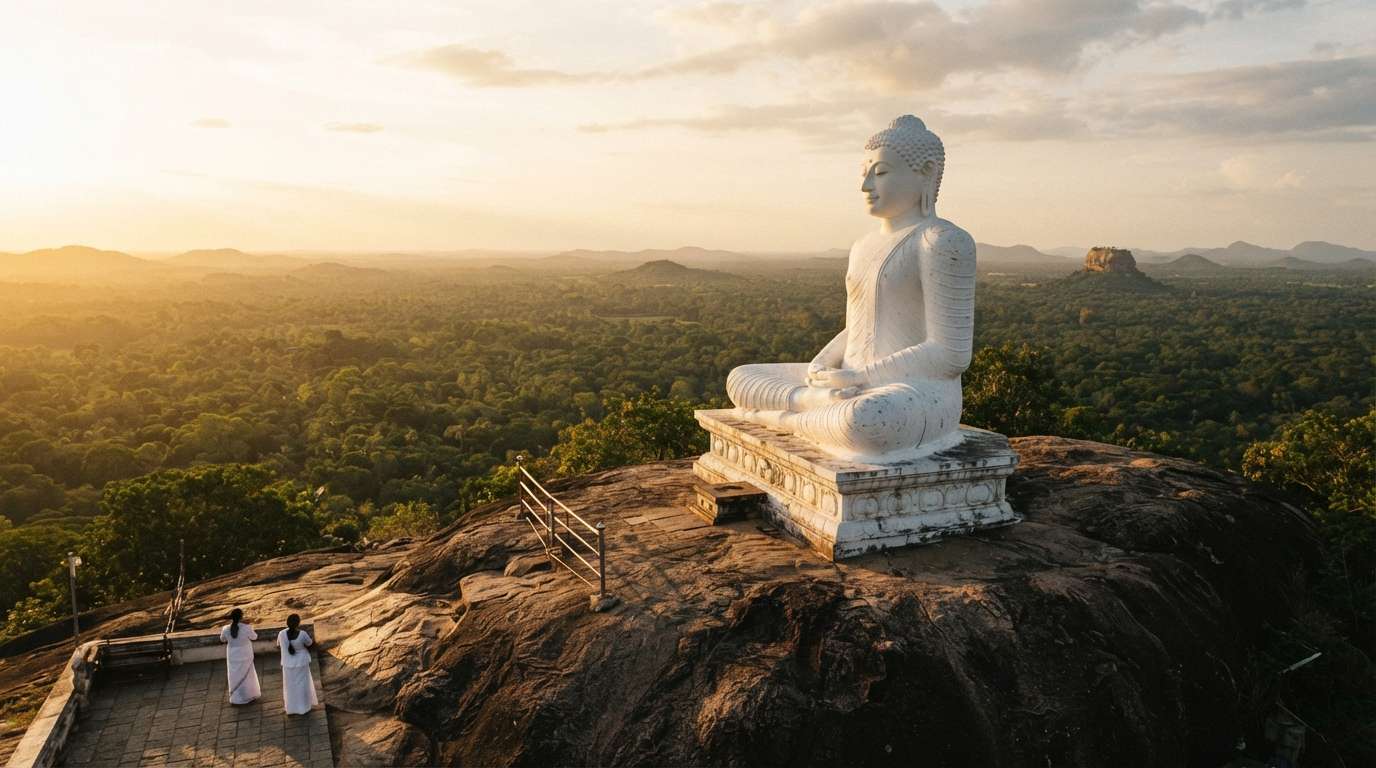
A short flight of steps above the terrace leads to a large white seated Buddha on a rocky outcrop. This is a modern statue, and from its platform you get a clear view across to Maha Seya and Aradhana Gala. It is also where most visitors take photographs. Remember the rule that you never stand with your back to a Buddha image for a selfie.
Aradhana Gala (the Invitation Rock)
Aradhana Gala is the bare rock summit opposite the Ambasthala, and it is the climb everyone remembers. Its name means “rock of invitation”. Tradition holds that Mahinda stood here when he called out to the king below. The final ascent is steep and polished, with an iron railing, and the top is small and windy. On a clear morning you can see the white domes of Anuradhapura’s stupas on the western horizon, and it is the best sunset point on the hill.
Maha Seya
The largest stupa at Mihintale crowns the hilltop above the terrace, and it is easier to reach than Aradhana Gala. King Mahadathika Mahanaga built Maha Seya in the 1st century CE (he ruled from 7 to 19 CE, per Wikipedia), and its base is about 41 m across. Tradition says it enshrines a relic of the Buddha. Smaller stupas stand on the same hilltop, and the 360-degree view takes in the tanks and forest of the plain.
Mihindu Guhawa (Mahinda’s cave)
A path down the eastern side of the hill leads to a cave formed under a boulder, with a flat stone slab where Mahinda is believed to have meditated and slept. The walk takes about 15 minutes each way and is steep in places, so it suits visitors with spare energy. The view over the jungle from the cave mouth is the quietest moment of the visit.
Naga Pokuna (the Cobra Pond)
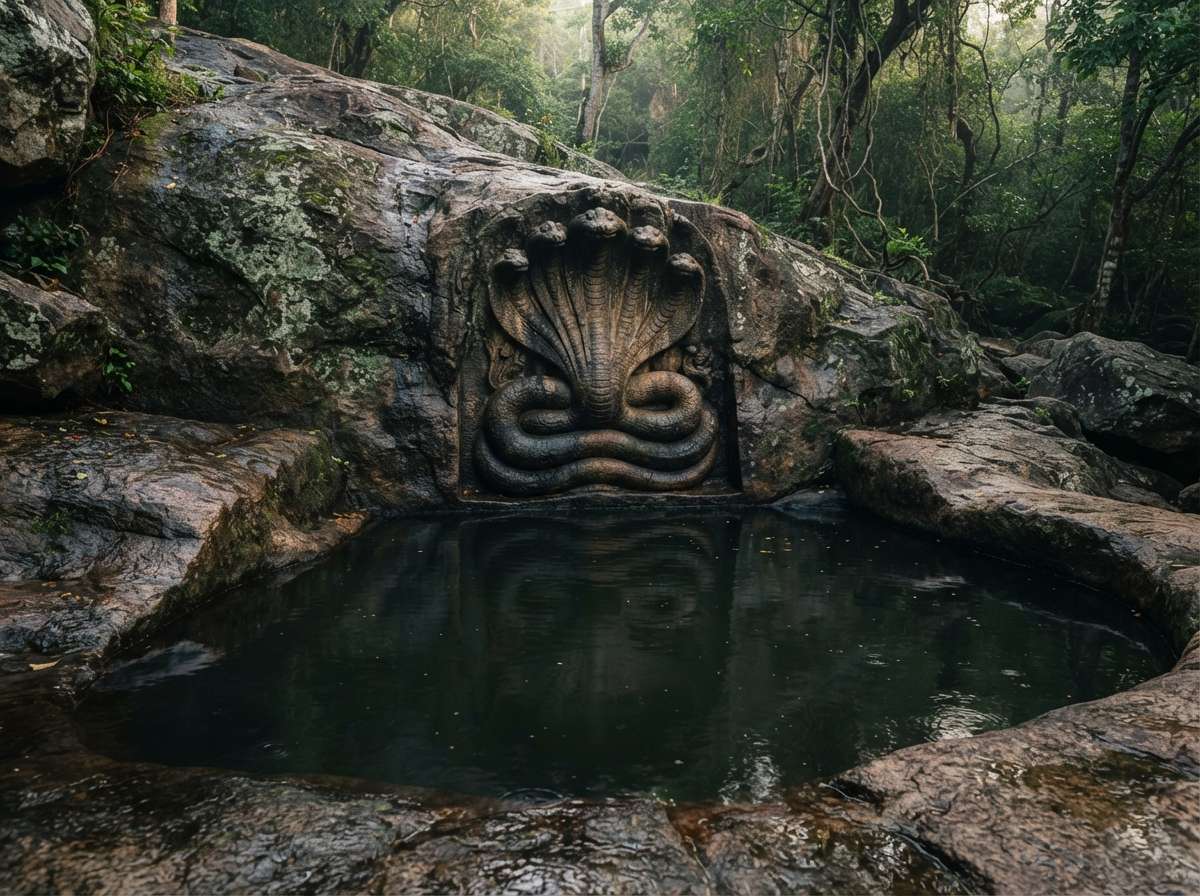
Naga Pokuna is a natural rock pool on the hillside with a five-hooded cobra carved in relief on the rock face above the water. Wikipedia links its present form to King Aggabodhi I (575 to 608 CE). It fed the Lion Pond below and was a bathing pool for the monks. From the pond, a rougher path continues up to Et Vehera, the highest stupa on the hill, about 600 steps further according to AmazingLanka. Only go if you have time and water.
Kaludiya Pokuna, Indikatu Seya and Rajagiri Lena
Three outlying sites sit a few minutes’ drive south of the main hill, and few tour groups stop at them. Indikatu Seya is a stupa complex where excavators found copper-plate inscriptions. Its smaller neighbour, Katu Seya, stands about 115 m further on. Kaludiya Pokuna, the “black water pond”, is a tank-side forest monastery about 500 m past Katu Seya, with ruins of a meditation complex reflected in dark, still water. Opposite its turn-off, a 250 m gravel track leads to Rajagiri Lena, a cluster of rock-cut caves. Allow 45 to 60 minutes for all three. Most are free to enter.
How To Reach Mihintale
Anuradhapura is the base for almost every visit, and Mihintale is a short ride east. Indian travellers usually fly into Colombo, then drive or take the train north. See our guide on how to reach Sri Lanka for flights from Indian cities and the Sri Lanka visa rules for Indians before you book.
From Anuradhapura
| Mode | Time | Cost | Good to know |
|---|---|---|---|
| Tuk-tuk (round trip with waiting) | 20 to 25 min each way | LKR 1,500 to 2,500 | Most flexible. Agree on the waiting time and drop-off car park before you leave |
| Car with driver | 20 min each way | Included in most driver hire | Ask to be dropped at the lower car park and collected at the upper one |
| Local bus from the New Bus Stand | About 20 to 30 min | Under LKR 100 | Buses on the Trincomalee road stop in Mihintale town, a 20-minute walk from the site |
| Bicycle or scooter | 40 to 50 min by bike | Hire in Anuradhapura | Flat road, but hot. Only worth it at dawn |
Tuk-tuk fares are from TravelMapSriLanka, and bus timings from Asian Wanderlust, whose writer paid LKR 30 for the ride a few years ago. Fares have risen since, so carry small notes. You can also book a tuk-tuk on the PickMe app in Anuradhapura.
From Colombo, Kandy, Sigiriya and Trincomalee
Road distances below are approximate, measured on Google Maps by road to the Mihintale car parks. Drive times assume a private car and normal daytime traffic.
| Starting point | Distance by road | Drive time | Other option |
|---|---|---|---|
| Colombo | About 210 km | 5 to 5.5 hours | Train from Colombo Fort to Anuradhapura (about 4 to 5 hours), then a tuk-tuk |
| Colombo airport (CMB) | About 190 km | 4.5 to 5 hours | Most Indian travellers fly in here |
| Kandy | About 130 km | 3 to 3.5 hours | Usually driven via Dambulla, so easy to combine with the cave temple |
| Dambulla | About 65 km | 1.5 hours | Easy morning add-on after the cave temple |
| Sigiriya | About 75 km | 1.5 to 2 hours | Leave at 5:30 am to climb Mihintale before the heat |
| Trincomalee | About 95 km | 2 hours | Mihintale sits on the A12 between Trinco and Anuradhapura |
Best Time To Visit Mihintale
Mihintale lies in Sri Lanka’s dry zone, so the season matters less than the time of day. It is hot all year, with afternoon highs that often pass 33°C. The best months are January to April, when skies are clearest and the plains are still green after the rains. June to September is dry and windy, which is pleasant on the summit. October to December is the north-east monsoon, the wettest stretch of the year in Anuradhapura District.
| Months | Weather | Crowds | Our verdict |
|---|---|---|---|
| January to March | Dry, clear views, cooler mornings | Moderate, busier on poya days | Best overall |
| April to May | Hottest, with some showers in April | Busy around Sinhala New Year (13 to 14 April) and Vesak | Good at dawn only |
| June | Dry and breezy | Very crowded at Poson Poya | Go for the festival, or avoid that week |
| July to September | Dry, windy, dusty | Moderate | Good, with clear sunsets |
| October to December | North-east monsoon, afternoon downpours | Low | Possible, but wet rock is slippery barefoot |
For broader season planning across the island, see our guide to the best time to visit Sri Lanka.
Best time of day
Be on the stairway by 6:30 am. By 10:30 am the granite on the upper terrace is too hot to cross barefoot in comfort, and the shade on the summit is close to zero. The second-best window is from 4 pm, when the light turns gold for photographs and you can watch the sunset from Aradhana Gala. If you go late, carry a torch for the walk down.
Poson Poya at Mihintale
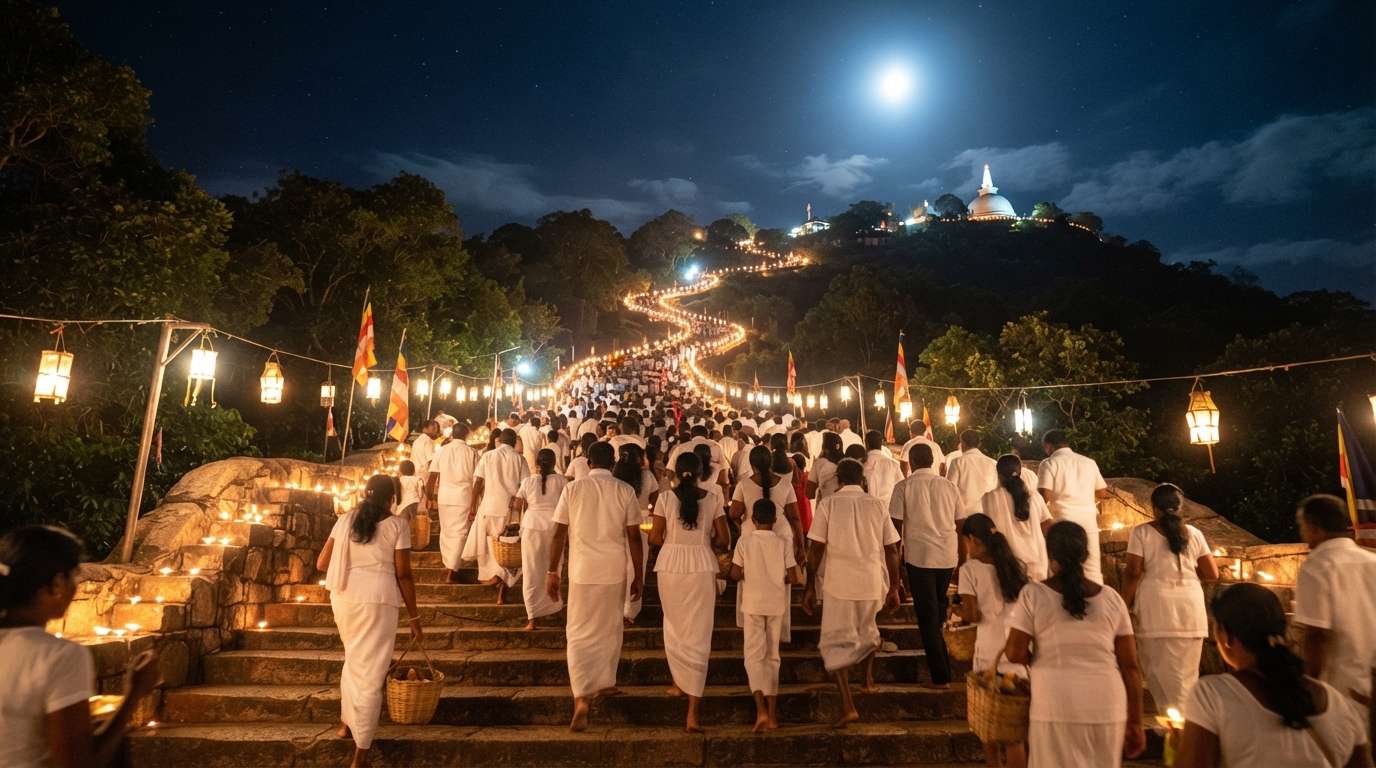
Poson Poya, the June full moon, marks Mahinda’s arrival, and it turns Mihintale into the busiest pilgrimage site in the country. In 2027 it falls on Friday 18 June, according to the Central Bank of Sri Lanka’s holiday calendar. Pilgrims in white climb through the night, roadside dansal stalls hand out free food and drinks, and the stairway is lit with lanterns. It is an extraordinary thing to witness, but expect road closures, parking several kilometres away and queues on the summit steps. Book Anuradhapura hotels months ahead. Our guide to Sri Lanka in June covers the wider festival period.
How To Plan Your Mihintale Visit, Step by Step
Follow these seven steps and your visit will run smoothly, even in peak season.
- Base yourself in Anuradhapura. Book a night there so you can leave for Mihintale at 6 am. Sigiriya and Dambulla also work as bases if you start by 5:30 am.
- Arrange transport the evening before. Fix a tuk-tuk or driver for a 6 am pickup, agree on the price for the round trip with two to three hours of waiting, and ask to be dropped at the lower car park and collected at the upper one.
- Draw cash in rupees. Carry LKR 2,000 per foreign adult for the ticket, plus small notes for water, a guide tip and the shoe-keeper. There is no card machine at the counter.
- Dress for the temple. Wear loose clothing that covers your shoulders and knees, ideally white or light colours, and pack thick cotton socks and a sarong or scarf.
- Climb in the right order. See the hospital ruins and Kantaka Cetiya on the way up, buy your ticket at the middle terrace, then take off your shoes for Ambasthala, the seated Buddha, Maha Seya and Aradhana Gala.
- Ask for an official guide at the counter. A guide adds the stories behind each ruin. The fee is not part of the ticket, so agree it before you start.
- Finish before 10 am, then head on. Stop at Kaludiya Pokuna on the way back, then return to Anuradhapura for the Sacred City in the late afternoon.
What To Wear, What To Bring and Temple Etiquette
Mihintale is an active place of worship, and the rules are the same as at any Sri Lankan Buddhist temple. Cover your shoulders and knees, and this applies to men and women alike. Shorts and sleeveless tops will get you turned away at the terrace, so carry a sarong if you are dressed for heat. White is the traditional colour for pilgrims, especially on poya days.
Shoes and hats come off at the upper terrace and stay off at Ambasthala, Maha Seya and Aradhana Gala. Thick socks are allowed and will save your feet on hot rock, but they are slippery on the polished summit steps, so go slowly and use the handrail.
What to bring:
- At least 1 litre of water per person. A few stalls at the car parks sell drinks, but there is nothing on the summit
- A small bag you can hold in front of you. Macaques snatch anything that looks like food
- Sunscreen and sunglasses for the walk, since you cannot wear a hat on the sacred terraces
- Cash in small notes
- A torch if you plan to stay for sunset
Photography is allowed across the site. Never pose with your back to a Buddha statue, never point your feet at an image, and do not climb on stupas or ruins. Sri Lankan law treats disrespect to Buddhist images seriously, and tourists have been deported for Buddha tattoos and disrespectful photos. Drones need permission from the Civil Aviation Authority of Sri Lanka and are not welcome over the temple. There are public toilets near the car parks and on the lower terrace.
One-Day Anuradhapura and Mihintale Itinerary
Mihintale and Anuradhapura’s Sacred City tell one story, Mahinda’s arrival and the Bodhi tree his sister brought, and they fit into one long day. Anuradhapura’s Sacred City is a UNESCO World Heritage Site (inscribed 1982) with its own separate ticket.
| Time | Stop | Why then |
|---|---|---|
| 6:00 am | Leave Anuradhapura by tuk-tuk | Cool air, empty road |
| 6:30 am to 9:30 am | Mihintale, from the lower car park to Aradhana Gala | Rock is still cool and the light is soft |
| 9:45 am | Kaludiya Pokuna and Indikatu Seya | Shaded forest monastery, few visitors |
| 11:00 am to 3:00 pm | Back in Anuradhapura for lunch and rest | Sit out the midday heat |
| 3:00 pm | Jaya Sri Maha Bodhi | The sacred Bodhi tree Sanghamitta brought from India |
| 3:45 pm | Ruwanwelisaya | The great white stupa, best in afternoon light |
| 4:30 pm | Jetavanaramaya | One of the largest brick stupas ever built. Leave Abhayagiri for a second morning |
| 5:45 pm | Sunset at Tissa Wewa bund | Locals gather on the embankment |
For the full list of what to see in the ancient capital, read our guides to places to visit in Anuradhapura, temples in Anuradhapura and things to do in Anuradhapura.
Places To Visit Near Mihintale
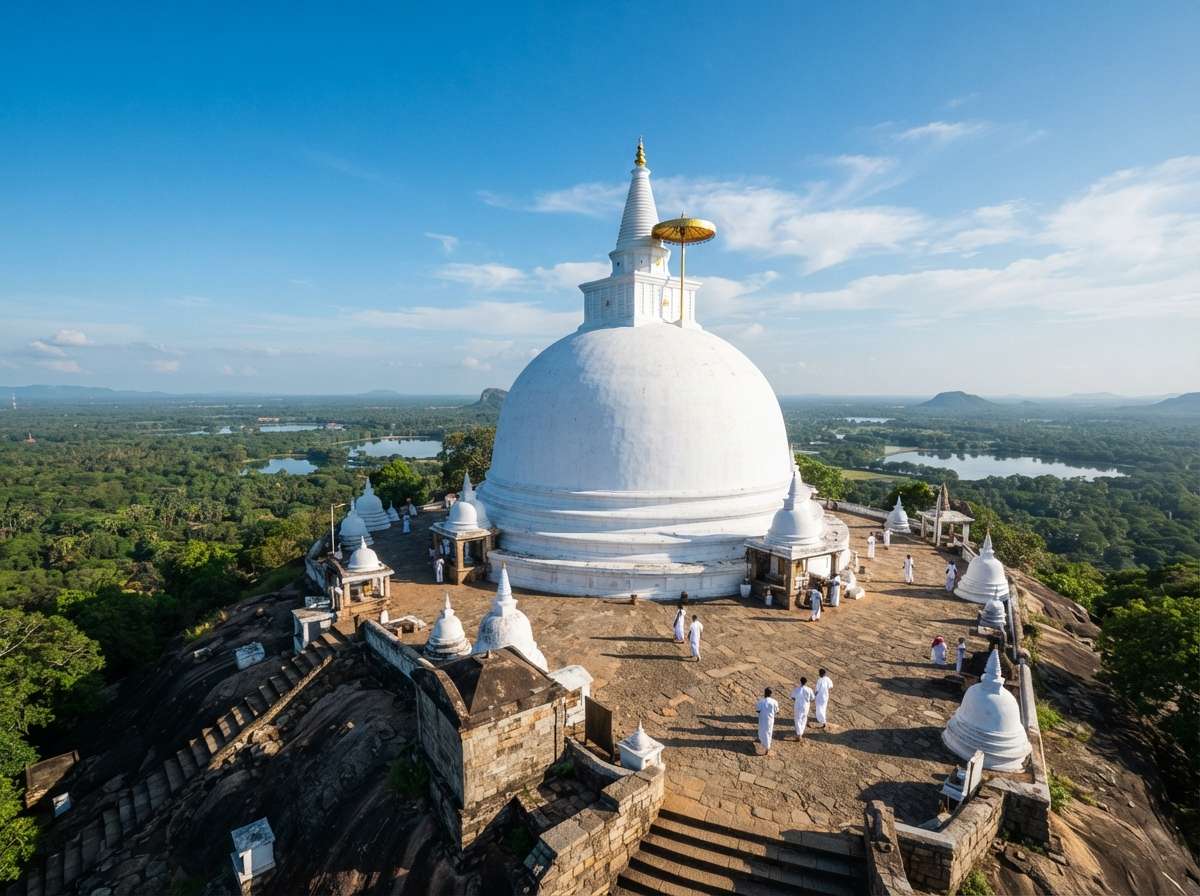
Mihintale sits at the northern tip of Sri Lanka’s Cultural Triangle, so most of the island’s ancient sites are within a two-hour drive.
| Place | Distance from Mihintale | Why go |
|---|---|---|
| Anuradhapura Sacred City | 12.5 km | Sri Maha Bodhi, Ruwanwelisaya, Jetavanaramaya, Isurumuniya |
| Ritigala forest monastery | About 40 km | Jungle-covered ruins of a hermit monastery on a misty ridge |
| Avukana Buddha | About 50 km | A 12 m standing Buddha carved from a single rock face, beside Kala Wewa |
| Dambulla cave temple | About 65 km | Painted cave shrines. See places to visit in Dambulla |
| Sigiriya | About 75 km | The rock fortress. See our Sigiriya guide |
| Polonnaruwa | About 95 km | The second ancient capital. See places to visit in Polonnaruwa |
If you are building a temple circuit, our list of Buddhist temples in Sri Lanka and the guide to UNESCO World Heritage Sites in Sri Lanka cover the rest of the route.
Where To Stay Near Mihintale
Stay in Anuradhapura. It has the widest range of hotels and guesthouses, many of them around the New Town and the Tissa Wewa and Nuwara Wewa tanks, and it puts you 20 minutes from Mihintale and inside the Sacred City for the afternoon. Mihintale town itself has a handful of simple guesthouses, which help only if you want to be first on the stairway at dawn or are visiting at Poson, when Anuradhapura fills up. Travellers on a Cultural Triangle loop often stay in Habarana or Sigiriya instead and do Mihintale as an early day trip of about 1.5 hours each way.
Sources and How This Guide Was Checked
The ticket price, opening hours, step counts and transport fares on this page were compared in November 2026 against the published accounts listed under Sources at the end of this article.
- Wikipedia, Mihintale (distance, height, 1,840 steps, Kantaka Cetiya, Maha Seya, hospital, tablets, ponds, inscriptions)
- The Mahavamsa, chapters 13 and 14, Geiger translation, via Wisdom Library (Mahinda’s mission, Vedisagiri, the meeting with Devanampiya Tissa)
- AmazingLanka, Mihintale: The Cradle of Buddhism (2026 fee list, Et Vehera, Kaludiya Pokuna, Indikatu Seya, Rajagiri Lena)
- The Restless Beans, Mihintale Temple: A Guide to Sri Lanka’s Sacred Buddhist Site (car parks with GPS, LKR 1,000 fee in 2025, guides, socks, toilets)
- RooWanders, Exploring Mihintale (LKR 1,000 fee, car parks)
- TravelMapSriLanka, Mihintale (opening hours, tuk-tuk fares)
- Asian Wanderlust, What To Do In Mihintale (bus from Anuradhapura)
- Central Bank of Sri Lanka, Bank Holidays for 2027 (Poson Poya, 18 June 2027)
- UNESCO World Heritage Centre, Sacred City of Anuradhapura (inscribed 1982)
Planning Your Trip to Mihintale
Mihintale is where Sri Lankan Buddhism began, and for travellers from India it closes a story that started with Emperor Ashoka. Climb early, carry cash and socks, park at the upper car park if steps are a concern, and pair the hill with Anuradhapura’s Sacred City for a full day. If you want Mihintale, Anuradhapura, Sigiriya and Kandy in one trip without arranging every driver and hotel yourself, our Sri Lanka tour packages can be customised around a Cultural Triangle route, and the Sri Lanka travel guide covers the rest of the island.
FAQs
FAQs About Mihintale
The Mihintale entry fee for foreign adults aged 12 and over is LKR 2,000, according to AmazingLanka's 2026 fee list, which is about ₹570. Visitors in 2024 and early 2025 reported paying LKR 1,000, so the price has gone up recently. Children under 12 and Sri Lankan citizens enter free. Payment is cash only, in Sri Lankan rupees, at the ticket office on the middle terrace. Guides are not included in the ticket and charge separately, and parking at both car parks is free.
There are 1,840 granite steps from the bottom of Mihintale to the summit. If you drive to the upper car park near the ticket office, about 800 steps remain, which cuts the climb by more than half. The lower flights are wide, shallow and shaded by frangipani trees. The final climb to Aradhana Gala is a steep rock face with carved footholds and an iron handrail, and you do it barefoot or in socks.
Mihintale's ticketed area is open daily, roughly from 6 am to 6 pm, though published hours vary between sources and some visitors report the counter staying open later. The temple stays open for worship beyond these hours, and on full moon poya days pilgrims climb into the night. Arrive between 6 and 7 am for the coolest rock, the softest light and the fewest people.
Mihintale is 12.5 km east of Anuradhapura, a 20 to 25-minute drive along the Anuradhapura to Trincomalee road. A tuk-tuk round trip with two to three hours of waiting costs about LKR 1,500 to 2,500. Local buses from Anuradhapura's New Bus Stand stop in Mihintale town, which is a 20-minute walk from the site. Most visitors combine both places in a single day.
The climb from the lower car park to the Aradhana Gala summit takes 45 to 60 minutes at a steady pace, and the walk down takes 35 to 45 minutes. From the upper car park, which sits at the middle terrace, the climb to the Ambasthala terrace takes about 15 to 20 minutes. Plan two to three hours in total to see the main sites without rushing, and three to four hours if you add Kaludiya Pokuna and Indikatu Seya.
Mihintale is where, according to the Mahavamsa chronicle, the monk Mahinda, son of India's Emperor Ashoka, met King Devanampiya Tissa during a deer hunt on the June full moon of about 247 BCE. Mahinda tested the king with a riddle about mango trees, then preached to him, and the king and his court accepted Buddhism. Mahinda's sister Sanghamitta later brought the Bodhi tree sapling to Anuradhapura.
Mihintale is worth visiting if you are in the Cultural Triangle and can go early in the morning. It tells the founding story of Sri Lankan Buddhism, offers a 360-degree view over the plains, costs far less than Sigiriya and is much quieter than Anuradhapura's Sacred City. The downsides are heat, steps, monkeys and barefoot walking on hot rock, so it suits travellers who can manage a long climb.
Wear loose clothes that cover your shoulders and knees. This applies to men and women, and white or light colours are the respectful choice. You must remove shoes and hats on the upper terrace, so bring thick cotton socks to protect your feet from hot rock, and carry a sarong or scarf if you are wearing shorts for the drive. Sunglasses and sunscreen help, since you cannot wear a hat at the sacred sites.
Poson Poya falls on the June full moon, and in 2027 it is on Friday 18 June, according to the Central Bank of Sri Lanka's holiday calendar. It marks Mahinda's arrival, so Mihintale is the centre of the celebrations, with pilgrims in white, free dansal food stalls and lantern-lit steps. Expect very large crowds, road closures and parking far from the site, and book Anuradhapura hotels months ahead.
Mihintale is not separately listed by UNESCO. The nearby Sacred City of Anuradhapura was inscribed as a World Heritage Site in 1982, and Mihintale is closely tied to it historically, because the Buddhism Mahinda brought here shaped the ancient capital. Many travellers visit both on the same day, though they have separate tickets.
Yes, you can visit Mihintale on your own, and the main route is easy to follow from the stairway to the summit. Guides wait near the ticket office, and it is worth hiring one to hear the stories behind the ruins and the tablets. A guide is not included in the ticket, so agree the fee before you start.
Mihintale suits most children and older travellers if you use the upper car park, which leaves about 800 steps instead of 1,840. There is no lift, ramp or wheelchair access, and the final climb to Aradhana Gala is steep and slippery, so skip it with small children or weak knees. Maha Seya and the Ambasthala terrace are easier to reach. Go early, carry water and keep snacks hidden from the monkeys.