
 7D / 6N
8% OFF


Which Temples in Ubud Are Worth Your Time?
Five temple stops in Ubud (six temples, since Pura Desa and Pura Puseh stand side by side) are a short walk from Ubud Palace: Pura Taman Saraswati with its lotus pond, Pura Dalem Agung Padangtegal inside the Monkey Forest, Pura Dalem Ubud, the twin village temples of Pura Desa and Pura Puseh, and Pura Gunung Lebah at the Campuhan river junction. Nine more are 10 to 40 minutes away by car, including Tirta Empul’s holy spring, the cliff-cut shrines of Gunung Kawi and the Elephant Cave at Goa Gajah. Most of them charge IDR 30,000 to 75,000 (about ₹160 to ₹400), and almost all lend you a sarong at the gate.
Ubud sits in Gianyar, the regency where Bali’s oldest kingdoms grew up along the Pakerisan and Petanu rivers, so the temples here are older and more varied than anywhere else on the island. You get 11th-century royal shrines carved into a ravine, a bronze drum nearly 2 m tall that locals say fell from the sky, and a spring Balinese Hindus have bathed in for over a thousand years. This guide lists the temples in Ubud town first and the ones near Ubud after, with fees, hours, the time each one needs and a route that fits seven of them into a single day, with an evening dance at an eighth. If you are Hindu, you will recognise a lot. Ganesha guards the Elephant Cave, and every Balinese village keeps one temple each for Brahma, Vishnu and Shiva.
Key takeaways
- Start at Tirta Empul by 8 am. Tour buses arrive from about 10 am and the purification queue triples.
- Budget about IDR 600,000 (about ₹3,200) per person for a full temple day: four or five entry tickets, a locker, offerings and a share of a driver.
- Walk the five town temples in one morning. Saraswati, Desa and Puseh Ubud and Pura Dalem Ubud are all on Jalan Raya Ubud or just off it.
- Carry a sarong and sash anyway. Most temples near Ubud include one with the ticket, but the village temples in town often do not.
- Skip Tanah Lot and Besakih if you only have one day from Ubud. Each is about 1.5 to 2 hours away by road.
Ubud temples at a glance
All 14 temples in the order this guide covers them, with the approximate drive or walk from Ubud Palace (Puri Saren) on Jalan Raya Ubud. Fees are for a foreign adult. Hours and how long to allow are in each temple’s own section below.
| Temple | Area | From Ubud Palace | Adult entry (IDR / ₹) | Best for |
|---|---|---|---|---|
| Pura Taman Saraswati | Ubud centre, Jl. Raya Ubud | 3 min walk | From around IDR 60,000 (₹319), sarong included | Lotus pond, evening dance |
| Pura Dalem Agung Padangtegal | Inside the Sacred Monkey Forest | 20 min walk | IDR 130,000 (₹691), forest ticket | Mossy carvings, the monkeys |
| Pura Dalem Ubud | Jl. Raya Ubud, west end | 10 min walk | No ticket outside show nights | Rangda carvings, fire dance |
| Pura Desa and Pura Puseh Ubud | Jl. Suweta, north of the palace | 5 min walk | No ticket; donation | Carved split gates, quiet |
| Pura Gunung Lebah | Campuhan, start of the Ridge Walk | 15 min walk | No ticket; donation | River junction, sunrise walk |
| Goa Gajah | Bedulu | 10 to 15 min drive | IDR 50,000 (₹266) | Ganesha, the cave, bathing pools |
| Yeh Pulu | Bedulu | 15 min drive | IDR 30,000 (₹160) | 25 m rock relief, rice fields |
| Pura Samuan Tiga | Bedulu | 15 min drive | Donation | Huge courtyards, very few visitors |
| Pura Penataran Sasih | Pejeng | 15 to 20 min drive | Donation | The Moon of Pejeng bronze drum |
| Tirta Empul | Tampaksiring | 30 to 40 min drive | IDR 75,000 (₹399) | Melukat purification bath |
| Gunung Kawi Tampaksiring | Tampaksiring | 35 to 40 min drive | IDR 50,000 (₹266) | 11th-century cliff shrines |
| Pura Mengening | Tampaksiring | 35 to 40 min drive | IDR 30,000 (₹160) | A calmer purification spring |
| Gunung Kawi Sebatu | Sebatu, north of Tegallalang | 30 min drive | IDR 50,000 (₹266) | Koi pools, water shrines |
| Pura Puseh Batuan | Batuan, Sukawati | 25 min drive | IDR 50,000 (₹266), sarong included | Ornate carving, Gambuh dance |
₹ conversions use IDR 188 = ₹1. Every foreign visitor to Bali also pays a one-time tourist levy of IDR 150,000 (about ₹800), collected through the provincial Love Bali portal or at the airport, and some major attractions may ask to see your levy receipt, so keep it on your phone.
Indonesia
Bali
14 temples in and near Ubud with fees, timings, a one-day route, dress code and 2027 festival dates
Best Time
November - March
Select Package Type
Best Selling Packages


14 Temples In And Near Ubud, Walkable Ones First
The five temples you can walk to from Ubud Palace come first, then nine within a 40-minute drive, followed by the Tirta Empul purification steps, a one-day route, dress code, dance shows and 2027 festival dates.
Explore Popular Destination In Bali
01
Pura Taman Saraswati
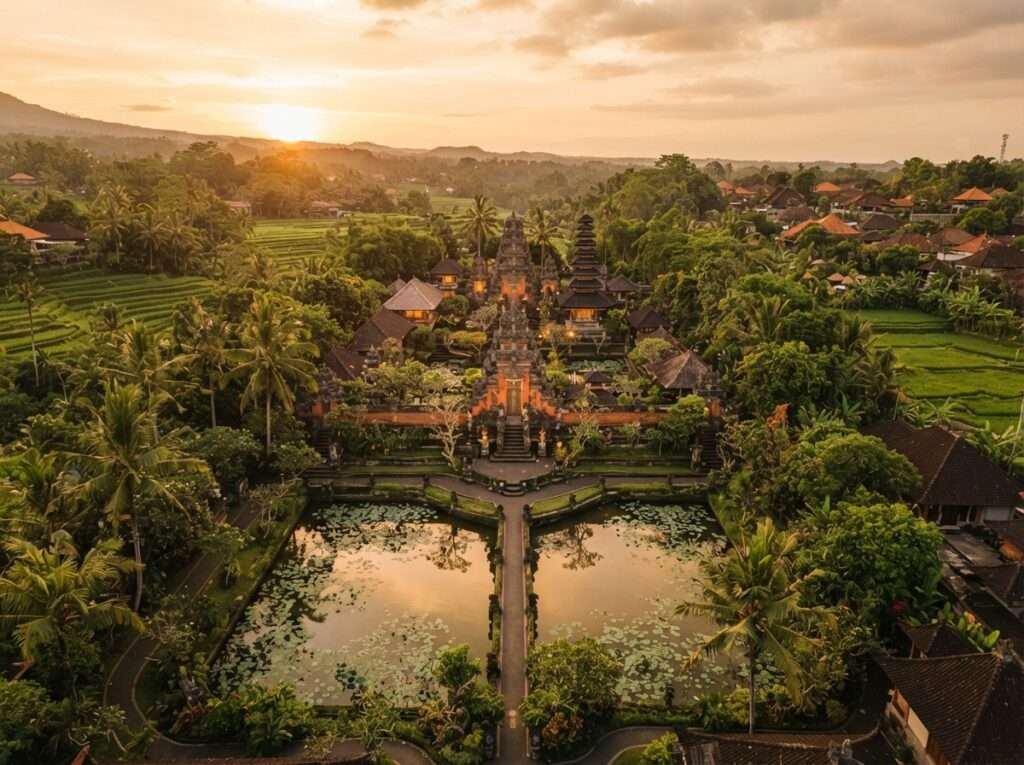
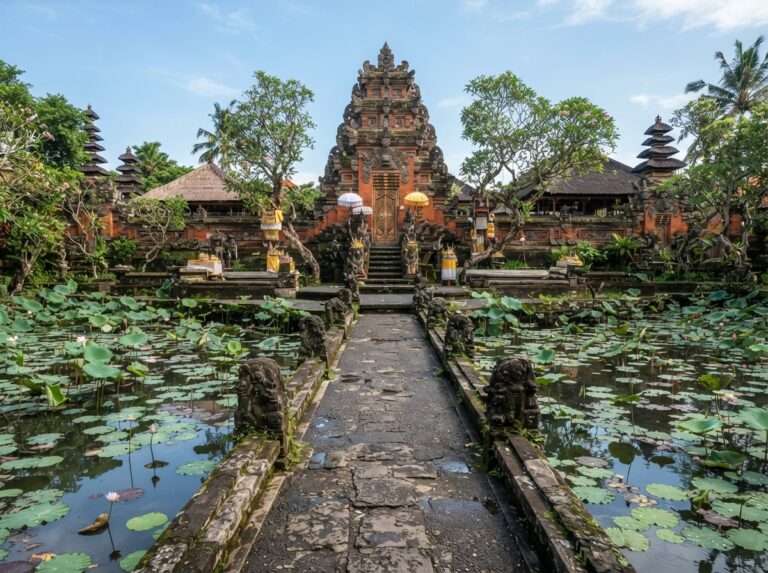
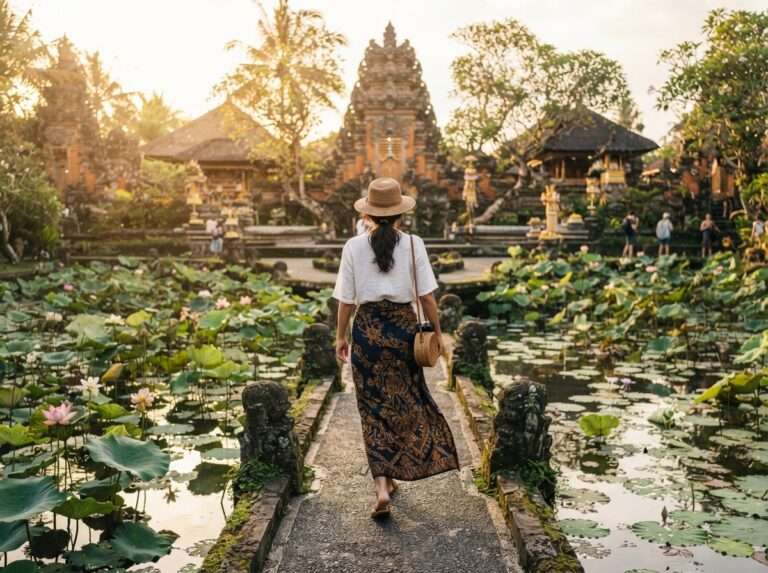
Pura Taman Saraswati is the temple most people mean when they say “the temple in the middle of Ubud”. It sits behind a long lotus pond right on Jalan Raya Ubud, the main road, entered beside Café Lotus at the corner of Jalan Kajeng, and a raised stone path runs straight across the water to the carved red-brick gate. The temple is dedicated to Dewi Saraswati, the goddess of learning, music and the arts, which suits a town that has lived off painting and dance for a century. You may know her better as Saraswati of Vasant Panchami. In Bali her day is Hari Saraswati, when students bring offerings for their books.
The temple is younger than it looks. It was built in 1951 and 1952 for the Ubud royal family by I Gusti Nyoman Lempad, the sculptor and architect whose work fills Ubud’s museums, and the carving on the inner gate is some of his finest. The pond is the main draw for most visitors. From roughly May to October the lotuses are in full flower and the reflection of the gate is clearest before 9 am, before the Jalan Raya traffic picks up.
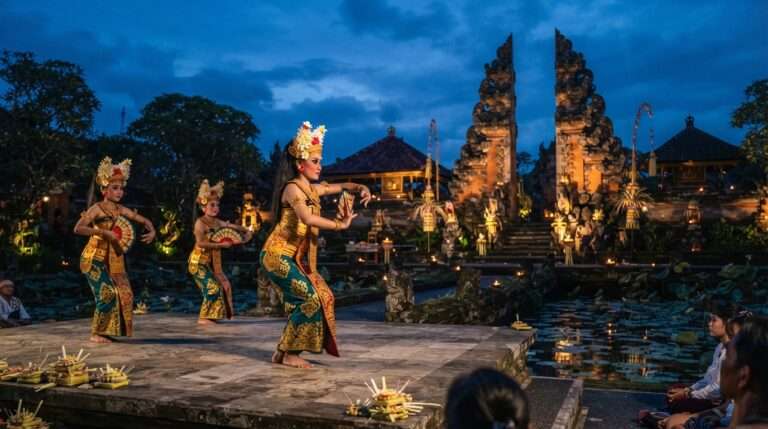
In the evening the temple turns into a stage. Most nights except Friday, a dance troupe performs in the forecourt with the lit-up gate as the backdrop, usually Legong or Barong, for about IDR 100,000 (about ₹530). Buy tickets at the gate after 6 pm and sit near the front: the lotus pond eats into the seating. You will see it called the Ubud Water Palace on some maps and booking apps, which is the same place (our Ubud Water Palace guide covers the photo spots). For the full history and the café next door, read our Pura Taman Saraswati guide.
| Address | Jl. Raya Ubud, beside Café Lotus (corner of Jl. Kajeng), Ubud |
| Open | About 8 am to 6 pm; dance shows from 7.30 pm |
| Entry | From around IDR 60,000, sarong and sash included (no longer free by day). Dance ticket about IDR 100,000 |
| Time needed | 30 minutes, or 2 hours with a show |
| Don't miss | Lempad's carving on the inner gate |
Related Tour Packages


❮
❯
02
Pura Dalem Agung Padangtegal
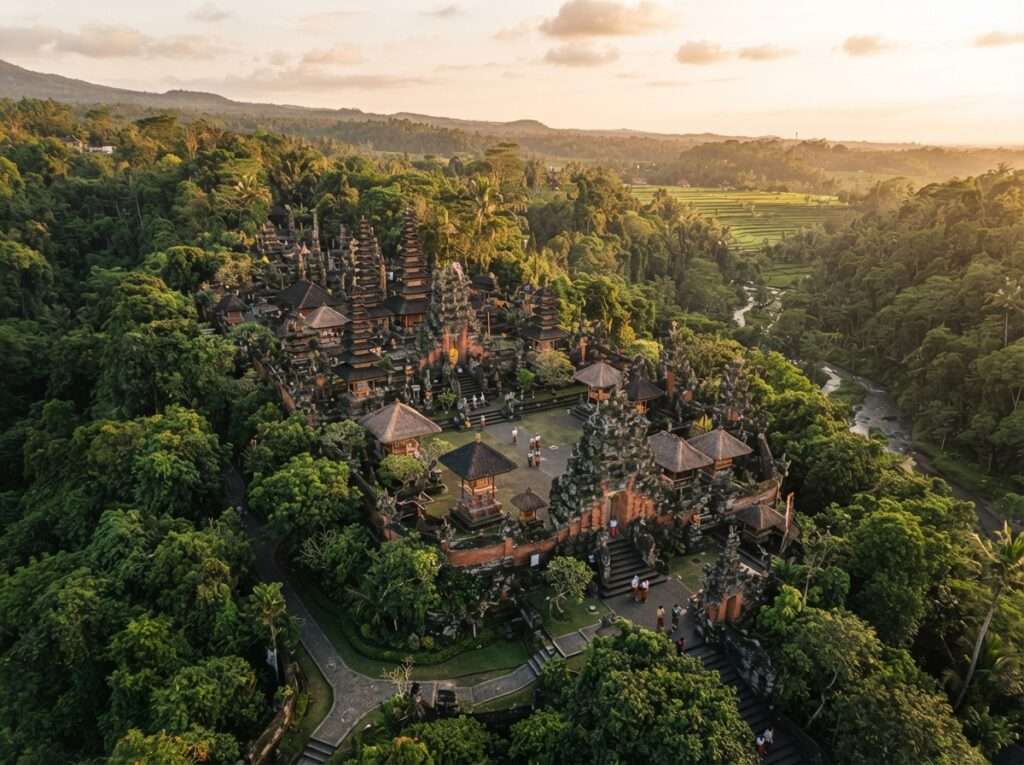
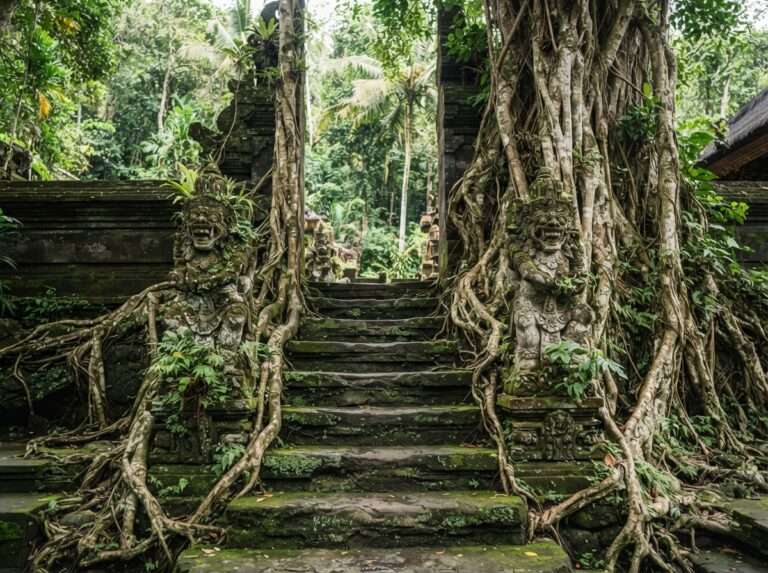
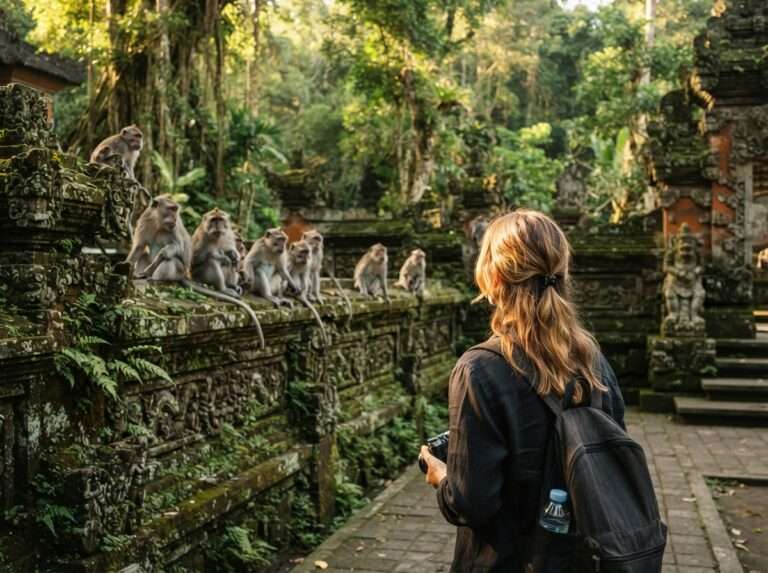
Inside the Sacred Monkey Forest Sanctuary, under banyan and nutmeg trees, sits the temple the forest exists to protect. Pura Dalem Agung Padangtegal is the death temple of Padangtegal village, generally dated to the 14th century, and it is the largest of three temples in the forest. The other two are Pura Beji, built around a holy spring where villagers purify themselves before ceremonies, and Pura Prajapati, which stands beside the village cremation ground.
You will not get into the inner courtyards. They are for worshippers only, and on most days the gates are shut. What you can see is the outside, which is the best part anyway: moss-covered walls, steps guarded by stone Rangda figures with long tongues and claw hands, and a gate half-swallowed by roots. The 1,200 or so long-tailed macaques treat the temple walls as their own. Keep sunglasses, earrings and plastic bags in a zipped bag, and don’t carry food. The monkeys can open a backpack faster than you can.
Entry is the forest ticket: IDR 130,000 for adults and IDR 100,000 for children (about ₹691 and ₹532), per the official Monkey Forest visit page, with last entry at 5 pm. You can walk in from the bottom of Jalan Monkey Forest in about 20 minutes from Ubud Palace. Come at 9 am for the gentlest light and the calmest monkeys. Our Ubud Monkey Forest guide has the forest map, the three entrances and the safety rules.
| Address | Sacred Monkey Forest Sanctuary, Jl. Monkey Forest, Padangtegal, Ubud |
| Open | 9 am to 6 pm; last entry 5 pm |
| Entry | IDR 130,000 adult, IDR 100,000 child (forest ticket) |
| Time needed | 1 to 1.5 hours for the forest and its three temples |
| Know before you go | The inner temple is closed to visitors. View it from the outer steps |
Related Tour Packages


❮
❯
03
Pura Dalem Ubud
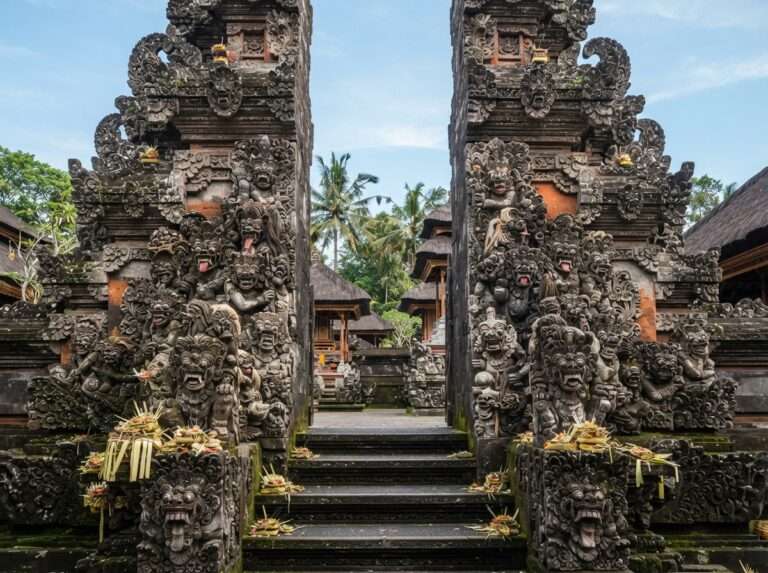
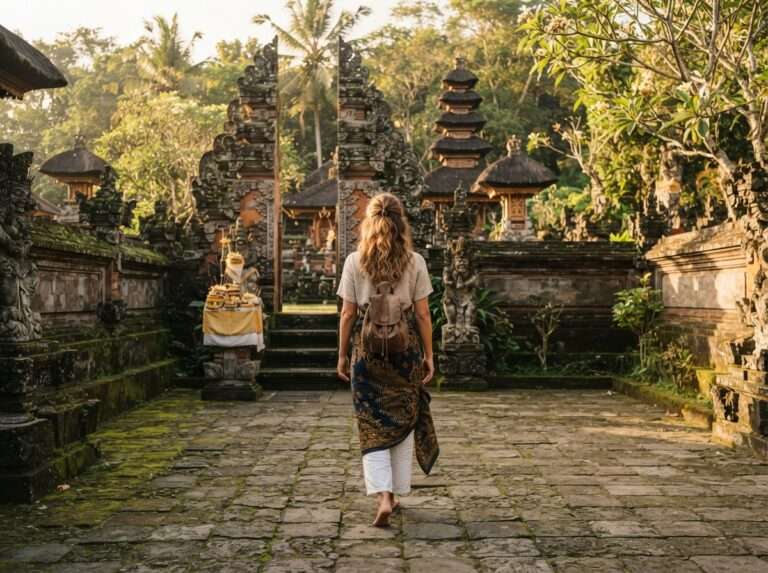
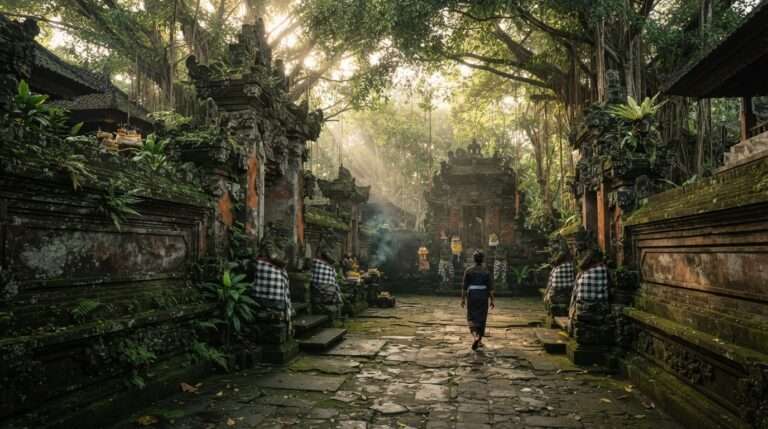
Pura Dalem Ubud is the village’s temple of the dead, at the west end of Jalan Raya Ubud where the road dips toward Campuhan. Every Balinese village has a pura dalem, dedicated to Shiva in his role as the destroyer who makes renewal possible, and to Durga, his fierce consort. That is why the carving here looks so different from Saraswati’s lotus calm. The walls are crowded with Rangda, the widow-witch queen of the Balinese underworld, with bulging eyes, fangs and pendulous breasts, and the gate is guarded by figures in mid-snarl.
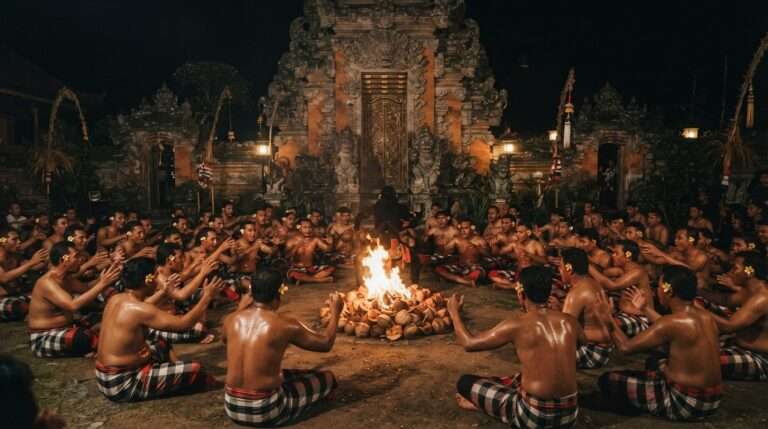
By day it is quiet. You can look at the outer courtyard and its carved split gate in 15 minutes, often with no one else there but a caretaker. The temple comes alive at night, when its forecourt becomes one of Ubud’s main dance venues. On set nights each week, troupes perform the Kecak, with its circle of 50 or more chanting men, followed by the fire dance, where a performer in a trance kicks through a pile of burning coconut husks. Other nights it is Barong or Legong. The flames against the carved gate make it the most atmospheric venue in town.
There is no ticket for a daytime visit. On show nights expect IDR 100,000 to 150,000 (about ₹530 to ₹800), bought at the gate from 6.30 pm. The cremation ground across the road is where Ubud holds its large royal cremations, so if you see bamboo towers being built, ask locally: those ceremonies are open to respectful onlookers. Read more in our Pura Dalem Ubud guide.
| Address | Jl. Raya Ubud, west of Ubud Palace, Ubud |
| Open | Daylight hours; dance shows from about 7.30 pm on set nights |
| Entry | No ticket by day. Show tickets about IDR 100,000 to 150,000 |
| Time needed | 15 minutes by day, 1.5 hours for a show |
| Don't miss | The Rangda figures on the main gate |
Related Tour Packages


❮
❯
04
Pura Desa and Pura Puseh Ubud
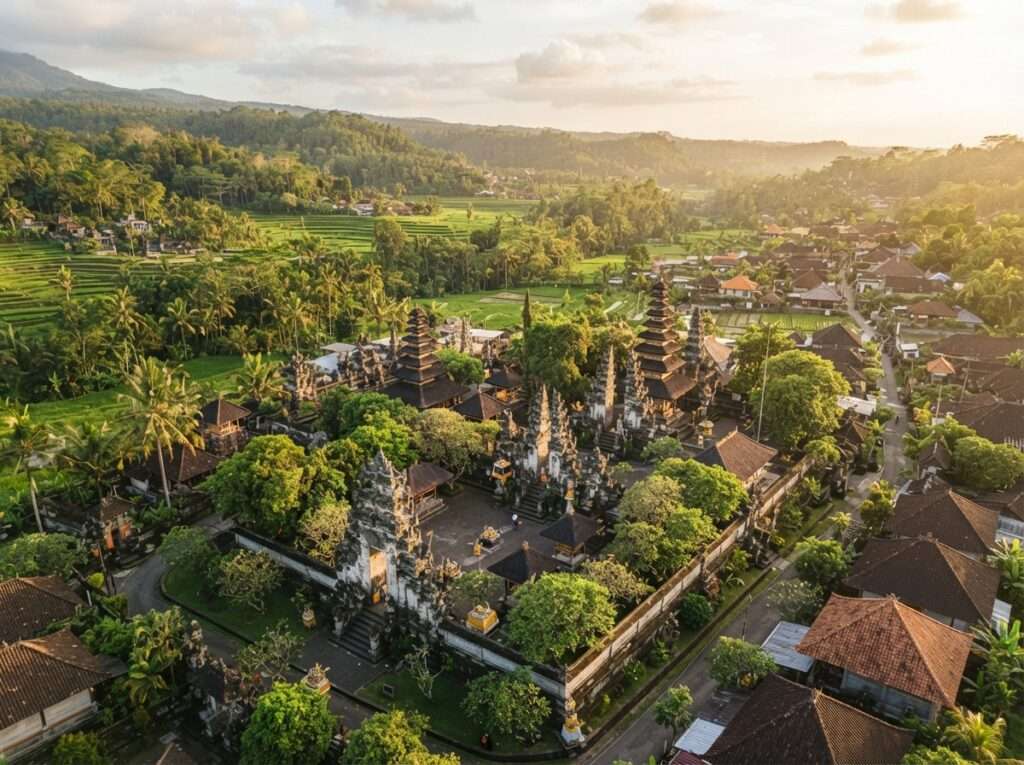
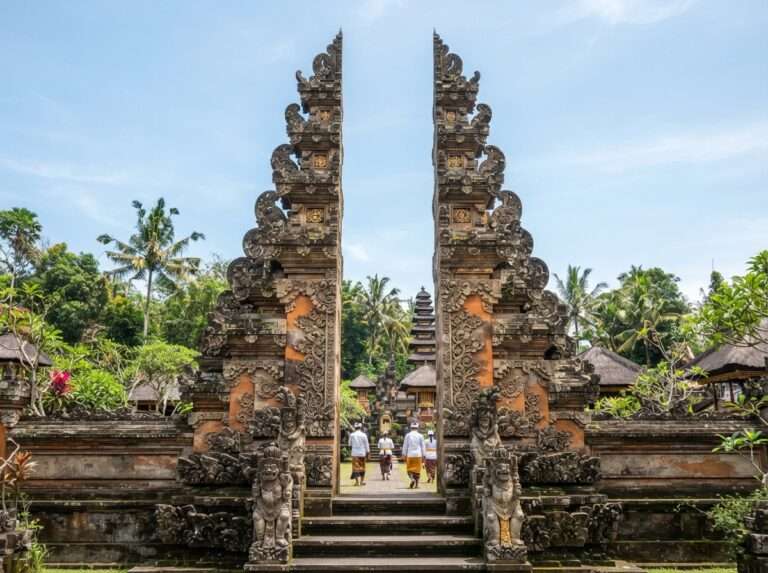
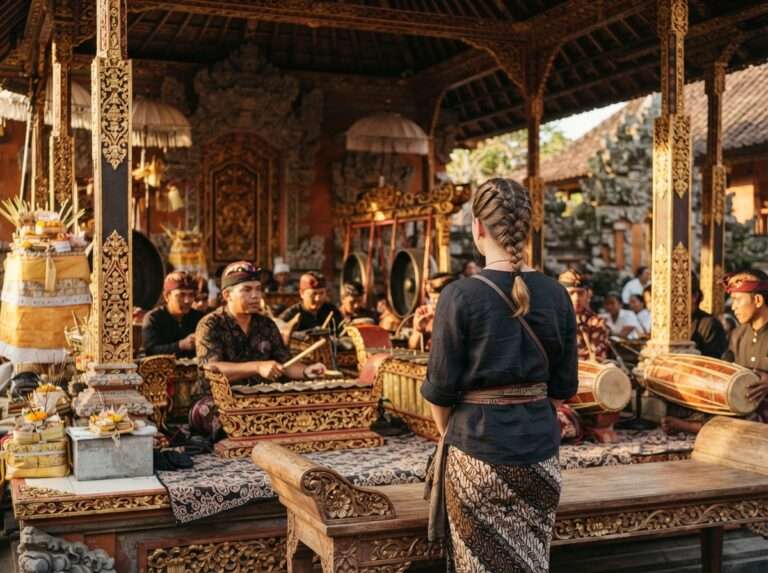
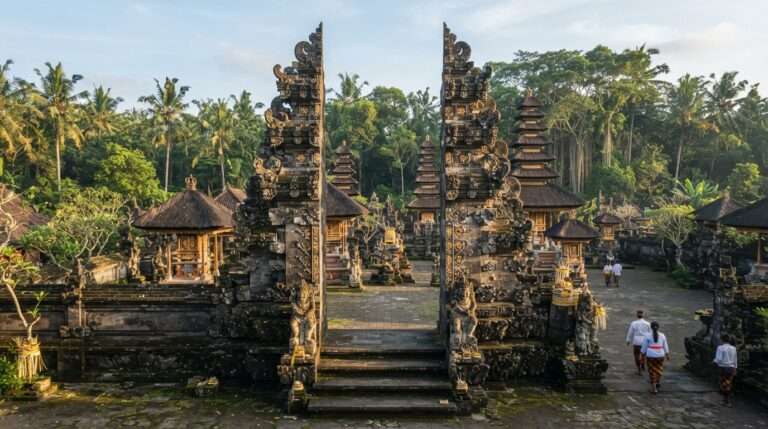
Walk five minutes north of the palace on Jalan Suweta and you reach two temples that stand side by side and rarely see a tour group. Pura Desa Ubud and Pura Puseh Ubud are two of the three village temples, known as Kahyangan Tiga, that every traditional Balinese village maintains. Pura Desa is the village temple tied to Brahma the creator, where the community meets and holds its everyday rites. Pura Puseh, “the navel temple”, honours Vishnu the preserver and the village’s founding ancestors. The third, Pura Dalem, honours Shiva. In Ubud that is Pura Dalem Ubud, so with these two you have walked the full trinity in under a kilometre.
Pura Puseh is the more striking of the pair. Its entrance is a tall, tiered gate covered in carved floral scrolls and small animal figures, and inside you will find old, weathered stone statuary in the courtyard. Pura Desa next door has a large open pavilion where the village gamelan practises in the late afternoon. If you hear it, stand at the gate and listen. Nobody minds.
Neither temple sells a ticket. Drop IDR 10,000 to 20,000 (about ₹53 to ₹106) in the donation box, and bring your own sarong because there is often no one at the gate to lend one. Mornings before 10 am are best for the light on the Puseh gate.
| Address | Jl. Suweta, about 300 m north of Ubud Palace |
| Open | Daylight hours |
| Entry | No ticket. Donation of IDR 10,000 to 20,000 |
| Time needed | 20 minutes for both |
| Know before you go | Bring your own sarong; the gate is often unstaffed |
05
Pura Gunung Lebah
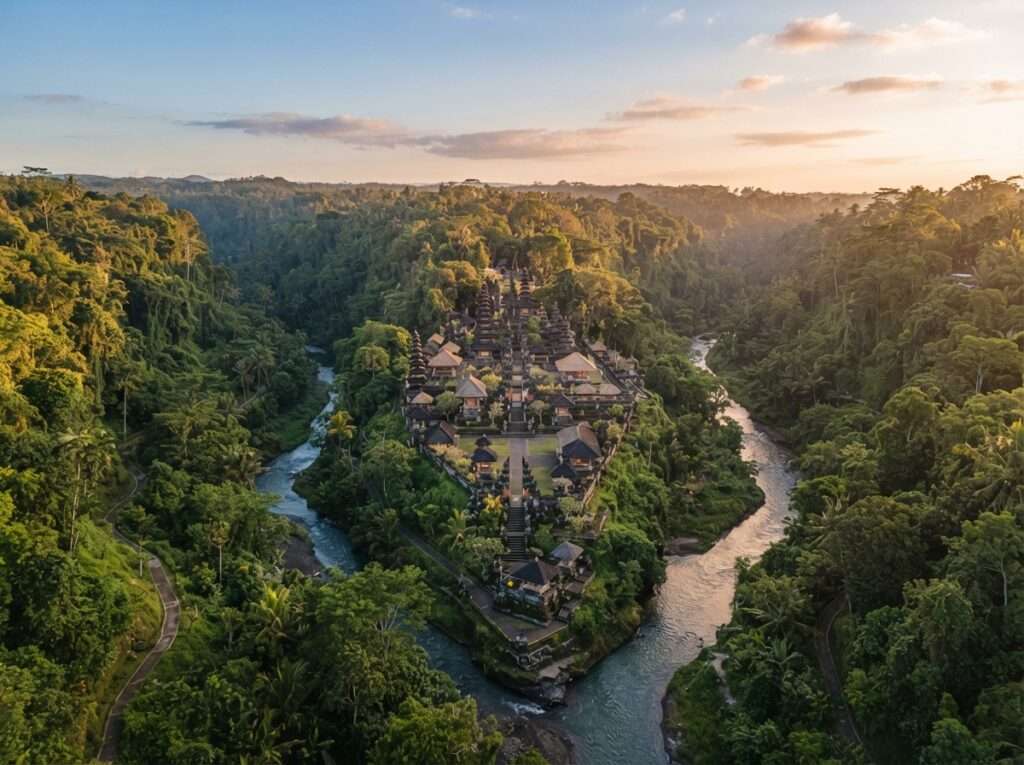
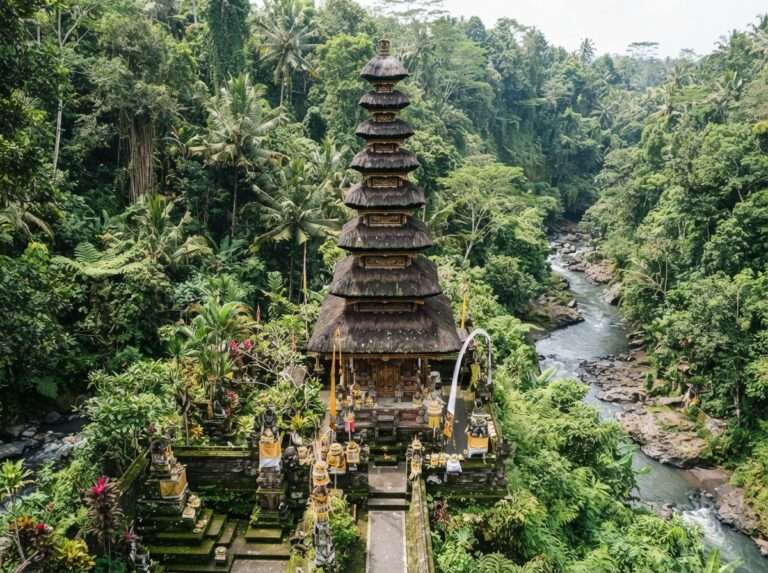
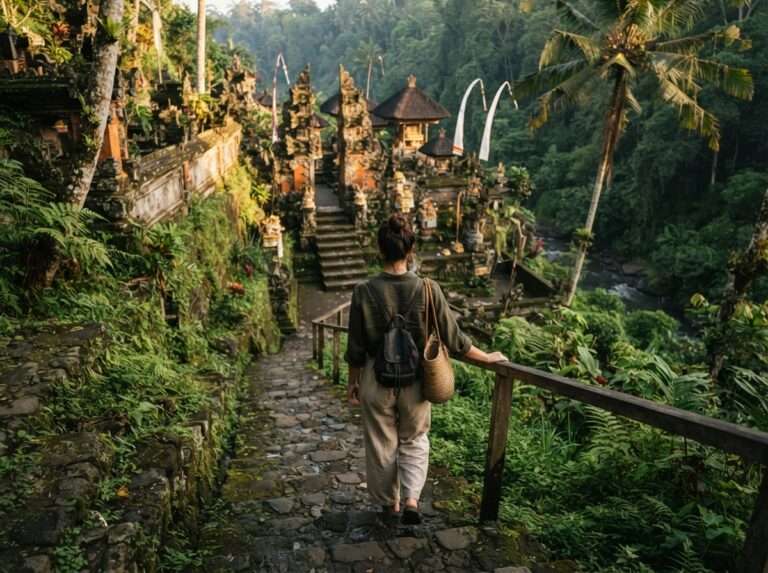
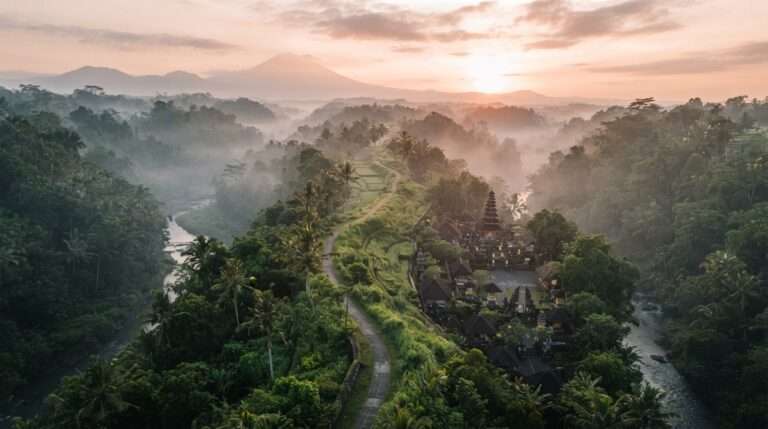
Pura Gunung Lebah stands where two branches of the Wos river meet in a ravine below the Campuhan bridge, on the western edge of Ubud. In Bali a river junction (campuhan) is a powerful place for purification, and local tradition says the Javanese holy man Rsi Markandeya founded a shrine here in the 8th century, before Ubud itself existed. That makes this, by legend at least, the oldest temple site in the area. The temple is dedicated to Dewi Danu, the goddess of Lake Batur, whose waters feed Bali’s rice fields.
You approach from the road down a short stone stairway, and the temple’s tall meru tower rises out of the trees as you descend. Inside, a carved padmasana (the empty stone throne for the supreme god) stands against a backdrop of jungle and the sound of the river. It is small, so 20 to 30 minutes is enough, but it is a perfect start to a morning. The Campuhan Ridge Walk begins at the temple’s side path and climbs onto a grassy spine between the two rivers. Do the temple at 6.30 am, then the ridge before the heat, and you are back in town for breakfast by 9.
There is no ticket. A donation box sits by the inner gate. The steps can be slippery after rain, so wear shoes with grip, not flip-flops.
| Address | Below the Campuhan bridge, Jl. Raya Campuhan, Ubud |
| Open | Daylight hours |
| Entry | No ticket. Donation |
| Time needed | 20 to 30 minutes |
| Pair it with | The Campuhan Ridge Walk, about 2 km each way (4 km return) |
06
Goa Gajah
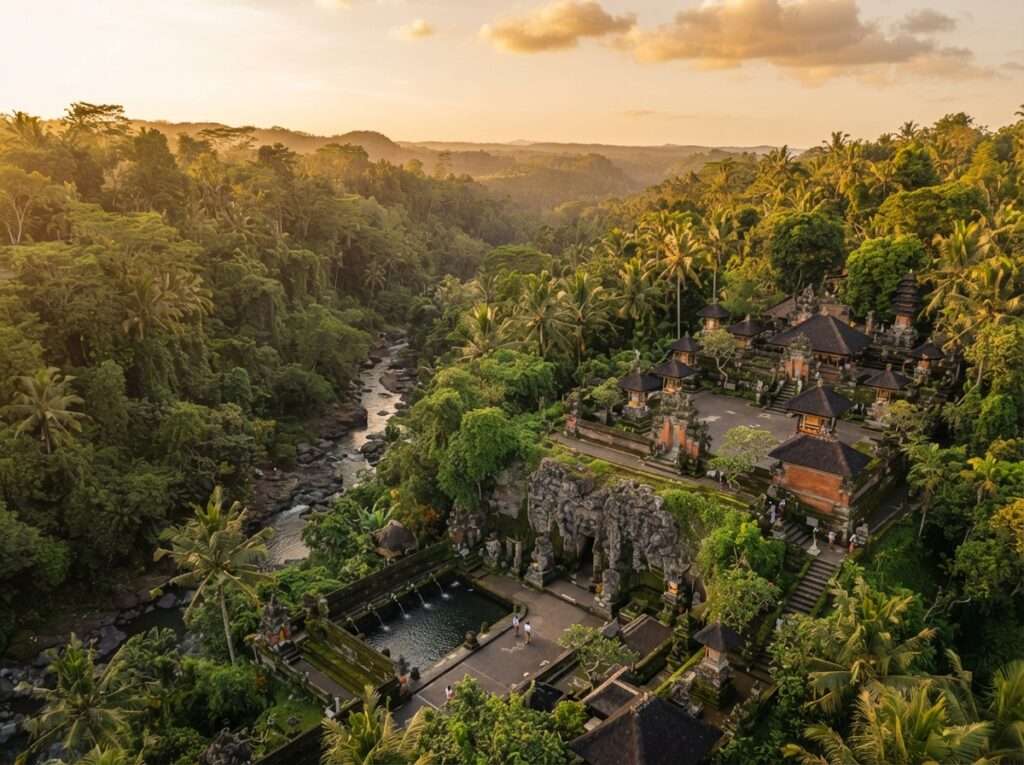
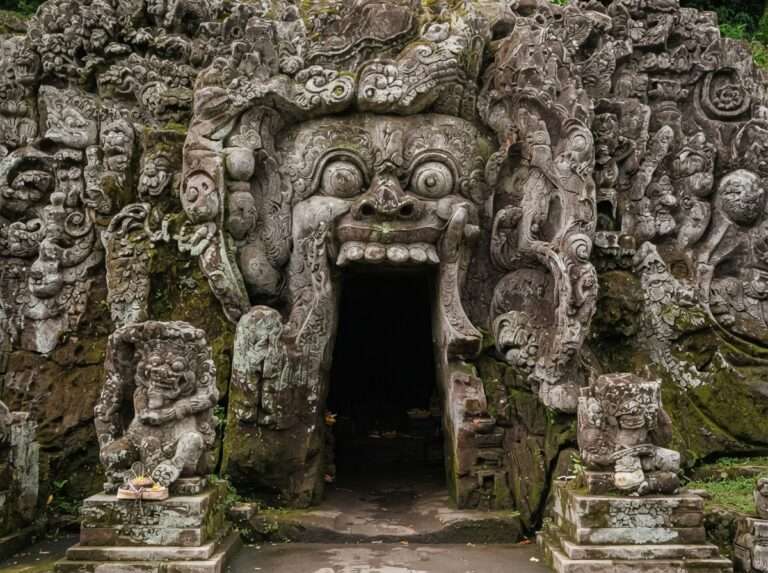
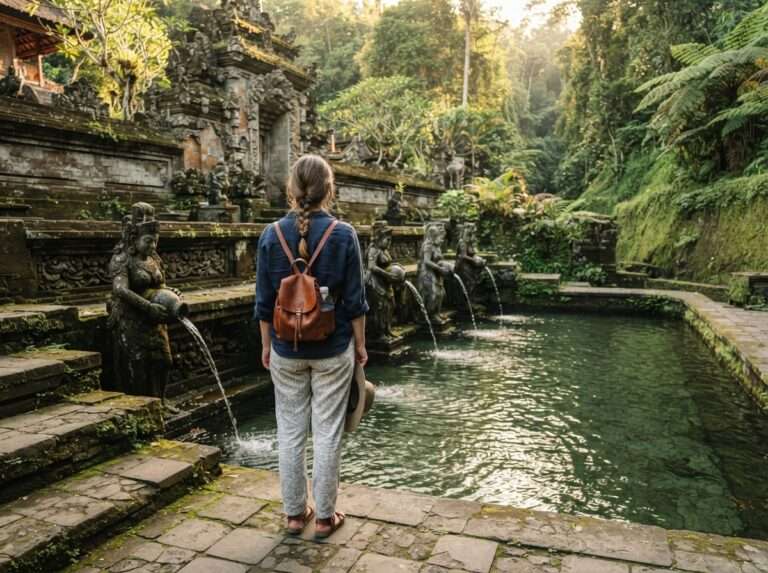
Goa Gajah, the Elephant Cave, is in Bedulu village, about 4 km east of Ubud, and it is the most visited temple near Ubud after Tirta Empul. You walk down a flight of steps into a hollow, and the first thing you see is the cave entrance: a giant demon face carved into the rock, mouth wide open, so that you enter the temple through its jaws. Inside, the T-shaped cave is only about 15 m deep and dim. In the left niche there is a stone Ganesha, darkened with offerings and incense. At the far end, three lingams stand on a single base, the symbol of Shiva, which Indian visitors tend to spot before anything else.
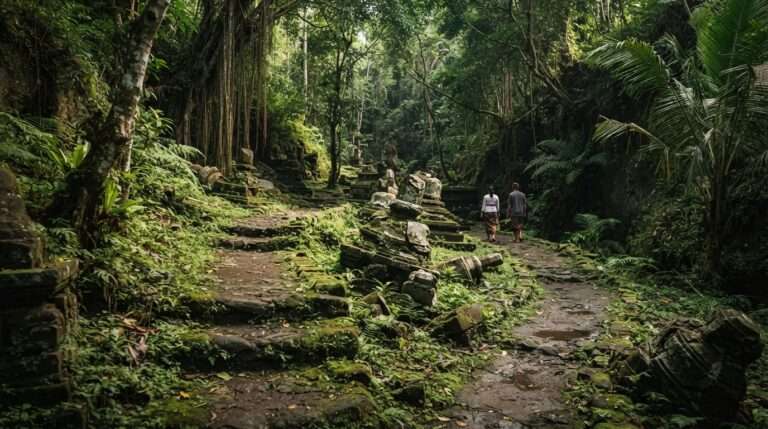
Sources date the cave to between the 9th and 11th centuries, and the mix of Hindu and Buddhist relics suggests both traditions used it as a hermitage. In front of the cave are the bathing pools, only excavated in 1954. Six female figures hold vases that still pour spring water into the pools. Further down a mossy path, past a giant banyan, you reach the stream and the scattered remains of a Buddhist shrine with toppled carved stupas. Most visitors miss this lower area. Don’t.
Entry is IDR 50,000 for adults and IDR 25,000 for children (about ₹266 and ₹133), sarong included, and the site is open from 8 am to about 6 pm. Allow an hour. The car park is lined with souvenir stalls, so walk through quickly. Check our Goa Gajah timings page before you go, and our Goa Gajah guide for the full legend.
| Address | Jl. Raya Goa Gajah, Bedulu, Blahbatuh, Gianyar |
| Open | 8 am to about 6 pm daily |
| Entry | IDR 50,000 adult, IDR 25,000 child, sarong included |
| Time needed | 1 hour, including the lower Buddhist ruins |
| Don't miss | The Ganesha niche and the three lingams |
07
Yeh Pulu
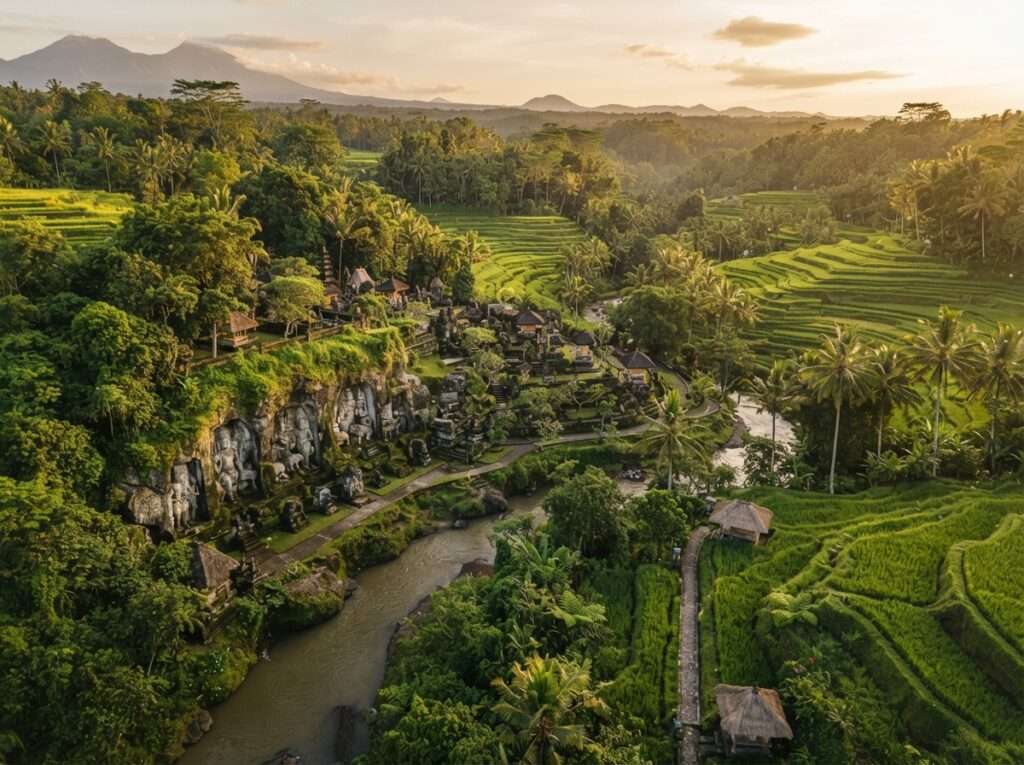
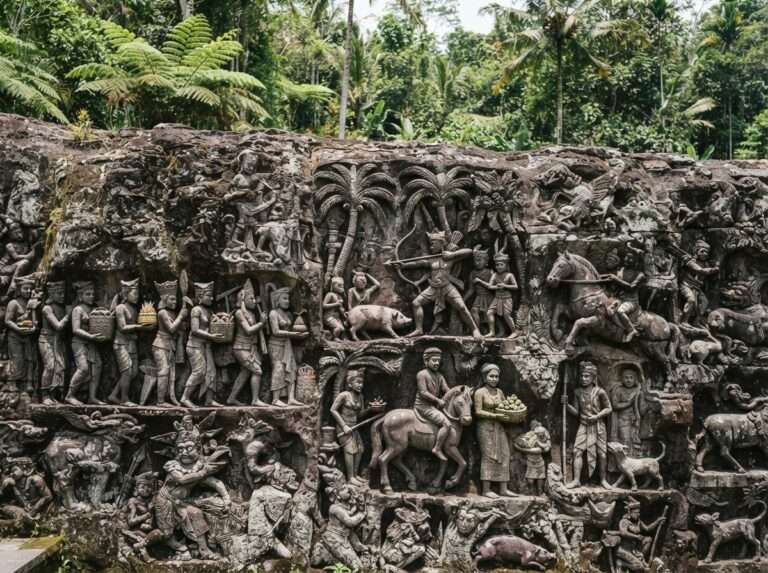

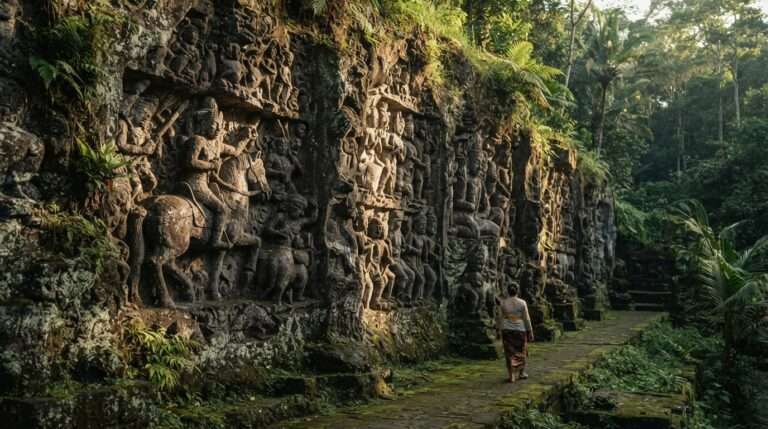
Yeh Pulu, 1 km south-east of Goa Gajah, is the stop most temple tours skip and the one many travellers remember best. It is a 25 m stretch of rock relief carved into a cliff face beside the rice fields, generally dated to the 14th or 15th century. Unlike the gods and demons on most Balinese temple walls, the panels here show everyday life: a man carrying jars on a pole, a woman holding a horse’s tail, a hunter fighting a bear, and figures resting and chatting. Near one end there is a small carving of Ganesha. The relief was rediscovered in 1925 by the punggawa (district chief) of Ubud, who reported it to the Dutch artist W.O.J. Nieuwenkamp; it was properly excavated in 1929.
The walk in is part of the appeal. From the car park, a 300 m path runs between rice paddies and a stream, and you will likely be the only visitor. At the end there is a small holy spring where local women come to collect water and pray. A caretaker will hand you a sarong and may offer to point out the scenes, which is worth a small tip because some are hard to read in flat light. Late afternoon, after 3 pm, when the sun is low across the cliff, brings the carving out best.
Entry is about IDR 30,000 (about ₹160), and the site is open from 8 am to 5 pm.
| Address | Banjar Batulumbang, Bedulu, Blahbatuh, Gianyar |
| Open | 8 am to 5 pm |
| Entry | About IDR 30,000, sarong included |
| Time needed | 30 to 45 minutes |
| Pair it with | Goa Gajah, 5 minutes away |
08
Pura Samuan Tiga
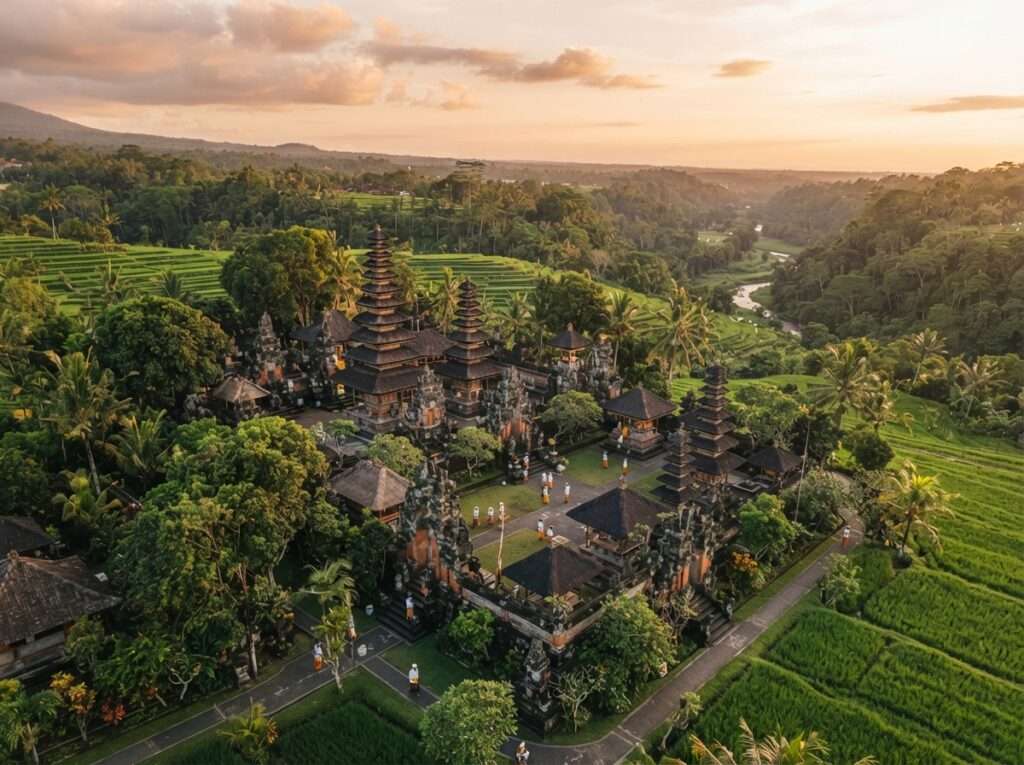
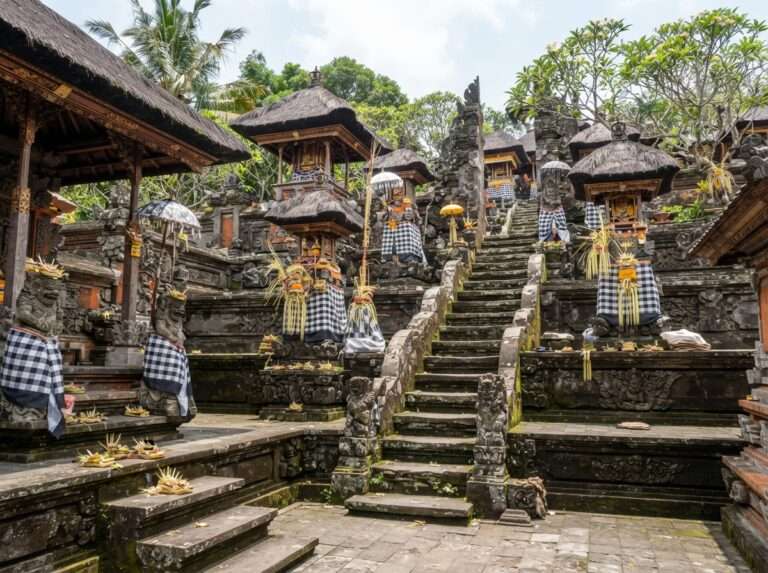
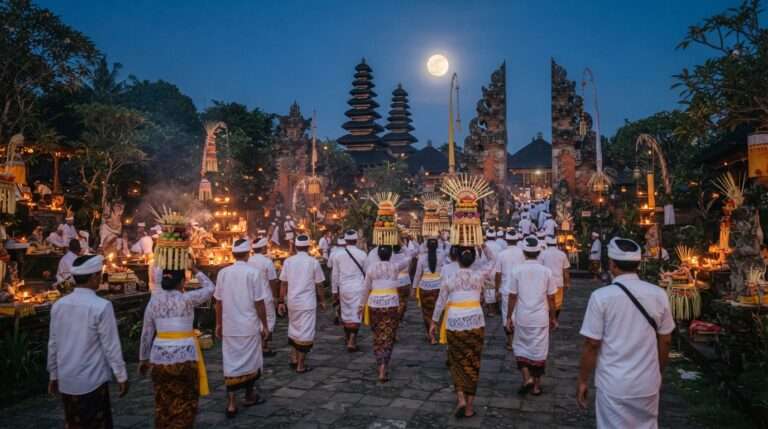
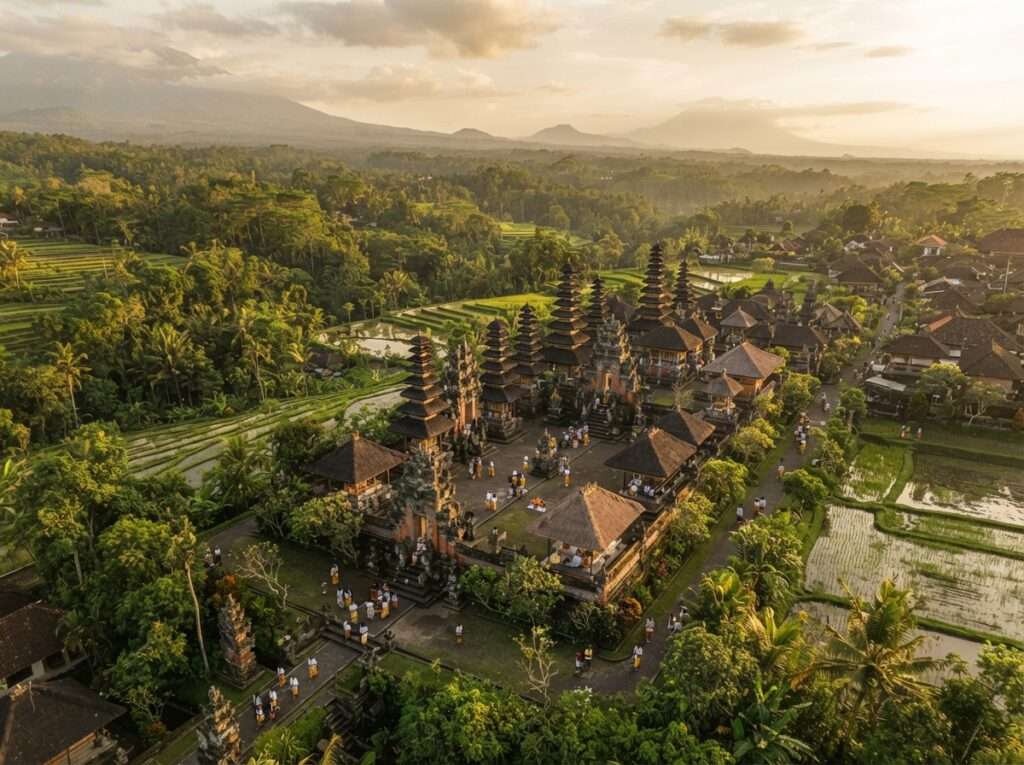
Pura Samuan Tiga is a large, quiet temple complex in Bedulu, about 1 km from Goa Gajah, and it holds one of the key moments in Balinese religious history. Its name means “the meeting of three”. According to Balinese tradition, in the 11th century the priest Mpu Kuturan called the island’s rival religious sects together here and they agreed on a single system of worship, which gave Bali the Kahyangan Tiga, the three village temples for Brahma, Vishnu and Shiva that you saw at Ubud’s Pura Desa, Pura Puseh and Pura Dalem.
The complex itself dates back to around the 10th century and climbs a hillside in a series of terraced courtyards linked by wide stone stairways and split gates. The scale surprises people. Huge banyan trees shade the upper courts, and the main shrines are wrapped in black-and-white poleng cloth. You may well have it to yourself. On its odalan (temple festival), which falls on Purnama Kedasa, the full moon of the tenth Balinese month, usually in March or April, thousands of villagers from across Gianyar come for the Siat Sampian, a mock battle fought with palm-leaf offerings.
There is no ticket. A caretaker at the gate lends sarongs and accepts a donation of about IDR 20,000 (about ₹106).
| Address | Jl. Raya Samuan Tiga, Bedulu, Blahbatuh, Gianyar |
| Open | Daylight hours |
| Entry | Donation, about IDR 20,000 |
| Time needed | 30 minutes |
| Best time | The April odalan, if your dates line up |
09
Pura Penataran Sasih
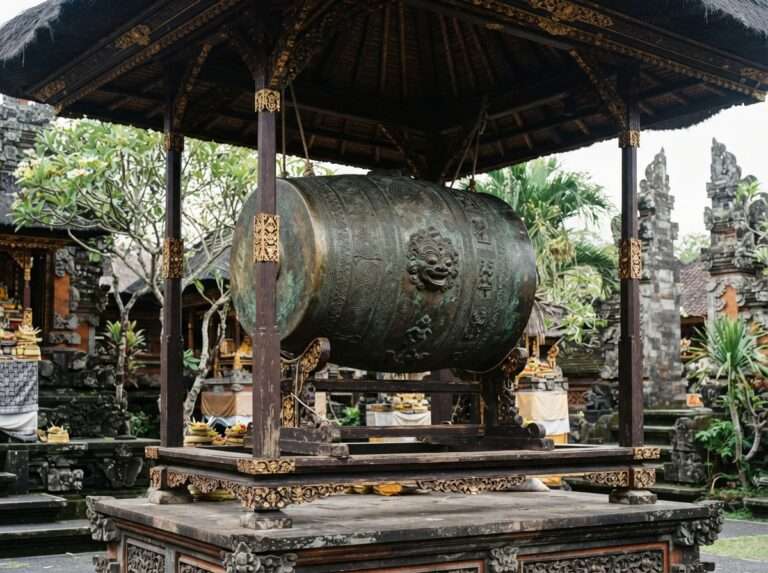
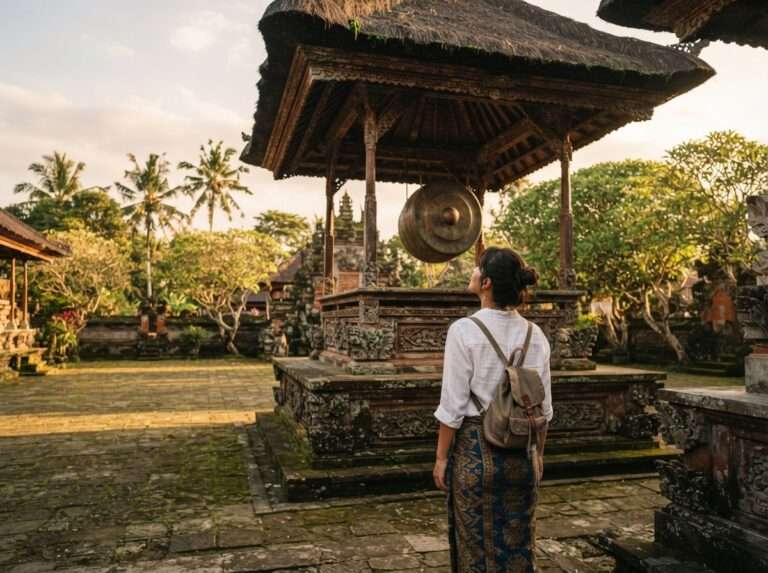
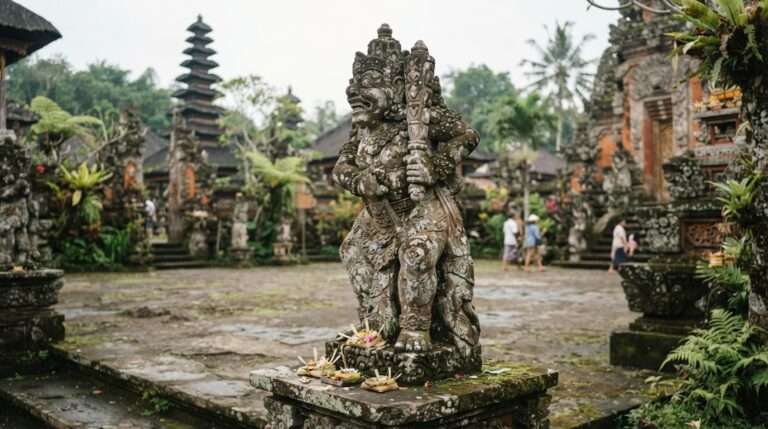
Pura Penataran Sasih in Pejeng, 15 to 20 minutes east of Ubud, keeps one of the strangest objects in Southeast Asia. At the back of the temple, raised high in a covered pavilion, hangs the Moon of Pejeng: a bronze kettle drum about 186 cm tall, the largest single-cast drum of its kind ever found. It is generally dated to the Bronze Age, roughly 2,000 years ago, and is linked to the Dong Son culture of northern Vietnam. Its sides carry stylised faces with large staring eyes.
Local legend tells it differently. The drum was once one of the moons, so the story goes, and it fell from the sky and landed in a tree in Pejeng, shining so brightly that thieves could not work. One thief climbed up and urinated on it to put the light out, and the moon exploded, killing him and leaving the drum cracked and dull. Locals still treat it with care, and you can only see it from below.
Pejeng was the seat of one of Bali’s early kingdoms, and the village is full of temples. Penataran Sasih is the main one, with old statues gathered around its courtyards. A small archaeological museum a short walk down the road holds stone sarcophagi from the same era. There is no ticket. Leave a donation and borrow a sarong at the gate.
| Address | Jl. Raya Tampaksiring, Pejeng, Tampaksiring, Gianyar |
| Open | Daylight hours |
| Entry | Donation, about IDR 20,000 |
| Time needed | 30 minutes |
| Don't miss | The Moon of Pejeng, at the back of the inner court |
10
Tirta Empul
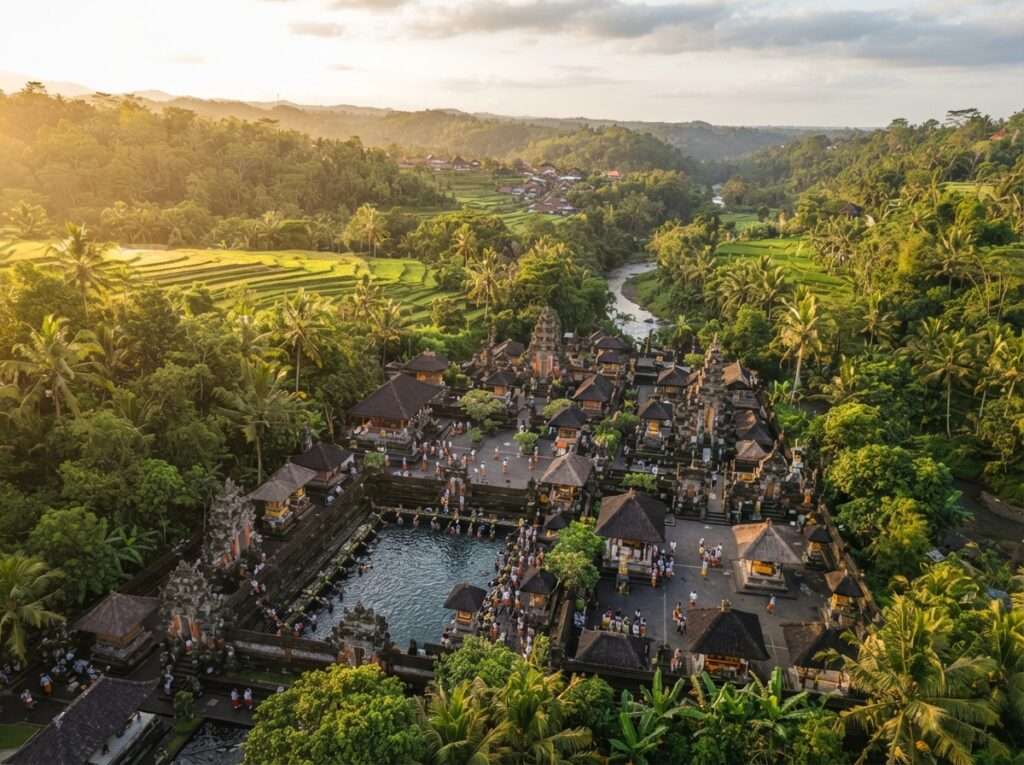
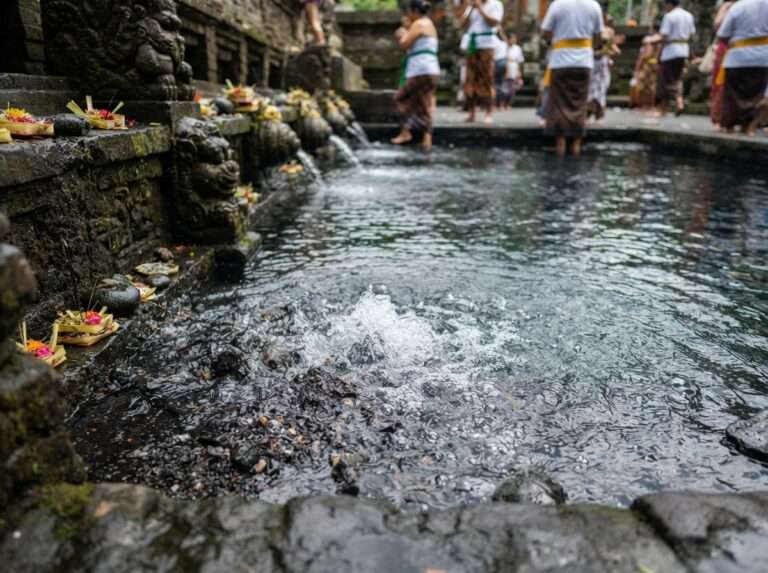
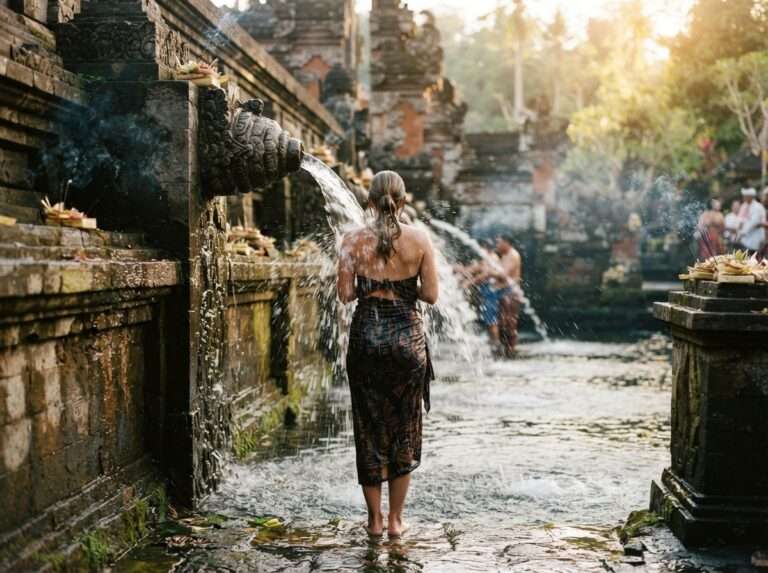
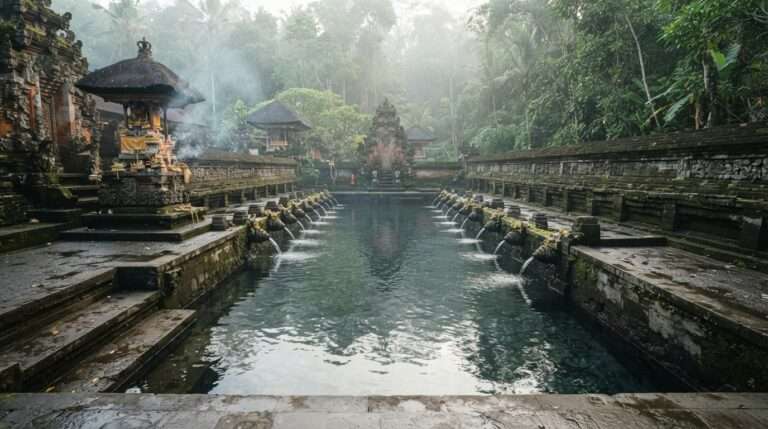
Tirta Empul in Tampaksiring is the temple most people come to Ubud for, and it is worth the drive. It was built around a spring in 962 CE, during the Warmadewa dynasty, and Balinese Hindus have bathed here ever since. The legend will feel familiar if you grew up with the Puranas. The tyrant king Mayadenawa poisoned the river, and Indra pierced the earth to create a spring of amerta, the water of immortality, to revive his army. The same story explains why devotees believe the water heals.
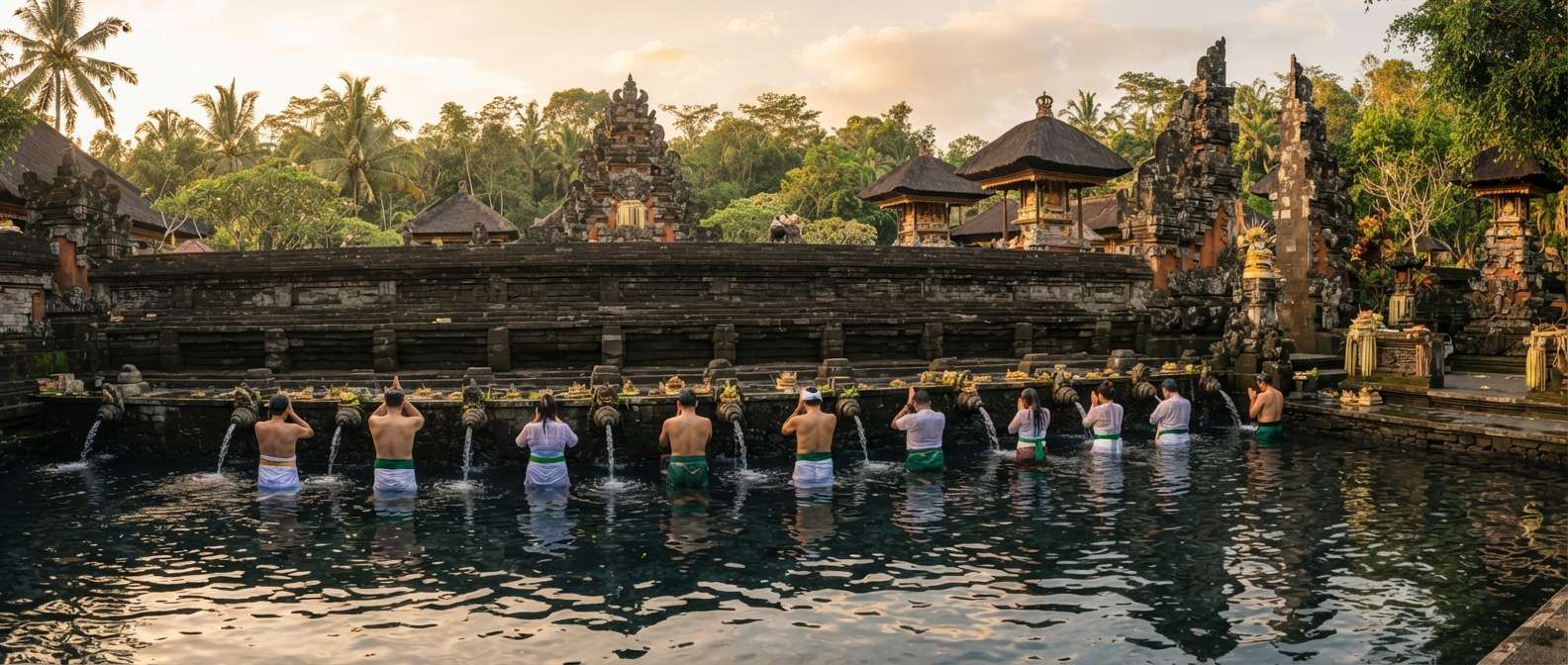
The heart of the temple is its purification area: long rectangular bathing pools fed by more than two dozen carved stone spouts. Balinese families come in white and green sarongs to work their way along the spouts in the melukat ritual, praying at each one, and visitors can join in (the steps are explained further down this guide). Behind the pool, in the inner courtyard, you can see the spring itself bubbling up through black sand in a clear pond. On the hill above sits a presidential palace built by Sukarno in 1957, and the whole Pakerisan valley, including Tirta Empul, is part of Bali’s UNESCO World Heritage cultural landscape.
Tickets are IDR 75,000 for adults and IDR 50,000 for children (about ₹399 and ₹266). The temple is open from 8 am to 6 pm every day, including ceremony days. Arrive at 8 am. By 10.30 am the pool fills with tour groups and you may queue several minutes at each spout. Our Tirta Empul timings page has the current hours, and our Tirta Empul temple guide covers the history in depth.
| Address | Jl. Tirta, Manukaya, Tampaksiring, Gianyar |
| Open | 8 am to 6 pm daily |
| Entry | IDR 75,000 adult, IDR 50,000 child. Locker and bathing sarong extra |
| Time needed | 1.5 to 2 hours if you bathe |
| Best time | 8 to 9.30 am |
11
Gunung Kawi Tampaksiring
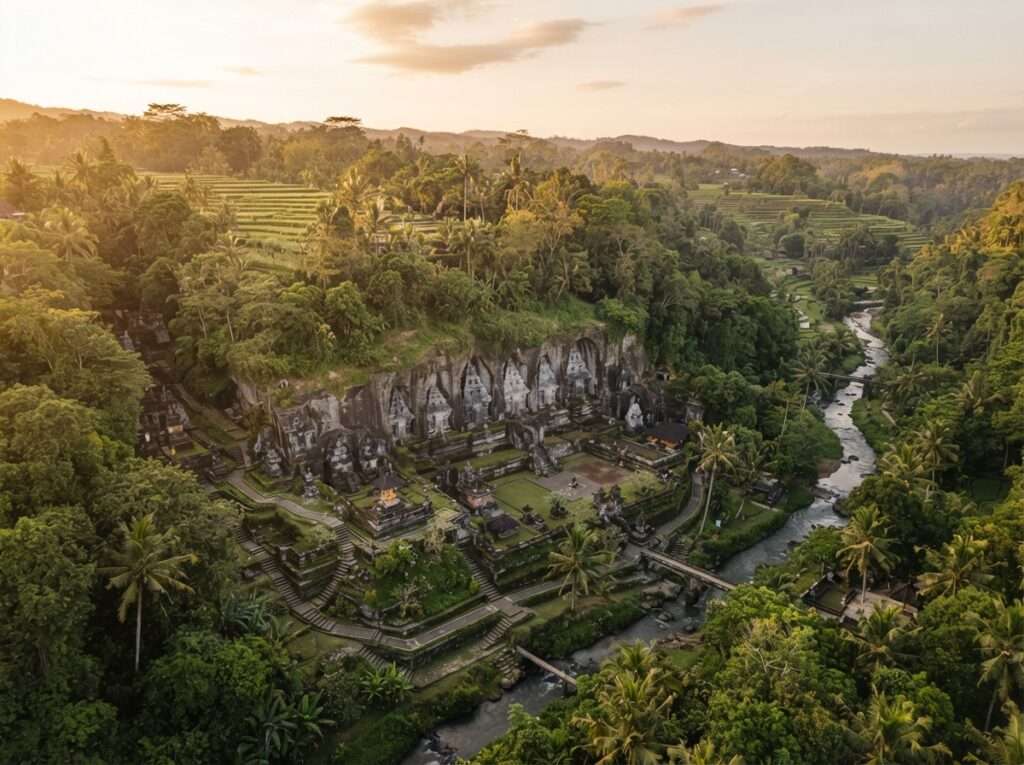
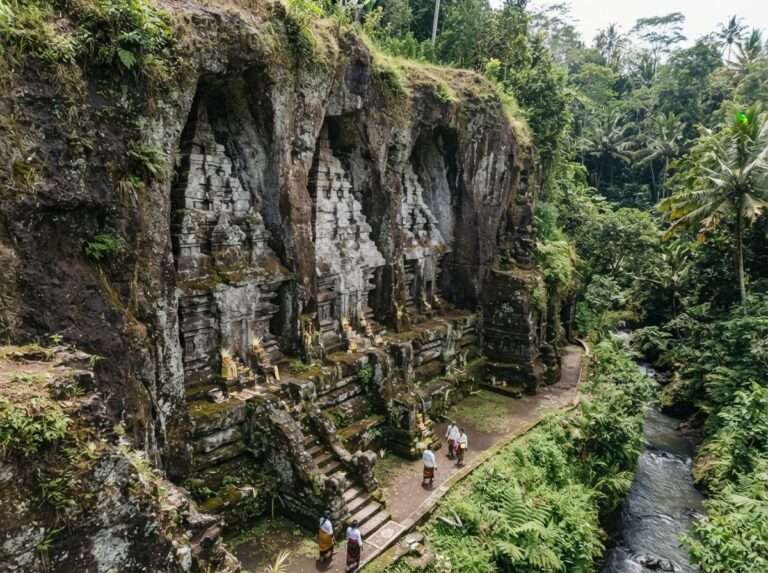
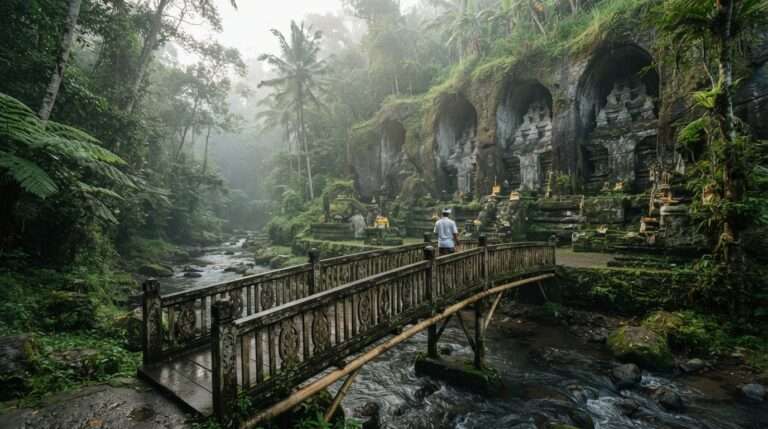
Gunung Kawi is a short drive downstream of Tirta Empul, and it looks like nothing else in Bali. In the 11th century, ten shrines, each about 7 m tall, were carved straight into the cliff walls of the Pakerisan river gorge. They are candi, memorials rather than tombs, and are generally linked to King Anak Wungsu and his family. Five stand in a row on the east bank, four on the west bank, and a tenth sits alone further down the valley. Each one stands in its own carved niche, like a temple facade with no building behind it.
Getting there is half the visit. From the road you walk down about 300 to 370 steps (counts vary by source), past rice terraces and small warung, into a cool, green ravine. You cross the river on a footbridge between the two groups of shrines. Near the east-bank shrines, look for the hermit cells carved into the rock, where monks once lived. The climb back is the hard part in midday heat, so go early and carry water. There is a reason the warung halfway up sell cold coconuts.
Entry is IDR 50,000 (about ₹266), sarong included, though some 2026 guides already quote IDR 75,000. The site is open from about 8 am. Allow 1 to 1.5 hours. Our Gunung Kawi guide has photos of each shrine group and the full story.
| Address | Banjar Penaka, Tampaksiring, Gianyar |
| Open | About 8 am to 6 pm |
| Entry | IDR 50,000, sarong included (some guides quote IDR 75,000) |
| Time needed | 1 to 1.5 hours, including the steps |
| Know before you go | About 300 to 370 steps each way. Not easy for knees |
12
Pura Mengening
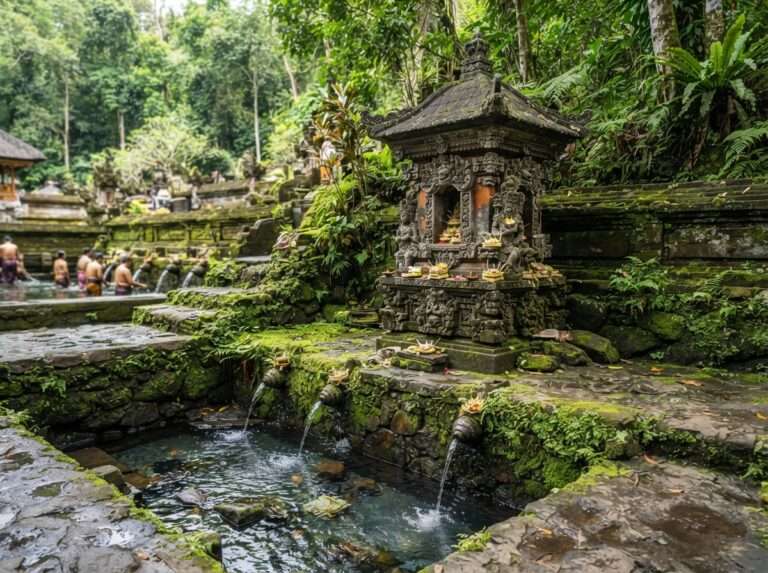
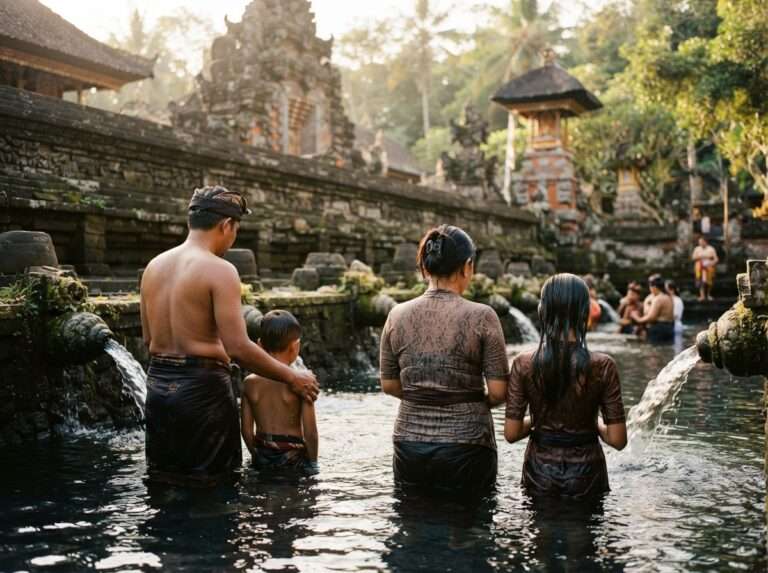
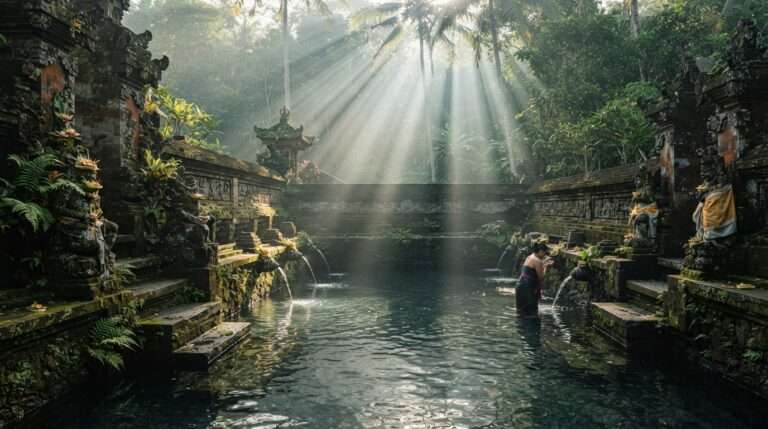
Pura Mengening is the temple to choose if Tirta Empul’s crowds put you off. It sits in the same Tampaksiring valley, about 1 km from Tirta Empul, around a spring that feeds the Pakerisan river, and it does the same thing on a far smaller scale. Water pours from a short row of spouts into a stone bathing pool, and local families come to perform the melukat, often guided by the temple’s own priest. The atmosphere is closer to how Tirta Empul felt decades ago.
Above the pool stands a small, restored stone candi, a shrine similar in style to the Gunung Kawi monuments, set among trees and moss. On a weekday morning you may hear only birdsong and running water. Because it is quiet, it is also more personal. If you want to bathe here, ask the priest at the gate for permission and guidance. He will likely ask for a small offering.
Entry is about IDR 30,000 (about ₹160), and sarongs are available at the gate. Allow 45 minutes, or longer if you bathe. Bring a change of clothes, because there are only basic changing facilities.
| Address | Saraseda, Tampaksiring, Gianyar (about 1 km from Tirta Empul) |
| Open | Daylight hours, about 8 am to 5 pm |
| Entry | About IDR 30,000 |
| Time needed | 45 minutes |
| Know before you go | Basic changing rooms only; bring your own towel |
13
Gunung Kawi Sebatu
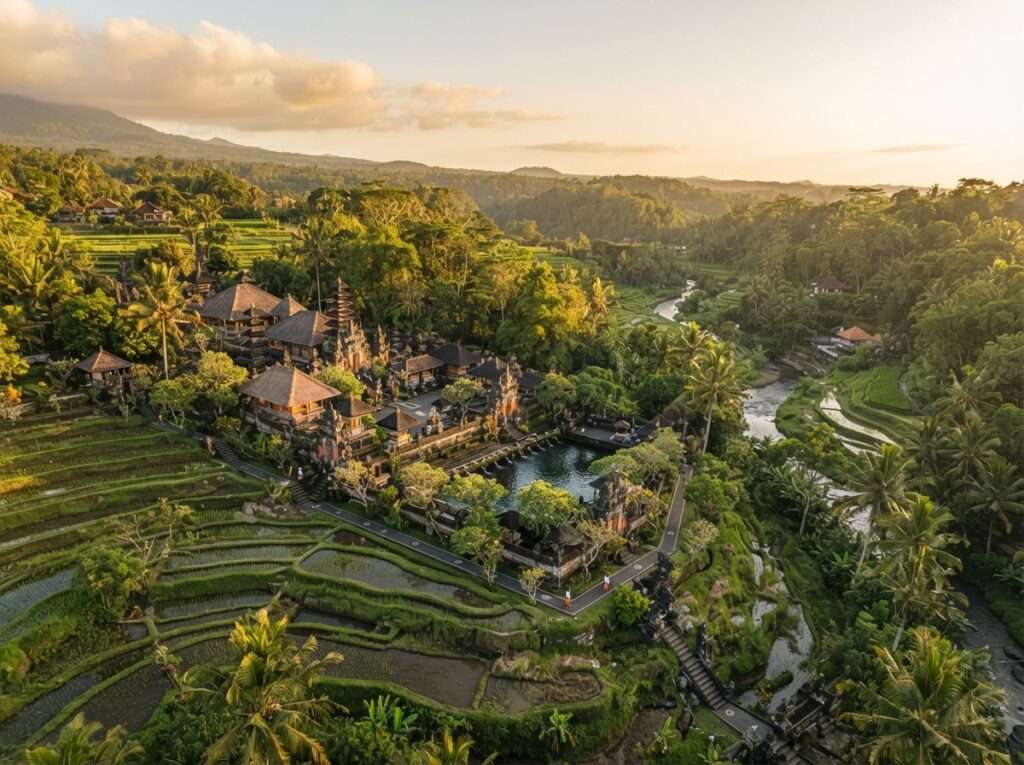
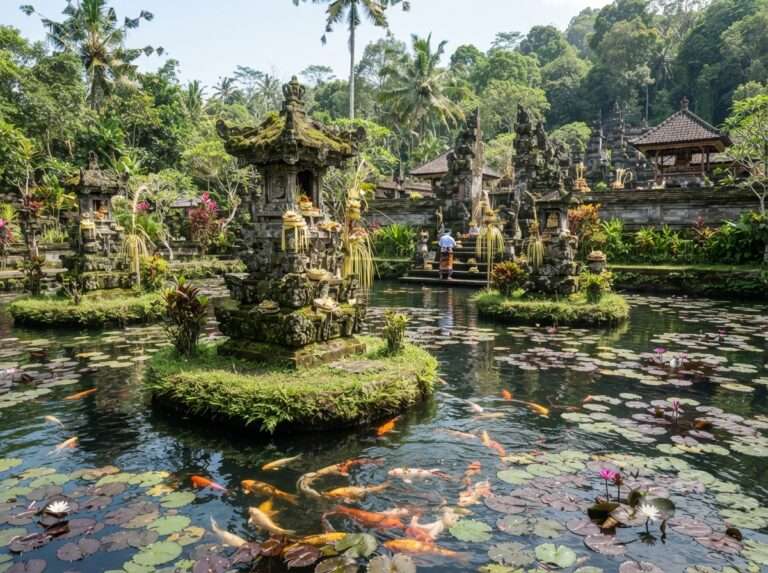
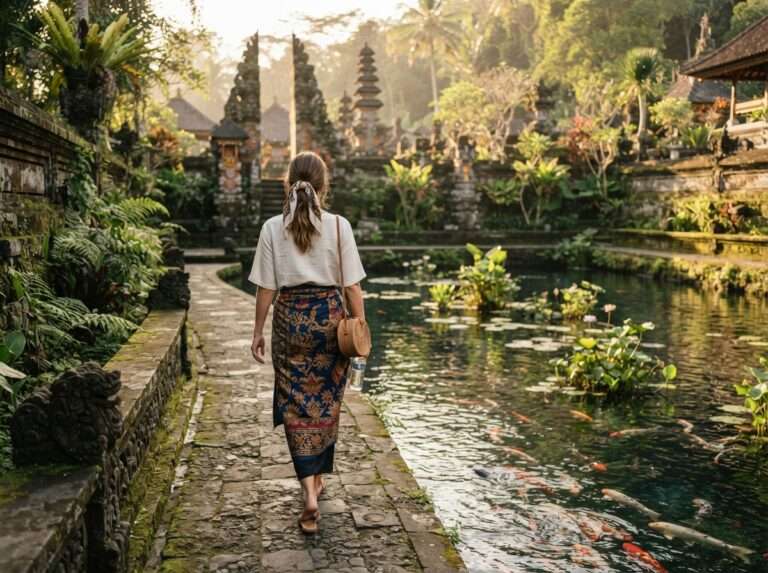
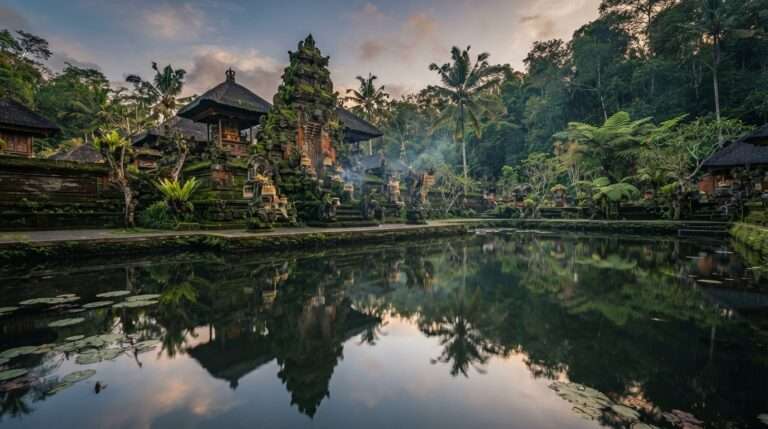
Gunung Kawi Sebatu shares a name with the cliff shrines at Tampaksiring but is a completely different place. It is a water temple in Sebatu village, about 30 minutes north of Ubud past the Tegallalang rice terraces, built around springs that fill a series of pools and channels. The main shrines sit on small islands in a pond full of koi and water lilies, and green moss covers almost every stone. Many visitors call it the most photogenic temple near Ubud.
The temple honours Vishnu, the preserver, here associated with water. There are separate bathing pools, one for men and one for women, where locals perform purification, and you can bathe if you ask first. Most visitors simply walk slowly around the pools. The temple sees a fraction of Tirta Empul’s crowds, even at midday, which is why so many guides now call it the “quiet alternative”.
Entry is about IDR 50,000 (about ₹266), sarong included, and the temple is open from 8 am to 6 pm. Plan it with the Tegallalang rice terraces, which are 10 minutes back toward Ubud on the same road.
| Address | Sebatu, Tegallalang, Gianyar |
| Open | 8 am to 6 pm |
| Entry | About IDR 50,000, sarong included |
| Time needed | 45 minutes |
| Pair it with | Tegallalang rice terraces |
14
Pura Puseh Batuan
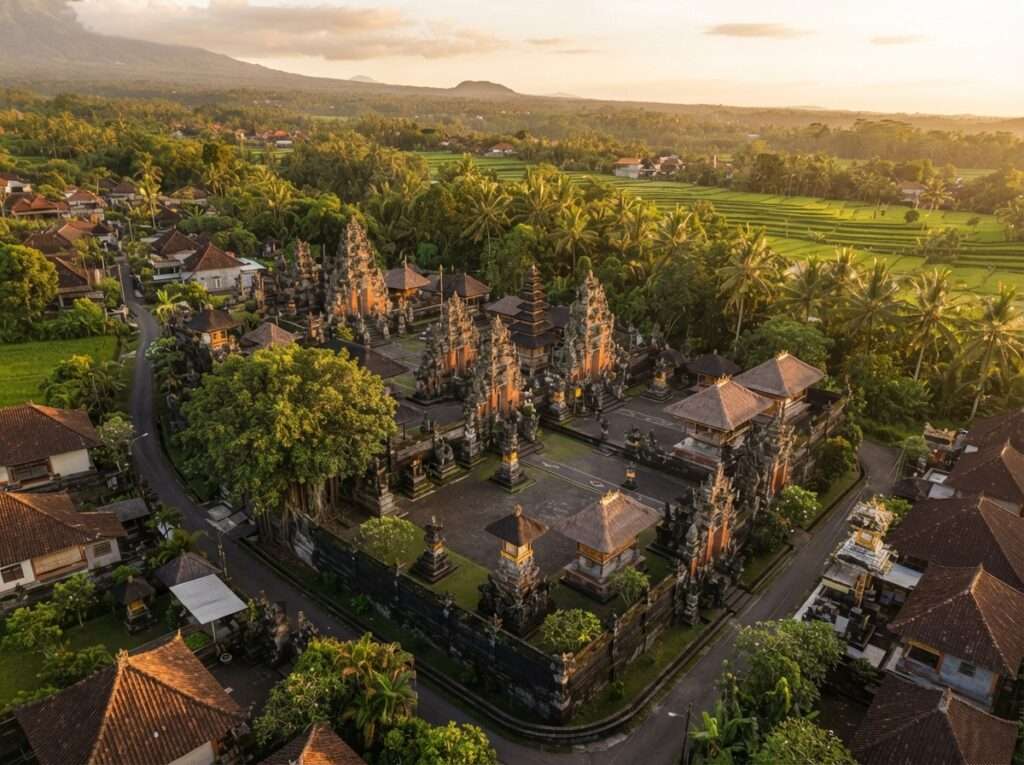
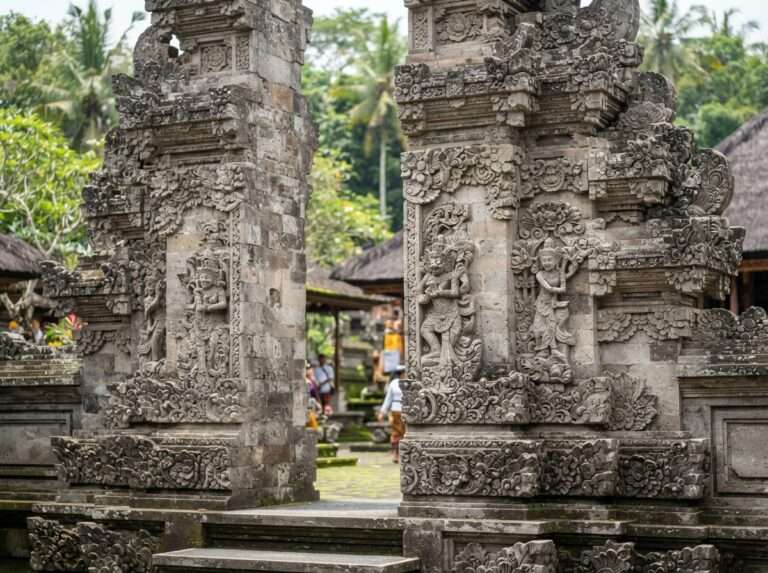
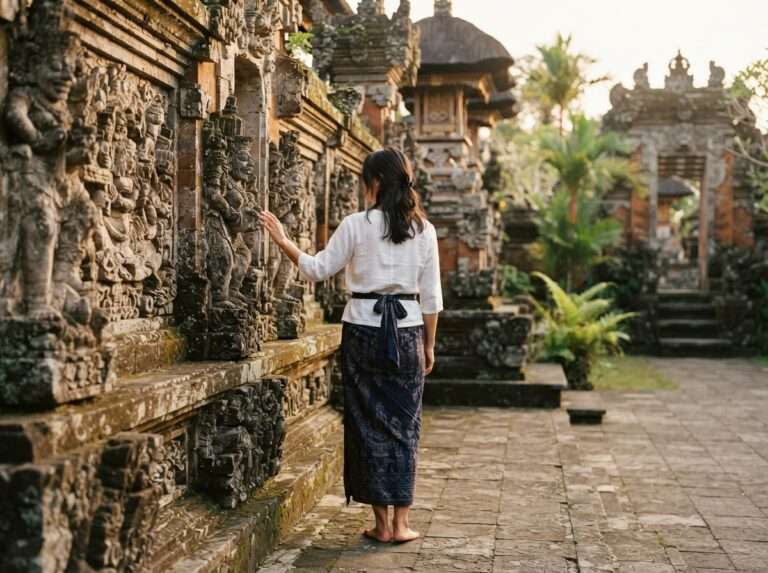
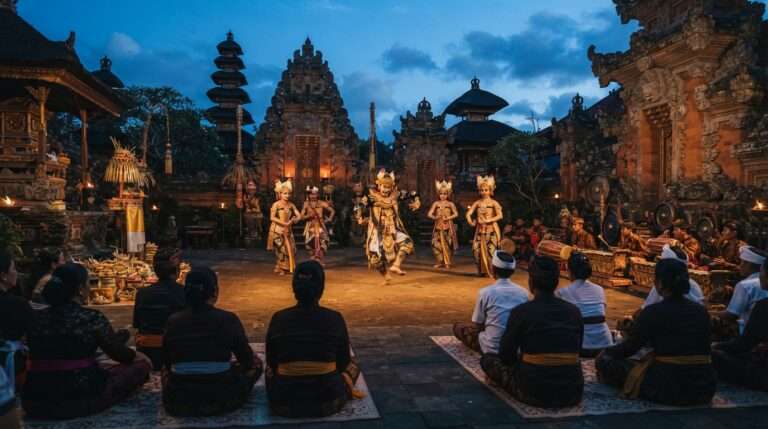
Pura Puseh Batuan is in Batuan village, about 10 km south of Ubud on the road toward Sanur, so it is not in Ubud town despite what many lists claim. It is worth the 25-minute drive. Founded, according to an inscription, in 1022 CE, it is one of the most finely carved temples in Bali. The split gate and the walls are covered in deep, layered carving in grey stone: demons, flowers, guardians and animals, all crowded into every surface. The temple is actually one of three in the village, one each for Brahma, Vishnu and Shiva, the same Kahyangan Tiga pattern you see in Ubud.
Batuan has a long arts history of its own. It gave its name to a dense, dark style of Balinese painting, and the village still performs Gambuh, the oldest form of Balinese dance theatre, which is rarely seen elsewhere. If you visit on the right evening you may catch it in the temple forecourt, so ask at the ticket desk.
The temple is open from 8 am to 6 pm, and the IDR 50,000 adult ticket (about ₹266) includes a sarong and sash. Allow 30 to 45 minutes. It fits on the way to or from the airport or Sanur, which saves you a separate trip.
| Address | Jl. Raya Batuan, Batuan, Sukawati, Gianyar |
| Open | 8 am to 6 pm |
| Entry | IDR 50,000 adult, sarong and sash included |
| Time needed | 30 to 45 minutes |
| Know before you go | 10 km south of Ubud. Best visited en route to Sanur or the airport |
How to Do the Melukat Purification at Tirta Empul
Anyone can take part in the melukat at Tirta Empul, whatever their faith, as long as they treat it as a ritual and not a photo session. The whole process takes 45 minutes to an hour once you are in the water. Here is how to do it.
- Arrive at 8 am. Buy your entry ticket at the counter. Lines and crowds build quickly from 10 am.
- Rent a locker and a bathing sarong. Visitors bathe in a green sarong, rented poolside, rather than the temple sarong you walked in with. Change in the changing rooms and leave your phone and valuables in the locker.
- Make an offering. Buy a small canang sari (a palm-leaf tray of flowers) from the stalls for about IDR 10,000 to 20,000 (about ₹53 to ₹106) and place it at the shrine at the head of the pool, with a short prayer or a quiet moment.
- Start at the first spout on the left. Stand under it, cup your hands, splash your face three times, rinse your mouth three times, then let the water fall over your head.
- Move right, one spout at a time. Repeat the same sequence at each. Skip the two spouts near the end that are reserved for priests and funeral rites. Staff or the person ahead of you will point them out.
- Finish in the inner courtyard. Change back into dry clothes and your temple sarong, then walk through to the spring pond where the water rises from the ground.
Women who are menstruating are asked not to enter the pool or the temple, in line with Balinese temple rules. Do not swim, do not dive and do not use soap. If you want a priest to guide you, ask at the gate. Some guides from Ubud also arrange it, for about IDR 100,000 to 200,000 extra.
A One-Day Ubud Temple Route
You can see seven of the temples near Ubud in one day with a driver, and still be back in town for an evening dance at an eighth. The route below runs north to south to beat the crowds, with Tirta Empul first while the pool is calm. A private car and driver for 8 to 10 hours costs about IDR 600,000 to 800,000 (about ₹3,200 to ₹4,250) per car, booked through your hotel or a ride app.
| Time | Stop | Drive from previous stop | Time at stop |
|---|---|---|---|
| 7.30 am | Leave Ubud | ||
| 8.00 am | Tirta Empul (melukat) | 30 to 40 min | 1.5 hours |
| 9.45 am | Pura Mengening | 5 min | 30 minutes |
| 10.30 am | Gunung Kawi Tampaksiring | 10 min | 1 to 1.5 hours |
| 12.15 pm | Lunch in Tampaksiring or Pejeng | 15 min | 1 hour |
| 1.30 pm | Pura Penataran Sasih, Pejeng | 5 min | 30 minutes |
| 2.15 pm | Pura Samuan Tiga, Bedulu | 10 min | 30 minutes |
| 3.00 pm | Goa Gajah | 5 min | 1 hour |
| 4.15 pm | Yeh Pulu | 5 min | 30 to 45 minutes |
| 5.15 pm | Back in Ubud | 15 min | |
| 7.30 pm | Dance at Pura Taman Saraswati or Pura Dalem Ubud | Walk | 1.5 hours |
Entry for this route comes to about IDR 235,000 per person (about ₹1,250: Tirta Empul 75,000, Pura Mengening 30,000, Gunung Kawi 50,000, Goa Gajah 50,000, Yeh Pulu 30,000), plus a locker and sarong at Tirta Empul and donations at Samuan Tiga and Penataran Sasih. If you only have half a day, walk the five temples in Ubud town instead: Gunung Lebah at 7 am, then the Monkey Forest temple at 9 am, Pura Dalem Ubud, Desa and Puseh Ubud and Saraswati, all on foot. That costs the Monkey Forest ticket (IDR 130,000) and the Saraswati entry (from around IDR 60,000), plus small donations at the village temples.
Goa Gajah, Gunung Kawi or Tirta Empul: Which Should You Pick?
If you only have time for one of the big three temples near Ubud, use this table. They are all within 25 minutes of each other, so you can combine any two in a morning.
| Tirta Empul | Gunung Kawi | Goa Gajah | |
|---|---|---|---|
| What it is | Holy spring and bathing temple | 11th-century shrines carved into a cliff | Cave temple with Ganesha and lingams |
| Adult entry | IDR 75,000 (₹399) | IDR 50,000 (₹266) | IDR 50,000 (₹266) |
| Drive from Ubud Palace | 30 to 40 min | 35 to 40 min | 10 to 15 min |
| Time needed | 1.5 to 2 hours | 1 to 1.5 hours | 1 hour |
| Physical effort | Easy; you get wet | About 300 to 370 steps each way | A few steps down to the cave |
| Crowds | Heavy after 10 am | Moderate | Heavy after 10 am |
| Pick it if | You want to take part, not just look | You love history and scale | You are short on time or travelling with elders |
Dress Code and Temple Etiquette
All temples in Ubud ask the same things of visitors, and the rules are easy to follow once you know them.
- Wear a sarong and sash. Both men and women must cover their legs with a sarong and tie a sash (selendang) around the waist. Most ticketed temples near Ubud include them with entry. The free village temples in town often have nobody to lend one, so buy your own at the Ubud Art Market for about IDR 50,000 to 100,000.
- Cover your shoulders. No tank tops or swimwear, even at water temples.
- Do not enter while menstruating. Balinese temple rules ask women on their period not to enter. The same rule of ritual impurity (cuntaka or sebel) also covers anyone with a bleeding wound, women within 42 days of giving birth and anyone recently bereaved. A sign at most gates says this.
- Do not step on offerings. The small palm-leaf trays (canang sari) on paths and steps are offerings. Walk around them.
- Do not climb on shrines or walls. Never sit higher than a priest, and do not point your feet at a shrine.
- Stay out of the inner courtyard. The innermost court (utama mandala or jeroan) is reserved for prayer, and visitors who are not there to worship keep to the outer and middle courtyards at most temples. Tirta Empul is the notable exception: dressed in a sarong and sash, you can walk into its inner court to see the spring pond.
- Ask before photographing people. Worshippers at prayer, priests and processions deserve the same courtesy as at home. Drones need permission from the temple.
- Give way to ceremonies. If a procession comes through, step aside and wait.
- Carry small notes. Donation boxes, parking (IDR 5,000 to 10,000) and offering stalls rarely give change for large notes.
Evening Dance Shows Near Ubud's Temples
Ubud is the best place in Bali to see traditional dance, and several of the town’s temples double as stages after dark. Shows usually start at 7.30 pm and run for about 90 minutes. Programmes rotate through the week, so check the daily board at the Ubud Tourist Information office (Bina Wisata) across from the palace before you buy.
| Venue | Typical dances | Nights | Ticket (approx.) |
|---|---|---|---|
| Ubud Palace (Puri Saren) | Legong, Barong, Ramayana | Nightly, 7.30 pm | IDR 100,000 (₹532) |
| Pura Taman Saraswati | Legong, Barong | Most nights except Friday | IDR 100,000 (₹532) |
| Pura Dalem Ubud | Kecak and fire dance, Legong | Set nights each week | IDR 100,000 to 150,000 (₹532 to ₹798) |
| Puri Agung Peliatan (10 min south) | Kecak and fire dance | Set nights each week | About IDR 100,000 (₹532) |
The palace show is the easiest to plan around. For its hours and seating tips, see our Ubud Palace timings page. For the full list of evenings and other things to fill an Ubud stay, our guide to things to do in Ubud has more.
Best Time to Visit Ubud Temples
Visit the temples near Ubud between April and October if you can. This is Bali’s dry season: the steps at Gunung Kawi are not slippery, the roads are clear and the lotus at Saraswati flowers. November to March brings afternoon downpours, but mornings are often dry, and the temples are greener and emptier. Our Bali best time to visit guide breaks it down by month.
Time of day matters more than season. Arrive at the big temples (Tirta Empul, Goa Gajah, Gunung Kawi) at opening time, around 8 am, and you will have them half to yourself until 10 am. Late afternoon after 3.30 pm is the second quiet window.
Ceremony days are a mixed blessing. You will see the temples at their most alive, with gamelan, offerings piled high and families in white, but some inner areas close to visitors and roads jam. These are the key dates for 2027.
| Festival | 2027 dates | What it means for temple visits |
|---|---|---|
| Galungan | Wednesday 13 January and Wednesday 11 August | Every temple is decorated and busy; bamboo penjor poles line the streets |
| Kuningan | Saturday 23 January and Saturday 21 August | Ceremonies end by midday; visit in the afternoon |
| Nyepi (Day of Silence) | Monday 8 March | All of Bali closes for 24 hours, including every temple, road and the airport |
| Odalan (temple festivals) | Every 210 days for most temples, different for each (some, such as Pura Samuan Tiga, follow the lunar calendar instead) | Ask your hotel if any temple near you has one during your stay |
These Famous Temples Are Not in Ubud
Some lists of “temples in Ubud” include temples that are hours away. If your base is Ubud, plan these as separate day trips.
| Temple | Where it actually is | Drive from Ubud |
|---|---|---|
| Tanah Lot | Tabanan, west coast | About 1.5 hours |
| Besakih | Karangasem, slopes of Mount Agung | About 1.5 hours |
| Taman Ayun | Mengwi, Badung | About 1 hour |
| Uluwatu | Bukit peninsula, south | About 1.5 to 2 hours |
For the full island picture, see our guide to Bali temples. If you are staying by the beach before or after Ubud, our temples in Sanur guide covers the coast.
Planning an Ubud Temple Trip From India
Getting to Ubud’s temples from India is simple. Fly to Denpasar’s I Gusti Ngurah Rai International Airport (DPS), non-stop from Bengaluru on IndiGo, or with one stop in Singapore, Kuala Lumpur or Bangkok from most other Indian cities (see our Delhi to Bali route guide). Ubud is about 35 km north of the airport, a 1 to 1.5 hour drive depending on traffic. Indian passport holders can get a visa on arrival; our Bali visa guide for Indians has the current fee and the documents you need.
Here is what a two-day temple-focused stay in Ubud costs per person, excluding flights and hotel, for a couple sharing a car.
| Item | IDR | ₹ (approx.) |
|---|---|---|
| Bali tourist levy (once per trip) | 150,000 | 798 |
| Temple tickets on the 1-day route | 235,000 | 1,250 |
| Monkey Forest ticket | 130,000 | 691 |
| Locker, bathing sarong and offering at Tirta Empul | 50,000 | 266 |
| Driver for 1 day (half of IDR 700,000) | 350,000 | 1,862 |
| One dance show | 100,000 | 532 |
| Total | 1,015,000 | About 5,400 |
Plan at least two nights in Ubud to see the temples without rushing, and three if you also want the places to visit in Ubud beyond its temples. If you would rather have the stay, transfers and a driver arranged, our Ubud tour packages bundle it with Ubud-area hotels.
Planning Your Ubud Temple Day
Ubud’s temples work best when you split them in two: the five in town on foot, and the big valley temples by car, starting at Tirta Empul at 8 am. Carry a sarong and small notes, skip Tanah Lot on a short trip, and save one evening for a dance in a temple forecourt.
If you would like Ubud built into a longer Bali holiday, with a beach stay, airport transfers and a driver for the temple day, browse our Bali tour packages and ask for two Ubud nights in the itinerary.
FAQs
Temples in Ubud: Frequently Asked Questions
Fees, dress code, timings and the purification ritual at Ubud's temples
Tirta Empul in Tampaksiring is the most famous temple near Ubud, known for its holy spring and the stone spouts where Balinese Hindus have bathed since 962 CE. It is 30 to 40 minutes by car from the centre. Inside Ubud town itself, Pura Taman Saraswati, with its lotus pond and nightly dances, is the most visited. Goa Gajah, the Elephant Cave in Bedulu, comes a close second for its Ganesha statue and carved demon-mouth entrance.
Five temple stops, six temples in all, are within a 20-minute walk of Ubud Palace. Pura Taman Saraswati is 3 minutes away on Jalan Raya Ubud, beside Café Lotus, Pura Desa and Pura Puseh Ubud are 5 minutes north on Jalan Suweta, Pura Dalem Ubud is 10 minutes west on Jalan Raya Ubud, Pura Gunung Lebah is 15 minutes west at the Campuhan bridge, and Pura Dalem Agung Padangtegal is 20 minutes south inside the Monkey Forest. All of them fit into one morning on foot.
Most temples near Ubud charge IDR 30,000 to 75,000 for a foreign adult (about ₹160 to ₹400). Tirta Empul is IDR 75,000, Goa Gajah and Gunung Kawi IDR 50,000, and Yeh Pulu and Pura Mengening about IDR 30,000. The Monkey Forest ticket, which covers its temple, is IDR 130,000. Village temples in town, such as Pura Desa and Pura Gunung Lebah, have no ticket and ask for a donation of IDR 10,000 to 20,000. Every foreign visitor also pays Bali's IDR 150,000 tourist levy once per trip.
Yes, if you go early and take part rather than just watch. Tirta Empul is one of the few places where visitors can join a living Balinese ritual, the melukat purification bath, under carved stone spouts fed by a spring that has been sacred for over a thousand years. Arrive at 8 am to avoid the tour buses that fill the pool from 10 am. If you only want to look, the quieter Gunung Kawi Sebatu or Pura Mengening may suit you better.
Wear a sarong that covers your legs, a sash tied around your waist and a top that covers your shoulders. The rule applies to men and women. Most ticketed temples near Ubud, including Tirta Empul, Goa Gajah and Gunung Kawi, include a sarong with entry. The free village temples in town often have nobody to lend one, so buy your own at the Ubud Art Market for about IDR 50,000 to 100,000. For the purification bath at Tirta Empul you rent a separate green bathing sarong.
No. Balinese temple rules ask women who are menstruating not to enter temple grounds, and this includes bathing at Tirta Empul and Pura Mengening. Most temple gates display a sign saying so. The rule is about ritual purity in Balinese Hinduism and is taken seriously by locals. If your dates clash, you can still see the outside of many temples, such as the Monkey Forest temple walls or the Gunung Kawi shrines from the river path.
Gunung Kawi is the more impressive sight, with ten 11th-century shrines about 7 m tall carved into the cliffs of a river gorge, but it needs 300 to 370 steps each way. Goa Gajah is closer to Ubud (10 to 15 minutes), easier on the legs and has the Ganesha statue and lingams that many Indian visitors want to see. If you are travelling with elders or are short on time, choose Goa Gajah. Both charge IDR 50,000.
With a car and driver, you can see seven temples outside town in one day (Tirta Empul, Pura Mengening, Gunung Kawi, Pura Penataran Sasih, Pura Samuan Tiga, Goa Gajah and Yeh Pulu), then make an eighth of the evening dance at a temple in Ubud. Start at 7.30 am and you will be back by about 5.15 pm. On foot, the five temples in Ubud town take a relaxed morning. Trying to add Tanah Lot or Besakih to the same day is not realistic.
Yes. Pura Dalem Ubud, at the west end of Jalan Raya Ubud, is dedicated to Shiva in his role as destroyer and renewer, as is every pura dalem in a Balinese village. Goa Gajah, 10 to 15 minutes away, has three Shiva lingams on a single base at the back of the cave, alongside a Ganesha statue. Pura Desa and Pura Puseh in Ubud town complete the trinity, honouring Brahma and Vishnu.
No. Tanah Lot is in Tabanan on Bali's west coast, about 1.5 hours by road from Ubud, and lists that call it an Ubud temple are wrong. If you are staying in Ubud, plan Tanah Lot as a separate half-day trip, ideally timed for sunset, or visit it on a day you are moving to a beach area such as Canggu or Seminyak. The same goes for Besakih, which is about 1.5 hours away in Karangasem.
Yes, in the outer and middle courtyards of most temples, and many visitors photograph the Saraswati lotus pond and the Gunung Kawi shrines. Do not photograph people praying without asking, do not use flash during ceremonies, and do not climb on walls or shrines for a better angle. Drones need permission from the temple. At Tirta Empul, leave your phone in the locker while you bathe, since the water and the queues make it easy to drop.