
- 1800-123-5555
- Travel Agent? Join Us
- Blog
- Offers











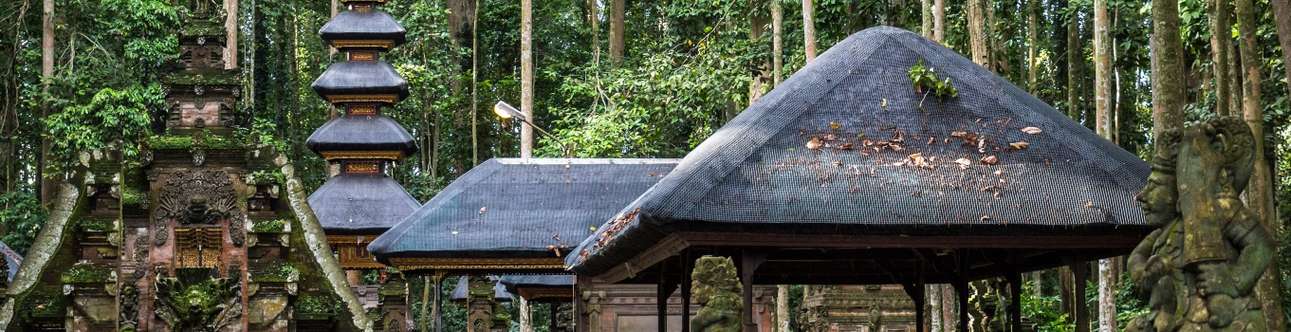
Ubud Monkey Forest (Sacred Monkey Forest Sanctuary): 2026 Visitor Guide
Welcome to the spiritual sanctuary of the Balinese people
Rated 3.50/5 ( based on 10 reviews )
About Sacred Monkey Forest Sanctuary In Bali
The Ubud Monkey Forest, officially the Sacred Monkey Forest Sanctuary (Mandala Suci Wenara Wana), is a 12.5-hectare temple forest in Padangtegal village at the south end of Jalan Monkey Forest in Ubud. About 1,050 Balinese long-tailed macaques live here around three Hindu temples built in the 14th century. Entry costs IDR 130,000 for adults and IDR 100,000 for children (about Rs 683 and Rs 526). The gates open at 9 am and close at 6 pm every day, and the last ticket is sold at 5 pm. Give it 90 minutes, get there at opening, and carry nothing edible. That last rule matters more than any other on this page.
Ticket prices and opening hours on this page were checked against the sanctuary's official visit page on 30 October 2026.
| Details | |
|---|---|
| Official name | Sacred Monkey Forest Sanctuary (Mandala Suci Wenara Wana), also called Monkey Forest Ubud |
| Address | Jalan Monkey Forest, Padangtegal, Ubud, Gianyar, Bali 80571 |
| Opening hours | 9:00 am to 6:00 pm daily, last entry 5:00 pm |
| Entry fee (foreign visitors) | Adult IDR 130,000 (about Rs 683) , Child IDR 100,000 (about Rs 526) |
| Time needed | 1 to 2 hours |
| Best time to go | 9 am to 10 am, or after 4 pm |
| Monkeys | About 1,050 Balinese long-tailed macaques in 7 groups |
| Temples | Pura Dalem Agung Padangtegal (Shiva), Pura Beji or Holy Spring Temple (Gangga), Pura Prajapati (Brahma Prajapati) |
| Facilities | Lobby ticket desk, lockers, toilets, first-aid clinic, animal clinic, café, open stage, parking building |
| Distance from Ubud Palace | About 1.3 km down Jalan Monkey Forest, 15 to 20 minutes on foot |
| Distance from Bali airport (DPS) | About 37 km, 1 hour 15 minutes to 1 hour 45 minutes by car |
About the Ubud Monkey Forest (Sacred Monkey Forest Sanctuary)
Most people call it the Ubud Monkey Forest. Its official name is the Sacred Monkey Forest Sanctuary, and for the people of Padangtegal village it is first of all a holy place, the forest around their death temple. The monkeys are Balinese long-tailed macaques (Macaca fascicularis). The sanctuary's own count puts the population at about 1,050 monkeys, split into seven groups that each hold a patch of forest (Cemetery, Central, Michelin, East, Temple, South and New Forest). The first ones usually sit on the path within a few steps of the lobby.
If you want to interact with the monkeys, watch them from a respectful distance. Do not feed them, and do not bring food or drink into the forest at all. Feeding by visitors is banned, and only sanctuary staff feed the monkeys. Do not touch them either. Most of a visit is simply walking the shaded paths, watching the troops groom and squabble, and photographing the temples.
Padangtegal village owns and runs the forest. The sanctuary lists 186 tree species across its 12.5 hectares (about 30.8 acres), and a "new forest" section was planted in the 1990s when the monkey population outgrew the old one. Everything here follows Tri Hita Karana, the Balinese idea that well-being comes from harmony between people and God, between people and each other, and between people and nature. In practice that means a working temple complex first and a tourist attraction second. Ceremonies take priority over visitors.
Ubud Monkey Forest Entrance Fee and Tickets 2026
The Ubud Monkey Forest entrance fee is IDR 130,000 for an adult and IDR 100,000 for a child, per the sanctuary's official visit page. A family of two adults and two children pays IDR 460,000, which is about Rs 2,417.
| Ticket | Price (IDR) | Approx. INR | Approx. AUD |
|---|---|---|---|
| Adult, foreign visitor | 130,000 | Rs 683 | A$10 |
| Child, foreign visitor | 100,000 | Rs 526 | A$8 |
| Family of 2 adults + 2 children | 460,000 | Rs 2,417 | A$36 |
Rupee and Australian dollar figures are rounded mid-market conversions from 30 October 2026, so your card statement will differ slightly.
You can buy tickets in two places. The ticket desk sits in the lobby next to the Central Parking building, or you can book online with the "Book Now" button on monkeyforestubud.com. Online booking is worth it in the peak weeks of late December, July and August, when the desk queue is at its longest. Outside those weeks you can buy at the counter.
Indonesian residents with a KTP card pay a lower local rate at the counter. That rate does not apply to Indian, Australian or any other foreign passport holders, so ignore blog posts that quote it as "the price".
Most Bali tour packages do not include the entry ticket unless the itinerary says "Monkey Forest entry" in writing. If you are booking an Ubud day, ask your agent whether the IDR 130,000 is covered. TravelTriangle's Ubud tour packages can build the forest, the ticket and a driver into the same day.
Monkey Forest Ubud Timings and the Best Time to Visit
The Monkey Forest is open from 9:00 am to 6:00 pm every day of the week, and the last entry is at 5:00 pm. If you arrive at 5:10 pm, you will not get in.
| Day | Opening hours | Last entry | Extra |
|---|---|---|---|
| Monday to Friday | 9:00 am to 6:00 pm | 5:00 pm | None |
| Saturday and Sunday | 9:00 am to 6:00 pm | 5:00 pm | Balinese dance on the open stage at 11:00 am and 4:00 pm |
| Nyepi (Day of Silence, Monday 8 March 2027) | Closed | n/a | All of Bali shuts for 24 hours, airport included |
| Temple ceremony (piodalan) days | Open, some areas roped off | 5:00 pm | Inner temple areas reserved for worshippers |
The best time to visit is the first hour after opening. The air under the canopy is still cool, tour coaches from Kuta and Nusa Dua have not arrived yet, and the monkeys have just had their morning feed, so they pay less attention to your bag. The second-best slot is after 4 pm, when the day-trippers head back south. From 11 am to 2 pm the paths around the Holy Spring Temple turn into a slow queue, and the light under the trees is flat for photos.
Season matters less than time of day. The forest stays green all year. In the wet months, roughly November to March, short afternoon downpours make the moss-covered steps slippery, so wear shoes with grip and go early. For month-by-month weather across the island, see our guide to the best time to visit Bali.
The weekend dance runs on the open stage beside Wana Café near the lobby, and it costs nothing beyond your entry ticket. Time a Saturday or Sunday visit to finish there at 11 am.
How to Reach Ubud Monkey Forest
The Ubud Monkey Forest sits at the southern end of Jalan Monkey Forest, about 1.3 km from Ubud Palace. If you are staying anywhere in central Ubud, walk. The street is lined with cafés, spas and sarong shops, and the stroll takes 15 to 20 minutes. From anywhere else in Bali you will need a car.
| Starting point | Distance | Time by car | Grab or Gojek car (approx.) |
|---|---|---|---|
| Ubud Palace / central Ubud | About 1.3 km | 5 to 10 min (walking is often faster) | IDR 15,000 to 30,000 (Rs 79 to Rs 158) |
| Sanur | About 25 km | 45 min to 1 hour | IDR 150,000 to 250,000 (Rs 788 to Rs 1,314) |
| Seminyak | About 30 km | 1 hour to 1 hour 30 min | IDR 200,000 to 300,000 (Rs 1,051 to Rs 1,577) |
| Kuta | About 33 km | 1 hour 15 min to 1 hour 45 min | IDR 250,000 to 350,000 (Rs 1,314 to Rs 1,839) |
| Canggu | About 32 km | 1 hour 15 min to 1 hour 30 min | IDR 250,000 to 350,000 (Rs 1,314 to Rs 1,839) |
| Ngurah Rai airport (DPS) | About 37 km | 1 hour 15 min to 1 hour 45 min | IDR 300,000 to 400,000 (Rs 1,577 to Rs 2,102) |
App fares are estimates and change with traffic and demand. Ubud has local driver zones, so getting picked up by Grab or Gojek near the forest can take longer than getting dropped off. Walk up to Jalan Raya Ubud if no driver accepts your pick-up.
A private car with a driver for a full Ubud day costs about IDR 600,000 to 800,000 (Rs 3,153 to Rs 4,204). It is the easiest way to pair the forest with Tegallalang and a waterfall without haggling at every stop. On a scooter, use the multi-storey Central Parking building by the lobby, which charges a small fee. Traffic on Jalan Monkey Forest crawls from late morning, so riders coming from the east can approach along Jalan Hanoman instead.
Flying in from India? Our how to reach Bali guide covers routes, flight times and visa-on-arrival steps.
Entrances, map and facilities
You enter through the lobby on the east side, next to the Central Parking building. The lobby has the ticket desk, lockers for your bags, a small koi pond and Wenara Café. The official map also marks Gate 2 and Gate 3 on the forest's edges, but buy your ticket at the lobby and treat those as exits. Download the sanctuary's PDF map before you go, because mobile signal under the trees drops in and out.
Inside you will find toilets at several points, a first-aid clinic with a nurse, an animal clinic, an exhibition room and the open stage. Paved paths and the raised wooden boardwalk are easy going. The steps down to the Holy Spring Temple are steep and uneven, so wheelchair users and parents with strollers will be able to do the upper loop but not the ravine.
Highlights of the Ubud Monkey Forest: Temples, Bridge and the Banyan Tree
The forest is the home ground to three temples, Pura Prajapati, Pura Dalem Agung Padangtegal and Pura Beji (the Holy Spring Temple). According to the temples' palm-leaf chronicle (Pura Purana), all three date from the middle of the 14th century. Visitors can see each temple from its outer courtyard, but the inner areas are for prayer only.
Pura Dalem Agung Padangtegal (the Main Temple)
The Main Temple stands in the south-west of the forest and is dedicated to Shiva, honoured here as the transformer. It is the largest of the three, and its carved stone gates are the backdrop for most temple photos in the forest.
Pura Beji (the Holy Spring Temple)
The Holy Spring Temple sits on the north-west side of the forest. It is dedicated to the goddess Gangga, and villagers come here for melukat, a ritual of spiritual and physical cleansing, before temple ceremonies. People toss coins into the spring pool to make a wish. The path down runs beside a stream through a narrow ravine, and it is the coolest and greenest corner of the forest.
Pura Prajapati (the Cremation Temple)
Prajapati Temple, in the north-east of the forest, is where the village worships Brahma Prajapati. Next to it is the village cemetery. The dead are buried here for a time and then cremated together in a mass ceremony held every five years.
The dragon bridge
Near the Holy Spring, a moss-covered stone bridge crosses the ravine with carved naga serpents along its sides. It is the most photographed spot in the forest, so get there before 10 am if you want it without a crowd.
Central Point and the banyan tree
In the middle of the forest a banyan tree at least 100 years old spreads over a small pool where monkeys bathe and play. All three temples are signposted from here.
The statues
Komodo and boar statues stand in front of the lobby, with a tiger for the goddess Durga on its north side and Sri Devi, the rice goddess, on its west side.
A 90-minute route that covers everything
1. Enter at the lobby at 9 am and walk past the statues and koi pond.
2. Follow the wooden path to Central Point and the banyan tree.
3. Turn north-west and take the steps down to the Holy Spring Temple and the dragon bridge.
4. Climb back up and head south-west to the outer walls of the Main Temple.
5. Cross to the north-east for the Cremation Temple and the village cemetery.
6. Loop back to the open stage and Wana Café, and leave by 10:30 am.
Meet the Monkeys: Balinese Long-Tailed Macaques
The forest staff feed the monkeys, not the visitors. Their main food is sweet potato, topped up with bananas, papaya leaves and seasonal fruit, and the staff feed them nine times a day. That schedule is the reason visitors must never feed them. They get plenty, and extra food from strangers is what teaches them to grab bags.
Each of the seven groups holds its own patch of forest, and fights break out where two territories meet, usually over space, females or rank. The noise sounds worse than it is. Spend ten minutes at Central Point and you will see grooming, nursing and the odd chase across the pool. Infants stay close to their mothers for about ten months, and you will see them clinging on underneath as the mothers move.
The monkeys have no fear of humans and are quick to approach anyone who looks like they are carrying food. A rustling plastic bag, a water bottle in a side pocket or a hair clip that resembles a peanut is enough. The species is listed as Endangered on the IUCN Red List (2022), and the sanctuary monitors the troop's health with the Primate Research Center of Udayana University.
Monkey Forest Ubud Tips and Rules: Things to Know Before You Go
Carry nothing edible, never feed or touch a monkey, and zip anything shiny into your bag before you pass the lobby. Those three habits prevent almost every problem at the Monkey Forest Ubud. Plan 60 to 90 minutes inside, arrive at the 9 am opening, and report any bite or scratch to the first-aid clinic straight away. The rules below were checked against the sanctuary's official guidelines and FAQ in November 2026.
Almost every bad story about the Monkey Forest starts with someone breaking one of the sanctuary's own guidelines. Here they are, along with what each one means on the path.
12 Monkey Forest Ubud tips
1. Leave all food and drink outside. The sanctuary bans both, because the monkeys grab anything edible, sealed packets included.
2. Never feed the monkeys. Only trained staff feed them, nine times a day. Peanuts are banned outright for the monkeys' health.
3. Bring no plastic bags. The sanctuary does not allow them, partly because monkeys snatch them and play with them.
4. Use the lobby lockers. Anything you would hate to lose, from snacks to sunglasses, can stay in a locker by the ticket desk.
5. Wear your bag on your front. A zipped cross-body bag beats a tote or a backpack with open side pockets.
6. Don't stare. Direct eye contact reads as a threat to a macaque. Smiling with your teeth showing does too.
7. Keep your distance, even from babies. Mothers defend infants fast, and that is when most scratches happen.
8. Freeze, then walk. If a monkey jumps on you, stand up, stay calm and walk away slowly. It usually hops off within seconds.
9. Watch the branches as well as the monkeys. The sanctuary warns that branches occasionally fall, especially after rain.
10. Go at 9 am. The monkeys have just been fed, the paths are quiet, and the tour groups from the south arrive from about 11 am.
11. Stay out of the temples. The inner temples are for Balinese prayer only. Follow the signs and the rope lines.
12. Ask the staff. Uniformed staff stand on every main path. They can get a monkey off you and often recover a grabbed item.
Do's and don'ts inside the sanctuary
| Do | Don't |
|---|---|
| Keep a respectful distance, even from babies | Touch, pick up or play with a monkey |
| Zip your bag and wear a backpack on your front | Bring food, drink or plastic bags into the forest (use the lobby lockers) |
| Put sunglasses, hats, earrings and hair clips in your bag before you enter | Leave a water bottle or phone visible in a side pocket |
| Look at the monkeys side-on | Stare a monkey in the eye or show your teeth in a smile |
| Stay still or walk slowly if a monkey climbs on you | Scream, grab, swat or run |
| Hold small children's hands | Let children wander off to play near the monkeys |
| Ask the uniformed staff for help | Feed peanuts or anything else, at any time |
| Respect signs at the temples | Enter roped-off sacred areas |
What to bring and what to leave in the lockers
The sanctuary provides lockers in the lobby so that nothing a monkey wants goes past the gate. Sort your bag in the car park, not on the first path.
| Bring into the forest | Leave in the car or a lobby locker |
|---|---|
| Your ticket (online booking confirmation or the lobby receipt) | All food, including sealed snacks, gum and mints |
| A small zipped cross-body bag | Drinks and water bottles |
| Phone on a wrist strap or lanyard | Plastic bags of any kind |
| Closed shoes or sandals with a back strap | Sunglasses and hats you can't hold onto |
| A light rain jacket or poncho from November to March | Dangling earrings, necklaces, beads and hair clips |
| Insect repellent, applied before you enter | Children's toys and anything small that looks like a peanut |
| IDR 50,000 cash if you want the official monkey selfie | Selfie sticks and loose umbrellas |
You can buy water and coffee at Wenara Café in the lobby once you come out, so there is no need to carry a bottle in.
What to wear to Ubud Monkey Forest
The sanctuary asks visitors to dress respectfully, because this is a sacred site and revealing clothing is discouraged. Keep your shoulders covered. You do not need a sarong, since visitors stay out of the inner temples. Wear closed shoes or sandals with a back strap for the wet stone steps. Leave dangling earrings, necklaces and anything shiny at the hotel. A small zipped cross-body bag is better than a tote.
Light cotton or quick-dry fabric works best. The forest sits in a humid ravine, and the climb back up from the Holy Spring Temple is steep enough to leave you damp by the top. Tie long hair back with a plain band rather than a decorated clip. Flip-flops are the most common footwear mistake. The moss on the stone steps near the dragon bridge is slick even in the dry months.
Visiting in the rainy season (November to March)
The wet season is a good time for the Monkey Forest Ubud if you plan around the weather. Showers in Ubud usually build in the afternoon, so a 9 am entry often gets you round before the first downpour, and the crowds are thinner than in July and August. Three things change. The steps down to the Holy Spring Temple and the dragon bridge get slippery, so footwear with grip matters more than ever. Branches come down more often after heavy rain, which the sanctuary itself warns about, so keep to the paved paths. And leave the umbrella in the car. Monkeys pull at umbrellas the way they pull at bags, and you need both hands free on wet steps. A packable poncho or rain jacket does the job.
Photos and the official monkey selfie
You can photograph the monkeys freely from a distance. Use a zoom rather than walking up to them, keep your phone on a strap, and do not hold the lens close to a monkey's face at its eye level. The temples, the banyan tree at Central Point and the dragon bridge photograph best before 10 am, when the light under the canopy is soft and the paths are empty.
If you want a close-up photo with a monkey, use the sanctuary's own monkey selfie activity inside the forest. The voucher costs IDR 50,000 (about Rs 263) and the shot is done under staff supervision. Do not try it on your own with food or a trick. That is how most bites start.
What to do if a monkey jumps on you, bites or scratches you
If a monkey climbs onto you, stand up straight, stay calm and walk away slowly. It will hop off within a few seconds. Call the nearest staff member if it does not.
Bites are rare and almost always follow someone touching or teasing a monkey. If it happens, wash the wound at once with soap and running water for 15 minutes, which is the World Health Organization's first-aid advice for animal bites. Then go straight to the first-aid clinic inside the sanctuary, where a nurse will clean and dress it.
The sanctuary points to 14 years of research by Dr Agustín Fuentes of the University of Notre Dame, which never found a case of rabies in Bali's monkeys. Bali as a whole is still a rabies-risk area, mostly because of dogs. So see a doctor the same day about post-exposure vaccination, keep your travel insurance details on your phone, and do not wait to see whether the scratch heals.
Rabies shots are given in hospitals, not at the forest clinic. Prof. Ngoerah General Hospital (formerly Sanglah) in Denpasar, about an hour's drive south of Ubud, is Bali's main public referral hospital. Closer to the forest, BIMC Hospital Ubud on Jl. Raya Sanggingan (24-hour emergency line +62 361 2091 030) is a private option about 15 minutes away by car. Whichever you choose, call ahead before you set off to check that the vaccine and immunoglobulin are in stock, because Bali hospitals ran short of it during the 2023 bite surge. If you had a pre-exposure rabies vaccine in India, carry the certificate. You will still need booster doses after a bite, but you avoid the immunoglobulin injection, which is the harder part of the treatment to find.
Visiting with children
The forest is fine for children who can follow instructions. Small kids are at monkey eye level, so the monkeys take more interest in them. Hold their hands on the paths, keep snacks in the car, and explain the "don't stare" rule before you go in. A stroller works on the upper paths but not on the steps down to the Holy Spring.
Brief them in the car park, not at the gate. Three rules are enough for a five-year-old: no touching, no staring, and stand still like a statue if a monkey climbs on you. Take toys, bright hair clips and anything that rattles out of their pockets. The child ticket is IDR 100,000 (about Rs 526).
Before-you-go checklist
•Ticket booked online on monkeyforestubud.com if you are going in late December, July or August (other weeks, buy it at the lobby desk)
•Arrival planned for 9:00 to 10:00 am (last entry 5:00 pm)
•All food, drinks and plastic bags left in the car or a lobby locker
•Sunglasses, hats, earrings and hair clips zipped into the bag
•Bag worn on the front, phone on a strap
•Closed shoes or back-strap sandals on
•Shoulders covered
•Poncho packed from November to March, umbrella left behind
•Children briefed: no touching, no staring, freeze if climbed on
•Travel insurance details and rabies vaccination record saved on your phone
Is the Ubud Monkey Forest Worth It (and Is It Ethical)?
For most first-time visitors to Ubud, yes. IDR 130,000 buys you a well-run forest with staff on every main path, a first-aid clinic and a vet clinic on site, and three working temples you can see without a guide. The monkeys are semi-wild. Nobody chains them, nobody trains them for shows, and no fence keeps them in. The entry fees fund the village's temples, the staff and the conservation work.
It is not a quiet nature walk. Between 11 am and 2 pm the paths are crowded, and if you are nervous around animals the main paths will feel busy even at opening time. Travellers who want a calmer monkey forest should look at Sangeh, west of Ubud (see the comparison below).
Ubud Monkey Forest vs Other Monkey Temples in Bali
Bali has four well-known places to see macaques. They suit different trips.
| Compare | Ubud Monkey Forest | Uluwatu Temple | Sangeh Monkey Forest | Alas Kedaton |
|---|---|---|---|---|
| Area | Central Ubud, Gianyar | Clifftop on the Bukit peninsula, far south | Abiansemal, about 40 min west of Ubud | Tabanan, about 20 min from Tanah Lot |
| Setting | Temple forest with ravine and three temples | Sea-cliff temple, sunset Kecak dance | Tall nutmeg forest around one temple | Small village temple in forest, fruit bats in the trees |
| Monkey behaviour | Used to people, staff on every path | The most likely to snatch glasses and phones and trade them back for food | Calmer, fewer visitors | Calm |
| Entry for a foreign adult | IDR 130,000 | Separate gate ticket, Kecak dance ticket extra | Small gate fee, paid at the counter | Small gate fee, paid at the counter |
| Best for | First-timers, families, temple lovers | Sunset and culture | Avoiding crowds | Combining with Tanah Lot |
If you only see one, make it Ubud. Uluwatu is worth it for the cliffs and the sunset, but tie your sunglasses down there. For more options across the island, read our guide to temples in Bali with monkeys and the full Uluwatu Temple guide.
Places to Visit Near the Ubud Monkey Forest
The forest is a short walk or drive from most of Ubud's best sights, so it slots easily into a half day.
• Ubud Palace (Puri Saren Agung) is 1.3 km north at the top of Jalan Monkey Forest. Its courtyards are free in the daytime, and Legong dancers perform there in the evenings. Check the Ubud Palace timings before you plan an evening show.
• Ubud Art Market is across the road from the palace, for sarongs, rattan bags and wood carvings. Opening offers run high, so counter at about half.
• Ubud Water Palace (Pura Taman Saraswati) is a lotus-pond temple a few minutes' walk from the palace.
• Campuhan Ridge Walk is a free, grassy ridge path on the west side of town, best at sunrise before the heat.
• Tegallalang Rice Terraces are 25 to 30 minutes north by car.
• Waterfalls near Ubud, including Tegenungan and Tibumana, are 20 to 40 minutes away.
For the full list, see our guides to places to visit in Ubud, things to do in Ubud and shopping in Ubud. If you are building a whole island trip, start with the places to visit in Bali hub and our main Bali travel guide.
A half-day Ubud plan with the Monkey Forest
1. 9:00 am. Enter the Monkey Forest at opening and walk the 90-minute route above.
2. 10:45 am. Coffee on Jalan Monkey Forest on the walk north.
3. 11:30 am. Ubud Palace courtyards, then the Art Market across the road.
4. 1:00 pm. Lunch in central Ubud. Vegetarian travellers have plenty of choice, and there are several Indian restaurants in Ubud.
5. 2:30 pm. Drive 30 minutes north to Tegallalang for the rice terraces in the softer afternoon light.
Where to stay near the Monkey Forest
Staying on Jalan Monkey Forest or Jalan Hanoman puts the forest, the palace and the market all within walking distance, and you can be at the lobby when it opens without a driver. Options run from family-run guesthouses to boutique resorts a few minutes' walk from the sanctuary on Jalan Monkey Forest, such as Komaneka at Monkey Forest. Browse our pick of Ubud resorts, or have a stay near the forest built into an Ubud honeymoon package or a Bali family package. Planning the wider trip? Our Bali tour packages cover Ubud, the beaches and the south coast in one itinerary.
Edited by TravelTriangle
Popular Packages
Unlimited Choices. Trusted Agents. Best Prices. Happy Memories.
Cities:
- Kuta
- Nusa Dua
Starting from:
₹19,990/-
₹29,990/-33% OffCities:
- Kuta
- Seminyak
Starting from:
₹19,998/-
₹22,180/-10% OffCities:
- Kuta
- Ubud
Starting from:
₹21,000/-
₹23,836/-12% OffCities:
- Denpasar
Starting from:
₹21,500/-
₹23,370/-8% OffCities:
- Kuta
- Gianyar
Starting from:
₹21,998/-
₹23,911/-8% OffCities:
- Kuta
- Gili Island
- Ubud
Starting from:
₹22,000/-
₹28,274/-22% OffCities:
- Kuta
- Seminyak
Starting from:
₹22,500/-
₹24,725/-9% OffCities:
- Kuta
- Ubud
Starting from:
₹22,998/-
₹25,273/-9% OffCities:
- Kuta
Starting from:
₹24,500/-
₹26,630/-8% OffCities:
- Kuta
- Seminyak
Starting from:
₹26,999/-
₹29,347/-8% OffCities:
- Kuta
- Seminyak
Starting from:
₹27,000/-
₹29,670/-9% OffCities:
- Kuta
- Bali
Starting from:
₹27,999/-
₹30,434/-8% OffCities:
- Kuta
- Ubud
Starting from:
₹29,000/-
₹32,222/-10% OffCities:
- Kuta
- Seminyak
Starting from:
₹29,999/-
₹32,608/-8% OffCities:
- Kuta
- Seminyak
Starting from:
₹29,999/-
₹32,608/-8% OffCities:
- Kuta
- Seminyak
Starting from:
₹30,000/-
₹32,258/-7% OffCities:
- Kuta
- Seminyak
Starting from:
₹30,999/-
₹32,978/-6% OffCities:
- Nusa Dua
- Ubud
Starting from:
₹31,500/-
₹35,000/-10% OffCities:
- Kuta
- Seminyak
Starting from:
₹31,600/-
₹33,978/-7% OffCities:
- Kuta
- Nusa Dua
- Bali
Starting from:
₹31,999/-
₹34,042/-6% OffPlaces To Visit In Bali
Let the experts guide you to the best of this mesmerizing destination
View AllNungnung Waterfall In Bali
Bali is no less than a Mecca when it comes to finding happiness in waterfalls. You could find the world’s most stunning waterfall here in Bali. Nungnung Waterfall is situated in the north of Ubud and takes just an hour drive from the main city. It is evaluated as a standout amongst the best Bali cascades on the island. Clim...
- Waterfalls
- Nature
- Adventure
- Ideal for friends
- Ideal for families
Pura Lempuyang Luhur In Bali
Lempuyang Temple is a complex of seven Hindu temples on Mount Lempuyang in Karangasem, East Bali, and its famous Gates of Heaven stand at the lowest of them, Pura Penataran Agung Lempuyang. Foreign visitors pay IDR 100,000 (about Rs 524) with a sarong included, plus a compulsory IDR 50,000 return shuttle from the car park, ...
- Temple Tour
- Sightseeing
- Ideal for friends
- Ideal for families
Sacred Monkey Forest Sanctuary In Bali
The Ubud Monkey Forest, officially the Sacred Monkey Forest Sanctuary (Mandala Suci Wenara Wana), is a 12.5-hectare temple forest in Padangtegal village at the south end of Jalan Monkey Forest in Ubud. About 1,050 Balinese long-tailed macaques live here around three Hindu temples built in the 14th century. Entry costs IDR 1...
- Sightseeing
- Monkey Forest
- Nature
- Ideal for friends
- Ideal for families
Gitgit Waterfall In Bali
Gitgit Waterfall (Air Terjun Gitgit, often written Git Git) is a 35 m jungle waterfall in Gitgit village, Sukasada district, about 10 km south of Singaraja in North Bali. It sits right beside the main road from Bedugul down to the north coast. A paved path of roughly 500 m drops through clove and coffee gardens to the pool,...
- Gitgit waterfall
- Nature
- Adventure Activities
- Ideal for friends
- Ideal for families
Pura Ulun Danu Batur In Bali
Pura Ulun Danu Batur is the great temple of Kintamani, on the rim of the Batur caldera at about 1,400 m, and the Balinese rank it second only to Besakih. Foreign adults pay IDR 50,000 to 75,000 (about Rs 262 to Rs 393) at the ticket counter across the road, and visitors are let in from about 8 AM to 5 PM. Driving up from Ub...
- Sightseeing
- Temple
- Nature
- Ideal for friends
- Ideal for families
Things To Do In Bali
Your list of the best things to do, compiled on the basis of actual traveler experiences
View AllSekumpul Waterfall Trekking In Bali
Sekumpul Waterfall (Air Terjun Sekumpul) is a cluster of waterfalls in Sekumpul village, Sawan district, Buleleng regency, in the hills of North Bali. Several streams drop about 80 m, roughly 262 feet, into a single jungle valley. A view-only ticket costs IDR 20,000 (about Rs 105). Treks to the bottom with a village guide c...
- Adventure
- Trekking
- Nature
Mount Batur Trekking In Bali
Mount Batur (Gunung Batur) is an active volcano in Kintamani, north-east Bali, 1,717 m above sea level, and its sunrise trek is one of the most popular hikes in Bali. You leave your hotel around 2 AM, start walking at about 4 AM with a licensed local guide, and reach the summit in roughly two hours for a fit person, in time...
- Trekking
- Adventure
- Nature
Safari And Marine Park In Bali
By the TravelTriangle Bali desk. Last updated November 2026. Hours, show times and shuttle slots on this page were checked by our Bali desk against the park's official schedule and shuttle pages on 2 November 2026.
Bali Safari and Marine Park, officially Taman Safari Bali, is a safari park and aquarium complex in Serongga,...
- Marine Park
- Adventure
- Nature
Bird Park Tour In Bali
Bali Bird Park is open from 9 AM to 5:30 PM every day, and an international adult ticket costs IDR 385,000 (about Rs 2,019) at the gate. Children aged 2 to 12 pay IDR 265,000 (about Rs 1,390), and the ticket covers every show and feeding session in the park, with no extra payments inside. It sits at Batubulan in Gianyar, 11...
- Bird Watching
- Nature
- Adventure
Mount Agung Sunrise Trekking In Bali
Mount Agung (Gunung Agung) is Bali's highest mountain and an active volcano, 3,031 m above sea level. You climb it at night with a licensed local guide, which is compulsory, so you stand on top for sunrise. There are two main routes. From the temple of Pura Pasar Agung you reach the crater rim in about 3 to 4 hours. From Pu...
- Adventure
- Mountains
- Trekking
- Ideal for friends
Our experts would love to create a package just for you!
Fill in your requirements here >
Fastest Growing Holiday Marketplace
650+
Verified Agents
22 Lac+
Happy Travellers
65+
Destinations
Easy, Secure & Reliable
Traveltriangle
Verified
Stringent
Quality Control
24/7
Support
What Travelers Say About Our Bali Packages
Read real reviews,packages, stories, and experiences from happy customers who booked with TravelTriangle.
Tanusharma
Noida
Tanusharma's 6 days trip to Bali
Richa Sahu
Delhi
Richa's 11 days trip to Bali
Vaibhav Nageshwaran
Chennai
Vaibhav's 5 days trip to Bali
Ranjeet Sethi
Delhi
Ranjeet's 7 days trip to Bali
Sandeepreddy Devarapalli
Hyderabad
Sandeepreddy's 10 days trip to Bali
Pranay Bhaskar
Hyderabad
Pranay's 6 days trip to Bali
Sanchayitamahato
Kolkata
Sanchayitamahato's 6 days trip to Bali
Prem Kumar Tyagi
Delhi
Prem's 6 days trip to Bali
Swarna B
Bengaluru
Swarna's 6 days trip to Bali
Manik Prabhu
Hyderabad
Manik's 7 days trip to Bali
Popular Kerala Holiday Packages
Spiritual Packages
Kerala Holiday Packages From Metro Cities
Popular 1 Night & Above Kerala Holiday Packages
Popular 6 Nights & Above Kerala Holiday Packages
Top Tour Packages In India
Top International Tour Packages
Tour Packages By Theme And Activity
Top Honeymoon Destinations In India
Top International Honeymoon Destinations
Top Destinations In India
Top International Destinations
Want best packages handpicked just for you?
Fill the form and get a callback from our holiday experts
Frequently Asked Questions
Get your answers — before you plan your trip.
Bali Travel FAQs
Is it safe to click pictures with the monkey?
If you keep a safe distance from the monkey, do not disturb their activities then it is completely safe to click pictures with the monkeys.
What is the Ubud Monkey Forest entrance fee in 2026?
The entrance fee is IDR 130,000 for a foreign adult and IDR 100,000 for a child, which is about Rs 683 and Rs 526. These are the prices on the sanctuary's official visit page, checked on 30 October 2026. A family of two adults and two children pays IDR 460,000 (about Rs 2,417). You can pay at the lobby ticket desk or book online through monkeyforestubud.com.
What are the Monkey Forest Ubud opening hours?
The Monkey Forest is open from 9:00 am to 6:00 pm every day, and the last entry is at 5:00 pm. It closes completely on Nyepi, Bali's Day of Silence, which falls on Monday 8 March in 2027. On temple ceremony days the forest stays open, but some areas near the temples are roped off for worshippers. On Saturdays and Sundays a Balinese dance runs on the open stage at 11:00 am and 4:00 pm.
What are the facilities in the Sacred Monkey Forest Sanctuary?
There is a first aid clinic, lavatories, park and an animal clinic within the premises of the monkey forest.
Can you feed the monkeys at Ubud Monkey Forest?
No. Visitors are not allowed to feed the monkeys, and food and drink are not allowed inside the forest at all. Staff feed the monkeys nine times a day, mostly sweet potato with banana, papaya leaves and seasonal fruit. Peanuts are banned for health reasons. Food in your bag is the main reason monkeys climb on people, so leave snacks in the car or in a lobby locker before you go in.
Is it safe to take photos with the monkeys?
Yes, if you keep your distance and let the monkeys come to you rather than following them. Put your phone on a wrist strap, keep sunglasses in your bag and avoid holding the lens close to a monkey's face at its eye level. For a close-up with a monkey, buy the sanctuary's own monkey selfie voucher for IDR 50,000 (about Rs 263). The photo is taken under staff supervision.
Is Ubud Monkey Forest safe for kids?
Yes, for children who stay close and follow the rules. Small children are at monkey eye level, so hold their hands on the paths, keep snacks out of the forest and remove hair clips and toys that look like food. Explain beforehand that they should not touch or stare at the monkeys. Staff patrol every main path. A stroller works on the upper loop, but the steps down to the Holy Spring Temple are steep.
Are the monkeys in the Sacred Monkey Forest Sanctuary free of rabies?
The Department of Anthropology at the University of Notre Dame, USA, ran 14 years of research led by Dr Agustín Fuentes and never found a case of rabies in any monkey in Bali. The monkeys in the forest are healthy and monitored by the Primate Research Center of Udayana University. Bali is still a rabies-risk area because of dogs, so after any bite or scratch, wash the wound for 15 minutes, visit the on-site clinic and see a doctor the same day.
What should I do if a monkey bites or scratches me?
Wash the wound immediately with soap and running water for 15 minutes. Then go to the first-aid clinic inside the sanctuary, where a nurse will treat it. See a doctor in Ubud or Denpasar the same day to ask about rabies post-exposure vaccination, and keep your insurance details handy. Bites are rare and almost always follow someone touching, teasing or feeding a monkey.
What can't I bring into Ubud Monkey Forest, and are there lockers?
You cannot bring food, drinks or plastic bags into the forest. The sanctuary bans all three, because monkeys grab anything edible and play with plastic. Lockers are provided in the lobby next to the ticket desk, so leave snacks, water bottles and anything you would hate to lose there or in your car. Zip sunglasses, hats and jewellery into a small cross-body bag, and keep selfie sticks and umbrellas out of the forest.
Do I need to book Ubud Monkey Forest tickets in advance?
No, you can buy tickets at the lobby desk on the day. Booking online through the "Book Now" button on monkeyforestubud.com saves queueing time in the busiest weeks, which are late December, July and August. The fee is the same either way: IDR 130,000 for a foreign adult and IDR 100,000 for a child (about Rs 683 and Rs 526). The gates open at 9:00 am and the last ticket is sold at 5:00 pm.
Can visitors enter the temples inside the Monkey Forest?
No. The three temples inside the forest, Pura Dalem Agung Padangtegal, the Holy Spring Temple (Pura Beji) and the Cremation Temple (Pura Prajapati), are for Balinese prayer only. You can see and photograph their gates and outer walls from the paths, and the Holy Spring pool is visible from the walkway. Signs and rope lines mark the sacred areas, and on temple ceremony days staff may close extra paths near the temples.
How long do you need at Ubud Monkey Forest?
Plan 1 to 2 hours. A 90-minute loop covers the lobby statues, the banyan tree at Central Point, the Holy Spring Temple and dragon bridge, the Main Temple and the Cremation Temple. Add 30 minutes on a weekend if you want to catch the Balinese dance on the open stage at 11:00 am or 4:00 pm.
What is the best time to visit Ubud Monkey Forest?
Go at 9:00 am, right at opening. It is cooler, the paths are quieter, and the monkeys have just been fed, so they show less interest in bags. After 4:00 pm is the next best slot. Avoid 11:00 am to 2:00 pm, when tour groups from the south arrive. In the wet season, roughly November to March, morning visits also beat the afternoon downpours.
Ubud Monkey Forest or Uluwatu, which is better for seeing monkeys?
Choose Ubud for a shaded forest, three temples and well-managed monkeys with staff on every path. Choose Uluwatu for the clifftop temple, the sunset and the Kecak dance, but expect its monkeys to snatch sunglasses, hats and phones far more often. Many travellers do both, Ubud in the morning and Uluwatu at sunset on a different day.
How It Works
Personalise This Package
Make changes as per your travel plan & submit the request.
Get Multiple Quotes
Connect with top 3 agents, compare quotes & customize further.
Book The Best Deal
Pay in easy installments & get ready to enjoy your holiday.
Corporate Office:
Holiday Triangle Travel Private Limited
Address: Plot No - 52 , 3rd Floor,
Batra House , Sector 32,
Gurugram -122001,Haryana
Landline: 1800 123 5555
Connect with us on :

Made with
in India
All rights reserved © 2026