5D / 4N
9% OFF


Is September a Good Time to Visit Vietnam?
Yes, if you pick the right half of the country. Vietnam in September is golden rice-harvest season in the northern mountains, and Nha Trang and Mui Ne on the south-central coast stay much drier than the rest of the coastline. Hue, Hoi An and Phu Quoc are the places to avoid. The terraces of Mu Cang Chai, Sapa and Hoang Su Phi turn gold from mid-month, and Hanoi celebrates both National Day (2 September) and the Mid-Autumn Festival (15 September 2027). The central coast is the problem. Hue averages 411 mm of rain in September, more than Hanoi gets in July, and October is wetter still. Phu Quoc sits in the peak of the south-west monsoon. Plan the trip around the north, add one dry beach, and September works well. It is also low season, so hotels and cruises cost less than in December.
For the full twelve-month picture, see our guide to the best time to visit Vietnam. This page goes deep on September only.
Key Takeaways
- Book the northern mountains for mid to late September. That is when the rice terraces of Mu Cang Chai, Sapa and Hoang Su Phi are golden and the harvest is underway.
- Skip Hue, Hoi An and Phu Quoc if the beach or the old town is the point of your trip. They get 350 to 475 mm of rain this month, and boat trips get cancelled.
- Swap Phu Quoc for Nha Trang or Mui Ne. Both sit in a rain shadow and stay much drier through September.
- Buy a Ha Long Bay cruise with free rescheduling. Most departures sail, but the port authority stops every tourist boat when a storm warning is issued.
- Fix your Hanoi dates around 2 September and 15 September 2027. National Day fills trains and hotels, and Mid-Autumn fills Hang Ma Street with lanterns.
Vietnam Weather and Temperature in September by Region
Average daytime highs and night-time lows, total September rainfall and the number of rainy days at each place, with our verdict for a September trip. Figures are long-term station averages from the Vietnam Institute for Building Science and Technology. Nha Trang, Mui Ne, Ho Chi Minh City and Can Tho are rounded from other long-term station records, so they carry “about”.
| Place | Region | High / low | Rain in September | Rainy days | September verdict |
|---|---|---|---|---|---|
| Sapa and Mu Cang Chai | North mountains | 22 °C / 16 °C | 303 mm | 20 | Go. Golden terraces, cool nights |
| Hanoi and Ninh Binh | North | 32 °C / 25 °C | 228 mm | 14 | Go. Rain easing, two big holidays |
| Ha Long Bay | North coast | 31 °C / 24 °C | 282 mm | 14 | Go with a flexible ticket |
| Hue | Central | 32 °C / 24 °C | 411 mm | 16 | Plan around it. The wet season starts |
| Da Nang and Hoi An | Central | 32 °C / 25 °C | 351 mm | 15 | First half of the month only |
| Nha Trang | South-central coast | 31 °C / 24 °C | about 170 mm | about 12 | Go. Calm sea, short showers |
| Mui Ne | South-central coast | 32 °C / 25 °C | about 160 mm | about 14 | Go. One of the driest coasts |
| Da Lat | Central Highlands | 23 °C / 16 °C | 283 mm | 24 | Go for cool air, expect afternoon rain |
| Ho Chi Minh City | South | 33 °C / 25 °C | about 330 mm | 18 | Fine for the city. Plan indoor afternoons |
| Can Tho (Mekong Delta) | South | 31 °C / 24 °C | about 270 mm | about 20 | Go for the floating season |
| Phu Quoc | South islands | 30 °C / 25 °C | 474 mm | 23 | Skip for a beach holiday |
The 10 Best Places for September at a Glance
When each pick peaks in September, how many nights to give it and what to go for.
| Place | Best part of September | Nights | Go for |
|---|---|---|---|
| Mu Cang Chai | 10 to 30 September | 2 | Golden terraces, Khau Pha paragliding |
| Sapa | Mid to late month | 2 to 3 | Harvest treks, Fansipan |
| Ha Giang and Hoang Su Phi | Last week of the month | 3 to 4 | The loop, late-ripening terraces |
| Hanoi | 2 September and the week before 15 September | 2 to 3 | National Day, Mid-Autumn lanterns |
| Ninh Binh | Any week | 1 | Trang An and Tam Coc boats |
| Ha Long Bay and Lan Ha Bay | Any week, with a flexible ticket | 1 | Low-season cruise fares |
| Pu Luong and Mai Chau | Second half of the month | 2 to 3 | Quiet harvest valleys |
| Nha Trang | Any week | 2 to 3 | The driest big beach |
| Mui Ne | Any week | 2 | Dunes, the fishing village |
| Mekong Delta | Any week | 1 to 2 | Floating-water season |
Vietnam
Vietnam
September weather by region, the 10 places that shine and which ones to plan around
Best Time
September - November
Select Package Type
Best Selling Packages


10 Places That Shine in Vietnam in September, North to South
Seven picks in the north for the rice harvest and the festivals, two dry beach towns on the south-central coast and the Mekong Delta at high water, followed by the weather, festivals, routes and India planning notes.
Explore Popular Destination In Vietnam
01
Mu Cang Chai
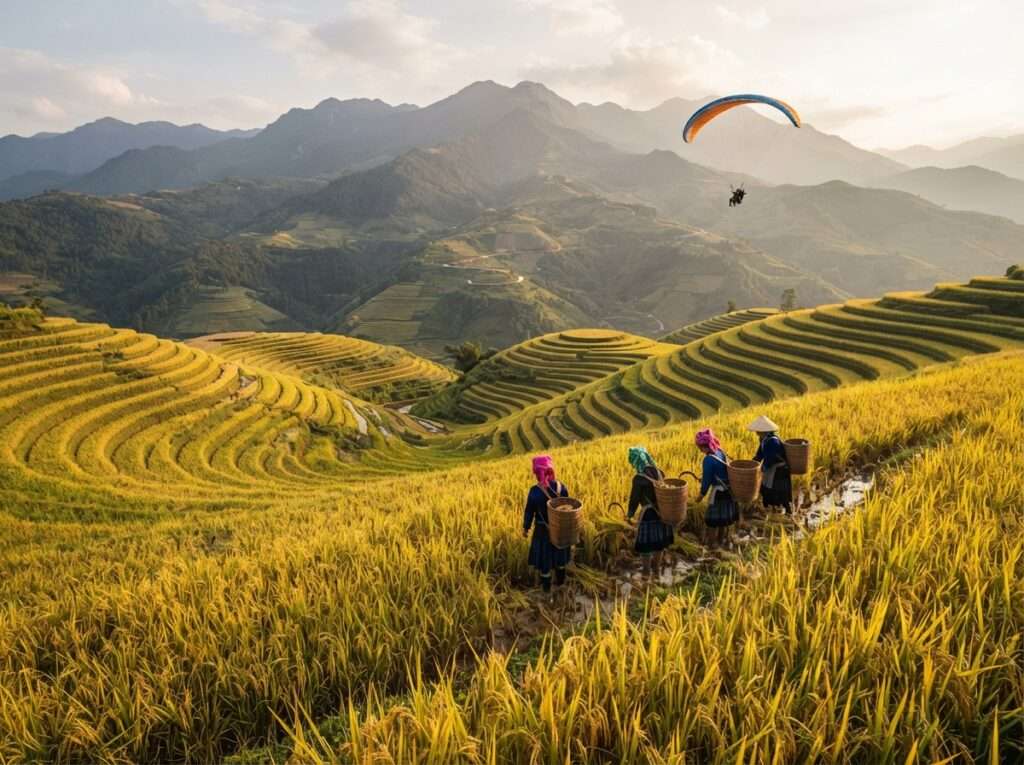
Mu Cang Chai is the reason photographers fly to Vietnam in September. The H’Mong farmers here have cut terraces into the slopes for centuries, and in the third and fourth weeks of the month the rice turns from green to gold before it is cut by hand. Mam Xoi, the “rice tray” hill in La Pan Tan commune, is the view on most posters, a round terraced hill that looks stacked like a tray of sticky rice. Go at 4 pm, when the low sun lights the steps. The Khau Pha Pass, one of the steepest in the north, hosts paragliders who launch over the terraces during the paragliding and terraced-field festival, usually held over a weekend in the second half of September. Tandem flights sell out, so book before you leave Hanoi. The drive takes 7 to 8 hours, and most people break it in Nghia Lo. Homestays in the valley are basic, with mattresses on a wooden floor and dinner with the family.
| Where | Lao Cai province (formerly Yen Bai), about 280 km north-west of Hanoi |
| Why September | Peak golden terraces from about 10 September into early October |
| Weather | Cool mountain air, warm afternoons, showers most days |
| Days needed | 2 nights, plus a day each way from Hanoi |
| Don't miss | Mam Xoi hill, La Pan Tan, the Khau Pha Pass |
Related Tour Packages


❮
❯
02
Sapa
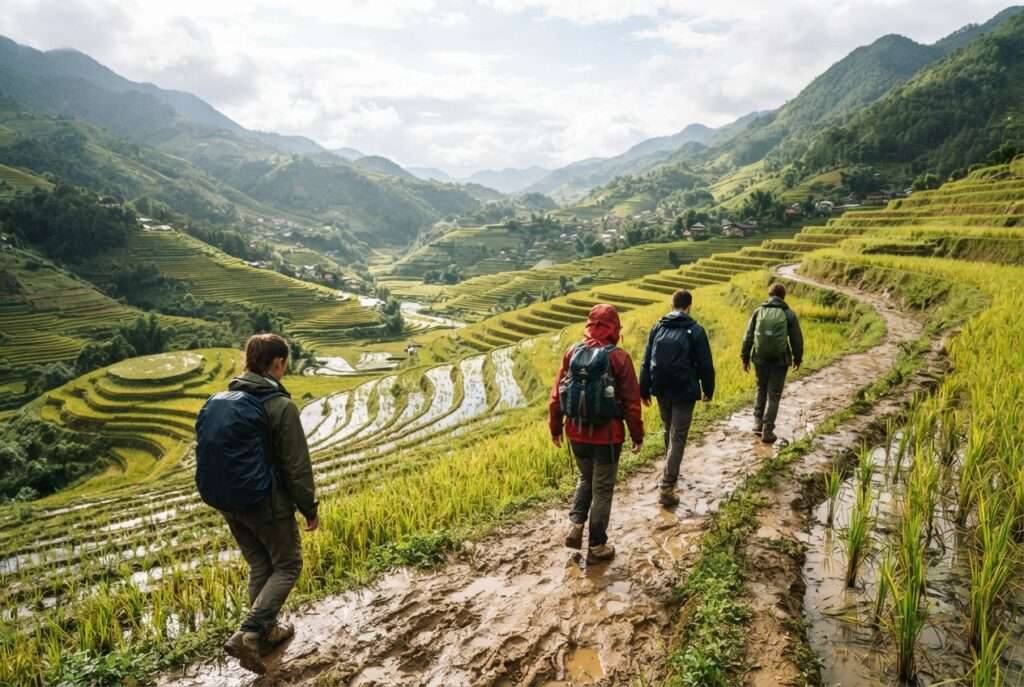
Sapa is the easier version of Mu Cang Chai, with better hotels, more trekking routes and a cable car up Fansipan, at 3,147 m the highest mountain in Indochina. The classic day walk heads south-east from town via Y Linh Ho and down the Muong Hoa valley to Lao Chai and Ta Van, about 12 km one way with terraces on both sides, and a car brings you back. Cat Cat village is a separate, shorter walk south-west of town. In September you walk past families cutting and threshing rice in the fields. Showers come mostly in the afternoon, so start by 8 am and you will usually finish dry. Carry leech socks for the forest sections. The Fansipan cable car costs about 800,000 to 850,000 VND (₹2,700 to ₹2,850) per adult on 2026 operator listings, and the summit is often in cloud by noon, so go up first thing. Our list of things to do in Sapa covers more walks, and our Sapa tour packages bundle the transfer and a guide.
| Where | Lao Cai province, about 5.5 hours from Hanoi by expressway bus |
| Why September | Harvest treks through golden valleys, before the cold sets in |
| Weather | 22 °C highs, 16 °C lows, 303 mm of rain over 20 days |
| Days needed | 2 to 3 nights |
| Don't miss | Lao Chai and Ta Van trek, Cat Cat village, Fansipan cable car |
Related Tour Packages


❮
❯
03
Ha Giang and Hoang Su Phi
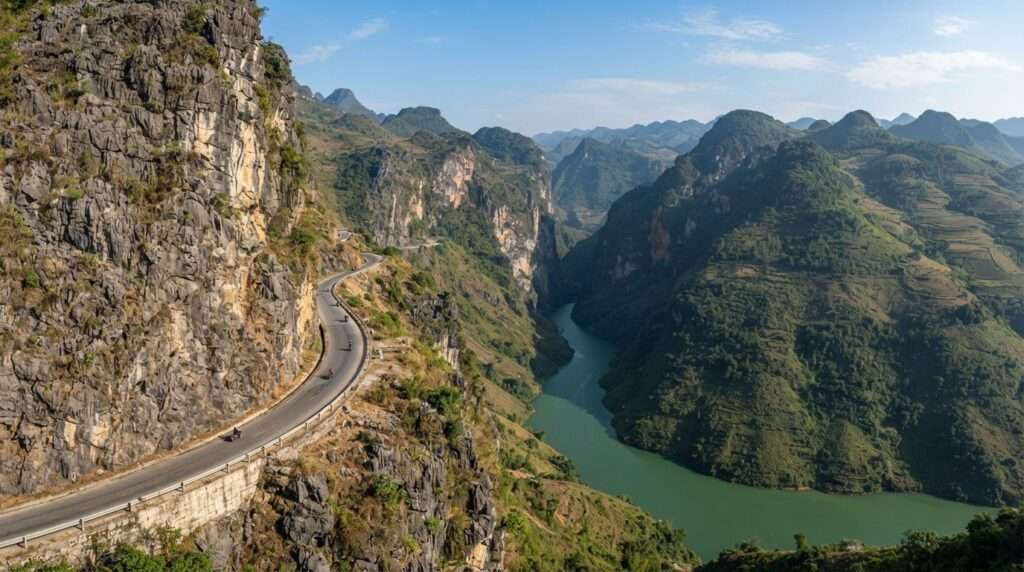
The Ha Giang Loop is a 350 km circuit through limestone peaks that most travellers ride over three or four days. Ma Pi Leng Pass is the high point, a road cut into a cliff with the jade-green Nho Que River far below, and a boat trip on the river through the Tu San canyon is worth the stop. September adds Hoang Su Phi, two to three hours west of Ha Giang city, where terraces at Ban Luoc and Ban Phung ripen a week or two after Mu Cang Chai. If your trip falls in the last week of the month, this is the better harvest stop. One practical warning. An Indian International Driving Permit is issued under the 1949 convention, and Vietnam recognises only the 1968 version, so Indian travellers should ride pillion with an “Easy Rider” driver rather than self-ride. A rider with a bike, fuel and homestays costs roughly US$58 to 75 a day on 2026 listings. See our guide to hiking in Vietnam for walking routes in the area.
| Where | Tuyen Quang province (formerly Ha Giang), on the China border |
| Why September | Hoang Su Phi's terraces ripen late September into early October |
| Weather | Warm days, cooler nights, regular afternoon showers |
| Days needed | 3 to 4 days for the loop, plus 1 for Hoang Su Phi |
| Don't miss | Ma Pi Leng Pass, the Nho Que River, Dong Van old quarter |
Related Tour Packages


❮
❯
04
Hanoi
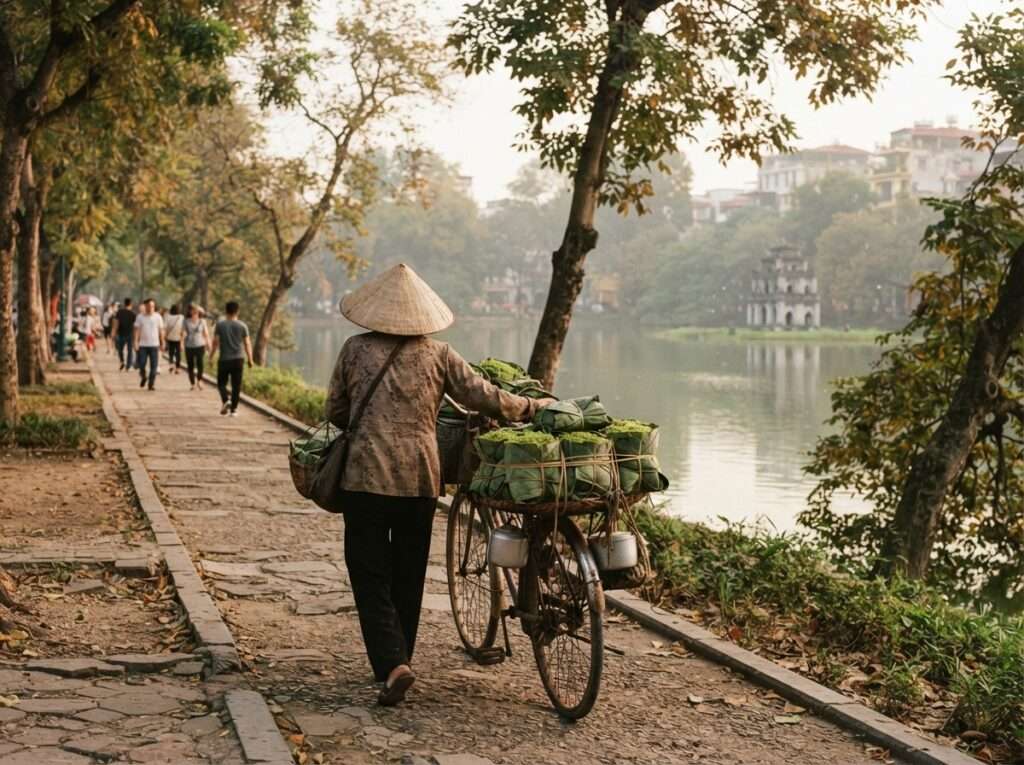
Hanoi in September smells of milk flowers (hoa sữa, the Alstonia tree), which bloom along the streets from late September into November, and tastes of cốm, young green sticky rice that is roasted and pounded into soft flakes in Vong village and sold wrapped in lotus leaves. It is the city’s autumn snack, and you will see it on bicycles all over the Old Quarter. National Day on 2 September brings flags, crowds at Ba Dinh Square and a two-day public holiday, so book trains and hotels early. Two weeks later, in the run-up to the Mid-Autumn Festival, Hang Ma Street turns into a tunnel of paper lanterns, star lamps and toy drums. Evenings around Hoan Kiem Lake are the coolest part of the day, and the lake road closes to traffic on weekend evenings. Rain this month usually falls as a heavy afternoon burst, so keep museums like the Temple of Literature for the afternoon. Our guide to Hanoi in September has a day-by-day plan, and things to do in Hanoi covers the rest of the city.
One thing to plan around. The Ho Chi Minh Mausoleum usually closes for its annual maintenance soon after National Day and reopens in early November, so see it on or before 2 September or view it from Ba Dinh Square outside. In 2026 the Mausoleum Command closed it from 4 September to 2 November, so check the 2027 notice before you plan a visit.
| Where | Capital city, the gateway to the north |
| Why September | National Day on 2 September, Mid-Autumn on 15 September 2027 |
| Weather | 32 °C highs, 228 mm of rain over 14 days, humid |
| Days needed | 2 to 3 days |
| Don't miss | Hang Ma Street lanterns, Hoan Kiem Lake, Old Quarter food |
05
Ninh Binh

Ninh Binh is Ha Long Bay on land. At Trang An, a UNESCO site since 2014, a local rower takes you for two to three hours along a river that runs through limestone cliffs and under caves low enough to make you duck. The boat costs 300,000 VND (about ₹1,000) per adult under the fee schedule that took effect on 1 January 2026. Tam Coc is the same idea on the Ngo Dong River, with paddies either side and rowers who steer with their feet. In September those paddies are green rather than gold, and the river is high and full. The boats keep running in light rain, and they hand out conical hats and ponchos. Finish at Hang Mua, about 500 stone steps to a dragon on the ridge, and climb at 4 pm for the light over Tam Coc. Read our guides to Trang An and Tam Coc before you choose between them.
| Where | Ninh Binh province, about 2 hours (100 km) south of Hanoi |
| Why September | Green paddies between the karsts and far fewer boats than spring |
| Weather | Like Hanoi, warm and humid with afternoon showers |
| Days needed | 1 day, or 1 night to see Hang Mua at sunset |
| Don't miss | Trang An boat ride, Tam Coc, the Hang Mua climb |
06
Ha Long Bay and Lan Ha Bay
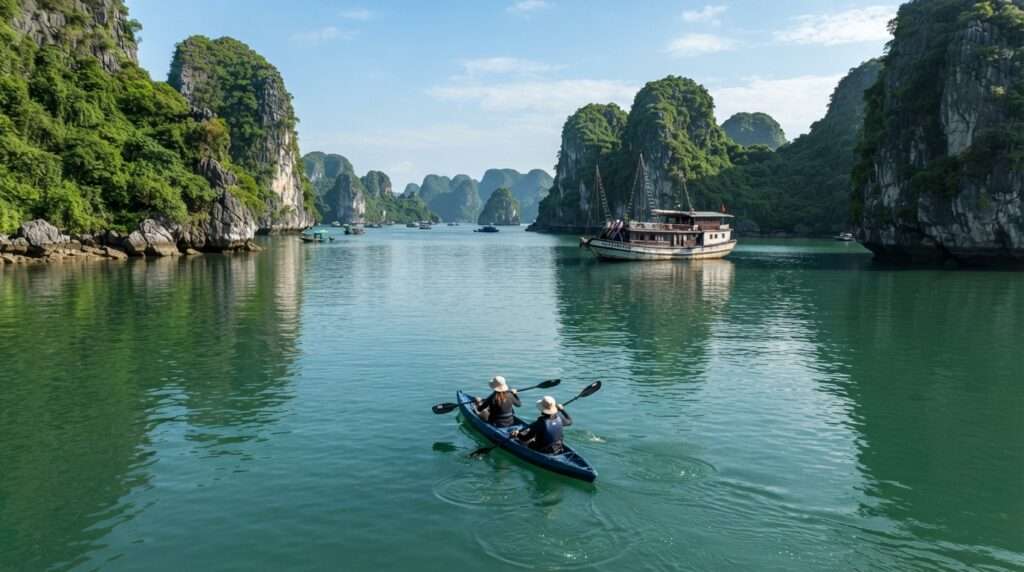
Should you cruise Ha Long Bay in September? Yes, as long as your ticket can move. Most sailings run as normal, the bay is green and calm between storms, and many cruise lines cut fares in the low season. The catch is storms. When the national forecasting centre issues a storm warning for the Gulf of Tonkin, the port authority suspends every tourist boat, sometimes for one or two days. In September 2024, Typhoon Yagi made landfall near Ha Long on 7 September and shut the bay for days. So book a cruise that offers free rescheduling or a full refund for weather cancellations, and put the cruise in the middle of your trip rather than the day before your flight home. Boats that sail Lan Ha Bay from Cat Ba or Bai Tu Long Bay are quieter than central Ha Long. A mid-range one-night cruise costs about US$150 to 250 per person with meals and kayaking on 2026 listings. Compare boats in our Vietnam cruise packages.
| Where | Quang Ninh and Hai Phong, about 2.5 hours from Hanoi by expressway |
| Why September | Lower cruise fares and quieter routes than the dry season |
| Weather | 31 °C highs, 282 mm of rain over 14 days, typhoon risk |
| Days needed | 1 night on board |
| Don't miss | Kayaking in Lan Ha Bay, sunrise on deck |
07
Pu Luong and Mai Chau
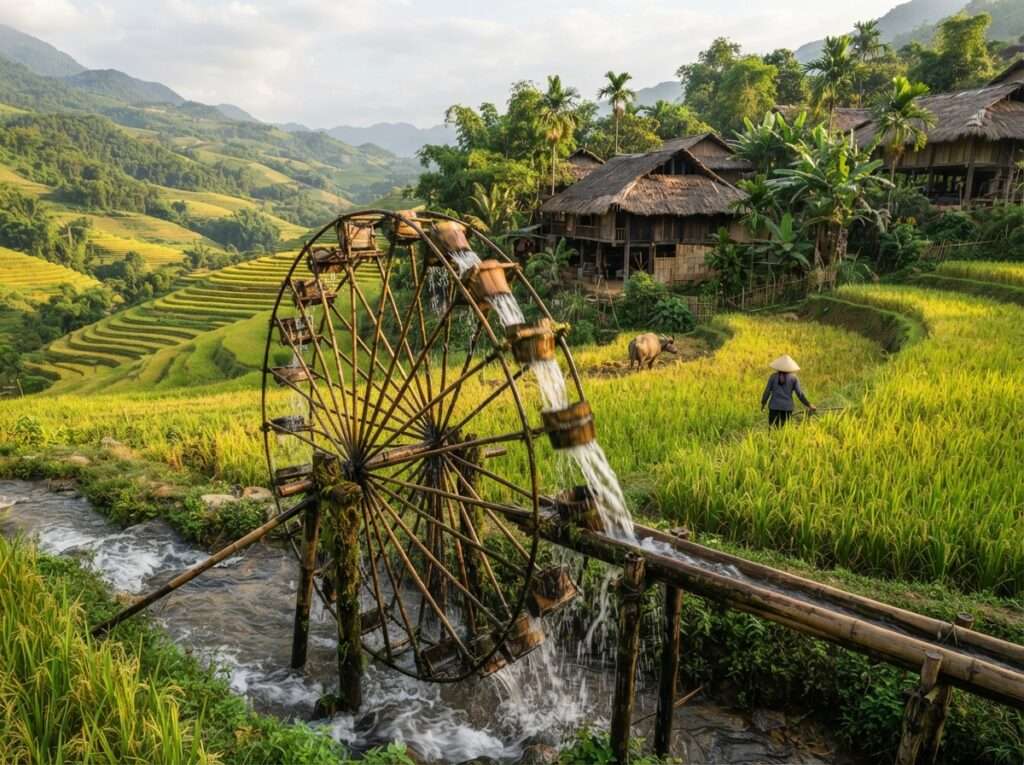
Pu Luong is the harvest without the crowds of Sapa. It is a nature reserve about four hours south-west of Hanoi, where Thai and Muong villages sit in stilt houses above terraced valleys, and water wheels made of bamboo lift water into the fields. The rice ripens in the second half of September, at the same time as Mu Cang Chai, but you can reach it in half the drive. Walk between Ban Don and Kho Muong, and swim under the Hieu waterfall on a hot afternoon. Mai Chau, on the way, is gentler, a flat valley of paddies where you cycle from Lac village between White Thai houses. Most people stop a night in Mai Chau and two in Pu Luong. This is a good pick for families and older travellers who want the September terraces without a 7-hour mountain road.
| Where | Pu Luong is in Thanh Hoa, Mai Chau in Phu Tho (formerly Hoa Binh) |
| Why September | Valley terraces ripen in the second half of the month |
| Weather | Warm days, showers, cooler than Hanoi at night |
| Days needed | 2 nights |
| Don't miss | Stilt-house homestay, Hieu waterfall, cycling Lac village |
08
Nha Trang
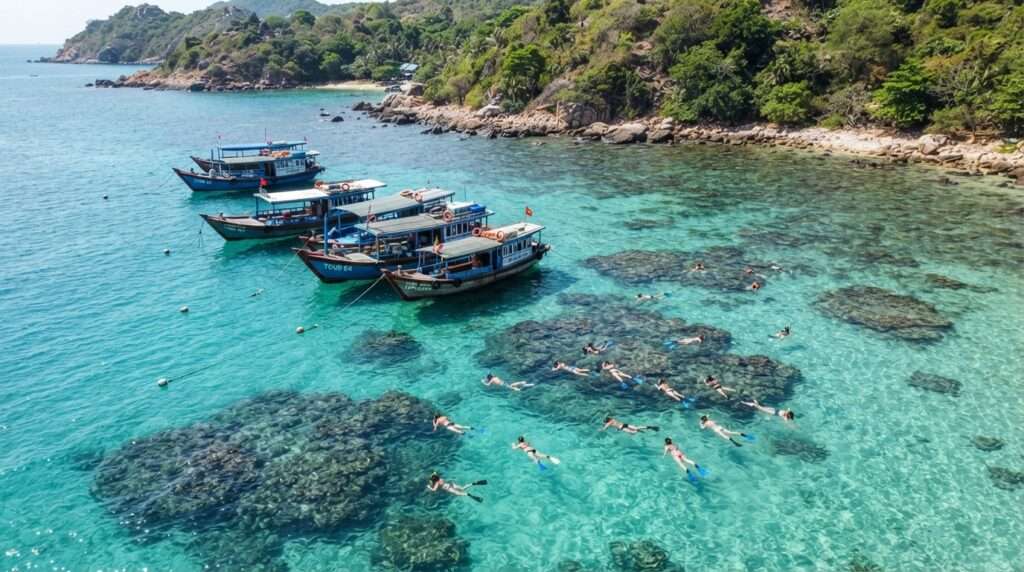
Where can you swim in Vietnam in September? Nha Trang is the safest answer. The town’s rainy season runs from about October to December, so September sits just before it, with roughly half the rain of Hoi An and calm water in the bay. Showers here tend to come late in the day and pass quickly. Boats leave the harbour each morning for the islands, and Hon Mun marine protected area has the best snorkelling within a day trip. If you have done Hanoi and the north, a flight to Cam Ranh airport gives you a beach finish without crossing the wet central coast. Afternoons are for the hot-spring mud baths outside town. Our guide to things to do in Nha Trang lists more, and divers should read our scuba diving in Vietnam guide.
| Where | Khanh Hoa province, on the south-central coast |
| Why September | The driest big beach town in Vietnam this month |
| Weather | About 31 °C, calm sea, short evening showers |
| Days needed | 2 to 3 nights |
| Don't miss | Island hopping, snorkelling at Hon Mun, mud baths |
09
Mui Ne

Mui Ne is on the south-central coast, not in central Vietnam, and that matters in September. The mountains behind it block much of the monsoon, so it gets a fraction of the rain that falls on Phu Quoc in the same week. Two sets of dunes are the draw. The red dunes sit just outside Mui Ne village and glow orange at sunset. The white dunes at Bau Trang, about an hour north-east, are bigger and best at sunrise, before the sand gets hot. Between them, walk barefoot up the Fairy Stream, a shallow red-water creek, and go down to the fishing village at dawn, when the round basket boats come in and the catch is sorted on the beach. Kitesurfing season runs November to April, so September is quieter and cheaper. Our list of things to do in Mui Ne has the rest.
| Where | Lam Dong province (formerly Binh Thuan), about 4 hours from Ho Chi Minh City |
| Why September | A rain-shadow coast with some of the lowest rainfall in the south |
| Weather | About 32 °C, short bursts of rain, breezy |
| Days needed | 2 nights |
| Don't miss | Red dunes at sunset, Bau Trang white dunes at sunrise, the fishing village |
10
Mekong Delta
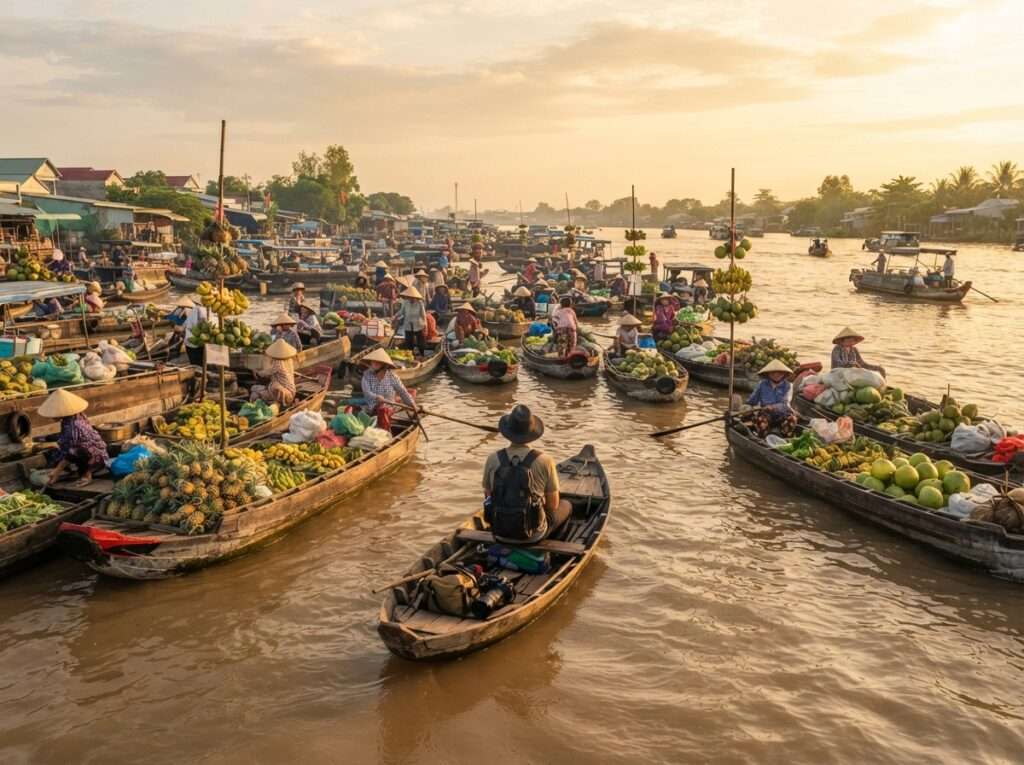
The Mekong Delta is not dry in September, and that is exactly why it is worth seeing. From about August to November the river spills into the fields, a season locals call mùa nước nổi, the floating-water season. Canals run high and wide, farmers fish in the flooded paddies, and water lilies are picked and sold at the markets. Base yourself in Can Tho and take a boat from Ninh Kieu pier at 5.30 am to Cai Rang floating market, where wholesale boats hang a sample of what they sell (a pineapple, a cabbage) from a tall pole. The Tra Su cajuput forest in An Giang, a few hours west, is at its best now, when boats glide through flooded trees under a carpet of green duckweed. Rain comes in heavy afternoon bursts, so do the boats in the morning. Read more in our Mekong Delta guide.
| Where | Can Tho city (merged with Hau Giang and Soc Trang in 2025), 3.5 hours from Ho Chi Minh City |
| Why September | Floating-water season, when the river is at its highest |
| Weather | 31 °C highs, about 270 mm of rain over about 20 days, short downpours |
| Days needed | 1 to 2 nights |
| Don't miss | Cai Rang floating market at dawn, a canal homestay, Tra Su forest |
Why Vietnam's Weather Splits Three Ways in September
Vietnam is 1,650 km long, and in September its three regions sit in three different seasons. The north is coming out of its rainy season, the centre is going into one, and the south is in the middle of its own. That is why one country can give you a perfect trip and a washed-out one in the same week.
Northern Vietnam in September
Northern Vietnam has its wettest months in July and August, and September is the turn. Hanoi’s rainfall drops from over 300 mm in August to 228 mm in September, and to about 130 mm in October. Days are still hot, with highs around 32 °C and 81% humidity, and rain tends to fall as a heavy afternoon storm rather than all day. In the mountains it is cooler, with Sapa at 22 °C by day and 16 °C at night. The one real risk is storms. Typhoons that form in the South China Sea between July and October often hit the north coast, so Ha Long Bay and Hai Phong get the warnings first. See our Vietnam in August guide for how the north looks a month earlier.
Central Vietnam in September
Central Vietnam has the opposite calendar. It stays dry from February to August and then turns wet from September to December, when the north-east monsoon meets the Truong Son mountains. Hue’s rain climbs from 411 mm in September to 773 mm in October, and Da Nang’s from 351 mm to over 600 mm. The first week or two of September are often still fine in Da Nang and Hoi An. The second half is a gamble, and floods in Hoi An’s old town become common from October. The Central Highlands are their own world. Da Lat sits at 1,500 m with highs of 23 °C, but it rains on 24 days of the month, usually in the afternoon. Our guide to things to do in Da Lat has wet-day ideas.
Southern Vietnam in September
The south has one long rainy season from May to November, and September sits near its peak. In Ho Chi Minh City that means sunny mornings and a downpour most afternoons that floods the streets for an hour and then clears. In Can Tho it means about 20 rainy days and a river at full height. The far south-west takes the monsoon head-on. Phu Quoc gets 474 mm across 23 days, with rough seas on the west coast. The south-central coast, from Nha Trang to Mui Ne, is the exception, sheltered by the mountains and much drier than either the centre or the south.
Places to Plan Around in September
These places are not off limits. They are the ones where September changes the trip, so go with a plan B or save them for another month.
Hue and Bach Ma National Park. Hue, the old imperial capital on the Perfume River, gets 411 mm of rain in September and is the wettest major city in the country from October. The Citadel and royal tombs are still open, and a rainy morning in the Imperial City can be atmospheric, but the river trips and cycling routes suffer. Bach Ma National Park, about 50 km south-east of Hue, is a separate place, a forested mountain with waterfalls and old French villa ruins. Its trails get slippery and leech-heavy in September, and its famous rhododendrons flower in spring, not now. If you go, go early in the month. Our guide to things to do in Hue has indoor options.
Hoi An and Da Nang. Visit in the first half of the month, and book a hotel away from the river in Hoi An. The lanterns still hang and the tailors still sew in the rain. From late September the Thu Bon River can rise into the old town after heavy rain, and boats to the Cham Islands are cancelled when the sea is rough. See things to do in Hoi An for the town itself.
Phu Quoc and Con Dao. These islands are at the peak of the south-west monsoon. Expect heavy rain on most days, rough water on the west coast and cancelled boat trips to the southern islands. If you must go, stay on the east coast near Sao beach or Ham Ninh, which is sheltered from the worst of the wind. Our Phu Quoc Island guide covers the best months.
Phong Nha. The caves of Phong Nha-Ke Bang close their river and wild-cave tours during the autumn floods, which usually start in September or October. Check before you book.
Festivals and Events in Vietnam in September 2027
| Event | Date in 2027 | Where to see it | What to expect |
|---|---|---|---|
| National Day | 2 September (Thursday), a two-day public holiday | Ba Dinh Square and the Old Quarter, Hanoi | Flags on every street, crowds, fully booked trains and Ha Long cruises |
| Mid-Autumn Festival (Tết Trung Thu) | 15 September (Wednesday), the 15th day of the 8th lunar month | Hang Ma Street, Hanoi. Hoi An old town the evening before | Lanterns, lion dances, mooncakes, children’s parades on the night of the full moon |
| Mu Cang Chai paragliding and terraced-field festival | Usually a weekend in the second half of September | Khau Pha Pass and Mu Cang Chai town | Tandem flights over the terraces, H’Mong music and food stalls |
| Rice harvest | About 10 September to early October | Mu Cang Chai, Sapa, Hoang Su Phi, Pu Luong | Golden terraces, threshing in the fields |
The Mid-Autumn Festival is the one to build a trip around. In Vietnam it is a children’s festival as much as a moon festival. In the week before it, Hang Ma Street in Hanoi sells star-shaped lanterns, paper fish and toy drums, and on the night itself children parade with lanterns and lion-dance troupes go door to door. In Hoi An, the monthly full-moon lantern night falls on the 14th day of the lunar month, the evening before Mid-Autumn (14 September 2027), when the old town dims its street lights and the river fills with candle lanterns. Mooncakes are sold everywhere for weeks before. Look for the vegetarian lotus-seed and mung-bean fillings.
What to Do If a Typhoon Hits: Step by Step
Typhoon season in Vietnam runs from about July to November. The north coast is most exposed in August and September, and the centre from September to November. Most September trips see no storm at all. If one comes, these steps keep the trip on track.
- Check the forecast every morning. The National Centre for Hydro-Meteorological Forecasting issues storm warnings 2 to 3 days before landfall, with the expected track. Hotel staff and your tour operator also get the alerts.
- Keep one buffer day before your flight home. Put Ha Long Bay, the Cham Islands or any boat trip in the middle of the trip, never on the last day.
- Book refundable or reschedulable cruises and boats. When a warning is issued, the port authority stops all tourist boats. Good operators then refund or move you to the next sailing. Read that clause before you pay.
- Move inland, not along the coast. If a storm is heading for Ha Long, go to Ninh Binh or Hanoi. If it is heading for the centre, fly over it to Nha Trang or Hanoi rather than driving the coast road.
- Carry travel insurance that covers weather delays. Check that it pays for missed connections and extra hotel nights, not only medical care.
- Stay indoors while the storm passes. Landfall usually brings 12 to 24 hours of wind and heavy rain, followed by fallen trees and power cuts. Charge a power bank and keep cash, since card machines go down with the power.
A 7, 10 or 14-Day Vietnam Route for September
The best September route stays north, adds one dry beach and avoids the central coast. All three versions start in Hanoi.
| Days | Route | Why it works in September |
|---|---|---|
| 7 | Hanoi (1 night), Ha Long or Lan Ha Bay cruise (1), Hanoi (1), Sapa by expressway bus (3), back to Hanoi for the flight | Harvest, Hanoi and the bay in two simple loops, with the cruise early and Sapa as the buffer before the flight |
| 10 | The 7-day route, then fly to Cam Ranh for Nha Trang (3 nights) | Adds a beach that stays mostly dry |
| 14 | Hanoi (1), Ha Long or Lan Ha Bay cruise (1), Ninh Binh (1) by the direct coast road, Pu Luong (2), Hanoi (1), Sapa (3), fly Hanoi to Cam Ranh for Nha Trang (2), fly to Ho Chi Minh City for the Mekong Delta (2) | Two harvest valleys, the bay and the floating-water season, grouped by region with no backtracking |
Our 7-day Vietnam tour package follows a similar northern route, and every one of our Vietnam tour packages can be changed to fit the September harvest dates. Couples can start from our Vietnam honeymoon packages, and families from our Vietnam family packages.
September vs August vs October in Vietnam
| Region | August | September | October |
|---|---|---|---|
| North (Hanoi, Sapa, Ha Long) | Hottest and wettest month. Typhoon risk | Rain easing, golden harvest, typhoon risk remains | Dry, clear and comfortable. Harvest over by mid-month |
| Central coast (Hue, Hoi An) | Dry, hot, best beach weather | Wet season begins, worse in the second half | Wettest month. Floods likely |
| South-central (Nha Trang, Mui Ne) | Mostly dry | Mostly dry, short showers | Rain begins in Nha Trang |
| South (HCMC, Mekong, Phu Quoc) | Rainy season | Rainy season peak, Mekong high water | Rain easing, floating season continues |
| Crowds and prices | Busy with domestic summer travel | Low season, except around 2 September | Prices start to rise towards the winter peak |
| Best for | Central beaches | Northern harvest, festivals, value | Northern trekking, Ha Long |
If the central coast is your priority, go in August. If clear skies in the north matter more than golden rice, wait for October. September is the month for the harvest, the Mid-Autumn lanterns and lower prices. Compare with our Vietnam in October guide before you choose.
Planning a September Trip to Vietnam From India
Flights. IndiGo flies non-stop to Hanoi from Delhi, Mumbai and Kolkata, Akasa Air flies Mumbai to Hanoi and Air India flies Delhi to Hanoi. VietJet and Vietnam Airlines connect several Indian cities to Hanoi and Ho Chi Minh City. Non-stop flights take about 3 hours from Kolkata and about 4.5 to 5.5 hours from Delhi and Mumbai. For a September trip, fly into Hanoi and out of Ho Chi Minh City or Cam Ranh so you never backtrack. Our page on how to reach Vietnam lists routes from each city.
E-visa. Indian passport holders apply online at Vietnam’s official e-visa portal for an e-visa of up to 90 days, at US$25 for a single entry and US$50 for multiple entries. Processing takes about three working days, so apply at least a week before you fly. Our Vietnam visa guide for Indians has the steps.
Money and budget. About 300 VND buys ₹1, so a 100,000 VND note is roughly ₹330. A comfortable mid-range trip costs most Indian travellers about ₹4,000 to ₹7,000 per person a day on the ground, before flights and cruises. September is low season, so hotels in Sapa, Ha Long and Nha Trang are cheaper than in December, except over the National Day weekend. Carry small notes for boats, markets and homestays.
Vegetarian food. Look for “chay” (vegetarian) restaurants near pagodas, which cook without meat or fish sauce. Say “an chay” (I eat vegetarian) and “khong nuoc mam” (no fish sauce). Hanoi, Da Nang and Ho Chi Minh City have Indian restaurants, listed in our guide to Indian restaurants in Vietnam. In the mountains, homestays will cook vegetarian if you tell them a day ahead.
Connectivity. Buy a local eSIM or a Viettel SIM at the airport. Viettel has the best coverage in the northern mountains, where you will want maps on the Ha Giang Loop.
What to Pack for Vietnam in September
Pack for heat, rain and one cold night in the mountains.
- A light, breathable rain jacket or poncho, plus a small umbrella for the cities
- Quick-dry shirts and trousers, since cotton stays wet in 80% humidity
- One warm fleece or jacket for Sapa, Mu Cang Chai and Da Lat, where nights drop to about 16 °C
- Trekking sandals or shoes with grip for muddy terrace paths, and leech socks for forest trails
- Insect repellent, as mosquitoes are worst after rain
- A waterproof phone pouch and a dry bag for boat trips
- Sunscreen and a hat, because the sun is strong between showers
- Trousers or a skirt below the knee and a shirt with sleeves for the Ho Chi Minh Mausoleum, where a scarf over shorts is not accepted, plus a light scarf for pagodas
How We Built This Guide
We chose these ten places because September is one of their best months, not just a month when they are open. Most weather figures are long-term station averages from the Vietnam Institute for Building Science and Technology, published in the Vietnam Building Code’s climate data. Where that series has no station (Nha Trang, Mui Ne) or sources disagree (Ho Chi Minh City, Can Tho), we give a rounded figure marked “about”. Storm guidance follows the National Centre for Hydro-Meteorological Forecasting. Visa terms come from Vietnam’s official e-visa portal, and province names follow the National Assembly’s 2025 merger resolution, with old names in brackets because most maps still use them. The previous version of this page recommended Phu Quoc and called the Mekong dry in September. Both were wrong for this month, and we have corrected them. Prices are 2026 figures and change often, so treat them as a guide.
Plan Your September Trip to Vietnam
September rewards travellers who choose a region rather than the whole country. Spend it in the north for the golden harvest, Hanoi’s lanterns and a cruise with a flexible ticket, then finish on a dry beach in Nha Trang or Mui Ne, and leave Hue and Phu Quoc for spring. If you would like the transfers, homestays and cruise sorted around the harvest dates, our Vietnam tour packages can be built that way, and our Vietnam tourism guide covers the rest of the country.
FAQs
Vietnam in September: Frequently Asked Questions
Quick answers on September weather, rain, typhoons, Ha Long, Sapa, Hoi An, Phu Quoc, festivals and visas
Yes, for the north and the south-central coast. Mu Cang Chai, Sapa and Hoang Su Phi are in golden rice-harvest season, Hanoi celebrates National Day and the Mid-Autumn Festival, and Nha Trang and Mui Ne stay much drier than the rest of the coast. Hue, Hoi An and Phu Quoc are the weak spots, with 350 to 475 mm of rain and a rising flood and typhoon risk. Prices are lower than in the winter peak.
It is hot and humid almost everywhere, with highs of 30 to 33 °C in the lowlands and about 22 °C in Sapa and Da Lat. Rain varies by region. Hanoi gets 228 mm over 14 days, Hue 411 mm, Ho Chi Minh City about 330 mm and Phu Quoc 474 mm. Nha Trang and Mui Ne get the least. Most rain falls as afternoon storms, so mornings are usually clear enough for sightseeing.
Partly. The north is at the end of its rainy season, the south is at the peak of its own, and the central coast is just starting its wettest months, which run to December. The south-central coast around Nha Trang and Mui Ne stays relatively dry. So it is a rainy month in much of Vietnam, but rain usually comes in short, heavy bursts rather than all day.
Yes. Storms affect Vietnam from about July to November, with the north coast most exposed in August and September and the central coast from September to November. Typhoon Yagi, for example, hit Ha Long on 7 September 2024. Most trips see no storm, but book flexible boat trips, keep a buffer day before your flight and follow warnings from Vietnam's national forecasting centre.
Yes, if your cruise can be rescheduled. Most September sailings run normally, the bay is quieter and many cruise lines lower their fares. When a storm warning is issued, though, the port authority stops all tourist boats for a day or more. Choose a cruise with free rescheduling, place it in the middle of your trip, and consider Lan Ha Bay from Cat Ba for calmer, less crowded water.
Yes, September is one of the best months for Sapa. The terraces in the Muong Hoa valley turn gold from about mid-month, and you walk past families harvesting rice by hand. Days are around 22 °C and nights 16 °C. Expect showers on many afternoons, so start treks early, carry a rain jacket and wear shoes with grip. The Fansipan summit is clearest in the early morning.
It is fine in the first half of the month and risky in the second. Da Nang and Hoi An get about 351 mm of rain in September, and the Thu Bon River can flood the old town after heavy storms, which becomes common from October. Book a hotel away from the river, keep plans flexible and expect boat trips to the Cham Islands to be cancelled in rough seas.
Not for a beach holiday. September is the peak of the south-west monsoon on Phu Quoc, with about 474 mm of rain over 23 days and rough water on the west coast. Boat trips to the southern islands are often cancelled. If you want a beach this month, Nha Trang or Mui Ne are better choices. Phu Quoc is at its best from November to April.
Nha Trang and Mui Ne are the best places to swim in September. Both sit on the south-central coast, which is sheltered from the monsoon and much drier than Phu Quoc or Hoi An. Nha Trang's bay is usually calm until its own rains begin in October. Da Nang's beaches can be fine in early September, but check the flags, as rip currents increase when storms are offshore.
The Mid-Autumn Festival (Tết Trung Thu) falls on Wednesday, 15 September 2027, the 15th day of the 8th lunar month. The best places to see it are Hang Ma Street in Hanoi, which fills with lanterns in the week before, and Hoi An, which holds its full-moon lantern night the evening before, on 14 September. Expect lion dances, children's lantern parades and mooncakes everywhere.
Yes, in most places. September is low season for international travel, so hotels in Sapa, Ha Long and the beach towns, and many Ha Long cruises, cost less than in December and January. The exception is the National Day holiday around 2 September, when Vietnamese families travel and prices rise. A mid-range trip costs most Indian travellers about ₹4,000 to ₹7,000 a day on the ground.
Yes. Indian passport holders need a visa, and the easiest option is the e-visa from Vietnam's official portal, evisa.gov.vn. It allows a stay of up to 90 days and costs US$25 for a single entry or US$50 for multiple entries. Processing takes about three working days, so apply at least a week before your flight and print a copy of the approval.