
- 1800-123-5555
- Travel Agent? Join Us
- Blog
- Offers










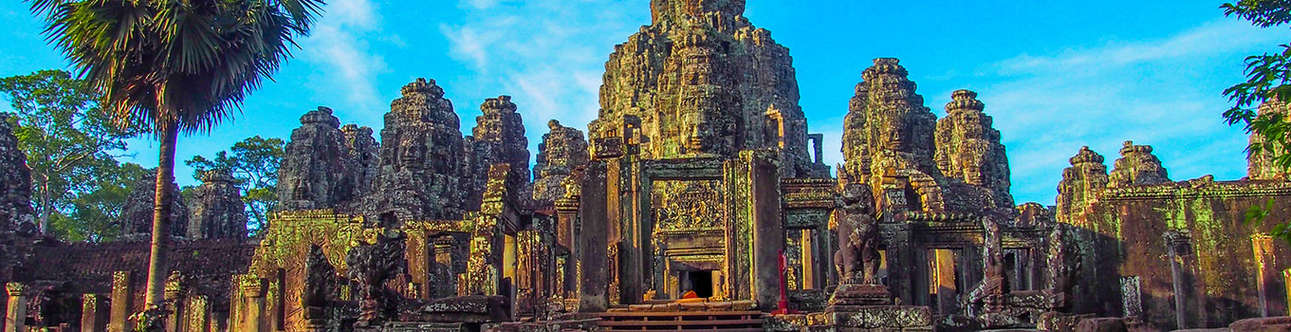
Bayon Temple in Siem Reap, Cambodia
Marvel at the majestic sight of the ancient Bayon Temple and feel at peace
Rated 4.60/5 ( based on 264 reviews )
About Bayon Temple in Siem Reap
Bayon Temple, known for its daunting, awe-inspiring series of smiling faces all around its uppermost tier, is the flagship construction of the ancient Khmer capital Angkor Thom. The temple sits right in the middle of the fortified city, though it took years for the historians to discover that fact owing to the dense outgrow all around Bayon Temple Cambodia.
Bayon Temple Siem Reap is one of the earliest demonstrations of full-fledged Mahayana Buddhism faith in the Khmer empire of Angkor. Before it’s patron, King Jayavarman VII, all the Khmer rulers were quintessentially Hindu, devoted towards gods of Hinduism like Shiva and Vishnu. Jayavarman VII constructed Bayon Temple to be a Buddhist temple after his reclamation of the Khmer empire from the Chams. Bayon Temple history takes us back to a time period which is still shrouded in so much anonymity and mystery.
Faces of Bayon Temple
Bayon Temple in Siem Reap is most popular for its large number of serene faces sculpted on its towers. Earlier, there were 49 towers, sculpted with large carved faces facing towards the four cardinal directions respectively. There were almost 200 faces, the largest ones being almost 2½ meters in height. Most towers have four faces, a few other have only three, and one tower with just a single face.
These faces were originally believed to represent Lord Brahma, the Hindu God with four heads. As it was later found out that the Bayon was not a Hindu temple but a Buddhist one, archaeologists adhered the sculpted faces to that of Lokeshvara, the Bodhisattva of compassion. Some theories also state that it is the King Jayavarman VII himself whose face is depicted on the towers.
History of Bayon Temple
Bayon Temple Siem Reap is one of the earliest demonstrations of full-fledged Mahayana Buddhism faith in the Khmer empire of Angkor. Before it’s patron, King Jayavarman VII, all the Khmer rulers were quintessentially Hindu, devoted towards gods of Hinduism like Shiva and Vishnu. Jayavarman VII constructed Bayon Temple to be a Buddhist temple after his reclamation of the Khmer empire from the Chams. Bayon Temple history takes us back to a time period which is still shrouded in so much anonymity and mystery.
Although the temple has more than 10,000 figures on its all three tiers on all four sides, it is the multitude of serene faces that catches everyone’s attention the most. Crafted in authentic Buddhist style, the Bayon Temple architecture rises above the wilderness around like a proud flag of victory. In fact, the original name of Bayon was Jayagiri which means ‘mount of victory.’ It is because of the temple’s connection to Buddhism that it got the name Bayon, mispronounced from Banyan, which was the tree under which Buddha attained enlightenment.
Highlights of Bayon Temple
The temple is constructed in the shape of a square.
The main sculpture is present right at the middle of the square.
The stone faces of the temple are that of Bodhisattva and Avalokiteshvara.
The Bayon Temple has been rebuilt several times over a period of others by various kings who ruled over the kingdom.
Architecture of Bayon Temple
There used to be around 50 towers with three or four faces on them, making their number close to 200 or more. Many theories believe that in Khmer culture, the rulers considered themselves to be one with the Almighty, whether their faith is Hinduism or Buddhist. So the Bayon Temple faces could be a representation of Lokesvara as well as Jayavarman himself, watching over the capital from its heart on all sides.
The middle tier is dominated by carvings of scenes from Hindu mythology like the Churning of the Sea Milk, and there are prominent characters like the universal trinity of Brahma, Vishnu and Shiva, celestial dancers called Apsaras and sages, Ravana with ten heads, Garuda – the demi-god with an eagle-face and wings with human body. The lower tier is mostly a series of bas-reliefs depicting the everyday life of Angkor back in the day – warfare, domestic scenes, trading, sports and so on.
Significance of Bayon Temple
Bayon Temple holds a major significance because of the mystical, serene faces sculpted on its towers. Several historians have presented a few hypotheses regarding similar-looking stone faces in Bayon. One of the highly accepted theories is that the stone face was carved to resemble King Jayavarman VII as per his orders. While another theory states that the faces represent the Buddhist bodhisattva of compassion called Avalokitesvara or Lokesvara.
Facts of Bayon Temple
Bayon Temple falls in the categories of temple ruins and World Heritage Sites
The guiding faith of Bayon Temple is Buddhism.
The construction of the temple dates back to 1190.
Temple is open for visits during dawn and dusk.
What To Wear
Women must cover their shoulders and knees before entering the Bayon Temple. You can either wear a loose t-shirt along with capri pants or regular trousers. Men can wear t-shirts which are not sleeveless along with pants or trousers.
Popular Packages
Unlimited Choices. Trusted Agents. Best Prices. Happy Memories.
Cities:
- Siem Reap
Starting from:
₹16,999/-
₹18,888/-10% OffCities:
- Siem Reap
- Phnom Penh
Starting from:
₹23,500/-
₹26,404/-11% OffCities:
- Hanoi
- Halong Bay
- Ho Chi Minh City
- Siem Reap
Starting from:
₹23,949/-
₹26,610/-10% OffCities:
- Phnom Penh
- Siem Reap
Starting from:
₹25,299/-
₹28,913/-12% OffCities:
- Siem Reap
Starting from:
₹25,900/-
₹28,461/-9% OffCities:
- Siem Reap
Starting from:
₹25,900/-
₹28,461/-9% OffCities:
- Phnom Penh
- Siem Reap
Starting from:
₹28,900/-
₹31,758/-9% OffCities:
- Siem Reap
Starting from:
₹28,900/-
₹31,758/-9% OffCities:
- Hanoi
- Ho Chi Minh City
Starting from:
₹29,000/-
₹31,868/-9% OffCities:
- Siem Reap
- Phnom Penh
Starting from:
₹29,999/-
₹32,608/-8% OffCities:
- Siem Reap
- Phnom Penh
Starting from:
₹29,999/-
₹32,608/-8% OffCities:
- Siem Reap
- Phnom Penh
Starting from:
₹30,999/-
₹33,695/-8% OffCities:
- Hanoi
- Halong Bay
- Siem Reap
Starting from:
₹31,899/-
₹35,054/-9% OffCities:
- Phnom Penh
- Siem Reap
Starting from:
₹31,899/-
₹35,054/-9% OffCities:
- Siem Reap
- Phnom Penh
Starting from:
₹31,899/-
₹35,054/-9% OffCities:
- Phnom Penh
- Siem Reap
Starting from:
₹41,648/-
₹46,796/-11% OffCities:
- Hanoi
- Siem Reap
Starting from:
₹42,000/-
₹45,652/-8% OffCities:
- Hanoi
- Halong Bay
- Ho Chi Minh City
Starting from:
₹42,000/-
₹45,652/-8% OffCities:
- Hanoi
- Siem Reap
Starting from:
₹42,999/-
₹46,307/-7% OffCities:
- Hanoi
- Ho Chi Minh City
- Siem Reap
Starting from:
₹44,000/-
₹47,826/-8% OffPlaces To Visit In Siem Reap
Let the experts guide you to the best of this mesmerizing destination
View AllPreah Khan Temple In Siem Reap
The temple of Preah Khan was built by King Jayavarman VII to honor his father and is located North-West of the Angkor Thom. The temple houses a number of cravings related to the Hindu mythology and Buddhist motifs are also present. The temple has been left largely unrestored, and nature has reclaimed most of the structures ...
- Temple
- Sightseeing
- Nature
Beng Mealea In Siem Reap
Located 40 km east of the Angkor group of temples and 77 km from the city of Siem Reap, the Beng Mealea is also a Hindu temple built by Suryavarman II in the early 12th century. The temple is built from sandstones and has Buddhist motifs carved on its walls in a few places. The World Heritage Site has a largely unknown hist...
- Temple
- Sightseeing
- Nature
Angkor Thom In Siem Reap
Angkor Thom, literally refers to "Great City", is a famous tourist attraction located in present-day Cambodia. Angkor Thom in Siem Reap was established by King Jayavarman in the late twelfth century. The entire place covers an area of 9 square km, and comprises of several monuments built during the early eras as well as tho...
- Angkor Thom
- Sightseeing
- Nature
Ta Prohm In Siem Reap
The ancient temple of Ta Prohm in Siem Reap built by the Khmer king Jayavarman VII in the early 13th century is built in Bayon style of architecture. The Ta Prohm temple was built to serve as a Mahayana Buddhist monastery and University and is one of the most visited sites in the Angkor complex. The overgrown trees have bec...
- Sightseeing
- Nature
- Temple
Angkor Wat In Siem Reap
The largest religious temple in the World, Angkor Wat In Siem Reap is a temple complex dedicated originally to the Hindu deity Vishnu which was then transformed into a Buddhist temple by the end of the 12th century. Built in the early 12th century by King Suryavarman II of the Khmer Empire, the Angkor Wat was a deviation fr...
- Angkor Wat
- Sightseeing
- Nature
Things To Do In Siem Reap
Your list of the best things to do, compiled on the basis of actual traveler experiences
View AllPrek Toal Bird Sanctuary
There is a reason why the Prek Toal bird sanctuary within the Tonle Sap Lake Biosphere is called the most important breeding ground in South-East Asia for large water birds. Tonle Sap has three distinct ecological spheres within its vast expanse. Among them, Prek toal with its 31,280 hectares area of lowlands and swamps is ...
- Bird Watching
- Sightseeing
- Nature
River Cruise In Siem Reap
Siem Reap river cruise is one of the best alternatives of going around Cambodia. Usually, most people take the roadway to travel from one part to another and have their whole Siem Reap experience. But the water cruises undeniably add an edge to the entire thing. There are many different Siem Reap river tours as offered by t...
- River Cruise
- Adventure
- Sightseeing
Hot Air Balloon In Siem Reap
The temples of Angkor look fascinating from the ground. Imagine how strikingly imperial it might look from up above in the sky. Hot air balloon Cambodia allows the visitors of Angkor to catch a glimpse of the majestic architectures from the elevated vantage point. This would be a lifetime experience and not something one ca...
- Adventure
- Hot Air Balloon Ride
- Unlimited Fun
Our experts would love to create a package just for you!
Fill in your requirements here >
Fastest Growing Holiday Marketplace
650+
Verified Agents
22 Lac+
Happy Travellers
65+
Destinations
Easy, Secure & Reliable
Traveltriangle
Verified
Stringent
Quality Control
24/7
Support
What Travelers Say About Our Siem Reap Packages
Read real reviews,packages, stories, and experiences from happy customers who booked with TravelTriangle.
Nrithika Anand Harish
Bangalore
Nrithika's 7 days trip to Siem Reap
Swapnil Wankhede
Navi mumbai
Swapnil's 9 days trip to Siem Reap
Ajesh Desai
Ahmedabad
Ajesh's 10 days trip to Siem Reap
Debasish Patnaik
Bengaluru
Debasish's 7 days trip to Siem Reap
Arvind Jayaprakash
Bangalore
Arvind's 6 days trip to Siem Reap
Chetan K
Bangalore
Chetan's 9 days trip to Siem Reap
Kotravel Murugan
Banglore
Kotravel's 8 days trip to Siem Reap
KRISHNAN VAIRAKANNU RAJA
Singapore
Gomthii's 7 days trip to Siem Reap
Ameya Natu
Mumbai
Ameya's 9 days trip to Siem Reap
Sujeeth Kumar
Sujeeth's 7 days trip to Siem Reap
Popular Kerala Holiday Packages
Spiritual Packages
Kerala Holiday Packages From Metro Cities
Popular 1 Night & Above Kerala Holiday Packages
Popular 6 Nights & Above Kerala Holiday Packages
Top Tour Packages In India
Top International Tour Packages
Tour Packages By Theme And Activity
Top Honeymoon Destinations In India
Top International Honeymoon Destinations
Top Destinations In India
Top International Destinations
Want best packages handpicked just for you?
Fill the form and get a callback from our holiday experts
Frequently Asked Questions
Get your answers — before you plan your trip.
Siem Reap Travel FAQs
How many faces are there on Bayon temple and what do they mean?
There are at least 200 faces on the uppermost tier of Bayon temple. They resemble the face of Lokesvara Buddha, but many believe the faces represent Buddha and King Jayavarman VII together.
What to see in Bayon temple?
The bas-reliefs and the green moss-covered ambiance are the main attractions of Bayon temple.
How to find Bayon temple?
The Bayon temple is right in the middle of Angkor Thom. The giant faces on the structure will help identify it. Otherwise, any guide can help you out in spotting it.
What was the Bayon temple used for?
Bayon Temple was originally designed to serve as the primary zone of the royal cult and also to act as a personal mausoleum to Jayavarman VII.
How old is the Bayon temple?
The construction of Bayon Temple dates back to 1190. Hence, the temple is almost 829 years old.
How It Works
Personalise This Package
Make changes as per your travel plan & submit the request.
Get Multiple Quotes
Connect with top 3 agents, compare quotes & customize further.
Book The Best Deal
Pay in easy installments & get ready to enjoy your holiday.
Corporate Office:
Holiday Triangle Travel Private Limited
Address: Plot No - 52 , 3rd Floor,
Batra House , Sector 32,
Gurugram -122001,Haryana
Landline: 1800 123 5555
Connect with us on :

Made with
in India
All rights reserved © 2026